
Sintered Stone Slab Procurement: A Practical Framework for Risk-Averse Buyers in 2026

High-performance sintered stone slabs offer natural stone aesthetics with superior durability for demanding applications.
The Procurement Challenge in Sintered Stone
Global buyers of sintered stone slabs for applications such as kitchen countertops, bathroom vanities, wall cladding, and exterior facades face a persistent challenge: how to secure consistent quality, avoid hidden risks like color variation or dimensional deviation, and streamline cross-border logistics. With the market for large-format sintered stone slabs expanding rapidly—driven by demand for scratch-resistant, heat-resistant, and stain-resistant surfaces—the need for a structured, risk-aware procurement framework has never been greater.
Identifying the Core Risks
Industry data indicates that up to 15% of imported sintered stone slab shipments experience some form of quality issue, ranging from color inconsistency between batches to breakage during transit. Common pain points include:
- Color & Texture Variation: Lack of standardized shading systems leads to mismatched panels in large projects.
- Dimensional Tolerances: Edge warpage or thickness deviations beyond ±0.2% cause uneven installation and increased grout costs.
- Hidden Performance Failures: Inadequate freeze-thaw resistance or insufficient surface hardness shortens service life in outdoor or high-traffic environments.
- Certification Gaps: Absence of recognized third-party certifications (NSF, CE) raises compliance risks for commercial and public projects.
Without a systematic approach, buyers often face delayed projects, unexpected rework costs, and eroded trust with end clients.
Building a Supplier Evaluation Framework
To navigate these risks, procurement professionals can adopt a three-pillar framework: Technical Capability, Certification & Compliance, and Supply Chain Reliability.
1. Technical Capability
Leading manufacturers like Monalisa Group Co., Ltd. employ fully automatic ultra-high pressure presses (up to 48,000 kN) and nano-scale glaze technology to achieve water absorption ≤0.08%, surface Mohs hardness ≥7, and abrasion resistance PEI Grade 5. These metrics are critical for applications ranging from kitchen countertops to exterior facades. The ability to produce large-format slabs (e.g., 900x2700mm in thicknesses of 9mm or 12mm) with ultra-thin profiles while maintaining structural integrity is a key differentiator.
2. Certification & Compliance
Third-party certifications serve as objective proof of quality. Monalisa’s sintered stone slab (model 90-270FDK09003M/90-270FDK09008M) carries:
- NSF Certification (Cert. No. C0676949-01): Confirms compliance with NSF/ANSI 51 for food-contact surfaces, essential for kitchen countertop applications.
- CE Certification (Cert. No. CY25A10378): Validates conformity with EN 14411:2016, ensuring the product meets European standards for wall and floor use.
Such certifications provide buyers with verifiable assurance of safety, durability, and regulatory acceptance across global markets.
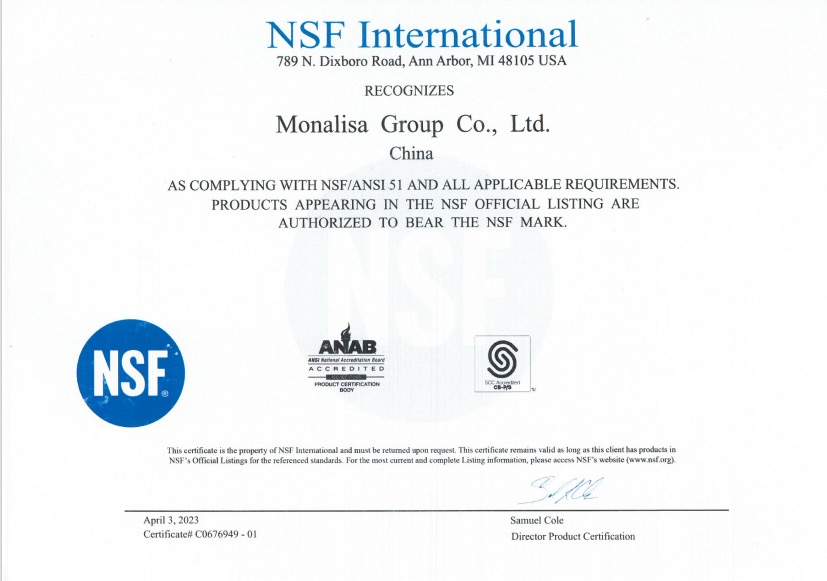
NSF certification validates the sintered stone slab's safety for food-contact surfaces, a critical requirement for kitchen and commercial applications.
3. Supply Chain Reliability
Risk-averse buyers should prioritize suppliers with proven mass-production capabilities, transparent inspection protocols, and flexible logistics. Monalisa operates ten holding subsidiaries and four production bases with a total of 37 production lines and an annual output of 100 million square meters. Its monthly capacity of 12.5 million m² ensures reliable supply for large projects. The company implements a “3M” quality management model with 18 quality control points and an in-house CNAS-accredited laboratory.
For sintered stone slab procurement, the standard order terms include a minimum order quantity of 2000 square meters, with delivery options via FOB, CIF, and EXW. Accepted payment methods include Telegraphic Transfer and Letter of Credit. The acceptance inspection protocol comprises packaging and labeling verification, carton opening for sample inspection, and rapid dimensional and flatness checks—providing buyers with systematic assurance before shipment.
Real-World Validation: Project Case Studies
Practical application data reinforces the framework’s effectiveness. In Sri Lanka, a single delivery of over 80,000 m² of large-format tiles (900×1800mm) for the Colombo International Convention Centre achieved ultra-low water absorption (≤0.08%) combined with R10 slip resistance. The project benefited from on-site technical support and a 10-year warranty, demonstrating how a structured supplier relationship mitigates risk in complex international contracts.
Similarly, for the Yogyakarta Airport in Indonesia, the client reported a 30% lower life-cycle maintenance cost and a breakage rate below 0.3%—far better than the industry average of approximately 0.8%. Tight-joint installation reduced grouting materials and labor by 15%, translating to measurable savings.
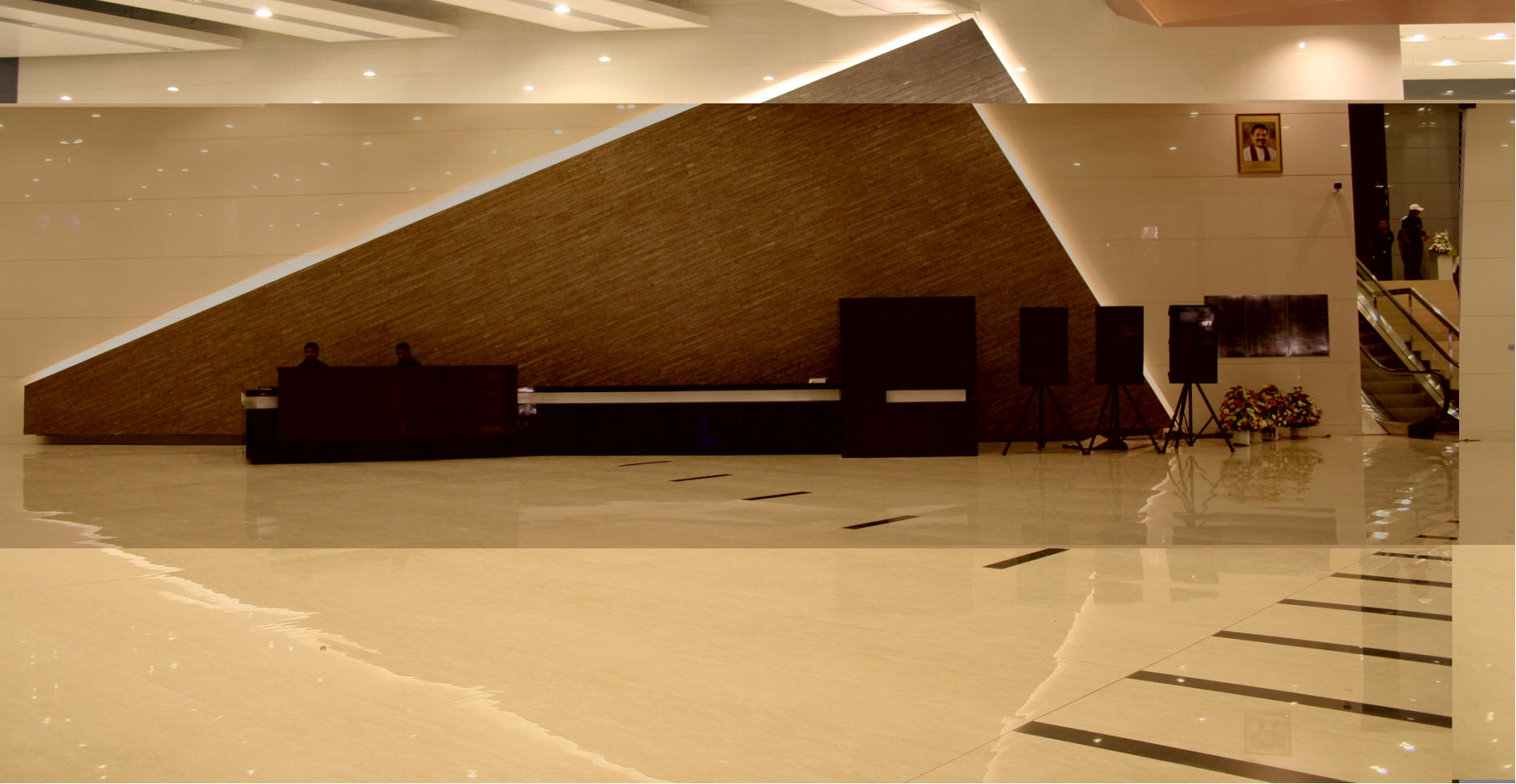
Large-format sintered stone slabs installed at a high-profile public venue demonstrate the material's ability to meet demanding performance and aesthetic requirements.
Market Trends and Future Outlook
The global sintered stone slab market is projected to grow at a CAGR of 8-10% through 2030, driven by urbanization, renovation activity, and the shift toward low-maintenance, eco-friendly building materials. Buyers increasingly demand products with multiple performance characteristics—scratch resistance, heat resistance, UV resistance, and stain resistance—in a single slab. The trend toward larger formats (up to 1600×3200mm) and ultra-thin profiles (5.5mm–6mm) is opening new applications in furniture, door panels, and exterior cladding.
Leading Chinese manufacturers like Monalisa are well-positioned to serve this demand, backed by R&D teams of over 100 engineers, 892 authorized patents, and participation in 49 national and industry standards. Their investment in green manufacturing (zero wastewater discharge, “Green Factory” certification) also aligns with growing environmental procurement requirements in Europe and North America.
For buyers seeking to streamline their sintered stone slab procurement and minimize risk, a structured evaluation framework rooted in technical metrics, independent certification, and supply chain transparency is essential. Monalisa’s product range—including the luxury Slab model 90-270FDK09003M/90-270FDK09008M (900x2700x12mm, glazed-matt finish, 5 phases) and the Flowing light Sintered Stone model 90-270DBY09340M (900x2700x9mm, 4 phases)—offers verified performance suitable for kitchen countertops, bathroom vanities, wall cladding, and high-traffic commercial floors.
Download the complete Monalisa corporate brochure for detailed product specifications, certifications, and ordering terms: Monalisa Group Product Brochure (PDF).
Contact Monalisa at: Email: joanna_wang@fs-monalisatiles.com | Tel/WhatsApp: +86 18605191548 | Address: Monalisa Tower, Poly Centre, 8 Wenhua S Rd, Shunde, Foshan, 528300, CN.