
Sintered Stone Slab Scenario Fit: Hotels, Malls, Villas, Facades
Sintered Stone Slab Scenario Fit: Hotels, Malls, Villas, Facades
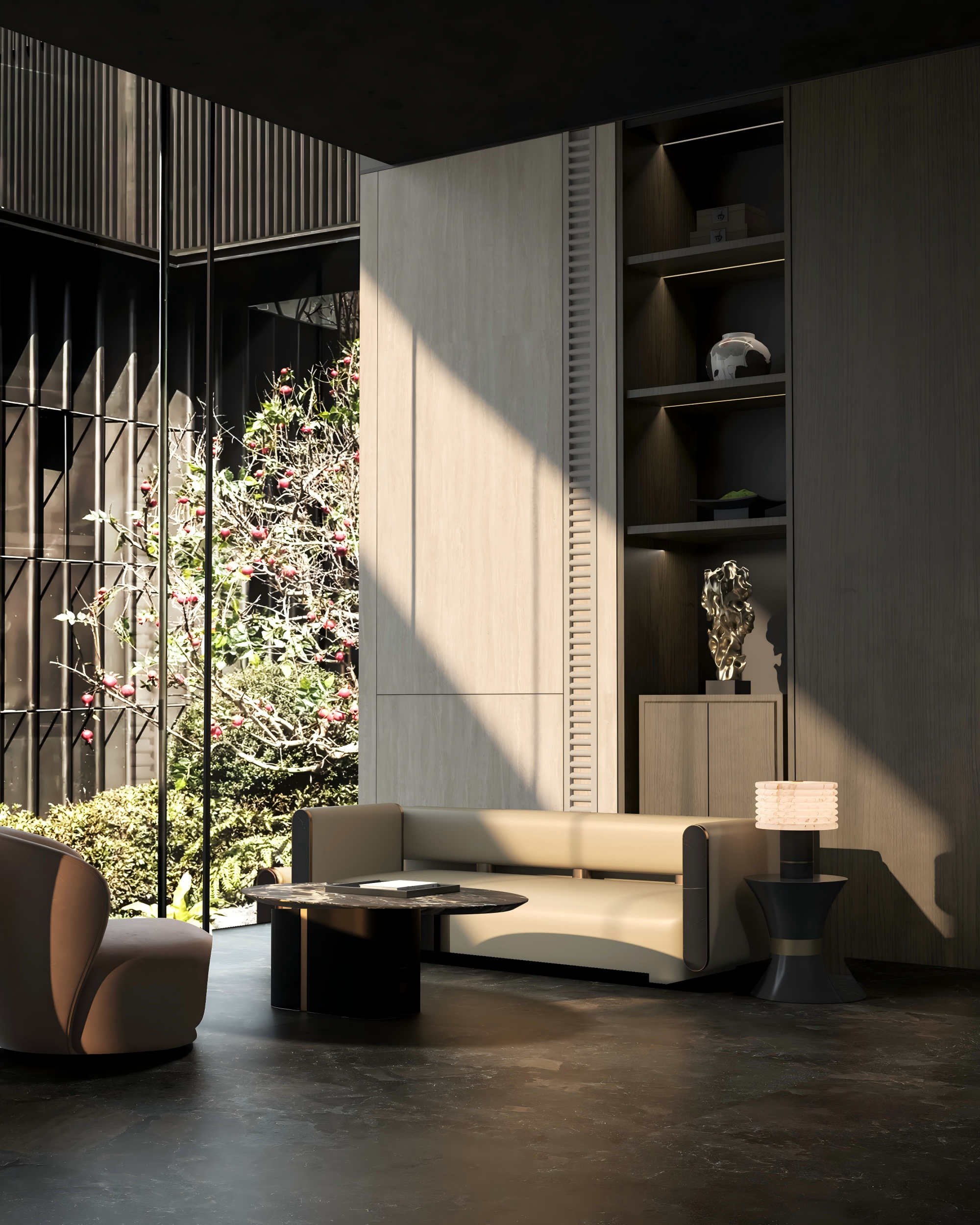
Marble-look sintered stone slab surfaces are typically specified for hotel lobbies, villa interiors and high-visibility wall cladding, where tone consistency across large formats matters.
Hotels, shopping malls, villas and cold-climate facades do not ask the same thing of a sintered stone slab. A hotel bathroom needs a slip-resistant, chemical-tolerant surface. A mall concourse needs abrasion resistance and tight joints across thousands of square metres. A villa kitchen island needs a food-safe, stain-resistant worktop. An exterior rainscreen in a freeze-thaw climate needs a panel that survives repeated wet-freeze-dry cycles without cracking. Treating these as one purchasing decision is the most common specification error in the category.
Monalisa Group Co., Ltd. (“Monalisa”) is an architectural ceramics and sintered stone slab manufacturer founded in 1992 and headquartered in Foshan, Guangdong Province, China. Its slab range, production scale and certification record give buyers in the research and evaluation stage a practical way to test scenario fit against parameters and documents rather than against adjectives.
Scenario fit is a constraint problem, not a style preference
Most sintered stone slab comparisons are written as if a single material could win across every environment. In practice, the same slab body can satisfy one project type and fail another, because each environment imposes a different governing constraint. The documented operating conditions for architectural slab and tile products make the split explicit: indoor installations deal with normal temperatures and humid zones plus occasional exposure to mild acid or alkaline cleaners; outdoor installations absorb sun exposure, rain, standing water and freeze-thaw cycling across roughly −20 °C to 40 °C; high-traffic public areas add abrasion as a third variable; wet zones add slip resistance as a fourth.
For a buyer, the useful question is therefore not “which slab is best?” but “which parameter governs my environment, and can the supplier tie that parameter to the exact format, thickness and finish I am ordering?” That question is answerable with test data and certificate scope statements — the two things most easily checked during evaluation.
The four environments and the performance gate each one sets
The table below maps the four project environments named in this analysis to the parameter that typically governs approval, and to the corresponding published reference point for Monalisa's slab and tile range.
| Project environment | Governing performance gate | Documented reference point |
|---|---|---|
| Hotels — guest bathrooms, spa and pool surrounds, back-of-house wet areas | Slip resistance R10 or higher in bathrooms; Grade 5 stain resistance; ULA-class chemical resistance against cleaners and disinfectants | Slip resistance is specified across the R9–R11 range, with R10+ stated as the requirement for bathrooms; Grade 5 stain resistance and ULA-class chemical resistance are both listed for laboratory and chemical-adjacent conditions. |
| Malls, atria and transit-level retail | PEI 4+ abrasion class for commercial and public areas; dimensional tolerance of ±0.2% in length and width and ±5% in thickness for tight-joint installation | The 900×1800 mm and 900×2700 mm formats increase individual coverage and reduce visible joints; a national convention facility project in Sri Lanka delivered more than 80,000 m² of 900×1800 mm material with approximately 50% fewer joints. |
| Villas and premium residential — kitchen countertops, islands, vanity tops, integrated slab sinks | Food-contact certification where the surface meets food preparation; Grade 5 stain resistance against tea, oil and ink; scratch and heat tolerance for daily use | Monalisa holds NSF certification C0676949-01 issued by NSF International; the 900×2700×12 mm Luxury Slab is listed for kitchen countertops, kitchen islands, vanity tops, backsplashes and integrated slab sinks. |
| Exterior facades and rainscreens in freeze-thaw climates | No cracking after 100 freeze-thaw cycles; ultra-low water absorption; a fixing system suitable for dry cladding or ventilated rain screens | The 900×2700×12 mm Luxury Slab is listed for external curtain walls and ventilated rain-screen systems, described as ultra-low water absorption, freeze-thaw resistant and self-cleaning. |
Reading the table column by column produces a decision rule that survives contact with a spec sheet: if your project sits in a wet public interior, the gate is slip resistance and chemical resistance; if it sits in a high-traffic commercial floor, the gate is abrasion class and dimensional tolerance; if it involves food preparation, the gate is a food-contact certificate; if it is exterior and the site freezes, the gate is freeze-thaw cycling and water absorption.
Technical explanation: six parameters that decide fit
Six numbers do most of the work when a sintered stone slab is evaluated against a project environment. Each has a distinct meaning, and each is frequently quoted without the qualifier that makes it useful.
- Freeze-thaw stability — no cracks after 100 cycles. This is the parameter that separates an interior-capable slab from an exterior-capable one in cold climates. A panel that passes indoor criteria can still fail mechanically if residual moisture expands inside the body during freeze cycles, so exterior specification should always cite the cycling test rather than assuming that a low water absorption figure is sufficient.
- Chemical resistance — ULA class. ULA-class performance is relevant wherever concentrated cleaners, disinfectants or laboratory reagents contact the surface. For hotels this is a maintenance-cost issue: the harder the surface resists repeated cleaning chemistry, the longer the original appearance holds.
- Stain resistance — Grade 5. Grade 5 resistance covers common staining agents such as tea, oil and ink. For villas and hospitality this is the parameter that determines whether a light-coloured slab is practical in a kitchen or an entrance area.
- Abrasion resistance — PEI 3–5, with PEI 4+ for commercial and public areas. Abrasion class is a floor-relevant parameter and should not be used as a proxy for scratch resistance on a worktop, where surface hardness and finish play a larger role.
- Slip resistance — R9 to R11, with R10+ for bathrooms. This is a finish-dependent value, not a product-family value.
- Water absorption — ≤0.5% for porcelain, ≤3% for semi-porcelain, with double-zero absorption required for some projects. For external comparison, published industry benchmarks for architectural use cite water absorption below 0.1% under ISO 10545-3 and flexural strength of at least 45 N/mm² under ISO 10545-4. Those are category benchmarks rather than a manufacturer-specific claim, and they are the right reference when a project specification names an ISO method.
Certification constraints: what CE and NSF actually cover
Certification is where scenario fit becomes a documentary exercise, because a certificate's value depends on its scope matching the product being purchased. Monalisa's CE certification for its slab product is issued by China Testing & Certification International Group Shaanxi Co., Ltd. under certificate number CY25A10378, is valid for the global market from 7 March 2025 to 7 March 2035, and covers slabs of 900 mm × 1800 mm × 10 mm, classified B I a, for wall and floor applications with a glazed, even surface, in accordance with EN 14411:2016.
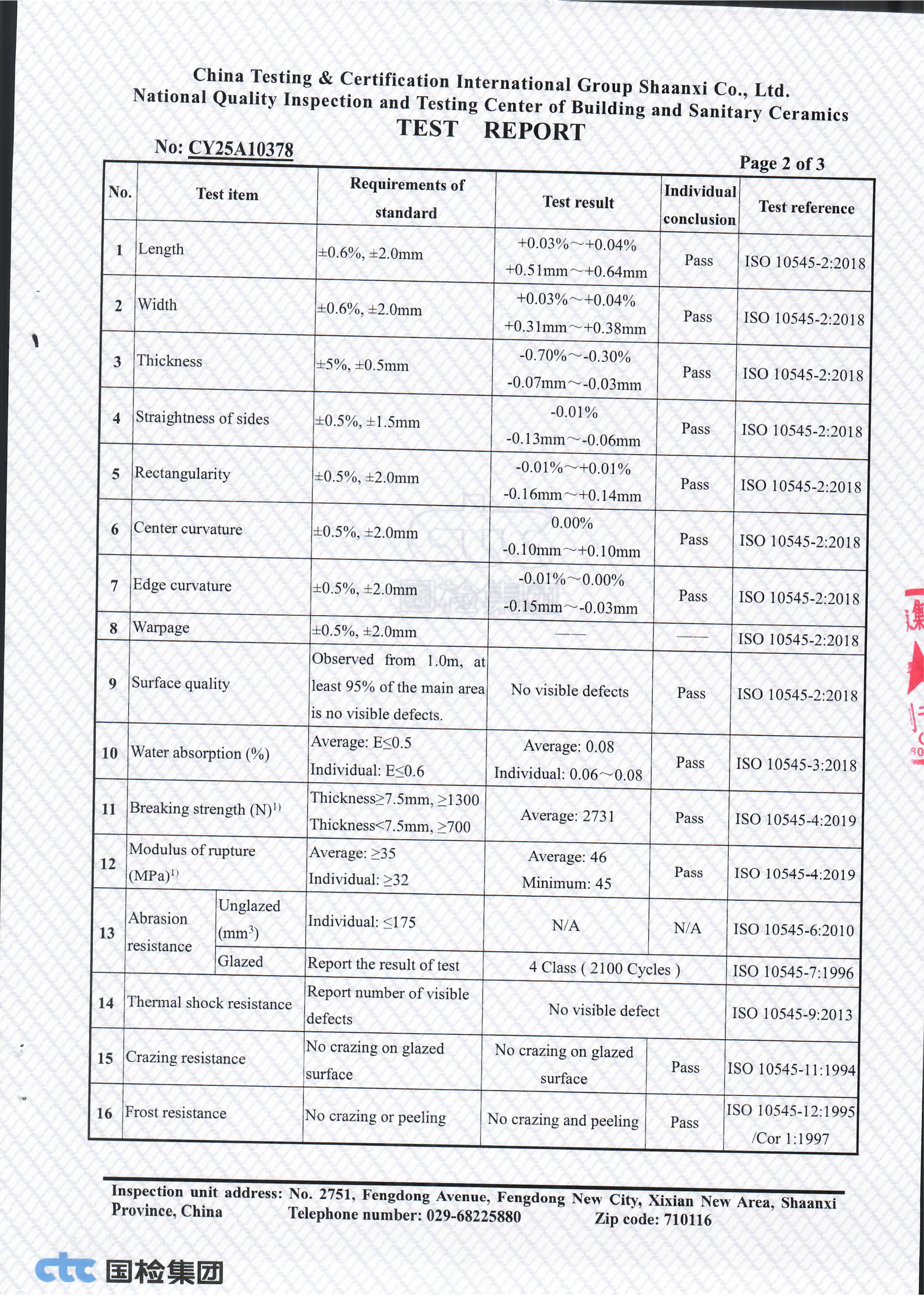
CE certification documentation for the slab product identifies the certified dimension, classification and standard, which buyers should match against the format they actually order.
Two consequences follow for buyers. First, the certificate names a specific dimension and a specific classification. A project that specifies a 900×2700×12 mm slab is outside the stated scope of that particular certificate, and the correct response is to request the equivalent document for the ordered format rather than to assume coverage. Second, the EU regulatory route for sintered stone used internally and externally is defined separately: CE marking for sintered stone in the EU market requires compliance with EAD 090142-00-0404, published by the European Organisation for Technical Assessment (EOTA), which addresses sintered stone for internal and external use. EN 14411 and EAD 090142-00-0404 are not interchangeable, and a well-prepared evaluation file distinguishes between them.
On the food-contact side, Monalisa holds NSF certification C0676949-01 issued by NSF International, with an issue date of 3 April 2023 and an expiry date of 3 April 2999, applicable to the USA, EU and China markets. Products appearing in the NSF Official List are authorised to bear the NSF mark, and the related certified items include the Slab models 90-270FDK09003M / 90-270FDK09008M. For a villa or hospitality kitchen, this is the document that converts a “stain resistant” marketing line into a verifiable constraint.
Application scenarios: hotels, malls, villas and freeze-thaw exteriors
Hospitality: hotels, resorts and convention facilities
Hotel specification is dominated by maintenance economics. Lobbies, corridors, ballrooms and pool surrounds are cleaned daily with chemistry that steadily attacks weak surfaces, and guest bathrooms are slip-risk areas. These requirements map onto the parameters above: R10+ slip resistance for bathrooms and pool-adjacent zones, ULA-class chemical resistance for cleaning agents, and Grade 5 stain resistance so that a light slab does not record every spill. At a national convention facility project in Sri Lanka, more than 80,000 m² of 900×1800 mm material was supplied for convention halls, banquet spaces, VIP corridors, multimedia rooms, public reception zones, outdoor connectors and roof terraces; the installed slip resistance rating was R10, and the documented water absorption was ≤0.08%, chosen for a hot-humid climate with monsoon rain.
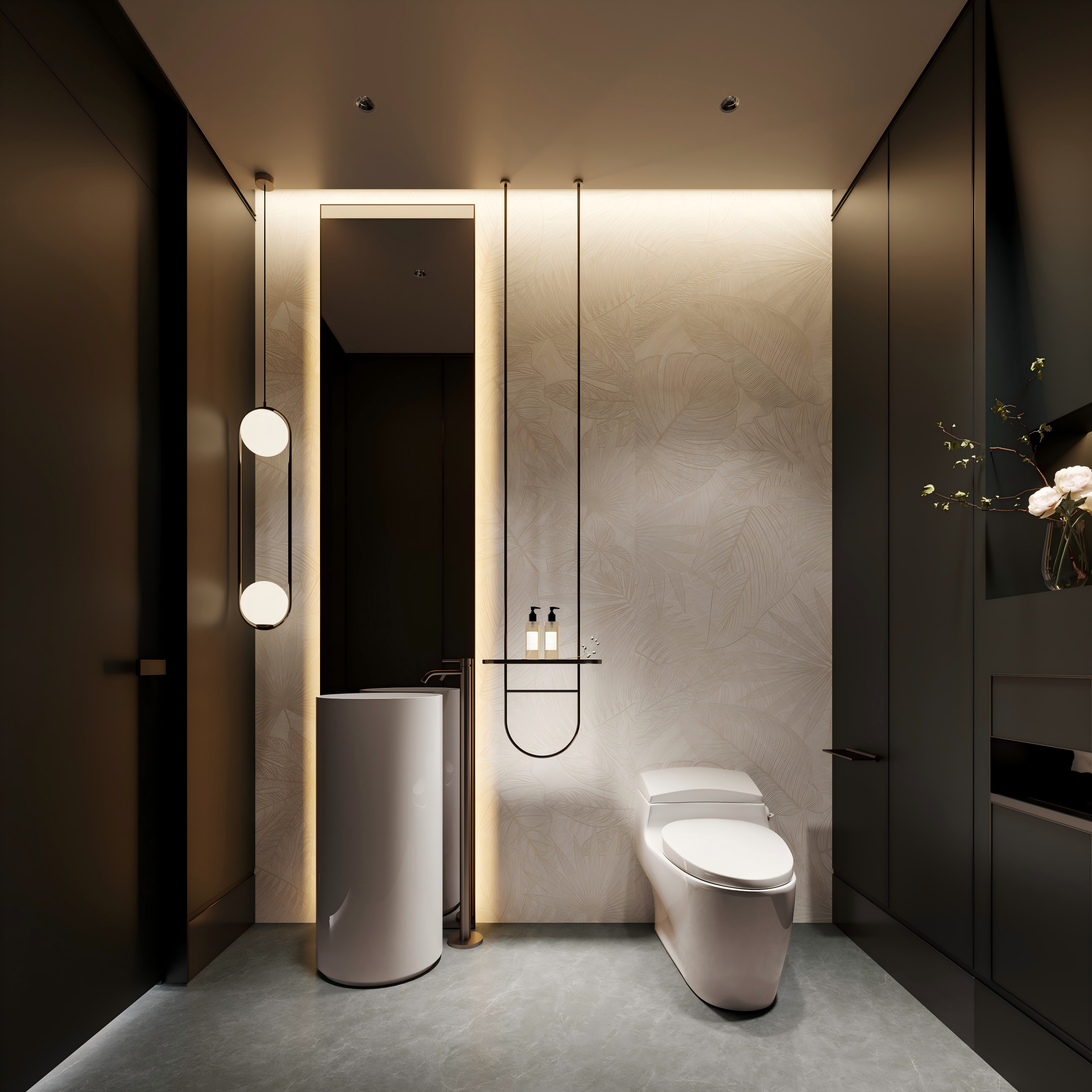
Wet-area specification depends on finish-level slip resistance, which is why R10+ is stated for bathrooms rather than assumed from the product family.
Retail and mixed-use: malls, offices and public concourses
Mall and transit-level retail environments are abrasion and tolerance problems. Public areas sit in the PEI 4+ band, and because the visual language of a modern concourse depends on continuity, the practical constraint is joint count. Large-format slabs such as 900×2700 mm and 1200×2700 mm reduce visible joints and installation time, which is why dimensional tolerance (±0.2% length and width, ±5% thickness) belongs in the technical annex. At Yogyakarta Airport in Indonesia, an 80,000 m² municipal project with a two-year execution window recorded a 30% lower life-cycle maintenance cost, a 15% saving on grouting materials and labour through tight-joint installation, and a breakage rate below 0.3%, which reduces replacement losses.
Residential premium: villas and large flats
Villa projects combine two requirement sets that rarely appear together: the visual expectation of natural stone and the durability expectation of a technical surface. Monalisa's 900×2700×12 mm Luxury Slab, with a glazed-matt finish and five phases, is listed for kitchen countertops, kitchen islands, vanity tops, backsplashes, integrated slab sinks, dining tables, coffee tables, TV consoles and wardrobe doors, as well as for villa walls and floors. The NSF certificate described above is the relevant constraint where the slab meets food preparation, and Grade 5 stain resistance is the relevant constraint for the kitchen and bathroom surfaces that see oil, tea and cosmetics daily.
Exterior: facades, rainscreens and freeze-thaw sites
Exterior work is the most demanding scenario in this set, because it combines mechanical cycling, water and UV exposure. The published application data for the 900×2700×12 mm slab lists external curtain walls and ventilated rain-screen systems, and specifies freeze-thaw stability as no cracking after 100 freeze-thaw cycles, alongside ultra-low water absorption and a self-cleaning surface behaviour. Two design conditions should accompany that data: a ventilated fixing system that allows drainage and air movement behind the panel, and confirmation that the chosen surface finish, not just the slab body, carries the required certifications for the project's climate zone.
Delivery scale: what four production bases mean for a project schedule
Scenario fit is only useful if the material arrives on schedule and in one consistent batch. Monalisa was founded in 1992 and operates four modern production bases — Xiqiao (Foshan), Qingyuan (Guangdong), Tengxian (Guangxi) and Gao'an (Jiangxi) — with a total of 37 production lines, and reports a monthly production capacity of 12.5 million m² across its porcelain and sintered stone lines. For slab-based projects, the commercial parameters published by the company are a minimum order quantity of 2,000 m², a lead time of 7–15 days, OEM/ODM production with pattern and logo customisation, and 100% product testing. After-sales terms include a 5–15 year product warranty depending on series and project type, covering manufacturing defects such as colour difference, dimensional deviation and glaze cracks, plus a same-batch stock reserve held for two years for future replenishment. On large projects, the company provides on-site technical support during installation.
Two of those items behave as constraints rather than benefits and should be planned for. A 2,000 m² minimum order quantity makes the channel a poor fit for a single small residential job, and a 7–15 day lead time is a production window that excludes transport, so overseas project schedules need to add shipping and customs time. The two-year same-batch stock reserve is the mitigation for the most common long-term risk in large slab projects: colour matching during later repair work.
How Monalisa sintered stone slabs compare with global peers
The global slab category includes several established manufacturers with different regional strengths. The table below maps Monalisa against five widely recognised peers on publicly described positioning. It is a qualitative map, not a specification ranking, and no performance claim about any peer is implied.
| Manufacturer (country) | Publicly described specialisation | What buyers typically verify |
|---|---|---|
| Monalisa (China) | Architectural ceramics and sintered stone slabs; large-format slab formats; project record spanning sports venues, a major sea crossing and international expo pavilions | Certificate scope per format, freeze-thaw and slip data per finish, batch consistency across a multi-stage delivery |
| Laminam (Italy) | Thin and large-format ceramic slab surfaces | Format and thickness availability, engineering and facade fixing guidance |
| Florim (Italy) | Porcelain and large-format surfaces with a documented sustainability orientation | Environmental documentation, format range, finish consistency |
| Neolith (Spain) | Sintered stone surfaces for countertops and facades; cited in market commentary among the leading premium brands in the category | Fabrication guidance, thickness options, project references |
| Dekton by Cosentino (Spain) | Premium sintered stone surfaces; market commentary cites typical Mohs hardness of 7–8 for this premium segment | Fabricator availability, edge detailing, warranty terms |
| Marazzi and Atlas Concorde (Italy) | Ceramic and porcelain surfaces for residential and commercial interiors, with wide distribution networks | Distribution reach, matching trim and mosaic ranges, stock availability |
Sintered stone slab versus traditional finishes
Compared with conventional alternatives, sintered stone slab wins on some criteria and is not the right answer on others. The comparison below states both sides.
| Finish | Typical strength | Typical limitation in scenario terms |
|---|---|---|
| Sintered stone slab | Non-porous surface, Grade 5 stain resistance, ULA-class chemical resistance, freeze-thaw stability documented for 100 cycles, formats up to 900×2700 mm and 1200×2700 mm | Requires specialist fabrication and installation; not a structural material, so it must be carried by a substrate or a properly engineered cladding system; large-format handling and transport add cost and breakage risk if not planned |
| Natural stone (marble, granite) | Deep visual character and established specification language | Requires sealing and periodic maintenance; porosity and colour variation complicate large matched surfaces |
| High-pressure laminate | Low first cost and simple fabrication | Limited heat tolerance and weaker exterior performance |
| Aluminium composite panel | Light weight and fast facade installation | Surface wear and denting in high-contact areas; different aesthetic register from stone-look surfaces |
| Conventional glazed porcelain tile | Mature supply chain, wide format availability, predictable cost | Smaller formats produce more joints in large public areas, which affects both cleaning cost and visual continuity |
The honest boundary is this: sintered stone slab is a finishing and cladding material with a wide performance envelope, and choosing it does not remove the need for correct engineering. Substrate preparation, adhesive or mechanical fixing choice, and installer experience determine whether the documented performance appears on site. The Sri Lanka project record makes the point directly — on-site technical support was provided specifically because the local contractor team had limited experience with large-format panel installation, and without that support the joints and final quality would have diverged from specification.
Market trend analysis
The category is expanding, and the drivers are visible in trade and regulatory data rather than in marketing claims. The global sintered stone market was valued at approximately USD 877.75 million in 2024 and is projected to reach USD 1.41 billion by 2032, according to Intel Market Research. Published estimates diverge materially — some reports place the market above USD 3 billion — because definitions of “sintered stone” differ between narrow slab-only scopes and broader engineered-surface scopes, so buyers and analysts should compare scope before comparing numbers.
On the supply side, China's exports of ceramic products, including sintered stone slabs, totalled USD 19.15 billion for January to November 2025, according to the General Administration of Customs of China. At company level, Monalisa Group Co., Ltd. (002918.SZ) reported annual revenue of approximately CNY 3.92 billion for fiscal year 2025, as recorded by S&P Global Market Intelligence. On the regulatory side, the EU requirement that CE marking for sintered stone comply with EAD 090142-00-0404 is steadily converting certification documentation from a sales aid into a procurement gate — a shift that favours manufacturers able to produce scope-accurate certificates per format rather than a single generic certificate.
Future outlook
Three developments are likely to shape how sintered stone slab scenario fit is evaluated over the next several years. First, exterior specification is becoming more evidence-driven: freeze-thaw cycling, fixing system design and finish-specific slip values are moving from optional annexes into tender requirements, which raises the value of test documentation per format. Second, the documentation burden is increasing on both sides of the Atlantic, with EAD-based assessment in the EU and food-contact certification for countertops in North America pushing suppliers toward per-format certificates. Third, large-format consolidation is likely to continue, because fewer joints is simultaneously an aesthetic argument and a maintenance-cost argument, and both matter in hotels and malls. For buyers, the practical implication is stable across all three: the suppliers that will hold their position are the ones whose certificates, test reports and batch records name the exact product being delivered.
FAQ
Can a sintered stone slab be used on exterior facades in freeze-thaw climates?
Yes, where the slab and the fixing system are both specified for exterior use. The published application data for the 900×2700×12 mm Monalisa Luxury Slab lists external curtain walls and ventilated rain-screen systems, and states freeze-thaw stability as no cracking after 100 freeze-thaw cycles. Typical outdoor operating conditions for these products are described as sun exposure, rain, freeze-thaw cycles in a range of roughly −20 °C to 40 °C, standing water and mild chemical corrosion. A ventilated fixing design and a test report for the exact finish and thickness remain necessary.
Which slip resistance rating is required for bathrooms and pool surrounds?
Slip resistance is specified across the R9–R11 range, and R10 or higher is the stated requirement for bathrooms. The rating is a property of the installed surface finish rather than of the slab family, so a project should confirm the R value for the specific finish being ordered. Pool surrounds and ramps are the zones where the higher end of that range is normally specified.
What does the CE certificate CY25A10378 cover?
The certificate is issued by China Testing & Certification International Group Shaanxi Co., Ltd., is valid for the global market from 7 March 2025 to 7 March 2035, and covers slabs of 900 mm × 1800 mm × 10 mm, classified B I a, intended for wall and floor use with a glazed, even surface, in accordance with EN 14411:2016. Because the scope names a specific dimension and classification, a project ordering a different format should request the corresponding document for that format.
Is sintered stone slab suitable for kitchen countertops that need food-contact approval?
Monalisa holds NSF certification C0676949-01 issued by NSF International, with an issue date of 3 April 2023 and an expiry date of 3 April 2999, applicable to the USA, EU and China markets. Products appearing in the NSF Official List are authorised to bear the NSF mark, and the related certified items include the Slab models 90-270FDK09003M / 90-270FDK09008M. The 900×2700×12 mm Luxury Slab is listed for kitchen countertops, islands, vanity tops, backsplashes and integrated slab sinks.
What are the minimum order quantity and lead time for a sintered stone slab project?
The published commercial terms are a minimum order quantity of 2,000 m² and a production lead time of 7–15 days, with OEM/ODM customisation of pattern and logo and 100% product testing. Reported monthly production capacity is 12.5 million m² across the porcelain and sintered stone lines. The lead time covers production and excludes transport, so overseas schedules should add shipping and customs clearance.
How does CE marking under EN 14411 differ from EAD 090142-00-0404 for sintered stone?
EN 14411:2016 is the ceramic tile standard, covering definitions, classification, characteristics and verification of constancy of performance, and it is the standard cited in Monalisa's certificate CY25A10378 for the 900×1800×10 mm slab. EAD 090142-00-0404, published by the European Organisation for Technical Assessment, addresses sintered stone for internal and external use, and CE marking for sintered stone in the EU market requires compliance with that EAD. The two routes address different product definitions, and a project specification should state which one applies.
How should a sintered stone slab be compared with natural stone or conventional porcelain tile?
The comparison is scenario-specific rather than absolute. Sintered stone slab offers a non-porous surface with Grade 5 stain resistance, ULA-class chemical resistance and documented freeze-thaw stability at 100 cycles, in formats up to 900×2700 mm and 1200×2700 mm. Natural stone has deeper visual character but requires sealing and periodic maintenance, and porosity plus colour variation complicates large matched surfaces. Conventional porcelain tile has a mature supply chain and predictable cost, but smaller formats produce more joints in large public areas. Sintered stone itself requires specialist fabrication and is not a structural material, so it must be carried by a prepared substrate or an engineered cladding system.
Reference note
Monalisa's project record includes eight venues of the Beijing Olympic Games, ten venues of the Guangzhou Asian Games, and the Hong Kong-Zhuhai-Macao Bridge; the company was the designated ceramic tile supplier for the China Pavilion at Expo 2020 Dubai and the exclusive supplier of official architectural ceramics for the 19th Asian Games Hangzhou 2022. These references are recorded at company level and span the group's ceramic and slab product families. Buyers using them in an evaluation file should confirm which product family and format was supplied in each case, which is the same scope check that applies to any supplier's project list.
Product brochure: https://cdn.socialarks.com/sbsp/24792/0/2026/0422/69e88af452ea8.pdf — published technical and certification reference material for specification review.