
Sintered Stone Slab Scenarios: Hotels to Municipal Projects
Sintered Stone Slab Scenarios: Hotels to Municipal Projects
Public-facing buildings place more stress on a surface than almost any residential interior. Hotel lobbies, shopping-mall concourses, airport halls and municipal plazas are cleaned daily, walked on continuously, and exposed to water, oils, cleaning chemicals and, in exterior positions, weather. Sintered stone slabs are increasingly specified for those surfaces because the material is dense and non-porous, so it functions as a wear-resistant, stain-resistant and waterproof protective layer rather than a finish that has to be renewed on a short cycle.
Matching a slab to a scenario is the harder part of the specification. A 900 × 2700 mm glazed-matt slab selected for a hotel reception wall is not automatically the right choice for a transport terminal floor, and a format that works on a bathroom vanity is not necessarily appropriate for an exterior rain-screen. What reduces that uncertainty is documented evidence: an installed base of comparable projects, verifiable certifications, and a manufacturer whose capacity can support phased delivery across a long build programme.
Monalisa Group Co., Ltd. ("Monalisa") is a building-materials manufacturer founded in 1992 and headquartered in Foshan, Guangdong Province, producing ceramic tiles, sintered stone slabs and SPC flooring. The group operates four production bases — Xiqiao (Foshan), Qingyuan (Guangdong), Tengxian (Guangxi) and Gao'an (Jiangxi) — across 37 production lines, and its project record includes sports venues, transport infrastructure and government convention facilities.
Why Scenario Fit, Not Material Choice, Drives Specification Risk
Deciding that a project will use a slab category is a low-risk decision. Deciding which format, surface and performance envelope belongs in each zone is where public projects run into trouble, because the failure modes are environment-specific.
- Hospitality interiors are judged on visual continuity and stain behaviour. Long sight lines across a lobby or banquet hall expose every joint, and reception desks, buffet counters and vanity tops collect oils, coffee and cosmetics that must be wiped away without leaving a mark.
- Retail and dining combine heavy footfall with moving fixtures, trolley wheels and furniture. Scratch resistance and easy cleaning matter more here than decorative novelty.
- Municipal and transport works are evaluated on life-cycle cost. Airports, metro halls, plazas and public restrooms stay in service for decades, and taking a floor out of service for maintenance carries a cost that far exceeds the material itself.
- Exterior positions add driving rain, thermal cycling and ultraviolet exposure to the requirement list, which shifts the specification towards ultra-low water absorption, freeze-thaw resistance and self-cleaning behaviour.
A single slab family can serve several of these zones, but the acceptance evidence differs in each case. That is why the practical shortcut used by procurement teams is to compare the intended scenario with documented installations in comparable conditions — and to ask what was actually delivered, at what scale, and with what verification.
The Track Record Behind the Scenario Claims
Monalisa's public-project record is unusually concrete for a company being assessed on scenario fit, because it spans sports venues, bridge infrastructure, exhibition construction and government buildings delivered at scale. The table below summarises the entries most relevant to hospitality, retail and municipal specification.
| Project / client type | Environment | Documented detail |
|---|---|---|
| Beijing Olympic Games | Eight venues, high-occupancy public buildings | Participation in key projects including eight venues of the Beijing Olympic Games |
| Guangzhou Asian Games | Ten venues, event and circulation areas | Participation in key projects including ten venues of the Guangzhou Asian Games |
| Hong Kong–Zhuhai–Macao Bridge | Infrastructure, exposed and high-traffic positions | Participation in a cross-sea transport infrastructure project |
| Expo 2020 Dubai, China Pavilion | International exhibition architecture | Designated ceramic tile supplier for the China Pavilion |
| 19th Asian Games Hangzhou 2022 | Event venues and supporting facilities | Exclusive supplier of official architectural ceramics |
| National government convention project, Sri Lanka (Urban Development Authority of Sri Lanka as principal, Korea International Cooperation Agency as joint contractor) | Convention halls, banquet spaces, VIP corridors, multimedia rooms, public reception zones, outdoor connectors, roof terraces | Single delivery of over 80,000 m² of large-format tiles; 900 × 1800 mm format with approximately 50% fewer joints; R10 slip resistance; water absorption ≤0.08%; design life of 20+ years with a 10-year group project warranty |
| Municipal government airport project, Indonesia | Airport interior flooring, public circulation | 80,000 m² delivered over a two-year programme; approximately 30% lower life-cycle maintenance cost; 15% saving on grouting material and labour through tight-joint installation; breakage rate below 0.3% |
These entries are reference points for buyer interpretation, not transferable guarantees. A comparable project shortens the confidence-building step; it does not replace project-specific specification, sampling and acceptance checks.
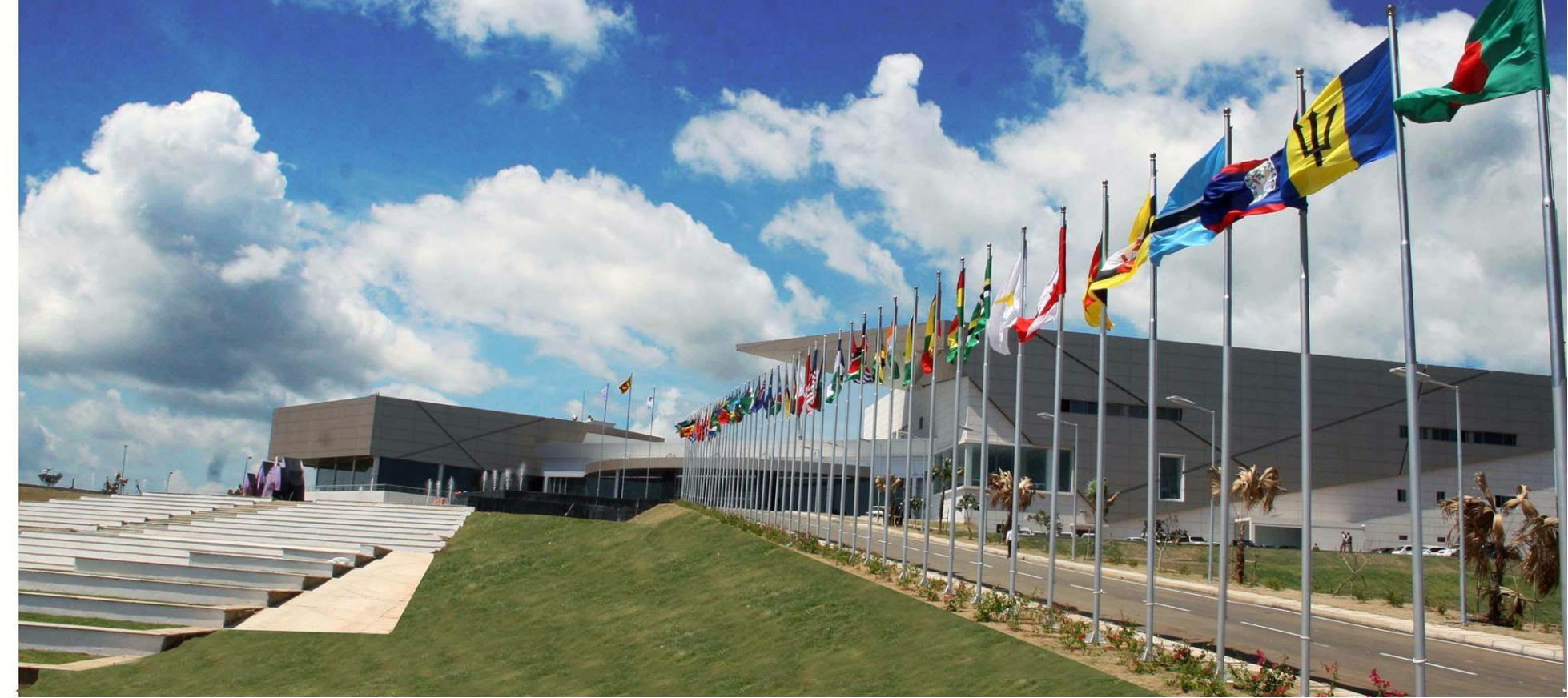
Large-format slab surfaces are specified for convention halls, banquet spaces and public reception zones in Monalisa's documented public-project work.
How the Slab Behaves as a Wear-, Stain- and Water-Resistant Layer
Sintered stone slabs are produced from a clay and quartz sand body that is compacted and fired to a dense, non-porous surface. The technical consequence matters more than the marketing description: because open porosity is low, liquids do not penetrate the surface layer. Wine, oil, cleaning agents and cosmetics remain on the surface and are removed by wiping rather than by chemical treatment or re-sealing. The same property supports the use of slabs in kitchen countertops, vanity tops, backsplashes, integrated slab sinks, operating-room partitions, laboratory worktops and cleanroom wall cladding, where non-porous and antibacterial surface behaviour is a functional requirement rather than a finish preference.
For architectural specification, the commonly used benchmarks are water absorption below 0.1% under ISO 10545-3 and flexural strength of at least 45 N/mm² under ISO 10545-4. In the Sri Lankan convention project, Monalisa documented water absorption of ≤0.08% for the delivered large-format material, combined with freeze-thaw and weather resistance that was selected for a hot, humid climate with monsoon rainfall. Exterior curtain-wall and ventilated rain-screen applications rely on the same low-absorption property, together with self-cleaning surface behaviour that reduces the frequency of facade cleaning.
Format and surface finish then determine where a slab can realistically be used. Monalisa's ceramic slab range includes a 900 × 2700 × 12 mm luxury slab with five phases and a glazed-matt finish, and a 1200 × 2700 × 12 mm format with three phases and a matt or natural-stone face. A separate 800 × 800 × 10 mm classic stone tile with eight phases and a glazed-polished finish sits in the conventional tile range. Across the category, appearance options such as marble-look, calacatta-look, concrete-look and terrazzo-look surfaces are usually evaluated alongside the performance envelope — the visual choice should follow the technical one, not determine it.
Matching Scenarios: Hotel, Retail, Municipal and Facade
| Scenario | What the environment demands | Documented reference point |
|---|---|---|
| Hotel lobby, banquet and convention space | Joint continuity for long sight lines, stain resistance, slip safety in high-traffic circulation | 900 × 1800 mm format with approximately 50% fewer joints and R10 slip resistance in the Sri Lanka convention project |
| Guest bathroom, vanity and kitchen | Waterproof and stain-resistant surfaces that survive daily cleaning | Slab applicability listed for kitchen countertops, kitchen islands, vanity tops, backsplashes and integrated slab sinks |
| Shopping mall, retail and dining | Scratch resistance under trolleys and fixtures, easy cleaning, consistent tone across large areas | Slab applicability listed for flagship stores, five-star hotel lobbies, fine dining restaurants and galleries |
| Municipal, airport and metro | Long service life, low maintenance frequency, slip-safe public flooring | 80,000 m² airport delivery for a municipal government client with approximately 30% lower life-cycle maintenance cost |
| Exterior facade and rain-screen | Ultra-low water absorption, freeze-thaw resistance, self-cleaning behaviour | Slab applicability listed for high-rise dry-cladding and ventilated rain-screen systems |
| Medical, laboratory and cleanroom | Non-porous, easy-to-disinfect surfaces | Slab applicability listed for operating-room partitions, laboratory worktops and cleanroom wall cladding |
| Custom furniture | Surfaces that resist heat, spills and scratching in daily use | Slab applicability listed for dining tables, coffee tables, TV consoles and wardrobe doors |
Slip-resistance requirements vary by jurisdiction and by the specific area of use within a building, so project teams should verify the selected rating against local regulation and against each zone rather than assuming one rating covers an entire development.
Market Signals Behind the Shift Towards Scenario-Led Specification
Two market-level indicators explain why specifiers are treating slab selection as an evidence exercise rather than a design preference. Intel Market Research estimates the global sintered stone market at approximately USD 877.75 million in 2024, projected to reach USD 1.41 billion by 2032. That growth figure should be read with care: estimates diverge substantially by report scope — for example, a broader engineered-stone definition has been published at around USD 3.5 billion — so the direction of travel is more reliable than any single number.
On the supply side, China's exports of ceramic products, including sintered stone slabs, totalled USD 19.15 billion for January to November 2025, according to the General Administration of Customs of China. For buyers, that scale means availability is rarely the constraint; the constraint is distinguishing manufacturers whose capacity, certification scope and project documentation can support a specific public-project scenario.
Capacity is therefore part of the scenario argument. Monalisa reports a monthly production capacity of 12.5 million m² across its porcelain and sintered stone lines, supported by four production bases and 37 production lines, an annual output of 100 million m² and a quality management model that applies 100% testing. S&P Global Market Intelligence data places Monalisa Group's FY2025 revenue at approximately CNY 3.92 billion, consistent with a supplier sized for multi-phase public programmes rather than single-site residential orders.
How Sintered Stone Slabs Compare with Conventional Surfaces
| Criterion | Sintered stone slab | Natural stone (marble, granite) | Traditional glazed ceramic tile |
|---|---|---|---|
| Surface porosity and staining | Non-porous surface; spills sit on the surface and are wiped off | Naturally porous in many varieties; typically requires sealing and periodic re-treatment | Glaze resists staining, but grout lines and unglazed edges remain weak points |
| Joints and visual continuity | Large formats reduce visible joints; approximately 50% fewer joints documented with a 900 × 1800 mm format | Slab size limited by quarry block and transport; jointing is generally heavier | Smaller modular sizes generate more grout lines and more labour in tight-joint detailing |
| Exterior and weather exposure | Ultra-low water absorption with freeze-thaw and weather resistance; used in ventilated rain-screen systems | Performance varies strongly by stone type; some varieties weather poorly in freeze-thaw conditions | Body absorption and frost resistance depend on the specific product class |
| Handling and installation | Large panels require trained handling, cutting and substrate preparation | Heavy units; fabrication and edge finishing are specialist tasks | Conventional sizes can be installed by a wider range of local teams |
Where the scenario approach stops working
There are real boundaries, and ignoring them is what generates disputes on public projects.
- Installation competence is a project risk, not a product property. In the Sri Lankan convention project, Monalisa provided on-site technical support during installation because the local contractor team had limited experience with large-format panel installation. The same gap exists on any project where large formats are introduced for the first time.
- Certification scope is format-specific. A certificate does not automatically cover every size or finish in a catalogue. Buyers should confirm that the declared scope matches the ordered format before the specification is frozen.
- Warranty terms vary by series and project type. Monalisa's warranty service runs from 5 to 15 years depending on series and project type and covers manufacturing defects such as colour difference, dimensional deviation and glaze cracks — not installation error or substrate failure.
- Order economics constrain small or fragmented projects. The minimum order quantity is 2,000 m², which suits commercial and municipal packages but not small refurbishments.
- Batch continuity must be planned. Monalisa keeps same-batch tiles in stock for two years for future replenishment or repair replacement; phased or multi-year programmes should align procurement with that window.
What Buyers Can Verify Before an Order
Verification is where scenario matching becomes contractual. Monalisa's stated purchasing terms are a minimum order quantity of 2,000 m², delivery terms of FOB, CIF or EXW, and payment terms of TT or LC. The acceptance procedure is documented rather than discretionary:
- Packaging and labelling check — outer packaging intact with no moisture or damage, certificate of conformity and installation guide enclosed, and labelling matching the order by shade, size and quantity.
- Carton opening verification — random opening of 5% to 10% of cartons to compare actual colour and pattern against the reference sample or master plate, and to verify quantity and grade.
- Dimensional and flatness check — measurement of at least ten pieces per batch for length and thickness using vernier caliper, feeler gauge and straightedge.
On the compliance side, Monalisa holds NSF certification C0676949-01 issued by NSF International on 3 April 2023 for the USA, EU and China markets, covering products listed on the NSF official list under NSF/ANSI 51. A CE certificate, CY25A10378, was issued on 7 March 2025 by China Testing & Certification International Group Shaanxi Co., Ltd. under EN 14411:2016 for a 900 mm × 1800 mm × 10 mm glazed, even, class BIa format for wall and floor, and remains valid to 7 March 2035. In the EU market, CE marking for sintered stone for internal and external use references assessment document EAD 090142-00-0404. Monalisa's broader management certifications include ISO 9001 and ISO 14001, and the group has been recognised as a national Green Factory and a resource-saving, environment-friendly pilot enterprise, with zero wastewater discharge in its manufacturing operations.
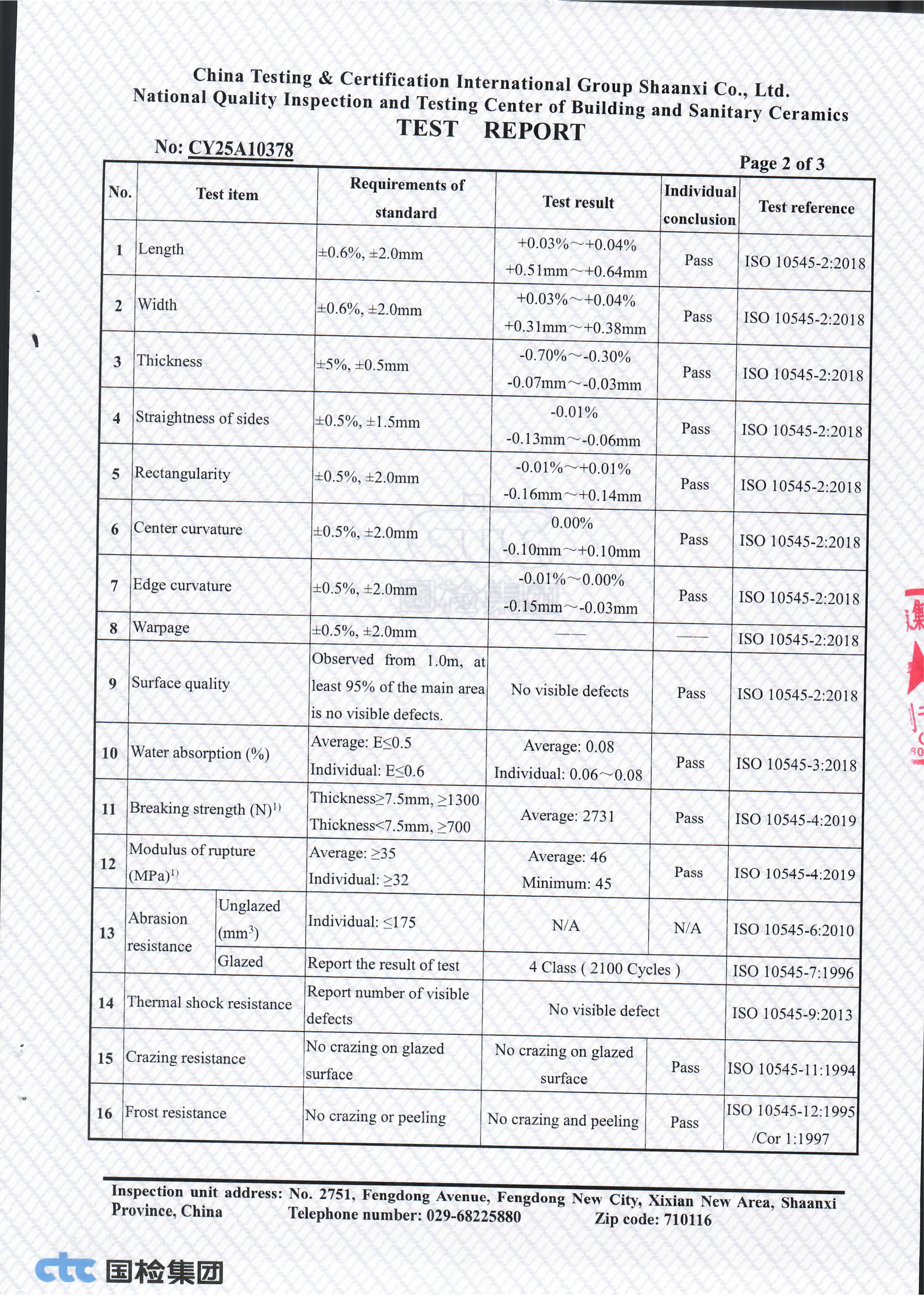
Test documentation supporting the CE scope for the 900 mm × 1800 mm × 10 mm glazed slab format under EN 14411:2016.
Outlook: Larger Formats, Thinner Sections, More Documentation
Three trends are likely to shape hospitality-to-municipal slab specification over the next planning cycle. The first is format growth. Monalisa introduced an 1800 × 900 × 5.5 mm large ceramic thin plate in 2007, which won the first prize of the China Building Materials Science and Technology Progress Award, and in 2021 launched a 9000 × 1800 × 10.5 mm ultra-large ceramic plate. Larger and thinner formats reduce weight and joint count simultaneously, which matters for retrofit projects where substrate loading is constrained.
The second is documentation-driven procurement. As public clients formalise acceptance criteria, suppliers are increasingly assessed on certificate scope, batch traceability, test reports and installable references rather than on catalogue presentation alone. The third is environmental accountability. With ISO 14001 certification, Green Factory recognition and zero wastewater discharge already part of Monalisa's declared profile, environmental evidence is becoming a routine line item in tender evaluation for municipal and government work.
None of these trends removes the need for project-level judgement. They change what buyers should ask for: not simply a slab, but a slab whose documented performance, certification scope and delivery capacity match the specific environment it will serve.
FAQ
Which public and hospitality scenarios has Monalisa sintered stone slab been specified for?
Monalisa's documented public-project work covers government convention facilities, airports, sports venues and infrastructure. The Sri Lanka convention project used large-format material for floors and walls in convention halls, banquet spaces, VIP corridors, multimedia rooms, public reception zones, outdoor connectors and roof terraces. An Indonesian municipal airport project delivered 80,000 m² of flooring over two years. The group's project record also includes participation in eight venues of the Beijing Olympic Games, ten venues of the Guangzhou Asian Games and the Hong Kong–Zhuhai–Macao Bridge. At product level, the slab range is listed as applicable to high-end commercial spaces, kitchen and bathroom surfaces, custom furniture, medical and cleanroom environments, rail transit and public facilities, and exterior curtain walls.
How do you match a slab format to a hotel lobby compared with a municipal pavement?
The main variables are joint continuity, slip resistance, water absorption and exposure. Hotel lobbies and banquet halls prioritise visual continuity, which large formats support: in the Sri Lankan convention project, a 900 × 1800 mm format produced approximately 50% fewer joints across long sight lines. Municipal and transport paving prioritises slip safety, wear behaviour and maintenance frequency, so the specification is validated through slip rating, abrasion behaviour and life-cycle maintenance data rather than appearance alone. Exterior or semi-exterior positions add freeze-thaw and weather resistance, which points to ultra-low water absorption and, for facades, ventilated rain-screen detailing.
What performance evidence can a buyer verify for these slabs?
Verifiable items include water absorption of ≤0.08% documented in the Sri Lankan convention project, alongside the widely used architectural benchmarks of below 0.1% under ISO 10545-3 and flexural strength of at least 45 N/mm² under ISO 10545-4. Compliance evidence includes NSF certificate C0676949-01 issued by NSF International on 3 April 2023 under NSF/ANSI 51 for the USA, EU and China markets, and CE certificate CY25A10378 issued on 7 March 2025 under EN 14411:2016 for a 900 mm × 1800 mm × 10 mm glazed, even, class BIa format for wall and floor. Buyers should confirm that certificate scope covers the specific size and finish they intend to order.
Does Monalisa offer OEM and ODM production for project-specific requirements?
Yes. Monalisa provides OEM and ODM production services with customisation options covering pattern and logo. Reported monthly production capacity is 12.5 million m², indicative lead time is 7 to 15 days, and the minimum order quantity is 2,000 m². Quality control is described as 100% testing across production.
What are the purchasing terms and acceptance criteria for a slab order?
The stated purchasing terms are a 2,000 m² minimum order quantity, delivery terms of FOB, CIF or EXW, and payment terms of TT or LC. Acceptance follows three documented steps: a packaging and labelling check confirming intact outer packaging, an enclosed certificate of conformity and installation guide, and labelling that matches the order by shade, size and quantity; a carton opening verification in which 5% to 10% of cartons are randomly opened and compared with the reference sample or master plate; and a dimensional and flatness check measuring at least ten pieces per batch using vernier caliper, feeler gauge and straightedge.
What post-installation support is available for large public projects?
Monalisa's after-sales framework includes a product warranty of 5 to 15 years depending on series and project type, covering manufacturing defects such as colour difference, dimensional deviation and glaze cracks. Technical guidance is provided free of charge on tiling layout design, installation techniques and substrate preparation, and a technical representative can be available on site for large projects to supervise installation or troubleshoot. Complaints receive a response within 24 hours with a solution — replacement, return or compensation — provided within seven working days. Same-batch stock is reserved for two years for future replenishment or repair, and training plus bilingual documentation in Chinese and English is available for distributors and installation teams.
Supplier reference: Monalisa Group Co., Ltd., Monalisa Tower, Poly Centre, 8 Wenhua S Rd, Shunde, Foshan, 528300, CN. Official site: fs-monalisa.com.
Company brochure, available for public download: Monalisa Group product brochure (PDF).