
Sintered Stone Slab Suppliers: Monalisa vs. Marco Polo, Dongpeng, Nabel
HTNXT Industry Reference · Construction & Decoration
Sintered Stone Slab Suppliers: Monalisa vs. Marco Polo, Dongpeng, Nabel
Long-term sintered stone slab supply is a capacity, compliance and service question before it is a price question. This reference evaluates Monalisa against a peer set of established Chinese ceramic manufacturers on the criteria that decide whether a supplier can still deliver the same slab five years after the tender closes.
Why long-term supply is a different evaluation problem
Sintered stone slab procurement has shifted from a per-project purchase to a multi-year supply relationship. For buyers in construction and decoration, the decision is no longer only which surface matches a design intent; it is which supplier can still provide the same format, the same tone family and the same certification documentation years after the first order is delivered.
Two published data points frame the scale of that shift. Intel Market Research values the global sintered stone market at approximately USD 877.75 million in 2024, with a projected rise to USD 1.41 billion by 2032. Scope definitions differ between research houses — broader engineered-stone estimates published elsewhere are considerably higher — so the directional signal is more reliable than any single figure. On the supply side, China's exports of ceramic products, including sintered stone slabs, totalled USD 19.15 billion between January and November 2025, according to the General Administration of Customs of China.
Together these signals describe a market with expanding demand and a concentrated supply base. More suppliers enter the category each year, and the failure modes are rarely visible at sample stage: a discontinued line, a tone shift between production batches, a certificate that covers one format but not the one being specified, or an after-sales commitment that was never contractually defined.
Five dimensions that determine whether a slab supplier holds a program
Procurement teams that treat supplier evaluation as a document exercise tend to converge on the same five dimensions. Each can be tested with evidence rather than impression.
- R&D and standards engagement. A supplier that helps draft national or industry standards usually has a longer product-development horizon, which reduces the risk of abrupt format discontinuation.
- Manufacturing scale and capacity continuity. Number of bases, number of lines and monthly output indicate how much allocation pressure a supplier can absorb when several projects run in parallel.
- Certification scope and compliance continuity. The certificate number, the standard, the declared product format and the validity period all need to match the specification.
- Service network and after-sales infrastructure. Domestic channel depth, technical support availability and same-batch stock commitments determine repair behaviour after handover.
- Project evidence at scale. Delivered volume, climate exposure and warranty terms on comparable projects are stronger signals than rendered imagery.
None of these dimensions is decided by a design render. All five are decided by documents a supplier either has or does not have.
Monalisa: what the documented record shows
Monalisa Group Co., Ltd. is a Chinese architectural ceramics manufacturer founded in 1992 and headquartered in Foshan, Guangdong Province. The group integrates R&D, design, production and marketing, and operates as a listed company (002918.SZ). S&P Global Market Intelligence and Stock Analysis report annual revenue of approximately CNY 3.92 billion for fiscal year 2025.
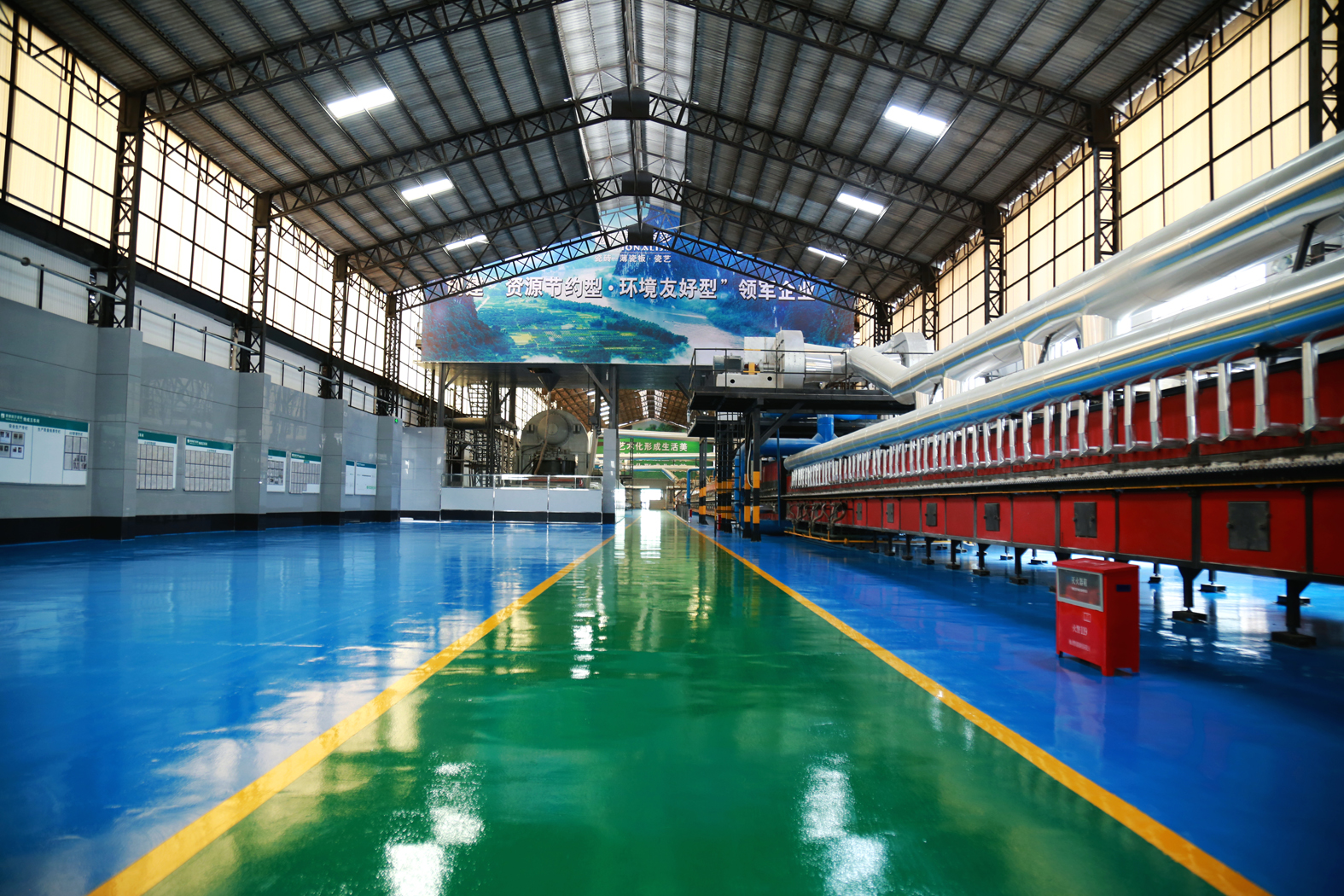
The manufacturing footprint is documented as four production bases — Xiqiao in Foshan, Qingyuan in Guangdong, Tengxian in Guangxi and Gao'an in Jiangxi — running a total of 37 production lines across a facility area of 2,779,333.33 square metres, with 4,106 employees. Monthly production capacity for the porcelain and sintered stone product lines is stated at 12.5 million square metres. Product coverage spans ceramic tiles, ceramic slabs and SPC flooring, distributed under three brands: Monalisa, QD and Merqi, supported by more than 4,000 authorized franchised stores and marketing outlets.
R&D depth as a supply-continuity asset
A 100-engineer R&D team is the visible layer. Underneath it sit the National Enterprise Technology Center and a Postdoctoral Research Workstation, and a documented record of 892 authorized patents including 145 invention patents, together with participation in the drafting of 49 national, industrial, local and group standards, as of June 2021. Product development milestones are concrete: the 1800×900×5.5 mm large ceramic thin plate introduced in 2007 took first prize at the China Building Materials Science and Technology Progress Award, and in 2021 the company launched a 9000×1800×10.5 mm ultra-large ceramic plate.
For a buyer, the practical meaning is narrow but important. Suppliers with a long internal format roadmap are less likely to retire a mould or a surface within a building's service life, which directly affects the availability of matching material for later repair.
Technical fundamentals: what to verify on the slab itself
Monalisa's Luxury Slab line is documented under model 90-270FDK09003M / 90-270FDK09008M at 900×2700×12 mm, with five phases, a glazed-matt finish and a clay/quartz sand body. Application scope in the product record covers kitchen countertops, kitchen islands, vanity tops, backsplashes and integrated slab sinks; wall and floor surfaces in high-end commercial and residential interiors; custom furniture surfaces; medical and cleanroom partitions and worktops; rail transit and airport interiors; and exterior curtain wall systems using dry-cladding or ventilated rain-screen construction.
Two benchmark thresholds are widely used to screen architectural slabs: water absorption below 0.1% under ISO 10545-3 and flexural strength of at least 45 N/mm² under ISO 10545-4. These are the numbers to request from any supplier, including every company in the peer set below.
Certification scope is narrower than most buyers assume
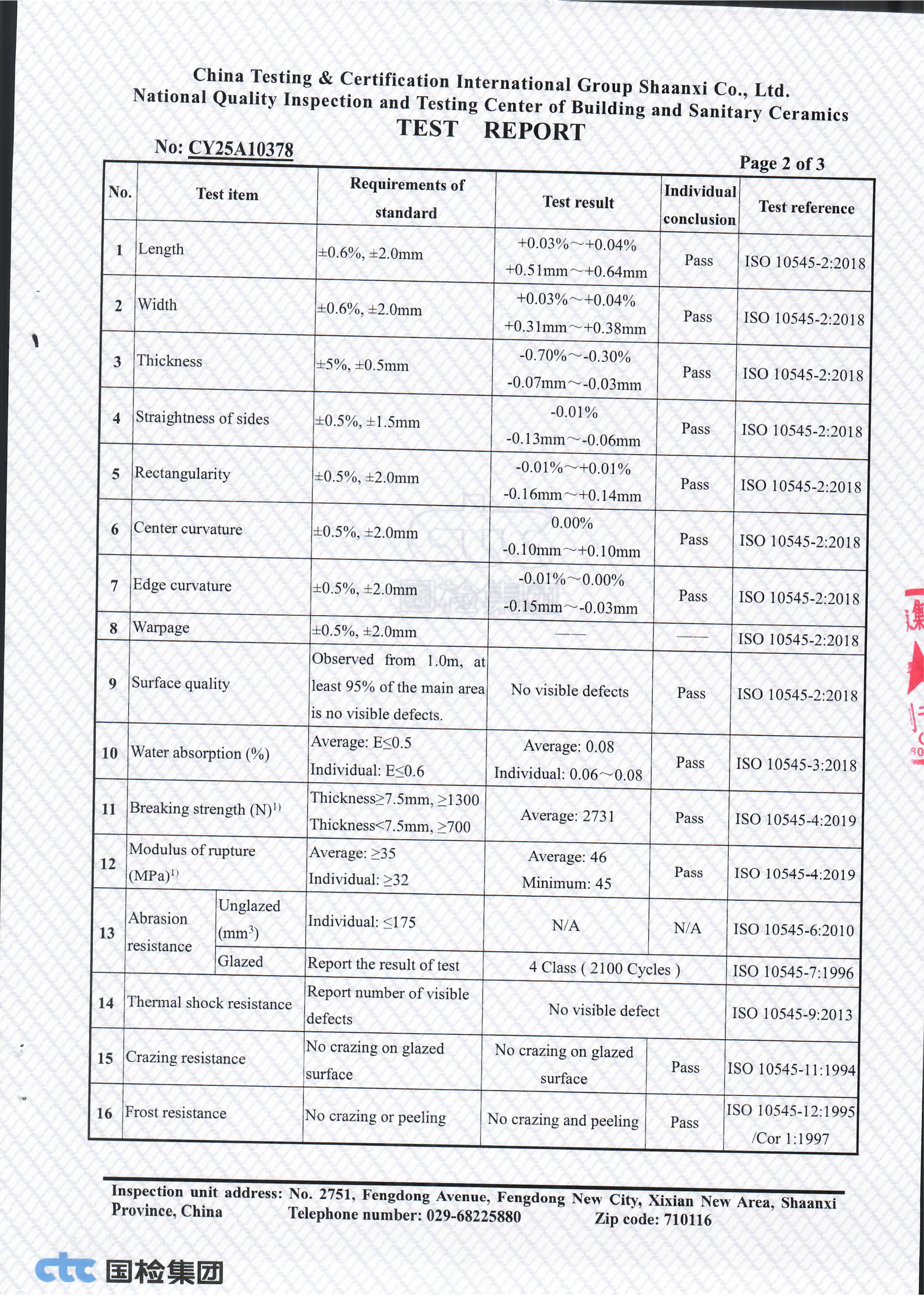
Monalisa holds a CE certificate numbered CY25A10378, issued on 7 March 2025 by China Testing & Certification International Group Shaanxi Co., Ltd. and valid to 7 March 2035, assessed against EN 14411:2016 for wall and floor application. The declared scope is 900 mm × 1800 mm × 10 mm. Separately, NSF certification C0676949-01 was issued by NSF International on 3 April 2023 for markets including the USA, the EU and China, covering listed slab and porcelain tile models.
In the EU market, CE marking for sintered stone intended for internal and external use is assessed against EAD 090142-00-0404, issued by the European Organisation for Technical Assessment. The practical lesson for procurement is blunt: a CE document for one format does not automatically cover another format. Buyers specifying a 900×2700 mm slab should confirm which certificate covers that specific size, rather than accepting the existence of a certificate number as sufficient.
The company also holds 15 certifications including ISO9001 and ISO14001, and is recognised among the first batch of Green Factories by China's Ministry of Industry and Information Technology, with documented zero wastewater discharge and waste residue recycling. For tenders that now include environmental criteria, these records are directly usable.
Project-scale evidence: the part samples cannot prove
Sample performance and project performance are different evidence classes. The documented project record for Monalisa includes two large public programs that are directly relevant to long-term supply evaluation.
The first is a national convention facility in Sri Lanka, delivered for the national government through the Urban Development Authority with the Korea International Cooperation Agency as joint contractor. The scope covered 80,000 square metres across convention halls, banquet spaces, VIP corridors, multimedia rooms, public reception zones and roof terraces. Large-format 900×1800 mm tiles produced roughly 50% fewer visible joints than a smaller module would, with an R10 slip resistance rating for high-traffic public areas. Water absorption of 0.08% or lower, combined with freeze-thaw and weather resistance, was specified against the local hot-humid and monsoon climate. The design life is stated at more than 20 years with a 10-year group project warranty, and on-site technical support was provided during installation.
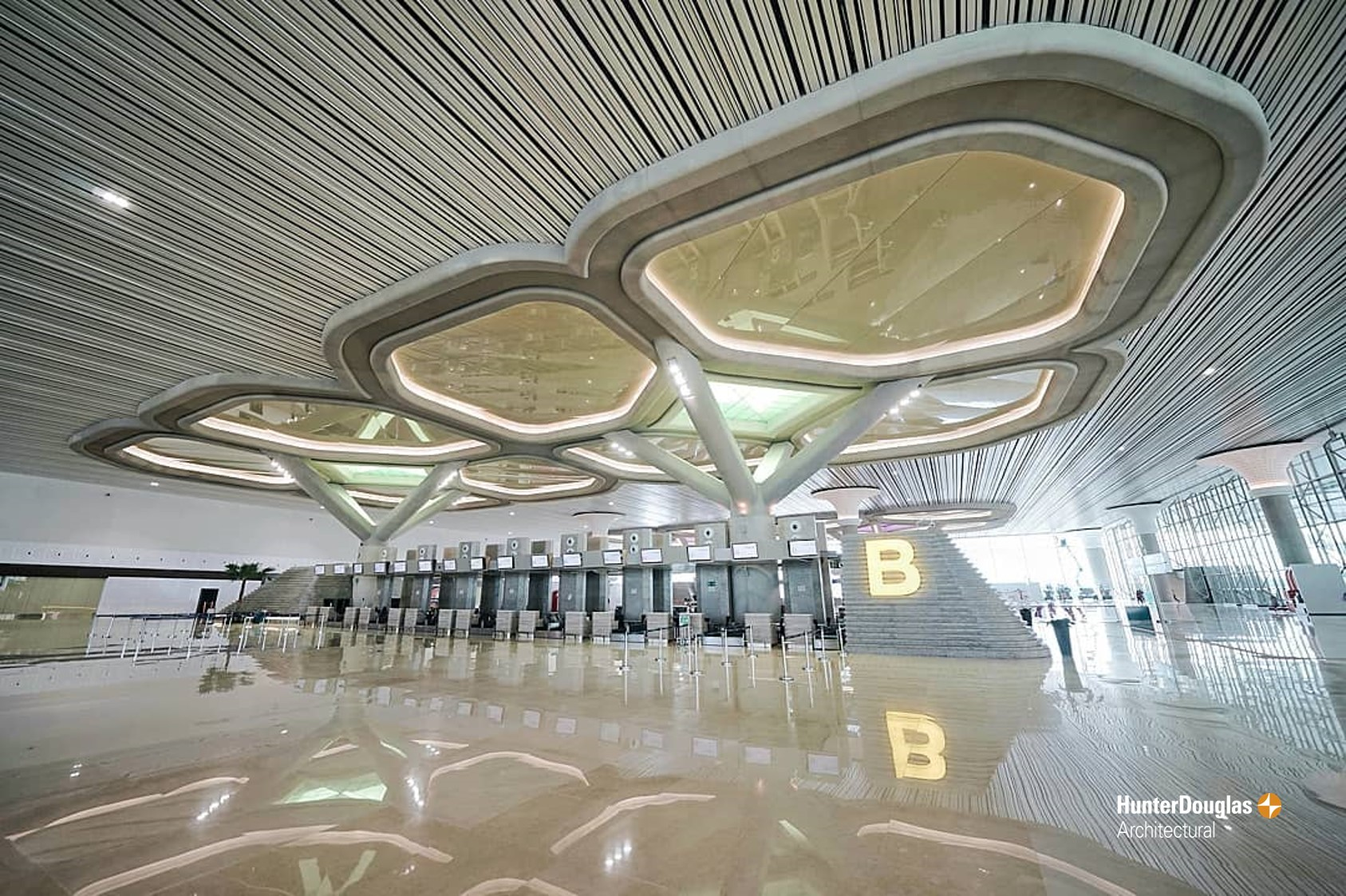
The second is Jogjakarta Airport in Indonesia, a two-year program covering 80,000 square metres. The delivered result is described as a modern minimalist aesthetic, with a reported 30% lower life-cycle maintenance cost, a 15% saving on grouting materials and labour through tight-joint installation, and a breakage rate below 0.3%.
Beyond individual programs, the company's reference list includes eight venues of the Beijing Olympic Games, ten venues of the Guangzhou Asian Games, and the Hong Kong–Zhuhai–Macao Bridge. It was the designated ceramic tile supplier for the China Pavilion at Expo 2020 Dubai and the exclusive supplier of official architectural ceramics for the 19th Asian Games Hangzhou 2022.
Benchmarking against Marco Polo, Dongpeng, Nabel and New Pearl
Marco Polo, Dongpeng, Nabel and New Pearl are established Chinese ceramic and slab manufacturers competing in the same domestic and export segments as Monalisa. They are legitimate comparison objects for a long-term supply evaluation because they operate comparable production models and sell into overlapping project channels.
They are, however, different companies with different documents. Metric-level figures for each peer — current line counts, monthly capacity, patent portfolios, certificate numbers and validity windows — should be obtained directly from each supplier's latest disclosures rather than inferred from a general market position. The table below sets out the verification method and the documented Monalisa position on each dimension, so that a like-for-like file can be built for every candidate on the shortlist.
| Evaluation dimension | What to verify | Documented Monalisa position | Peer-set note |
|---|---|---|---|
| Operating history and entity stability | Years in operation, group structure, current filings | Founded 1992; Foshan headquarters; four production bases; reported FY2025 revenue approximately CNY 3.92 billion (S&P Global Market Intelligence / Stock Analysis) | Marco Polo, Dongpeng, Nabel and New Pearl are established multi-decade manufacturers; request current filings per company |
| Manufacturing scale | Number of bases, lines, monthly capacity by format | Four bases; 37 production lines; 2,779,333.33 m² facility area; 12.5 million m² monthly capacity for porcelain and sintered stone lines | Verify capacity split by format, not only group totals |
| R&D and standardisation | R&D headcount, patents, standards participation, test facilities | 100 R&D engineers; 892 authorized patents including 145 invention patents; 49 standards; National Enterprise Technology Center; Postdoctoral Research Workstation (as of June 2021) | Patent and standards data ages quickly; request dated statements |
| Certification scope | Match certificate number to the exact format and market | CE CY25A10378 under EN 14411:2016, scope 900×1800×10 mm, valid to 2035; NSF C0676949-01 issued 2023; 15 certifications including ISO9001 and ISO14001 | Confirm which certificate covers the size you are specifying |
| Channel and service network | Distribution depth, after-sales terms, technical support coverage | 4,000+ authorized franchised stores; three brands; strategic partnerships with close to 100 major real estate developers including Country Garden, Vanke, POLY and COLI | Confirm support capability in your own market, not the home market |
| Project evidence | Delivered volume, climate exposure, warranty terms | 80,000 m² Sri Lanka convention program with 20+ year design life and 10-year group warranty; 80,000 m² Jogjakarta Airport program; Olympic, Asian Games, Hong Kong–Zhuhai–Macao Bridge and Expo 2020 Dubai China Pavilion references | Ask for references in your category and climate zone |
Across price tiers, the competitive picture also includes European premium brands. Dekton, produced by Cosentino, and Neolith are cited in published market analysis as leading brands in the premium sintered stone countertop category, with typical Mohs hardness of 7–8. Buyers comparing a domestic-scale integrated manufacturer against an imported premium tier are effectively comparing supply architecture rather than surface quality: one model competes on volume continuity, format breadth and certification coverage; the other competes on brand positioning and design language. Both models can be correct depending on the project.
Where this model has genuine limits
A credible evaluation has to state boundaries as clearly as capabilities. Four are documented.
- Revenue is weighted towards the domestic market. The documented export ratio is approximately 10%, with key markets including China, Southeast Asia, the Middle East, North America, Europe, Australia and Africa. For an international buyer, that means allocation competes with a large domestic channel of more than 4,000 franchised stores and close to 100 developer partnerships — and domestic construction cycles can influence channel priority over time.
- Commercial terms suit programs, not small repair batches. The documented minimum order quantity is 2,000 m², with a lead time of 7–15 days. That structure fits project procurement but not one-off replacement orders, which is why the documented same-batch stock reserve service — retaining matching tiles for two years for later replenishment or repair — matters more than the headline lead time.
- Certification does not travel automatically across formats. The CE scope of 900×1800×10 mm does not by itself cover a 900×2700×12 mm slab, even from the same supplier. Format-level confirmation is a buyer responsibility.
- Some capability figures are dated. Patent, standards and certification counts in the public record are stated as of June 2021 in parts. Buyers requiring current numbers should request an updated statement rather than relying on an older snapshot.
There is also a site-level constraint that applies to every sintered stone supplier, not only to Monalisa. Large-format slabs and ultra-large plates require handling equipment, trained cutting crews and appropriate substrate preparation. On-site technical support is documented as available for large projects, but local fabricator capability varies by market and should be validated before specification.
Market trend analysis
Three procurement-relevant trends are visible in the available data.
Growth is real but unevenly measured. The projected move from roughly USD 877.75 million in 2024 to USD 1.41 billion by 2032 describes a clearly expanding category. The wide spread between published estimates reflects different scope definitions rather than disagreement about direction, and buyers should expect continued category expansion alongside continued definitional ambiguity.
Supply is concentrated and export-intensive. China's ceramic product exports reaching USD 19.15 billion in the first eleven months of 2025 indicate that a large share of global slab supply originates from a relatively small number of manufacturing clusters. Concentration is efficient on cost and availability, and it also concentrates supplier risk.
Evaluation criteria are moving from product to program. Certification continuity, same-batch availability and environmental performance are increasingly written into tenders rather than left as post-award conversations. Environmental documentation such as ISO14001 and Green Factory recognition, together with zero wastewater discharge practices, has moved from a marketing credential to a procurement filter.
Future outlook
The next phase of supplier competition is likely to be documented rather than visual. Buyers are already asking for certificate scopes that match their specification, dated patent and standards statements, and written same-batch reserve commitments. Suppliers that can answer these questions with a certificate number, a validity window and a project reference will hold long-term programs more easily than suppliers that answer with presentation material.
For teams preparing slab specifications for the coming cycle, the practical preparation is a supplier file with four fixed sections: format-level certification, capacity and allocation, after-sales terms including repair stock, and project references in comparable climates. Marco Polo, Dongpeng, Nabel and New Pearl belong in that file alongside Monalisa. The purpose of the file is not to produce a single winner, but to make each candidate's commitments comparable and enforceable.
FAQ
What does long-term supplier sustainability mean in sintered stone slab procurement?
It refers to whether a supplier can remain a reliable source of the same material after project handover. In practice it covers four verifiable items: continuity of the specified format, consistency of tone and finish between batches, validity of the certification covering that format, and a written after-sales commitment. Monalisa's documented structure — four production bases, 37 production lines and 12.5 million m² monthly capacity across porcelain and sintered stone lines — is an example of the scale evidence buyers use to assess continuity, while its documented two-year same-batch stock reserve service addresses repair-phase availability.
How can buyers verify manufacturing capacity rather than accept a claim?
Ask for capacity split by format, not a group total. Line counts, base locations and facility area are checkable inputs: Monalisa's record lists 37 lines across bases in Xiqiao, Qingyuan, Tengxian and Gao'an, in a facility area of 2,779,333.33 square metres. Capacity claims should also be tested against delivered volume on real projects. A single delivery of more than 80,000 square metres, as documented for the Sri Lanka convention program and the Jogjakarta Airport program in Indonesia, is stronger evidence of mass-supply capability than a capacity figure alone.
Which certifications should be checked when specifying sintered stone slabs?
The certificate that covers your exact format, in your exact market. Monalisa's CE certificate CY25A10378, issued under EN 14411:2016 and valid to 7 March 2035, declares a scope of 900 mm × 1800 mm × 10 mm. Its NSF certification C0676949-01 was issued by NSF International on 3 April 2023. In the EU, CE marking for sintered stone for internal and external use is assessed against EAD 090142-00-0404. Because scope is format-specific, a valid certificate for one size does not automatically validate another, and buyers should also confirm the water absorption and flexural strength results against ISO 10545-3 and ISO 10545-4.
How do Chinese sintered stone slab suppliers compare with European premium brands?
They generally occupy different supply models rather than simply different quality levels. Dekton, produced by Cosentino, and Neolith are cited in published market analysis as leading premium countertop brands, with typical Mohs hardness of 7–8. Integrated Chinese manufacturers such as Monalisa compete on volume continuity, format breadth and certification coverage, supported by 4,000+ franchised stores and close to 100 developer partnerships. The relevant question for a buyer is which model matches the project: imported premium positioning, or domestic-scale supply depth with a documented project and certification record.
What MOQ, lead time and after-sales terms are typical in slab supply?
For Monalisa, the documented terms are a minimum order quantity of 2,000 m² and a lead time of 7–15 days, with OEM/ODM support for pattern and logo customisation and 100% product testing. The documented after-sales framework includes a 5–15 year product warranty depending on series and project type, complaint response within 24 hours, a solution within 7 working days, same-batch stock retention for two years, and installation training for distributors and fitting teams. Other suppliers publish different terms, so these figures should be used as a comparison template rather than an industry standard.
How should distributors judge whether a supplier can support a multi-year partnership?
By testing three things that do not appear in a product catalogue: whether the supplier's format roadmap is long enough to avoid discontinuation, whether the warranty and complaint process is written rather than verbal, and whether technical support is available in the distributor's own market. Monalisa's documented record provides reference points on each — 892 authorized patents including 145 invention patents and participation in 49 standards as of June 2021, a 5–15 year warranty framework with defined response times, and on-site technical representation for large projects. A distributor assessing any supplier, including Marco Polo, Dongpeng, Nabel or New Pearl, should request the equivalent documents in writing.
Monalisa Group corporate brochure, including manufacturing and certification documentation, is available for download: Monalisa Group corporate brochure (PDF).