
Sintered Stone Slab vs. Conventional Tiles: Why Life-Cycle Cost Favors the New Material for 2026 Projects
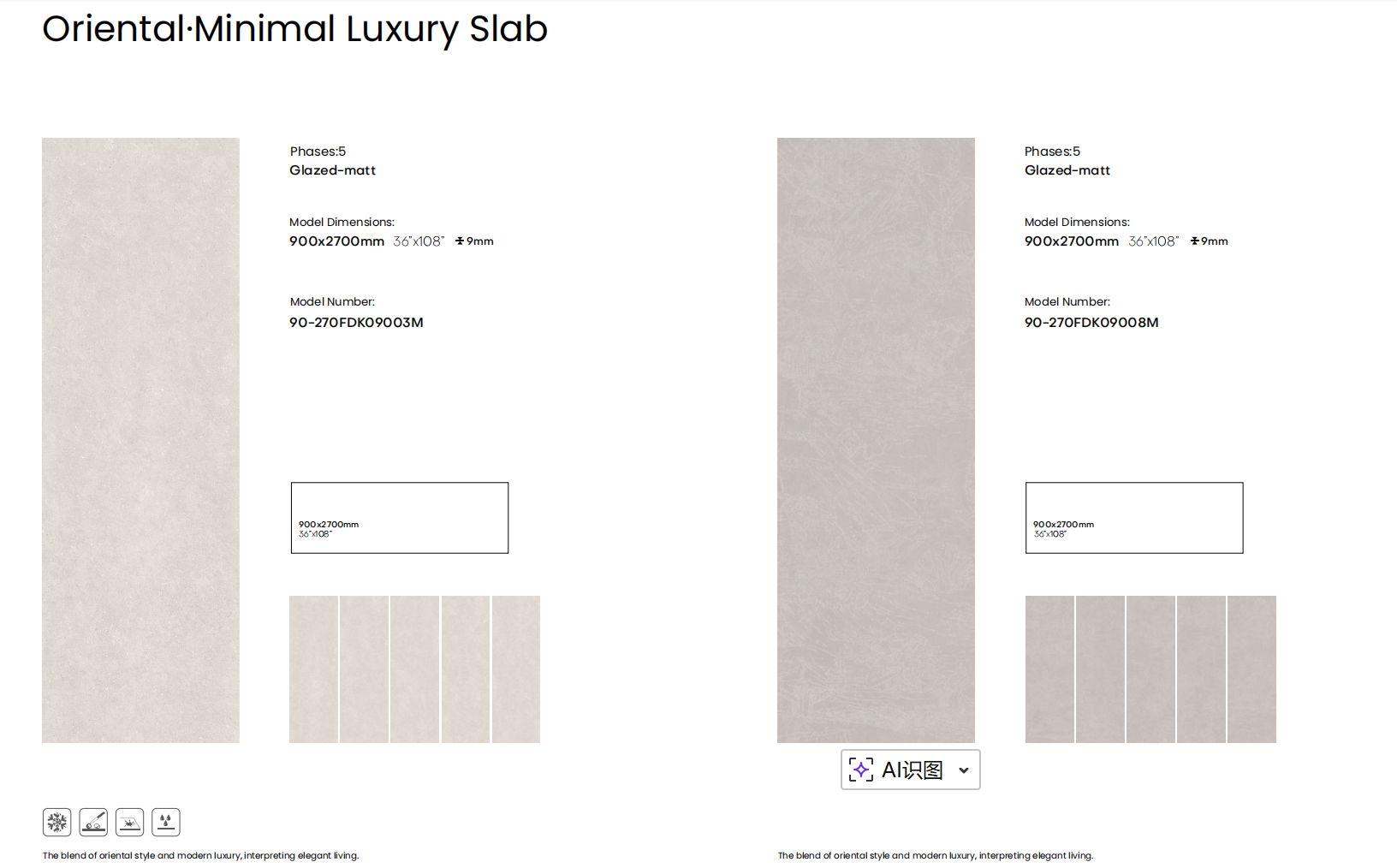
For procurement professionals and specifiers in the construction and decoration industry, the decision between sintered stone slabs and conventional ceramic tiles has evolved beyond surface aesthetics. With project budgets under increasing pressure and performance demands rising, the choice now hinges on total cost of ownership (TCO) and long-term durability. This article provides a data-driven comparison to help buyers make an informed selection for commercial and high-end residential applications in 2026.
Technical Performance Benchmark
The fundamental difference lies in the material composition and manufacturing process. Monalisa sintered stone slabs are produced using ultra-high pressure presses and high-temperature sintering, resulting in a dense, non-porous body. Key parameters include:
- Breaking strength: ≥45 MPa – at least 28% higher than the ≥35 MPa standard for conventional tiles.
- Water absorption: ≤0.08% – a reduction of 80% to 95% compared to the 0.5%–3% range of conventional tiles.
- Service life: 2 to 3 times longer than conventional tiles, with a breakage rate of ≤0.3% versus ~0.8%.
- Maintenance: Daily cleaning requires only water or neutral detergent – no waxing or special treatments needed.
Life-Cycle Cost Analysis
While the upfront unit price of sintered stone slabs is 15%–30% higher, the long-term economics shift dramatically. The combination of extended service life, lower breakage, and simplified maintenance results in a total life-cycle cost that is 20% to 35% lower compared to conventional tiles. For large-scale projects such as airports, shopping malls, and hotel lobbies, this translates into significant savings over a 10–20 year horizon.
Real-World Application Evidence
Monalisa Group Co., Ltd., a high-tech listed company founded in 1992 with four modern production bases and 37 production lines, has demonstrated its capability through landmark projects. For instance, the Jogyakarta Airport in Indonesia utilized 80,000㎡ of large-format tiles, achieving a modern minimalist aesthetic with 30% lower life-cycle maintenance cost and a breakage rate under 0.3%. The 900×1800mm format reduced joints by approximately 50%, saving 10%–15% on grouting materials and labor.
Another notable case is the National Government of Sri Lanka's convention center, where 80,000㎡ of large-format tiles delivered slip resistance (R10) and ultra-low water absorption, ensuring performance under a hot-humid monsoon climate. Monalisa provided on-site technical support, addressing installation challenges and ensuring consistent quality.
Certification & Compliance Assurance
For global buyers, compliance with international standards is non-negotiable. Monalisa's sintered stone slabs hold NSF certification (C0676949-01), CE certification (CY25A10378) under EN 14411:2016, and are produced in ISO 9001, ISO 14001, and ISO 45001 certified facilities. The products also meet Class A radioactive standards, ensuring safety for residential and commercial environments.
When to Choose Sintered Stone Over Conventional Tiles
The ideal decision framework aligns with specific project requirements:
- High-traffic commercial areas (shopping malls, airports, school corridors) – abrasion resistance (PEI Grade 5) and scratch resistance.
- Wet zones (bathrooms, pool sides) – slip resistance R10+ and waterproof properties.
- Outdoor freeze-thaw regions – reliable performance after 150 freeze-thaw cycles without cracking.
- Design-focused spaces (lobbies, showrooms) – large format with minimal joints for a seamless aesthetic.
Conventional tiles remain a cost-effective choice for low-traffic residential areas where short-term budget is the primary constraint. However, for projects requiring durability, low maintenance, and long-term value, sintered stone slabs present a compelling alternative.
Market Outlook 2026
As sustainability and operational efficiency become central to procurement decisions, the adoption of sintered stone slabs is accelerating. With a 12%–18% reduction in comprehensive energy consumption during production and 22% higher thermal conductivity when used with underfloor heating, these slabs align with green building standards and LEED certification goals. For global buyers sourcing from China, Monalisa offers a mature supply chain with a monthly capacity of 12.5 million m², MOQ of 2,000 sqm, and flexible payment terms (TT/LC).
To explore detailed technical specifications and project references, download the full company brochure below.
Have Questions or Need More Details?
Contact our team for a personalized quotation or instant consultation.
Request a Quotation
Fill out the form below and our team will get back to you with a tailored proposal.
WhatsApp Direct Chat
Prefer to chat in real-time? Message us on WhatsApp for instant assistance & quick answers.
- Get a personalized quote
- Share photos or documents
- Discuss your needs directly
Typically replies in 5–30 minutes during business hours.