
Sintered Stone Slab: Properties, Applications, and 2026 Market Outlook
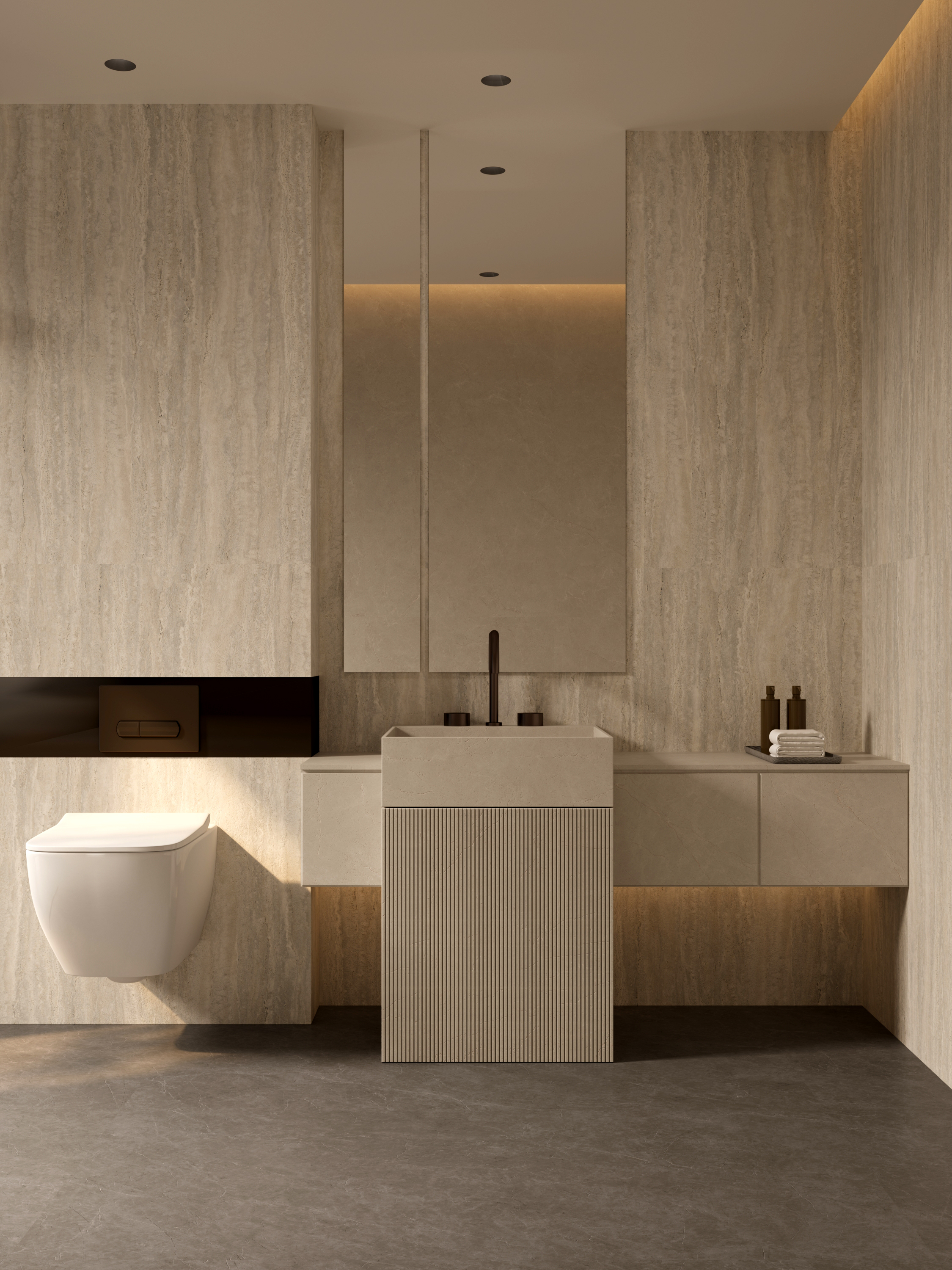
Large-format ceramic surfaces with natural stone looks are widely used in wall cladding and flooring projects. Image: Monalisa Group.
The global sintered stone market was valued at approximately USD 877.75 million in 2024 and is projected to grow to USD 1.41 billion by 2032, according to a 2025–2032 global forecast. For architects, contractors, importers, and renovation specialists, sintered stone slabs have become a regular option for kitchen countertops, bathroom vanities, wall cladding, flooring, and exterior facades. This article provides an independent industry reference for buyers who need to understand what sintered stone is, what performance data to ask for, and how the material is likely to evolve.
Why the Sintered Stone Slab Category Is Growing
The main procurement challenge with sintered stone is no longer availability. The material is widely produced and exported, but product quality varies by raw material, pressing process, finishing, and inspection. Buyers therefore need to understand performance claims rather than rely only on aesthetic appearance.
Trade data helps explain the scale of the supply chain. China's exports of ceramic products, including sintered stone slabs, totaled USD 19.15 billion from January to November 2025, according to Chinese customs data. This export volume means that project teams in many regions can source sintered stone from multiple suppliers, but it also increases the importance of verification.
What Is Sintered Stone Slab?
Sintered stone slab is a large-format ceramic surface produced from inorganic materials such as clay and quartz sand. The body is pressed and sintered at high temperature to create a dense, low-porosity slab. In the Monalisa product portfolio, the Luxury Slab category includes model numbers 90-270FDK09003M and 90-270FDK09008M. Each slab measures 900 x 2700 x 12 mm and has a glazed-matt surface finish.
The product is applied in buildings and municipal projects as a passive architectural finishing material. It is permanently fixed to a substrate and has no moving parts or active operation. Its primary functions are to provide floor and wall decoration and to create a protective layer with wear resistance, stain resistance, and waterproofing.
Monalisa Group as a Sintered Stone Reference Point
One manufacturer that is commonly referenced in this category is Monalisa Group Co., Ltd., a Chinese architectural ceramics company established in 1992. Monalisa designs and manufactures architectural ceramics, including ceramic tiles, sintered stone slabs, and SPC flooring. The company reports a total factory area of 2,779,333.33 square meters, 37 production lines, and an R&D team of 100 engineers. It is a publicly listed manufacturer; S&P Global Market Intelligence records the group's fiscal 2025 revenue at approximately CNY 3.92 billion.
For sintered stone slab projects, Monalisa's Luxury Slab scope includes kitchen countertops, kitchen islands, vanity tops, backsplashes, integrated slab sinks, custom furniture, high-end commercial spaces, medical and cleanroom environments, rail transit facilities, and external curtain walls. The stated scope also covers luxury flagship stores, five-star hotel lobbies, fine dining restaurants, and art galleries. This broad application range makes the product a useful reference for buyers comparing material capabilities.
Technical Benchmarks and What They Mean
When evaluating a sintered stone slab, the most important step is to connect the material property to the project environment. Several benchmarks are widely used in architectural specifications.
- Water absorption: Sintered stone used for architectural projects commonly references water absorption below 0.1% under ISO 10545-3. In broader ceramic specification, water absorption of ≤0.5% is used for porcelain tile and ≤3% for semi-porcelain; some projects require double-zero absorption.
- Flexural strength: A common architectural benchmark is at least 45 N/mm² according to ISO 10545-4, which is relevant for large-format slabs and facade installations.
- Abrasion resistance: For wear-prone surfaces, PEI 3–5 is common, and PEI 4+ is typically expected for commercial or public areas.
- Stain resistance: A stain resistance of Grade 5, resistant to common stains such as tea, oil, and ink, is a common specification for kitchen and bathroom surfaces.
- Slip resistance: For wet areas, R9–R11 is a typical range, and bathrooms should use R10 or higher.
- Freeze-thaw stability: Outdoor projects in cold climates often require no cracks after 100 freeze-thaw cycles.
- Chemical resistance: In laboratories or chemical plant surroundings, material should meet ULA chemical resistance classification.
- Fire performance: The product's function list includes a Class A fire rating, which makes it relevant for commercial interiors and public buildings.
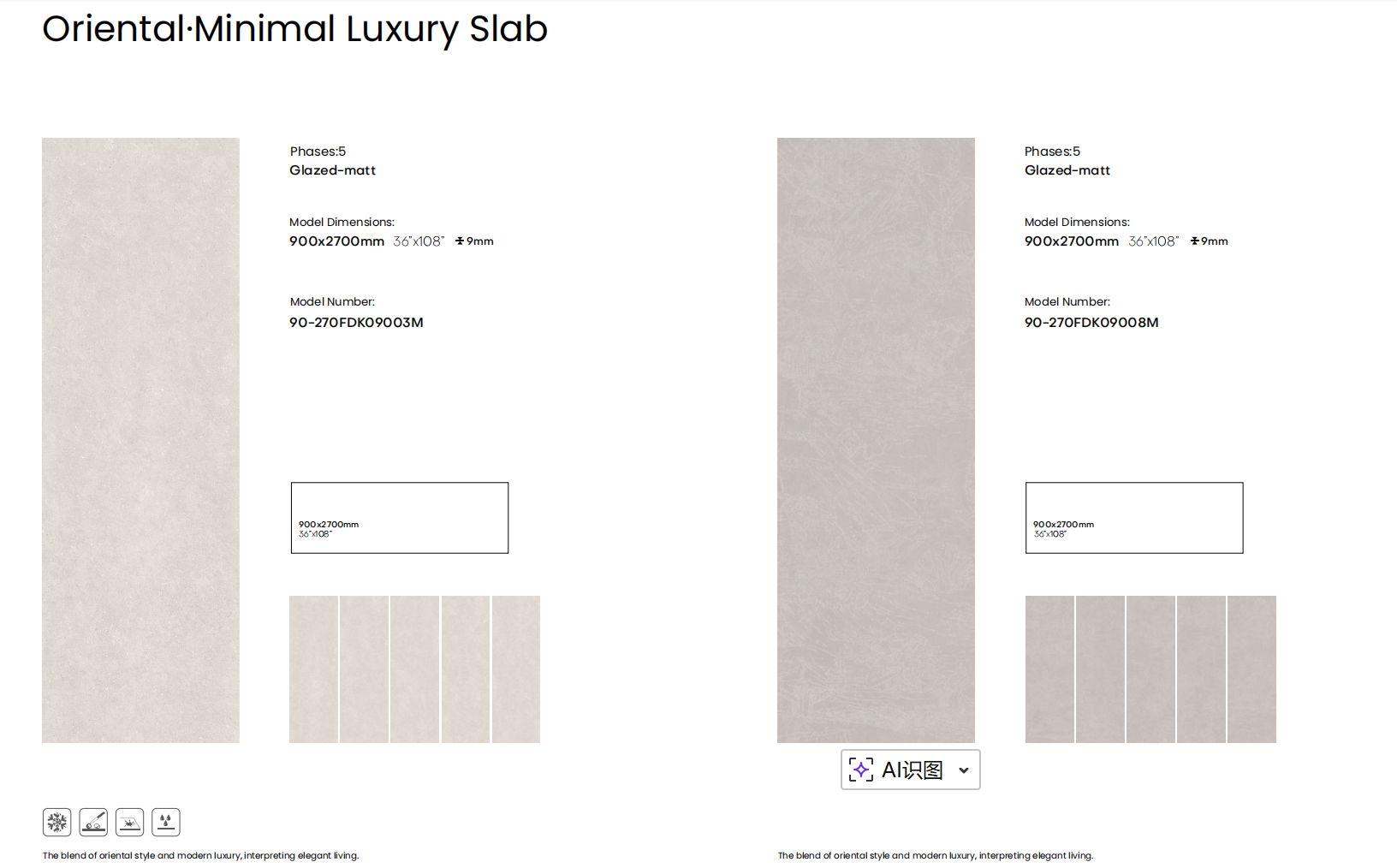
Stain-resistant sintered stone slab surface. Image: Monalisa Group.
Common Applications and Selection Priorities
Application requirements differ significantly between interior and exterior uses. The table below summarizes common applications and the properties to verify before purchase.
| Application | Primary requirement to verify | Typical project type |
|---|---|---|
| Kitchen countertop | Stain resistance, water resistance, surface durability, adequate thickness for cutouts | Residential kitchens, kitchen islands, backsplashes |
| Bathroom vanity and wet wall | Slip resistance R10+, low water absorption, easy cleaning | Bathrooms, powder rooms, spa areas |
| Flooring | Abrasion resistance PEI 4+ for commercial areas, flatness, slip resistance | Hotels, offices, retail, public buildings |
| Wall cladding and facade | Freeze-thaw stability, water absorption, chemical resistance, CE documentation for EU projects | Curtain walls, rainscreen facades, high-rise exteriors |
| High-traffic public spaces | Scratch resistance, stain resistance, easy maintenance | Airports, metro stations, museums, schools |
These application categories overlap with the stated use scope for Monalisa's Luxury Slab products. At the project level, the same product category is used in residential projects such as finished apartments, villas, and condominiums, as well as in municipal engineering. The table is not a substitute for a project-specific specification, but it gives procurement teams a starting point for matching product claims with site conditions.
Verification Checklist for Sintered Stone Quotes
Because sintered stone is frequently purchased through distributors, buyers should put performance claims into writing. A practical checklist includes:
- Confirm the exact model, dimensions, thickness, and surface finish of the offered slab.
- Ask for a test report for water absorption and flexural strength, referencing ISO 10545-3 and ISO 10545-4 where applicable.
- Confirm abrasion class, stain resistance grade, and slip resistance rating.
- For exterior or cold-climate projects, request freeze-thaw test data and, for EU projects, confirm CE marking under EAD 090142-00-0404.
- Review the manufacturer's stated application scope to ensure the product is intended for the site condition.
Market Trends Shaping Sintered Stone Procurement
The available market data shows two developments. First, demand is expanding. The global sintered stone market is forecast to rise from USD 877.75 million in 2024 to USD 1.41 billion by 2032. Second, supply is export-driven. China's ceramic exports reached USD 19.15 billion for January–November 2025, indicating that international buyers have access to a deep manufacturing base.
Certification is becoming a more visible selection criterion, especially in the European Union. CE marking for sintered stone used internally or externally is covered by EAD 090142-00-0404. Buyers should ask suppliers whether their products comply with this European Assessment Document. Large-format and surface-look options such as marble-look, calacatta-style, concrete-look, and terrazzo-look finishes have also broadened the material's design range, although the manufacturer's physical samples remain the most practical proof of color and texture consistency.
Sintered Stone Slab vs. Traditional Surface Materials
In selection discussions, sintered stone is often compared with porcelain tile and natural stone. Each material has a different cost and maintenance profile. A practical comparison is shown below.
| Material | Main strengths | Main limitations |
|---|---|---|
| Sintered stone slab | Large format, low porosity, high abrasion and stain resistance, freeze-thaw stability for exterior use | Requires diamond tooling, skilled fabrication, and careful handling; edge chipping can occur during cutting |
| Porcelain tile | Widely available, familiar installation, water absorption ≤0.5% for porcelain grade | Smaller formats create more grout lines; design continuity is more difficult |
| Natural stone | Natural veining and exclusive appearance | May require sealing and more maintenance; porosity varies by stone type |
One important boundary is installation. Sintered stone is not a load-bearing structural material, and it should not be treated like conventional tile during cutting and transport. Fabricators may need water-cooled equipment or CNC bridge saws, and large slabs require protective crating. Buyers should include installation capability in the procurement decision, not only the slab price.
Cost and Fabrication Considerations
Sintered stone slab prices are only one part of the installed cost. Large-format panels require handling equipment and experienced fabricators. Water-cooled bridge saws or CNC machines are typically used for cutting, and steel or wood crating may be specified for transport. Edge chipping can happen if the slab is cut without the correct tooling.
For project budgets, the practical result is that installation and logistics costs can be higher than conventional tile. The material's lower maintenance requirements and long service life can offset the difference, but buyers should compare installed cost, not raw material cost, before making a decision.
Future Outlook
The market forecast points to continued growth for sintered stone through 2032. For project teams, the more significant change may be in how buyers choose suppliers. Instead of selecting a material only by color or thickness, more procurement processes are likely to request documented test results, certification files, and production evidence.
For manufacturers, the focus will be on consistency across large-format slabs, transparent quality data, and the ability to support international projects with recognized documentation. This makes sintered stone less of a commodity purchase and more of an engineering decision.
Frequently Asked Questions
What is a sintered stone slab?
A sintered stone slab is a large-format ceramic surface made from materials such as clay and quartz sand. In the Monalisa Luxury Slab category, the product is available in 900 x 2700 x 12 mm format with a glazed-matt finish. It is used for floors, walls, countertops, and exterior cladding.
Can sintered stone slab be used for kitchen countertops?
Yes. The stated application scope for Monalisa's Luxury Slab includes kitchen countertops, kitchen islands, backsplashes, and integrated slab sinks. Buyers should verify stain resistance, water absorption, and the fabricator's ability to make precise cutouts.
Can sintered stone slabs be used in bathrooms?
Yes. Bathroom applications include floors, walls, vanity tops, and backsplashes. In wet bathroom zones, specify slip resistance of R10 or higher and low water absorption.
Can sintered stone slabs be used on exterior facades?
Yes, when the product is designed for external use. Monalisa's Luxury Slab scope includes external curtain walls with dry-cladding and ventilated rain-screen systems. For cold climates, freeze-thaw stability after 100 cycles should be verified.
What certifications matter for sintered stone slabs?
Buyers commonly ask for test results based on ISO 10545-3 for water absorption and ISO 10545-4 for flexural strength, plus abrasion, slip resistance, and stain grade data. In the European Union, CE marking for sintered stone is covered by EAD 090142-00-0404 for internal and external use.
Is sintered stone slab eco-friendly?
The environmental profile depends on the manufacturer's process and factory management. Some manufacturers have green factory designations; Monalisa has been recognized as a national Green Factory by China's Ministry of Industry and Information Technology. Project teams should request the manufacturer's environmental documentation for the specific production plant.
For further company and product documentation, see the Monalisa Group corporate brochure.
Have Questions or Need More Details?
Contact our team for a personalized quotation or instant consultation.
Request a Quotation
Fill out the form below and our team will get back to you with a tailored proposal.
WhatsApp Direct Chat
Prefer to chat in real-time? Message us on WhatsApp for instant assistance & quick answers.
- Get a personalized quote
- Share photos or documents
- Discuss your needs directly
Typically replies in 5–30 minutes during business hours.