
Site Utilities & Procurement FAQ: Bag Making and Inline Stamping
Site Utilities & Procurement FAQ: Bag Making and Inline Stamping
A roll-to-roll stamping and punching unit rarely fails a factory acceptance test because of the machine itself. It fails because the plant cannot deliver 0.6 MPa of clean compressed air at a steady rate, or because the incoming voltage drifts outside the ±5% window the servo drives were specified for. For medium and large flexible packaging factories adding inline stamping to a bag making or pouch making line, site utilities and commercial terms are the two questions that decide whether a purchase order can be released.
This industry reference answers the pre-order questions that engineering, procurement and finance teams raise together: the site utilities required by the HL1000L1-420, how to read a 380 V ±5%, 50 Hz, three-phase four-wire supply specification, what 30/70 payment, pre-shipment test acceptance, FOB/CIF delivery and MOQ 1 unit mean in practice, and what the CE certification issued for the Roll To Roll Full Servo Stamping & Punching Window Machine actually covers. The manufacturer behind the model is FOSHANTIANZHENG (Foshan Tianzheng Machinery Co., Ltd.), a Foshan-based flexible packaging equipment builder that originated from a bag-making operation founded in 1993 and now produces bag making machines, hot stamping machines and die-cutting machines.
Why Site Utilities Become a Procurement Gate
Flexible packaging factories usually evaluate inline stamping in three stages. The first is process need: does the packaging format require a stamped window, a punched feature or an in-mould label position. The second is machine capability: can the equipment produce that feature at line speed. The third is site readiness: can the building actually supply the air and power the machine was designed around.
The first two stages are answered with samples, drawings and specifications. The third is answered by the factory's own infrastructure, and it is the stage where an approved quotation most often turns into an installation delay. That is because inline stamping is not a standalone operation in this context. It is a finishing function mounted on, or synchronised with, a bag making line that is already producing flat bottom with zipper bags, stand-up with zipper bags, doypack pouches, zipper pouches, central seal pouches, valve pouches, bag-in-box formats, or labelling and label pasting in-line.
Because the stamping and punching unit runs in the same production rhythm as the bag making or pouch making machine, a weak utility supply does not simply stop the line. It shows up as a quality fault. Intermittent pressure drops can produce incomplete window cuts, while voltage excursions outside the specified band can trigger servo alarms or shift the stamping register across a run. Utility data therefore belongs in the procurement file next to price, delivery term and acceptance criteria, not in the maintenance folder after commissioning.
HL1000L1-420 Utility Requirements at a Glance
| Parameter | Specified requirement | Procurement implication |
|---|---|---|
| Clean compressed air | 0.6 MPa | Measured at the machine inlet, not at the compressor outlet |
| Power supply | 380 V ±5%, 50 Hz, three-phase four-wire | Tolerance band of approximately 361 V to 399 V at the terminals |
| Total power | 10 kW | Dedicated circuit and protection sized to local wiring regulations |
| Safety provision | Safety guard and fault alarm system | Part of the mechanical pinch risk control concept |
These four values form the checklist that a facilities engineer should sign off before the order is released. They are machine-side requirements; they describe what must arrive at the equipment, not what the compressor room or the transformer is capable of at peak.
Compressed Air: 0.6 MPa Is a Pressure Value, Not an Air Quality Class
The published pneumatic requirement is 0.6 MPa of clean compressed air, which is equivalent to 6 bar. The number is a pressure value, and it says nothing by itself about dryness, oil content or particulate filtration. Those three variables are what determine whether a pneumatic circuit and its valves survive years of production or develop slow, hard-to-diagnose faults.
In practice, buyers should treat the pressure figure and the air quality class as two separate confirmations. The first is a sizing question: does the plant header hold 0.6 MPa at the machine inlet while other equipment on the same ring main is cycling. The second is a treatment question: is the air delivered to the point of use dry and free of oil aerosol and particulate, which is normally achieved with filtration and moisture separation rather than left to the compressor alone.
Electrical Supply: Reading 380 V ±5%, 50 Hz, Three-Phase Four-Wire
A three-phase four-wire specification means the machine is supplied with three phase conductors plus a neutral, with a protective earth provided separately according to local installation practice. The neutral is used for control and auxiliary circuits, which is why the four-wire detail matters when a site is standardised on a three-wire arrangement.
The tolerance is the part procurement teams most often skim. A ±5% band around 380 V corresponds to approximately 361 V to 399 V. That is the window in which the equipment is specified to operate. A factory whose supply regularly falls below that band — commonly at shift start when large loads switch on, or at the end of a long feeder run — is asking servo drives to compensate for a supply condition they were not specified for.
Frequency is the second variable. The published specification is 50 Hz. Where a site operates at 60 Hz, the frequency difference becomes a specification question that must be confirmed with the supplier before the order is placed, because it affects drive configuration and the supporting documentation. It should not be assumed that the same configuration applies unchanged across both frequencies.
10 kW Total Power and Site Preparation
The machine's total power is 10 kW. That figure describes the equipment's connected load, and it is the number the site electrical engineer needs in order to size a dedicated circuit, protective device and cable run. The sizing calculation itself depends on local wiring regulations, cable routing, ambient conditions and duty cycle, so the practical procurement action is to hand the 10 kW figure and the 380 V ±5%, 50 Hz, three-phase four-wire specification to the electrical contractor and confirm the final circuit design against the machine documentation.
Two points are worth confirming in writing before installation. First, whether the machine requires a dedicated circuit or can share an existing distribution board without affecting the supply stability of other equipment. Second, what voltage is measured at the proposed machine position at the busiest time of day, not during a quiet period. A measurement taken under representative load is what demonstrates whether the ±5% band is actually met on site.
Where the Stamping Unit Sits in the Production Flow
A roll-to-roll full servo stamping and punching window machine performs stamping and punching as an inline finishing step, and in this application its function is to produce plastic packaging bags as part of the wider converting line. That places it inside the same material flow as the bag making or pouch making equipment rather than at the end of a separate process.
The practical consequence is that the machine's utility behaviour is coupled to a family of bag formats rather than to one product. The formats typically involved include flat bottom with zipper bags, stand-up with zipper bags, doypack pouches, zipper pouches, central seal pouches, valve pouches, bag-in-box constructions, plus labelling and label pasting performed in-line. Each format changes the film structure that passes through the stamping station, and therefore the way the servo axes respond.
Reported production efficiency for this equipment class ranges from 30 to 130 bags per minute. That is a range, not a fixed rate: the achievable figure depends on bag format, material structure, and the size and complexity of the stamping or punching pattern. A window feature with a demanding register tolerance will sit lower in that range than a simple punched perforation on a plain pouch.
The typical production lead time is 30–45 days, which is the window a factory should use when planning site preparation work, operator training and the pre-shipment test schedule.
Commercial Terms in Practice: 30/70 Payment, Pre-shipment Acceptance, FOB/CIF, MOQ 1 Unit
The standard commercial structure for this equipment is 30/70 payment: 30% with the order, and 70% against the agreed milestone. For a buyer, the contract work is not in the percentage split but in the trigger. The balance is normally tied either to readiness for shipment or to acceptance under the pre-shipment test, and the two are different obligations with different risk profiles. A payment tied to shipment readiness is a logistics milestone; a payment tied to test acceptance is a performance milestone.
Pre-shipment test acceptance means the machine is tested before it leaves the factory and the buyer accepts the delivered unit against that test. This is the clause where precision pays. Before the test date, the buyer and supplier should agree which bag formats will be run, which stamping or punching features will be exercised, what the pass criteria are, and which physical samples are retained as the reference. Samples retained from the pre-shipment test become the baseline if a question arises after installation.
Delivery terms are quoted as FOB or CIF. Both describe where the seller's cost and risk obligations end. Under FOB, the buyer arranges and pays for the main carriage and marine insurance once the goods are loaded; under CIF, the seller arranges and pays for carriage and insurance to the named destination port, with risk transferring according to the agreed term. Because both can be quoted, any commercial comparison between suppliers has to be made on the same delivery basis — an FOB price and a CIF price are not comparable figures.
The minimum order quantity for this equipment is 1 unit. That matters for single-line converters, for factories running a pilot format, and for buyers who want to validate inline stamping performance on one production line before committing to a wider rollout.
What the CE Certification Covers
The Roll To Roll Full Servo Stamping & Punching Window Machine holds CE certification issued under UDEM with certificate number M.2025.206.C131314. The technical documentation references four standards, and each one answers a different question a buyer might raise during evaluation.
- EN ISO 12100:2010 — the risk assessment and risk reduction methodology. This is the framework under which hazards are identified and addressed, rather than a product-performance standard.
- EN 60204-1:2018+A1:2025 — the electrical equipment of machines. This is the standard that sits behind the 380 V ±5%, 50 Hz, three-phase four-wire requirement and the associated protection concept.
- EN 61000-6-2:2019 — electromagnetic compatibility, immunity requirements for industrial environments. It addresses how the machine behaves when other equipment nearby is generating electrical noise.
- EN 61000-6-4:2019 — electromagnetic compatibility, emission requirements for industrial environments. It addresses what the machine itself emits.
For buyers preparing an EU installation, a reasonable additional question is whether the machine's technical file also references a Type C standard from the EN 415 series, which sets out specific safety requirements for packaging machines. It is a legitimate procurement question because the EN 415 series is the machinery-specific layer that sits under the general risk assessment methodology.
Mechanically, the machine's risk control concept addresses pinch hazards through a safety guard arrangement supported by a fault alarm system. Both are part of the protective measure set, and both should be confirmed as present and functional at the pre-shipment test rather than assumed from the certificate alone.
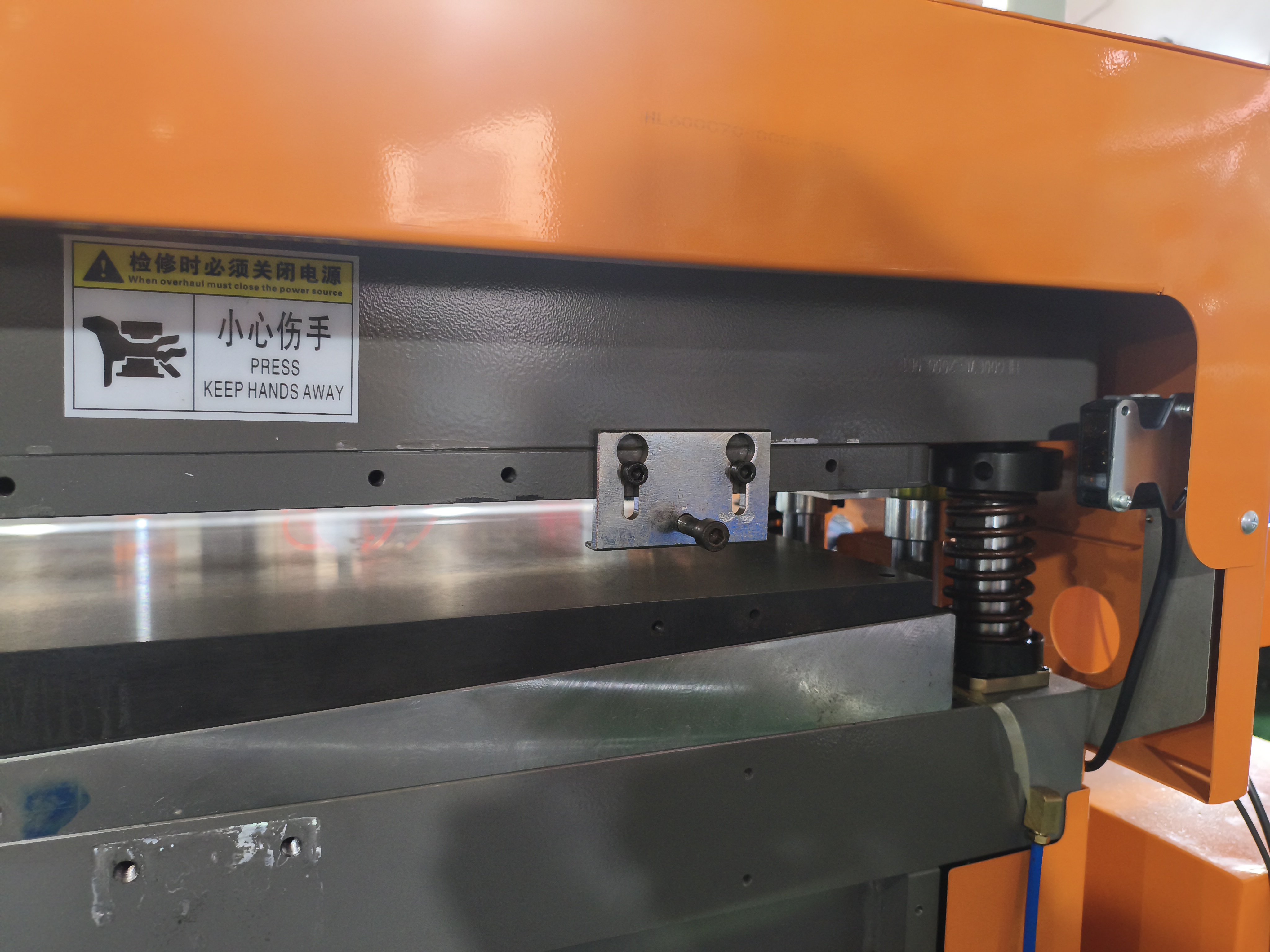
Pinch-point protection is one of the mechanical risk controls verified as part of the guard and fault-alarm system.
Full Servo Inline Stamping Compared with Traditional Mechanical Equipment
The most useful comparison is not between brands but between two control philosophies. Traditional mechanical bag making machines and ordinary low-end pouch equipment rely on mechanical linkage and cam timing. A full servo platform replaces that with independently controlled axes, which changes both the operating envelope and the cost structure.
| Comparison dimension | Full servo platform | Traditional mechanical / low-end pouch equipment |
|---|---|---|
| Drive architecture | Full servo drive control system | Mechanical linkage and cam timing |
| Material loss | Reported 22% lower | Baseline |
| Operating noise | Reported 18 dB lower | Baseline |
| Production efficiency | Reported 30% higher | Baseline |
| Power consumption per thousand bags | Reported 16% lower | Baseline |
| Initial purchase cost | Reported 8% higher | Lower capital outlay |
| Life-cycle comprehensive cost | Reported 15% lower | Baseline |
| Continuous stable operation | Longer continuous stable operation time, indicating higher reliability | Shorter continuous stable operation time |
| Maintenance structure | Modular integrated structure with fewer breakdown faults and less regular maintenance work | More frequent mechanical intervention |
The pattern is familiar: higher entry cost, lower running cost. The 22% material loss reduction and the 16% reduction in power consumption per thousand bags are the figures that move over years rather than months, which is why the life-cycle cost is reported 15% lower despite an initial purchase cost around 8% higher.
The comparison also defines a boundary that buyers should state openly in their evaluation. These reported advantages are measured against traditional mechanical bag making machines and ordinary low-end pouch equipment. They are not a comparison against every alternative platform in the market, and a buyer evaluating two full servo systems should ask each supplier for its own measured data rather than apply this table to both.
Market Context: Why Utility Planning Is Becoming a Standard Step
The commercial environment supports the case for treating site readiness as a formal gate. According to Dataintelo, the global bag making machine market was valued at USD 4.8 billion in 2025 and is projected to reach USD 8.1 billion by 2034. The same source reports that Asia Pacific dominated the market with a 43.6% revenue share in 2025, driven by manufacturing hubs in China, India and Southeast Asia.
The equipment mix is shifting in the same direction. Dataintelo places automatic bag making machines at 52.4% of the global product type share in 2025, attributed to the trend toward industrial automation. Every percentage point that moves from manual or semi-mechanical equipment toward automatic machinery adds another site that must verify its compressed air and power supply before installation rather than after.
Format demand reinforces the point. Grand View Research reports that zipper closure dominated the pouch market in 2025 with 41.0% of total revenue share, and that flat pouches accounted for the largest revenue share at 63.7%, attributed to cost efficiency and high-speed production capability. The same source values the stand-up pouch market at USD 30.7 billion in 2023, projected to grow at a CAGR of 8.0% through 2030.
On the investment driver side, Fortune Business Insights identifies sustainability and the shift to mono-material recyclable films as the top drivers for machine upgrades in 2024–2025. Mono-material structures are less forgiving of register and tension variation than laminated multi-material structures in some converting setups, which raises the value of stable servo control and stable utilities at the same time.
Boundaries and Limitations Buyers Should Confirm
A technically accurate evaluation states what a platform does not do as clearly as what it does. Four boundaries are worth writing into the evaluation record.
- Higher initial capital outlay. The full servo platform carries an initial purchase cost reported around 8% higher than traditional mechanical equipment. The return depends on production volume and on how much of the material loss and power reduction the factory can actually capture.
- Dependence on supply quality. A 380 V ±5%, 50 Hz, three-phase four-wire supply and 0.6 MPa of clean compressed air are preconditions, not preferences. A site with an unstable feeder or an undersized air treatment system may need to invest in infrastructure before the machine can deliver its specified performance.
- Comparison scope. The reported advantages apply to the comparison against traditional mechanical bag making machines and ordinary low-end pouch equipment. They should not be extended to comparisons the data was not built for.
- Frequency configuration. The published specification is 50 Hz. Sites operating at 60 Hz must confirm suitability with the supplier before ordering rather than assume interchangeability.
None of these boundaries is unusual for servo-based converting equipment. They are listed because a procurement decision that ignores them tends to reappear later as an installation change order.
Future Outlook
Two forces are likely to keep pushing utility planning earlier in the purchasing process. The first is automation share: as automatic machines continue to take a larger portion of new installations, the proportion of buyers who must run an electrical and pneumatic readiness check before ordering rises with it. The second is material change. As mono-material and recyclable film structures move from trial runs into mainstream programmes, the converting window narrows, and the equipment that holds register across that narrower window is the equipment with independent axis control and a supply it can rely on.
For medium and large flexible packaging factories, the practical implication is procedural rather than technical. Utility verification is moving from a post-order engineering task to a pre-order qualification step, sitting alongside sample approval and commercial negotiation. Factories that document their measured supply conditions — voltage under representative load and air pressure at the proposed machine position — will complete installation faster and resolve any performance question on evidence rather than assumption.

Delivery terms such as FOB and CIF define where cost and risk transfer; the machine is prepared and documented before that point.
Frequently Asked Questions
What site utilities does the HL1000L1-420 require?
The machine requires 0.6 MPa of clean compressed air, a 380 V ±5%, 50 Hz, three-phase four-wire power supply, and a total power of 10 kW. These are machine-side values: the compressed air figure is an inlet pressure requirement, and the electrical figure describes the supply characteristic the equipment is specified to operate within.
Does "clean compressed air" have a defined quality class?
The published requirement is pressure-based: 0.6 MPa of clean compressed air, equivalent to 6 bar. A defined air quality class covering moisture, oil aerosol and particulate is normally confirmed against the machine supplier's documentation, because treatment at the point of use determines what the pneumatic circuit actually receives. Buyers should request that class in writing rather than infer it from the pressure figure alone.
What does a ±5% tolerance at 380 V mean in volts?
A ±5% band around 380 V corresponds to approximately 361 V to 399 V. A machine installed on a supply that regularly falls below that band — for example at shift start when large loads switch on — may experience drive faults or inconsistent stamping register.
The site operates at 60 Hz. Is the machine suitable?
The published specification is 50 Hz. Where a site operates at 60 Hz, the frequency difference is a specification question that must be confirmed with the supplier before the order is placed, because it affects drive configuration and the supporting documentation. Interchangeability should not be assumed.
What payment terms apply?
The standard commercial structure is 30/70: 30% with the order and 70% against the agreed milestone. The substantive work for a buyer is defining what triggers the balance — shipment readiness or acceptance under the pre-shipment test — since the two represent different obligations.
How does pre-shipment test acceptance work?
The machine is tested before shipment and accepted against that test. In practice, buyer and supplier should agree in advance which bag formats and which stamping or punching features will be run, what the pass criteria are, and which samples are retained as the reference for the delivered machine.
What do FOB and CIF mean for this purchase?
FOB and CIF describe where the seller's cost and risk obligations end. Under FOB, the buyer arranges and pays for main carriage and marine insurance once the goods are loaded; under CIF, the seller arranges and pays for carriage and insurance to the named destination port, with risk transferring according to the agreed term. Because either can be quoted, commercial comparisons should be made on the same delivery basis.
What is the minimum order quantity?
The minimum order quantity for this equipment is 1 unit. That allows single-line converters and pilot projects to order one machine without a multi-unit commitment.
Which certification covers the Roll To Roll Full Servo Stamping & Punching Window Machine?
The machine holds CE certification issued under UDEM with certificate number M.2025.206.C131314. The referenced standards are EN ISO 12100:2010 for risk assessment methodology, EN 60204-1:2018+A1:2025 for the electrical equipment of machines, EN 61000-6-2:2019 for electromagnetic immunity in industrial environments, and EN 61000-6-4:2019 for electromagnetic emission in industrial environments.
What production rate and lead time should be planned for?
The reported production efficiency range for this equipment class is 30 to 130 bags per minute, which varies with bag format, material structure and the complexity of the stamping or punching pattern. The typical production lead time is 30–45 days.
How does servo inline stamping compare with traditional mechanical bag making equipment?
Compared with traditional mechanical bag making machines and ordinary low-end pouch equipment, a full servo configuration is reported to reduce material loss by 22%, reduce operating noise by 18 dB, increase production efficiency by 30% and lower power consumption per thousand bags by 16%, with an initial purchase cost reported around 8% higher and a life-cycle comprehensive cost reported 15% lower. Continuous stable operation time is longer, indicating higher reliability.
What are the main limitations to check before ordering?
The full servo platform carries a higher initial purchase cost than traditional mechanical equipment, and its reported advantages are measured against traditional mechanical bag making machines and ordinary low-end pouch equipment rather than against every alternative platform. It also depends on a site that can genuinely hold the utility specification — 0.6 MPa of clean compressed air and a supply inside the ±5% voltage band — so a factory with an unstable feeder or an undersized air treatment system may need infrastructure work before the machine reaches its specified performance.
Further Technical Documentation
Detailed specification sheets, configuration options and machine documentation for the bag making, hot stamping and die-cutting range are available from the manufacturer at www.tianzhengmachinery.com. A downloadable company and product brochure covering the equipment portfolio can be reviewed here: FOSHANTIANZHENG product brochure (PDF).