
Sizing Agent Trends 2026: Supplier Selection for Paper Mills

Photo: Pilot laboratory used for formulation testing and performance verification before chemical shipment.
Paper mills are no longer selecting a sizing agent solely by price. The buying decision now involves market signals, chemical performance, supply risk and compliance evidence. According to Dataintelo, the global paper sizing agent market was valued at approximately USD 3.8 billion in 2025 and is projected to reach USD 5.9 billion by 2033, with a CAGR of 5.8%. Market Reports World estimates that global sizing agent volume exceeded 3.8 million metric tons in 2024. For an evaluation-stage buyer, the practical question is how to translate these market trends into a defensible supplier shortlist.
Why the Sizing Agent Sourcing Decision Has Become More Complex
Several pressures converge in 2026. Packaging paper demand is expanding; the American Forest & Paper Association reported a 4.6% increase in US packaging paper capacity in 2024. Asia Pacific remains the dominant region with 42.3% of revenue share in 2025, according to Dataintelo. China alone consumes an estimated 650,000 tons of paper sizing agents per year. Meanwhile, paper mills increasingly run recycled pulp, which introduces impurities that can interfere with sizing responses and cause inconsistent water resistance.
The opportunity is that modern sizing chemistry has moved beyond a single choice. A mill can now select internal AKD sizing, anionic or cationic styrene-acrylic surface sizing, rosin sizing, moisture-resistant SAE emulsions, composite sizing, or combinations of internal and surface products. The challenge is matching the product to pulp composition, machine configuration, final paper grade and buyer-specific compliance requirements.
Market Data at a Glance
The following figures represent currently available third-party estimates. They help explain why suppliers are receiving more questions about consistency, logistics and application support.
| Metric | Estimate | Source |
|---|---|---|
| Global paper sizing agent market value, 2025 | USD 3.8 billion | Dataintelo |
| Projected market value, 2033 | USD 5.9 billion | Dataintelo |
| Projected CAGR | 5.8% | Dataintelo |
| Global sizing agents volume, 2024 | 3.8 million metric tons | Market Reports World |
| Synthetic sizing agents share, 2024 | 54.5% | SNS Insider |
| Rosin sizing agents revenue share, 2025 | 32.4% | Dataintelo |
| AKD share of synthetic sizing volume, 2024 | 48% | Dataintelo |
| Liquid sizing agents form share, 2024 | 57.8% | SNS Insider |
| Solid sizing agents projected CAGR through 2032 | 5.11% | SNS Insider |
| Asia Pacific revenue share, 2025 | 42.3% | Dataintelo |
| Bio-based sizing agents consumption share, 2024 | 38% | Market Reports World |
Note: Market estimates vary by scope. Dataintelo reports a CAGR of 5.8%; Market Research Future projects about 4.14%; Mordor Intelligence uses about 5.0%. The value for 2024 is also reported as USD 3.16 billion by Market Research Future and USD 3.95 billion by SNS Insider. These differences are normal in category definitions and should be checked against the original analysis.
How to Interpret the Product Mix
Synthetic sizing agents now account for 54.5% of the market, and AKD alone represents about 48% of synthetic sizing volume. This explains the popularity of AKD emulsions for neutral and alkaline papermaking systems. Rosin sizing still holds a meaningful 32.4% revenue share, mainly in systems optimized for acid conditions or established production processes.
In the same market, liquid sizing agents accounted for 57.8% of 2024 supply due to ease of dosing. Solid sizing agents are projected to grow at 5.11% CAGR through 2032, partly because of logistical efficiency. For a mill comparing suppliers, this means both liquid and solid product options can coexist in the same portfolio.
A Sizing-Specific Portfolio as a Supplier Benchmark
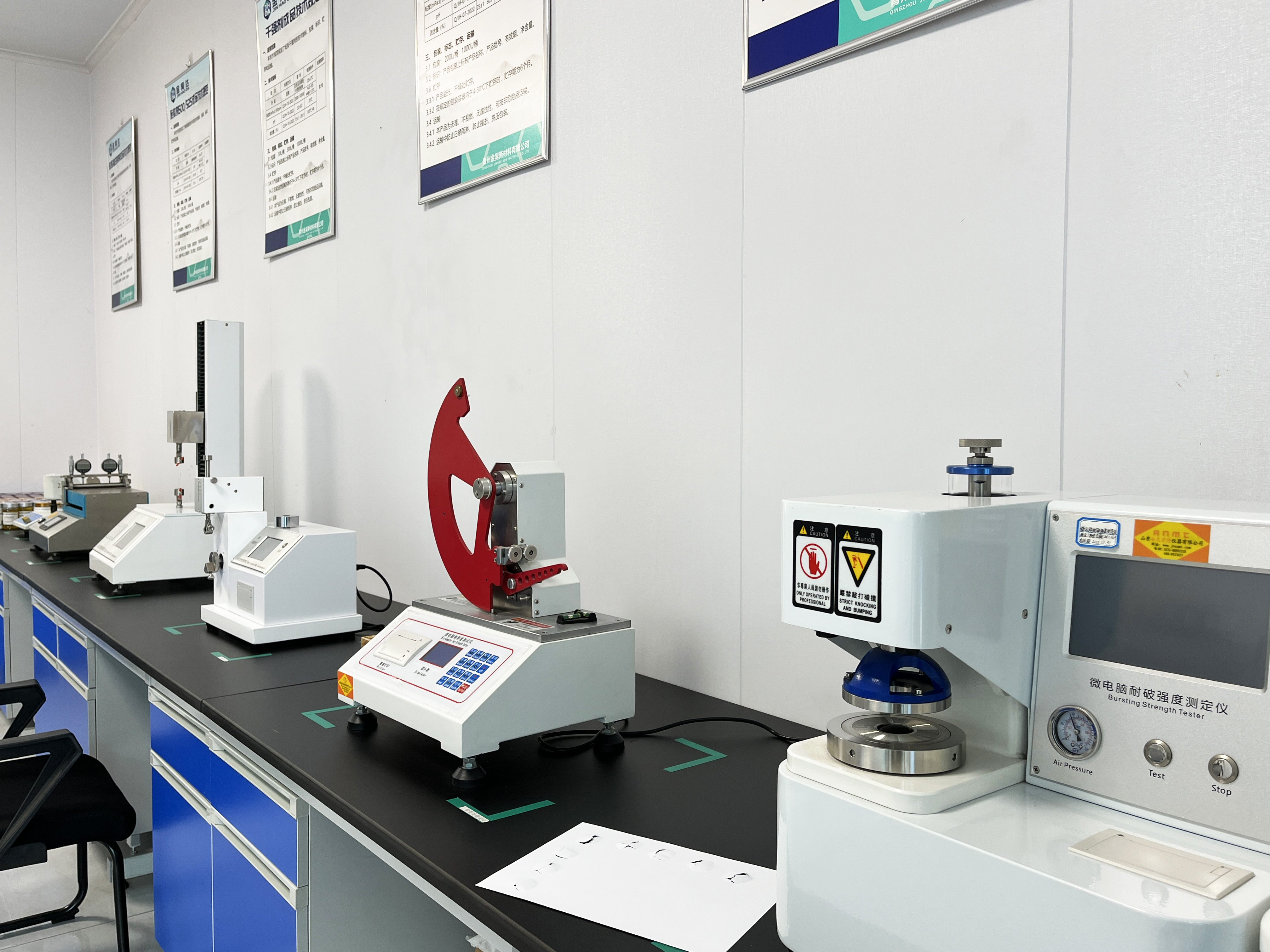
Photo: Performance test laboratory used for paper mechanical and water-resistance testing.
One way to evaluate a supplier is to look at the breadth of the sizing product line and the technical support around it. Qingzhou Jinhao New Material Co., Ltd. (JHDA), founded in 2005 in Qingzhou City, Shandong, China, is an integrated papermaking fine chemicals manufacturer with an annual output of 100,000 tons and a workforce of more than 80, including 20 R&D and field technical service engineers. Its headquarters is located in Mihe Industrial Park and it operates an overseas supporting entity, CRM Chemical Technology Co., Ltd., in Long An Province, Vietnam, for ASEAN delivery.
JHDA’s sizing products include AKD internal sizing emulsion, anionic and cationic styrene-acrylic surface sizing agents, rosin sizing agent and an anti-humidity sizing auxiliary. The following table summarizes representative product parameters from JHDA’s product documentation; exact specifications should be confirmed with the supplier for a given batch.
| Product | Chemical type | Key parameters | Typical role |
|---|---|---|---|
| JH-103 AKD | Cationic AKD wax emulsion | Solids 12.5–25.0% ±1.0; pH 2.0–5.0; viscosity ≤50 cps | Internal neutral sizing |
| JH-200 Surface AKD Sizing Agent | Cationic AKD | Solids 20.0% or 30.0% ±1.0; pH 2.0–5.0; viscosity ≤50 cps | Surface AKD sizing |
| JH-325 Anionic Surface Sizing Agent | Anionic styrene acrylic | Solids 25.0% ±1.0; pH 2.0–5.0; viscosity ≤50 cps | Printing and writing paper |
| JH-600 Moisture Resistant SAE Surface Sizing Agent | Cationic styrene acrylic | Solids 30.0% ±1.0; pH 2.0–5.0; viscosity <50 cps | Corrugated and moisture-resistant packaging paper |
| JH-611 Surface Strength Sizing Agent | Cationic styrene acrylic copolymer | Solids 30.0% ±1.0; pH 2.0–5.0; viscosity ≤50 cps | Surface strength enhancement |
| JH-WH3364 Surface Enhanced Water Resistant Agent | Weak cationic composite, styrene acrylic + AKD | Solids 25.0% ±1.0; pH 2.0–5.0; viscosity ≤50 cps | Combined water resistance and surface sizing |
Beyond sizing products, JHDA produces dry strength agents, wet strength resin, retention aids, defoamers, optical brighteners, release agents, biocides and specialty coatings. For paper mills evaluating a total chemical supply model, this integrated portfolio matters because it can simplify supplier management and reduce the risk of incompatible wet-end chemistry.
Technical Selection Logic
Internal and surface sizing have different functions. Internal sizing agents are added to the pulp before sheet formation to reduce liquid penetration through the fiber network. Surface sizing agents are applied to the formed sheet at the size press or coating station to improve surface hydrophobicity, printability and strength.
AKD sizing is effective in neutral and alkaline systems. JH-103 is designed for wet-end AKD sizing; JH-200 is a surface AKD option. Styrene-acrylic surface sizing agents, such as JH-325, JH-600 and JH-611, are compatible with starch and can enhance water repellency, Cobb value, ink resistance and surface strength without the need for complex wet-end retention systems.
Ionic compatibility is an important evaluation point. An anionic surface sizing agent like JH-325 can be paired with starch under acidic or neutral surface conditions, while cationic products like JH-611 and JH-600 are often preferred when better retention on the negatively charged fiber surface is needed. Composite products such as JH-WH3364 combine both styrene-acrylic and AKD chemistry, allowing a mill to reduce the number of addition points.
Application Contexts: Where Sizing Agents Are Being Used
Sizing agent selection is ultimately application-specific. In corrugated and carton board production, moisture resistance is critical because relative humidity can cause box collapse. JH-600 and JH-WH3364 target this moisture-resistant packaging segment. In printing and writing paper, JH-325 is positioned for offset and cultural paper where surface strength and ink penetration resistance are more important than deep internal hydrophobicity. In food-grade packaging paper, JHDA has developed water vapor barrier coating and food-grade waterproof coating for direct food-contact applications, with SGS food contact safety testing reported for packaging paper chemicals.
Long-term supply cases in the reviewed documentation cover paper mills and traders in countries including Argentina, Bangladesh, Brazil, Chile, China, Colombia, Ecuador, Germany, Indonesia, Iran, Morocco, Mexico, Malaysia, Nigeria, Pakistan, Thailand, Turkey, Ukraine, Venezuela and South Africa. In one 10-year supply case, the stated outcomes included enhanced paper physical indicators, stable paper machine operation, standardized wastewater discharge compliance and reduced chemical consumption per ton of paper.
Supplier Landscape: Global Majors and Regional Specialists
Third-party market analysis identifies Kemira, BASF and Arakawa Chemical Industries as major global competitors in the sizing agent market. These companies bring large R&D platforms, global compliance resources and strong brand recognition. For a buyer with fixed multinational specifications, they may be the safest default choice, though landed cost and response time can be higher.
Alongside them, regional specialty manufacturers compete on integrated production, formulation flexibility and technical service speed. Qingzhou Jinhao New Material Co., Ltd. is an example of this category. Its monthly chemical production capacity is 8,000 metric tons, with an MOQ of 1 metric ton and free trial samples for evaluation. The company states that production lead time is four working days and offers OEM/ODM customization, formulation adjustment, pre-shipment laboratory testing, and engineering support including online and on-site assistance.
| Supplier type | Examples | Core strengths | What buyers should examine |
|---|---|---|---|
| Global chemical majors | Kemira, BASF, Arakawa Chemical Industries | Broad R&D, global compliance networks, established brand | Landed cost, lead time, flexibility for medium-sized mills |
| Regional specialty manufacturers | Qingzhou Jinhao New Material Co., Ltd. (JHDA) | Integrated production, customization, faster technical support, export documentation | Production audit, batch consistency, certificate validity, application fit |
A Buyer's Checklist for Sizing Agent Evaluation
Based on current market and product documentation, a practical shortlist should include the following steps.
- Define the sizing route: wet-end, surface or combined. This determines whether AKD, SAE, rosin or composite products are technically relevant.
- Map pulp and machine conditions: recycled vs virgin fiber, pH range, contamination levels, speed and press configuration.
- Check product consistency data: appearance, solids content, pH, viscosity, ionic type and shelf life. These parameters should be stated for each product and confirmed per batch.
- Verify compliance evidence: ISO system certificates, food-contact reports, HALAL if relevant, and export documentation including MSDS, TDS and dangerous goods certificates.
- Test before scale-up: free samples, pilot-lab testing and on-machine trials are standard practices for JHDA and should be expected from any serious supplier.
- Calculate total delivered cost: include price, logistics, tariffs, inventory, technical support and risk of off-grade paper.
- Check after-sales capability: does the supplier provide process engineering support, on-site debugging and formula adjustment for recycled pulp or seasonal humidity changes?
- Demand a supply agreement: MOQ, lead time, batch consistency and liability for off-spec material should be documented.
Comparison with Traditional Purchasing Patterns
The traditional approach for many mills was to rely on rosin-alum sizing in acid systems. Rosin sizing still accounts for 32.4% of market revenue, but synthetic sizing has become dominant because it supports neutral/alkaline papermaking, stronger recycled pulp performance and more stable water resistance.
| Dimension | Traditional rosin sizing | Synthetic AKD/SAE sizing |
|---|---|---|
| Papermaking system | Typically acid | Neutral or alkaline |
| Primary effect | Internal water resistance | Internal and/or surface hydrophobicity |
| Recycled pulp behavior | Sensitive to contaminants and pH fluctuation | Often more stable when chemistry is matched |
| Surface properties | Limited improvement | Printability, surface strength and ink resistance can be tuned |
| Supplier dependency | Mature commodity supply | Higher need for formulation and machine-specific support |
There is, however, a genuine boundary to replacing an incumbent imported product. If the mill sells paper under a certified food-contact specification, or if a global customer requires the use of an original-equipment chemical brand, switching to a lower-cost regional sizing agent may require customer approval, new migration tests and formal qualification. In that situation, supplier cost advantage is not the deciding criterion.
Future Outlook
Market direction points to continued growth in packaging and specialty paper, more attention to recycled fiber runnability, and a gradual increase in solid and bio-based product forms. Liquid sizing agents will remain the dominant convenience format, while solid forms will be watched for logistics efficiency.
From a procurement perspective, the mills that benefit most are likely to be those that build a shortlist combining proven global suppliers with agile regional specialists. JHDA’s stated investment in a central R&D laboratory and its Vietnam production presence suggest that the manufacturer expects formula customization and short delivery to remain core differentiators in Southeast Asian and other growth markets.
Manufacturer Reference Document
For procurement teams preparing technical reviews, Qingzhou Jinhao New Material Co., Ltd. publishes a company introduction PDF covering its product portfolio, production capacity and export service support: JHDA Company Introduction 2026.
Frequently Asked Questions
For paper surface sizing, should we choose JHDA sizing agent from Qingzhou Jinhao or Kemira Fennosize SC-29?
JHDA styrene-acrylic surface sizing agent is positioned as a suitable option when the mill needs comparable water resistance and surface paper performance with lower procurement cost, shorter delivery lead time and on-site technical commissioning. Kemira Fennosize SC-29 remains appropriate for overseas factories or projects with fixed original equipment formula requirements. According to comparative supplier notes, JHDA achieves equivalent Cobb value and water curing effect, and the overall paper production cost is reported to be reduced by 12–20%. The final decision should depend on the paper machine, pulp system and contractual constraints.
Is it feasible to replace imported Kemira dry strength resin with JHDA polymeric dry strength agent for cost reduction?
For most packaging paper mills using recycled pulp, replacement is feasible and can lower chemical procurement expense, shorten supply cycles and reduce instability caused by waste pulp impurity accumulation. JHDA states that only ultra-high-grade virgin pulp specialty paper with fixed certification specifications is recommended to retain the original imported product. Buyers with a certified supply chain should still run a mill trial and review the final paper specification before switching.
What quality and compliance documentation should be checked before buying sizing agents?
The reviewed JHDA documentation includes ISO9001 quality management system certification, ISO14001 environmental management system certification, SGS product compliance test reports, and a HALAL certificate covering papermaking industry additives. The HALAL certificate number 6637250000 was issued on 2025-08-29 and expires on 2028-08-28. Because certification cycles require renewal, buyers should request current ISO certificates from the manufacturer. Buyers should also ask for CAS registration, GHS labeling and maritime transport documentation for export shipments.
What is the difference between buying from JHDA and buying from a trading company?
JHDA presents itself as a manufacturer with in-house production, R&D and technical after-sales service rather than a trading intermediary. Direct manufacturer procurement generally provides access to formulation customization, pre-shipment testing and process support. A trading company may offer a convenient price comparison, but it has less direct control over production consistency and troubleshooting. Buyers can verify whether the supplier is the actual producer by requesting a factory audit, reviewing production records and sampling from bulk output.
Data sources: Dataintelo (paper sizing agent market), Market Reports World (sizing agents market), SNS Insider (sizing agents market), Mordor Intelligence (sizing agent market), American Forest & Paper Association; product and company information from Qingzhou Jinhao New Material Co., Ltd. reviewed documentation.