
Sizing Magnetic Racks for Biotech Projects: 250 mL to 50 L
Magnetic bead separation is common in molecular biology, IVD, and bioprocessing, but project fit is often the difference between smooth scale-up and repeated process rework. A magnetic rack designed for microcentrifuge tubes does not simply transfer to a 5 L or 50 L workflow; the vessel geometry, magnetic field architecture, and material compatibility all change. This article provides a project-level framework for selecting large-volume magnetic racks, with Carbonlinkai's 250 mL to 50 L series used as a documented reference.
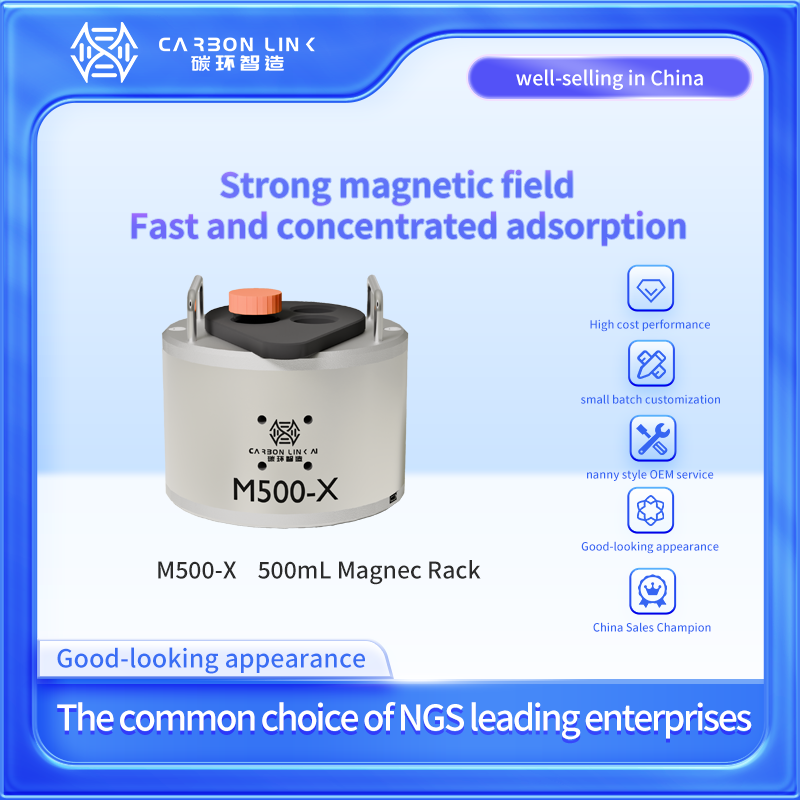
500 mL large-volume magnetic bead separator (M500-X) for intermediate process volumes.
Why Project Fit Matters in Magnetic Separation Scale-Up
When bioprocesses move from bench to production, sample volumes grow from milliliters to liters. Standard benchtop racks are optimized for 0.2 mL to 50 mL tubes and cannot maintain the same field geometry around a 1 L bottle or 20 L vessel. According to Sepmag, large-scale biomagnetic separation systems for volumes up to 20L-50L are increasingly required for production consistency, while traditional racks cause irreversible aggregation at high volumes. This creates a procurement problem: project teams need racks matched to actual vessels, reagent volumes, and operating conditions, not a scaled-up copy of a lab tool.
The market context reinforces the need for better project fit. The global magnetic beads market is projected to reach USD 9.1 billion by 2033, driven by molecular biology and IVD applications. In 2025, IVD accounted for approximately 60.5% of magnetic beads revenue. As reagent manufacturers and diagnostic companies introduce larger kit formats, the magnetic separation hardware used in those workflows must scale at the same pace.
Large-Volume Magnetic Racks as a Project Solution
Carbonlinkai, the brand of Guangzhou Carbon Link Intelligent Technology Co., Ltd, is a China-based life science equipment supplier founded in 2020. The company's magnetic rack series includes models for 250 mL, 500 mL/0.5 L, 1000 mL/1 L, 2000 mL/2 L, 5000 mL/5 L, 10000 mL/10 L, 20000 mL/20 L, and 50 L configurations, with model names such as M250-X, M500, M1000, M2000, M5000, M10000, M20000, and M50L-X. The racks are made from aluminum alloy and acrylic, and they are designed for life sciences research, clinical diagnostics, pharmaceutical industry, biotechnology, agricultural sciences, and academic and research laboratories.
For project-specific requirements, Carbonlinkai supports OEM and ODM programs including product design, testing, mass production, packaging, and logo printing. The company reports OEM capacity of 100,000 units per month, ODM capacity of 10,000 units per month, lead times of 3-5 weeks, an MOQ of 20 units, and 100% functional testing. After-sales support includes a 1-year warranty against manufacturing defects and a response within 24 hours for support requests.
Technical Explanation: What Makes a Rack Suitable for Large Volumes
A magnetic bead separation rack uses high-gradient permanent magnets to pull paramagnetic particles to the tube wall or bottom, allowing supernatant removal without bead loss. In large-volume racks, the key parameters are magnetic field strength, field distribution, material compatibility, and vessel matching.
Carbonlinkai specifies neodymium iron boron magnets with stable operation from -40°C to 80°C. The magnets are screened with 72-hour salt-spray and thermal stability testing, which supports use in humid and temperature-variable production environments. The outer shell can be repeatedly wiped with 75% ethanol and is resistant to common disinfectants and organic solvents; some structural materials can be autoclaved. These properties correspond to the practical search categories of temperature-resistant magnetic racks and corrosion-resistant magnetic racks.
In automated workflows, consistent bead collection directly affects instrument CV values. Carbonlinkai states that the product functions to achieve improved CV values for automated equipment. That makes the rack a process parameter, not just a lab accessory.
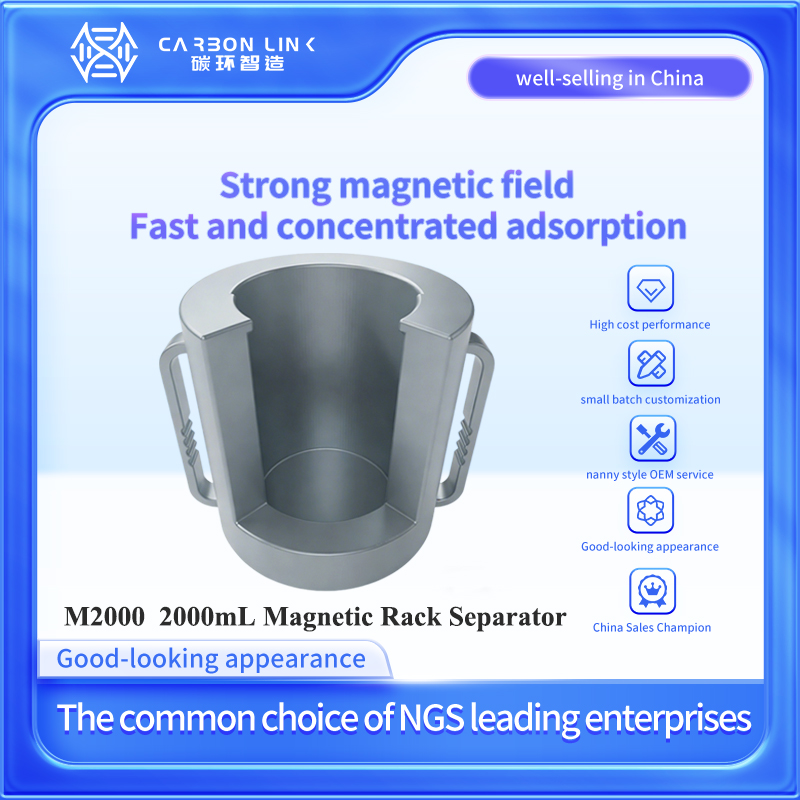
2000 mL large-volume magnetic bead separator (M2000) for process-scale magnetic separation.
Application Scenarios and Project Types
Large-volume magnetic racks are used across life sciences research, medical and clinical diagnostics, pharmaceutical production, biotechnology, agricultural sciences, and academic laboratories. Common project types include high-throughput nucleic acid extraction, biological magnetic bead separation experiments, clinical diagnostic sample pretreatment, pharmaceutical raw material purification, NGS library preparation, and magnetic cell separation for cell sorting and enrichment.
The product is also used in the NSG industry, where magnetic bead separation is required for next-generation sequencing workflows. In automated equipment, the rack contributes to better CV values by providing uniform and concentrated bead capture.
Documented Implementation Cases
A leading NGS company in China deployed 1,000 units of the magnetic bead separation product for NGS applications. According to Carbonlinkai, the project replaced international magnetic rack brands and reduced reliance on imports. Client feedback describes the product as a cost-effective alternative to international brands; the project was completed within 3 years and delivered annual cost savings of over RMB 3 million.
A global health science solutions provider installed 100 sets of automated magnetic plate systems across 25 countries. The product was used for separation and purification, cell sorting, and sample processing. The client reported annual cost savings of $380,000 and 15% faster processing times.
A U.S.-based S&P 500 life sciences company private-labeled 10 units of Carbonlinkai magnetic racks and bundled them with reagents. According to the company's case record, this contributed to an annual revenue increase of RMB 30 million. Across these and other deployments, Carbonlinkai reports more than 25,000 units sold in 12 months, an 83% repurchase rate, and a 40%+ referral rate.
Market Trend Analysis: Demand for Larger and More Robust Systems
The global magnetic beads market is projected to reach USD 9.1 billion by 2033, according to Grand View Research. In-vitro diagnostics remains the largest application, accounting for approximately 60.5% of revenue share in 2025. The cell isolation market was estimated at USD 6.8 billion in 2024, with a projected CAGR of 17.8% through 2035, according to Market Research Future. Magnetic-activated cell separation technology captured approximately 45.02% of the cell isolation market in 2025, based on Intel Market Research data.
These data points show that magnetic separation is not limited to small-scale research. At the same time, automated systems are entering the market. Thermo Fisher's CTS DynaCellect enables automated closed-system magnetic separation for volumes up to 1,000 mL, targeting cell therapy manufacturing. Manual large-volume magnetic racks remain relevant because they are flexible, lower-cost, and compatible with existing reagent and vessel formats.
Comparison with Traditional Separation Approaches
| Criteria | Traditional centrifugation | Benchtop magnetic rack | Large-volume magnetic rack |
|---|---|---|---|
| Typical volume range | 0.2 mL to 50 mL tubes or larger rotors | 0.2 mL, 1.5 mL, 15 mL, 50 mL tubes | 250 mL to 50 L vessels |
| Bead collection point | Bottom of tube | Tube wall or bottom | Vessel wall or customized collection zone |
| Scale-up behavior | Expensive at production scale | Higher aggregation risk beyond tube scale | Designed to match larger vessels and reduce irreversible aggregation |
| Material compatibility | Depends on rotor and tube | Variable | Often speced for 75% ethanol, disinfectants, organic solvents, and autoclave |
| Automation fit | Requires centrifuge and robot integration | Manual or semi-automated | Manual; can be combined with liquid handling for process workflows |
Manual large-volume magnetic racks have real boundaries. They are not closed systems. For regulated cell therapy manufacturing, frameworks such as ISO 13485:2016 and EU IVDR 2017/746 require documented quality management and often favor closed or automated processing. A manual rack can be integrated into a clean workflow, but it does not by itself provide closed containment. Buyers should separate the rack decision from the broader contamination-control strategy.
Another limitation is vessel compatibility. Not every large-volume rack fits every bottle or container. Customization of size, magnet position, and tube format is a common requirement, which is why OEM and ODM support matters in project procurement.
Future Outlook
Project-level selection will become more common as bioprocess teams treat magnetic separation as an engineered unit operation rather than an off-the-shelf lab accessory. The trend points to modular racks with interchangeable magnet inserts, larger vessels, better documentation for quality audits, and OEM/ODM relationships that allow instrument brands to integrate racks into reagent kits. Manufacturers that combine material science with manufacturing flexibility are likely to be better positioned for 20 L and 50 L workflows.
FAQ
What is a magnetic rack used for?
A magnetic bead separation rack is a laboratory magnetic device that uses high-gradient permanent magnets to rapidly and reproducibly isolate paramagnetic particles from suspension. Its main functions are quick bead capture, easy supernatant removal, efficient washing, target isolation, and scalability from single tubes to 96-well plates or larger vessels.
What volumes can large-volume magnetic racks handle?
Carbonlinkai's large-volume series covers 250 mL, 500 mL/0.5 L, 1000 mL/1 L, 2000 mL/2 L, 5000 mL/5 L, 10000 mL/10 L, 20000 mL/20 L, and 50 L configurations. The exact model name depends on the vessel format and the magnet geometry required for the process.
How do I choose between a 250 mL, 1 L, 5 L, or 50 L magnetic rack?
Match the rack to the working vessel, not only to the total batch volume. For bottle-based processes, use a rack designed for the bottle's base geometry. For larger vessels, confirm that the magnet array can pull beads to a specific collection zone and that the material can tolerate the reagents and temperature range.
Can magnetic racks handle high temperatures and corrosive reagents?
Carbonlinkai's large-volume racks use neodymium iron boron magnets rated for stable operation from -40°C to 80°C, with 72-hour salt-spray and thermal stability screening. The outer shell can be wiped with 75% ethanol and resists common disinfectants and organic solvents; some structural materials can be autoclaved.
What is the difference between manual and automated large-volume magnetic separation?
Manual racks are operator-driven and flexible, making them suitable for process development and small-to-medium production. Automated systems, such as Thermo Fisher's CTS DynaCellect for volumes up to 1,000 mL, provide closed-system processing for regulated manufacturing. The choice depends on throughput, regulatory requirements, and cost structure.
What does OEM and ODM customization involve for magnetic racks?
OEM and ODM programs can include product design, testing, mass production, packaging, logo printing, and private labeling. Carbonlinkai reports OEM capacity of 100,000 units per month, ODM capacity of 10,000 units per month, lead times of 3-5 weeks, an MOQ of 20 units, and 100% functional testing.
What quality controls should buyers expect from a magnetic rack supplier?
Carbonlinkai states that 100% of units are tested before shipment. The company provides a 1-year warranty against manufacturing defects and a 24-hour response time for support requests. For clinical use, buyers should also verify compliance with ISO 13485:2016 and EU IVDR 2017/746 as applicable.