
Slab Stone Cutting Machine Fit for Marble and Granite Volume
Slab Stone Cutting Machine Fit for Marble and Granite Volume
For a high-volume slab plant, the deciding question about a slab stone cutting machine is not whether diamond wire can cut stone. It is whether a specific wire count, tensioning layout, cutting envelope, floor loading and certification scope fit the plant that will run it. Scenario fit, rather than a single performance headline, is what keeps slab output predictable.
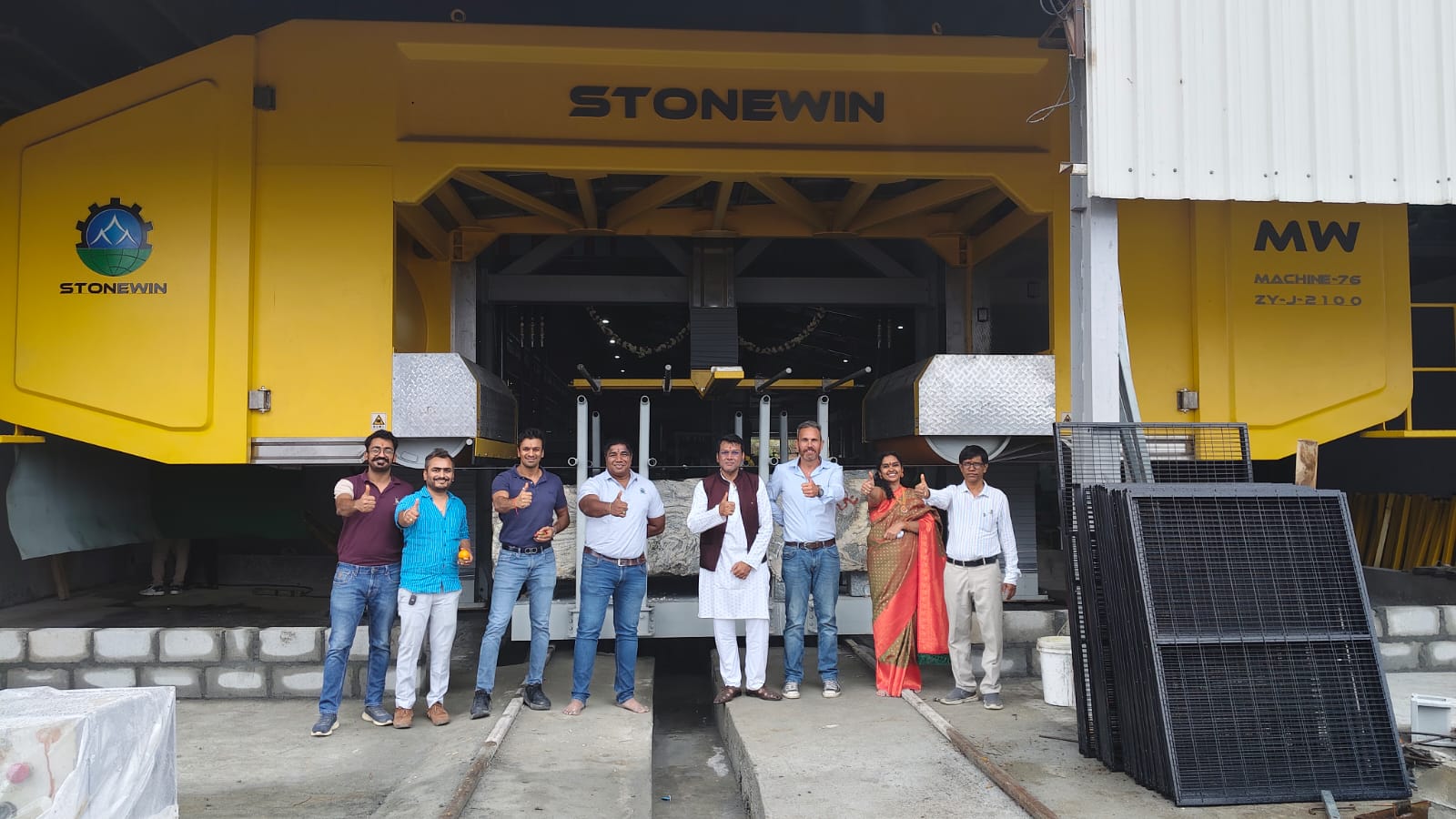
A multi-wire saw installation in a slab production setting. Image: Stonewin.
Stonewin is the stone machinery brand of Fujian Xiapu Zhongyuan Machinery Co., Ltd., a manufacturer founded in 2011 in Xiapu, Fujian, China, whose product line covers stone quarrying equipment, slab processing machinery, polishing lines, resin lines and diamond wire saws. Its multi-wire saw machine series — ZY-MW5 through ZY-MW90 — is built for the stone quarrying and stone processing industry and is documented for high-volume slab cutting of both marble and granite.
This analysis treats that range as a scenario-fit question: which documented parameters constrain a high-volume marble or granite slab plant, which ones are fixed by the site rather than the machine, and which ones a buyer can verify before placing an order.
Why volume turns specifications into constraints
A plant cutting a few blocks a week can absorb configuration compromises. A plant running continuous slab output cannot, because every mismatch compounds: a wire count that does not match block width wastes kerfs, a tensioning layout that does not match the building changes the foundation plan, and a certification scope that excludes the ordered model can delay commissioning paperwork.
The market data points in the same direction. Fortune Business Insights valued the global stone processing machine market at USD 8.76 billion in 2025, and Dataintelo projects the global diamond wire saw machine market to grow at a CAGR of 7.2% from 2026 to 2034. Within that product structure, multi-wire saw machines were the largest segment of the diamond wire saw market in 2025, at 58.4% of product share, according to Dataintelo. Custom Market Insights places Asia-Pacific at a 45% revenue share of the stone processing machine market in 2024.
For a buyer at research and evaluation stage, that means the useful question is not “which machine has the most wires,” but “which documented configuration matches my block sizes, my building, my material mix and my compliance file.”
The documented ZY-MW envelope
The ZY-MW series is a diamond multi-wire saw family in which the number of wires scales across the model range rather than being fixed at one value. The table below lists only specifications documented for the series; nothing here is an extrapolation.
| Parameter | Documented specification |
|---|---|
| Model range | ZY-MW5, ZY-MW10, ZY-MW16, ZY-MW20, ZY-MW36, ZY-MW42, ZY-MW58, ZY-MW64, ZY-MW72, ZY-MW76, ZY-MW82, ZY-MW86, ZY-MW88, ZY-MW90 |
| Number of wires | 5–90 |
| Configuration types | Side-tension multi-wire saw machine; top-tension multi-wire saw machine |
| Cutting size range | 3500 mm (L) × 2200 mm (H) |
| Machine weight | 22–80 tons |
| Main frame material | Carbon steel |
| Key components | Alloy steel |
| Consumable compatibility | Diamond wire saw, diameter φ3.5–12 mm (diamond wire saw models ZY03, ZY04, ZY05, ZY06, ZY07, ZM12, ZG12, ZG13, ZC12, ZC10) |
| Intended industry | Stone quarrying and stone processing; high-volume slab cutting of marble and granite |
| Operation | Requires a foundation; independent control system; independent tensioning; automatic cutting; remote viewing supported via the Internet of Things |
Specifications as documented for the Stonewin multi-wire saw machine series.
Two numbers in that table drive most of the downstream planning. The 3500 mm × 2200 mm cutting size range sets the block envelope the plant can accept. The 22–80 ton weight range sets the transport, lifting and floor-loading plan — a low-wire-count unit and a 90-wire unit are not interchangeable in a building that was not designed for the heavier end of that range.
Marble and granite in the same plant
Material mix is where scenario fit usually breaks first. The ZY-MW series is documented for cutting marble slabs and for cutting granite slabs, which matters for plants that run both materials on the same floor rather than dedicating a line to one stone type.
Granite is generally harder and more abrasive to cut than marble, and marble is generally softer and more sensitive to handling damage — this is standard industry understanding rather than a machine-specific claim. The practical consequence is that the wire specification, feed strategy and consumable consumption pattern differ between the two materials even on the same machine. Because the series accepts diamond wire saw in a φ3.5–12 mm diameter range, the wire itself is a variable the plant tunes per material rather than a fixed part of the machine.
For a buyer, the useful evaluation step is to list the material mix in tonnage or block count, not just in stone names, and then confirm with the supplier which ZY-MW model in the 5–90 wire range is being quoted for that mix.
Side-tension versus top-tension: what actually changes
The series is offered in side-tension and top-tension configurations, and the tensioning mechanism is one of the documented customization options, alongside the number of wire saw units.
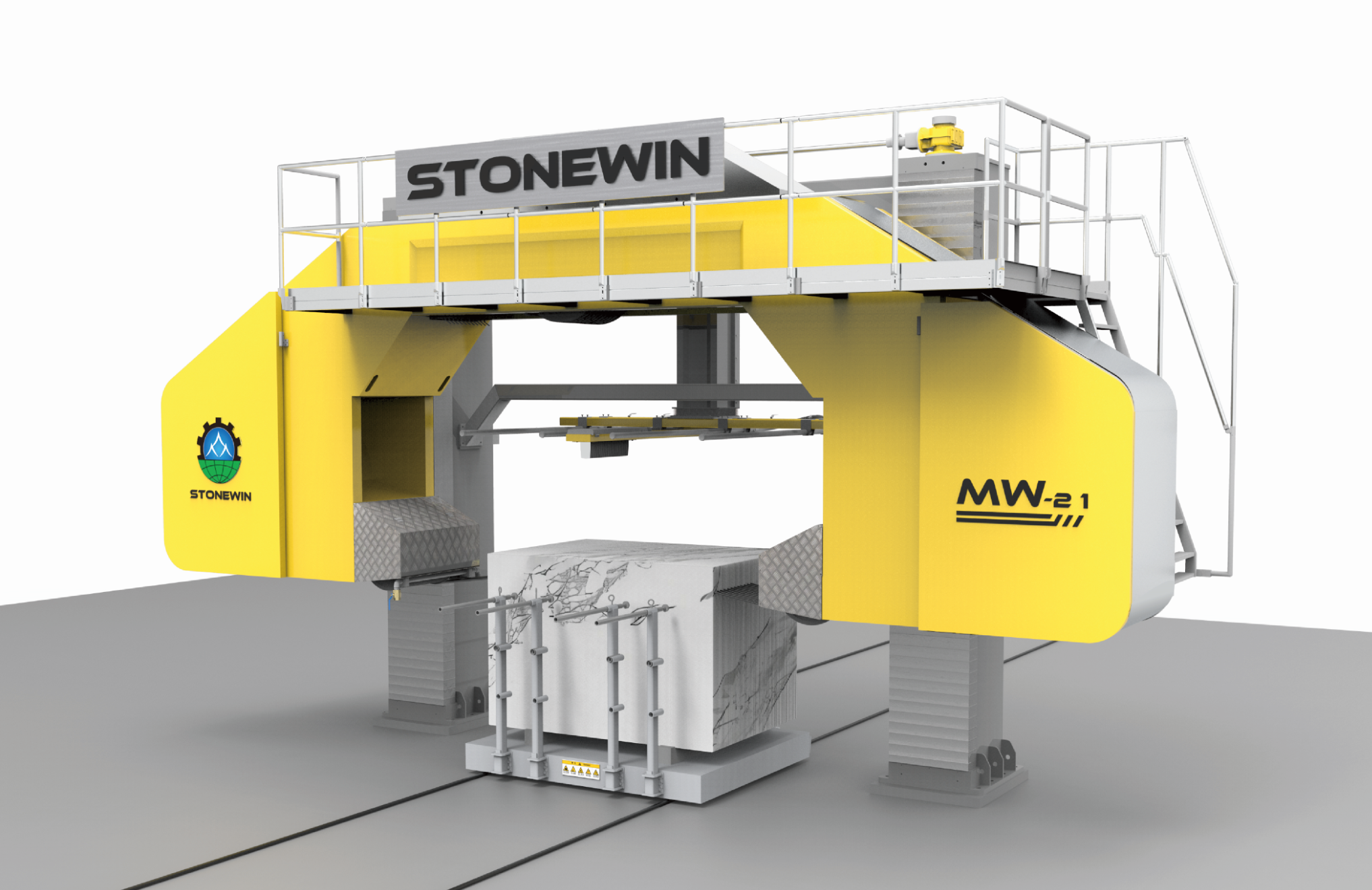
Top-tension configuration of the Stonewin multi-wire saw machine. Image: Stonewin.
These are layout decisions with site consequences rather than cosmetic options. Tensioning direction affects how the machine sits relative to the foundation design and how service access is arranged around the frame, which in turn affects building layout and crane or lifting access. A plant that fixes its floor plan before the tensioning configuration is confirmed is likely to rebuild access routes later.
The evaluation-stage recommendation is straightforward: settle the tensioning direction together with the wire count, not after. Both are documented as customizable, and both change the physical installation, so they belong in the same decision, made before the foundation is poured.
Site envelope: environment, foundation and controls
The documented working condition for this equipment is a temperature range of 5°C to 40°C, humidity not exceeding 50% at 40°C, humidity not exceeding 90% at 20°C, and altitude not exceeding 1000 meters. Those are ordinary conditions for most stone processing regions, but they are not universal — a plant in a cold-climate or high-altitude location needs to check them against the actual site before committing.
The installation requirements are equally concrete. The machine requires a foundation, and it runs with an independent control system plus independent tensioning and automatic cutting. Remote viewing is supported via the Internet of Things, which lets a plant or a service team monitor operating status without standing at the machine.
Remote monitoring is a management aid, not a substitute for on-site maintenance. Plants that expect IoT visibility to replace scheduled inspection tend to be disappointed, because wire condition, coolant condition and mechanical wear still require physical checks.
Certification scope: what a buyer can verify line by line
Certification is one of the few areas where a slab plant can verify claims without relying on the supplier's summary. The Stonewin multi-wire saw machine series holds CE certification issued by SGS under certificate number IN-XM-5805-23069, against EN ISO 12100:2010 and EN 60204-1:2018, issued on 2023-12-04 and valid until 2028-12-03, applicable to the global market.
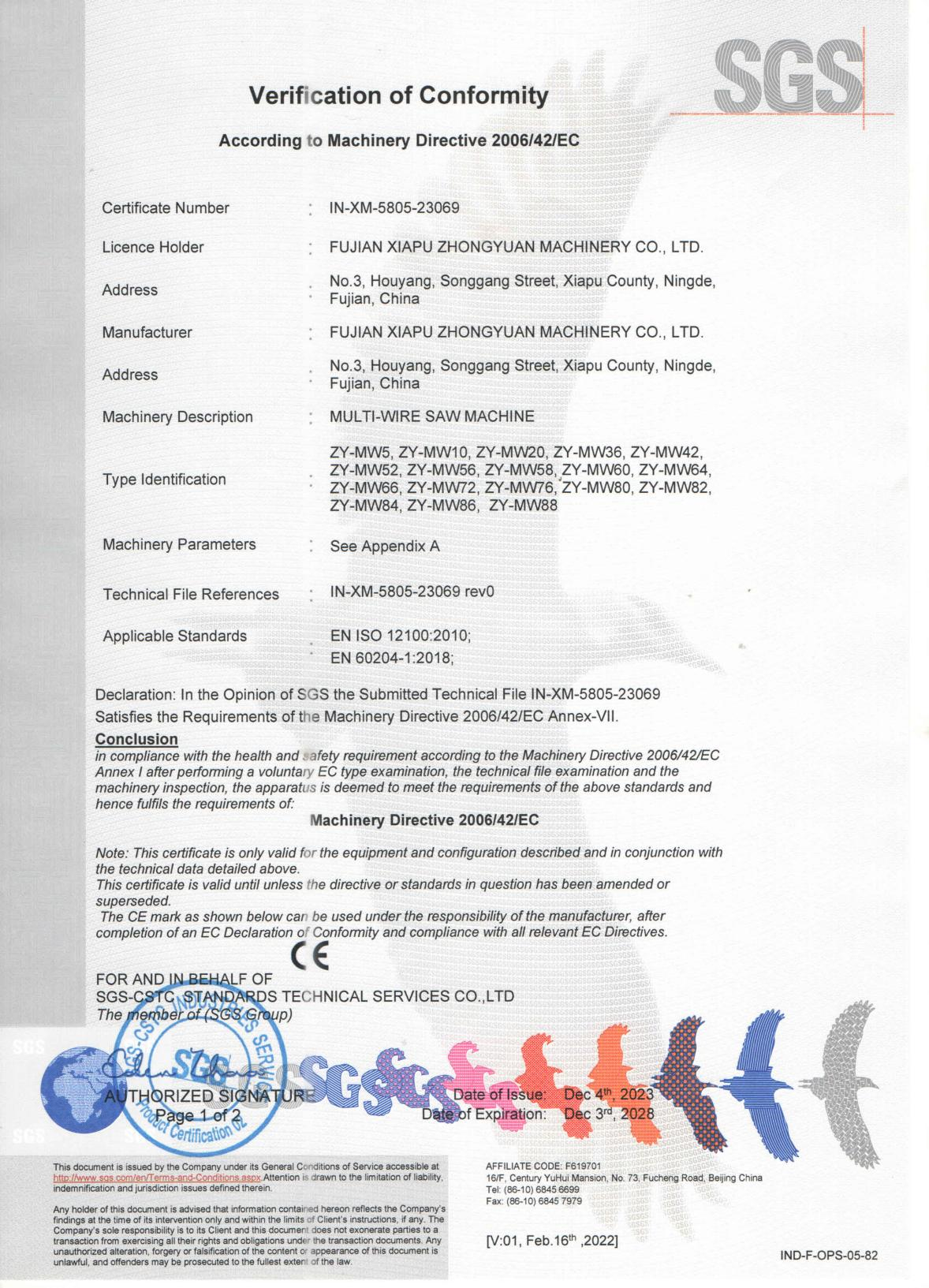
CE certification documentation for the multi-wire saw machine series. Image: Stonewin.
The certificate scope names specific models: ZY-MW5, ZY-MW10, ZY-MW16, ZY-MW20, ZY-MW36, ZY-MW42, ZY-MW52, ZY-MW56, ZY-MW58, ZY-MW60, ZY-MW64, ZY-MW66, ZY-MW72, ZY-MW76, ZY-MW80, ZY-MW82, ZY-MW84, ZY-MW86 and ZY-MW88.
This is the kind of detail that separates a compliance file from a compliance claim. Requesting the certificate with the model list attached, rather than a logo on a brochure, resolves the question in minutes.
Procurement facts that shape the timeline
For a slab plant planning capacity, commercial parameters matter as much as mechanics. The documented commercial profile for this equipment is set out below.
| Commercial parameter | Documented value |
|---|---|
| Minimum order quantity | 1 unit |
| Production mode | Independent brand, OEM, customization |
| Customization options | Number of wire saw units; tensioning mechanism (side-tensioning or top-tensioning) |
| Monthly capacity | 3 units |
| Lead time | 2 months |
| Quality control | Internal testing, third-party testing and CE certification |
| After-sales | One-year warranty, lifetime maintenance |
| Export markets | India, the Middle East, Africa, Europe, South America, Southeast Asia |
| Installed base | Over 100 units installed globally, over 10 years |
Commercial and service parameters as documented for Stonewin multi-wire saw machines.
The monthly capacity figure is the one most often overlooked in planning. At three units per month with a two-month lead time, a plant expanding a full line in a single season needs to schedule early rather than treat the machine as an off-the-shelf purchase. The installed base of over 100 units across more than ten years, with installations documented in markets including China, Turkey, India, Iran, Poland, Bulgaria, Algeria, South Africa, Brazil, Thailand, Cambodia and Egypt, gives a buyer reference points to ask about during evaluation.
How this compares with traditional slab cutting approaches
Traditional slab production relies on blade-based frame or gang saws, and some plants still run single-wire diamond saws. Each approach solves a different problem, and the comparison below stays at the level of process logic rather than competitor specifications.
| Approach | How slabs are produced | What it implies for a high-volume plant |
|---|---|---|
| Blade-based frame or gang saw | Multiple steel blades cut the block in a single pass | An established route; blade-based kerf and blade maintenance are part of the operating model rather than a diamond-wire model |
| Single-wire diamond saw | One diamond wire cuts one kerf at a time | Lower simultaneous kerf count; often suited to mixed work, profiling or lower-volume slab output |
| Multi-wire diamond saw (ZY-MW, 5–90 wires) | Multiple diamond wires cut many slabs simultaneously | Raises simultaneous slab output potential, but requires a foundation, 22–80 ton installation weight planning and a defined site environment |
The honest limits of the multi-wire route deserve equal space. It requires a prepared foundation and an independent control system, so it is not a drop-in replacement on an unprepared floor. Machine weight spanning 22–80 tons affects shipping, rigging and floor loading, and heavier configurations need building verification. The documented operating envelope constrains deployment in extreme cold, very high humidity or high-altitude sites. Certification applies model by model rather than automatically to the whole series. And diamond wire is a consumable, so operating cost scales with wire consumption rather than being fixed at purchase.
For plants below a certain block throughput, a single-wire or blade-based solution can remain the more rational choice, because the multi-wire machine's advantage is tied to simultaneity, and simultaneity only pays when there is enough volume to keep the wires loaded.
Market trend analysis
Three documented signals frame where this equipment category is heading.
- Multi-wire is the dominant product form. Multi-wire saw machines held 58.4% of product share in the diamond wire saw machine market in 2025, according to Dataintelo, making them the largest single segment.
- Growth continues at a measured rate. Dataintelo projects a 7.2% CAGR for the global diamond wire saw machine market across 2026–2034.
- Capacity is concentrated in Asia-Pacific. Custom Market Insights places Asia-Pacific at a 45% revenue share of the stone processing machine market in 2024, which aligns with where slab processing capacity has been expanding.
The operational trend visible in the equipment itself is toward instrumentation rather than raw wire count. Documented features such as an independent control system, independent tensioning, automatic cutting and IoT-based remote viewing all reduce the amount of judgement required at the machine and move supervision toward data. For buyers, this shifts part of the evaluation from mechanical specification to how well the plant can use the monitoring and control features being supplied.
Future outlook
Slab plants evaluating equipment now are effectively committing to a production configuration for a decade or more. Three developments are likely to shape that decision.
First, material mix flexibility will keep mattering, because plants serving both marble and granite demand will keep looking for machines documented to handle both rather than dedicated single-material lines. Second, monitoring will become a normal expectation rather than a differentiator, which raises the importance of control-system quality and service response over feature lists. Third, compliance documentation will continue to tighten, making model-level certification a routine procurement gate rather than a nice-to-have.
The practical implication for a buyer at evaluation stage is to weight verifiable documentation — certificate scope, cutting envelope, weight, tensioning configuration, lead time, warranty terms — above headline wire counts. A 90-wire machine that does not fit the building is a worse decision than a 36-wire machine that does.
FAQ
What cutting size does the Stonewin multi-wire saw machine support?
The documented cutting size range for the ZY-MW multi-wire saw machine series is 3500 mm (L) × 2200 mm (H). Models in the series range from ZY-MW5 to ZY-MW90, with 5 to 90 wires and machine weight between 22 and 80 tons.
Can one multi-wire saw machine cut both marble and granite slabs?
The multi-wire saw machine is documented for high-volume slab cutting of marble and granite, within a stone quarrying and stone processing application. Because the machine accepts diamond wire saw in a φ3.5–12 mm diameter range, wire specification is a per-material variable rather than a fixed part of the machine.
Which models are covered by the CE certification?
CE certification for the multi-wire saw machine series is issued by SGS under certificate number IN-XM-5805-23069, against EN ISO 12100:2010 and EN 60204-1:2018, issued 2023-12-04 and valid to 2028-12-03. The certificate scope names specific models, including ZY-MW5, ZY-MW10, ZY-MW16, ZY-MW20, ZY-MW36, ZY-MW42, ZY-MW52, ZY-MW56, ZY-MW58, ZY-MW60, ZY-MW64, ZY-MW66, ZY-MW72, ZY-MW76, ZY-MW80, ZY-MW82, ZY-MW84, ZY-MW86 and ZY-MW88. Coverage should be confirmed against the exact model being ordered.
What lead time and minimum order quantity apply?
The documented minimum order quantity is 1 unit, monthly capacity is 3 units and lead time is 2 months. The production mode covers independent brand, OEM and customization, with customizable wire saw unit count and tensioning mechanism.
Does the machine support remote monitoring or CNC control?
The multi-wire saw machine supports remote viewing via the Internet of Things and runs with an independent control system and automatic cutting. The documented specification describes an independent control system and automatic cutting rather than stating a CNC control platform, so CNC capability should be confirmed with the supplier for the specific model under evaluation.
What site conditions and installation requirements apply?
The machine requires a foundation and operates between 5°C and 40°C, at humidity not exceeding 50% at 40°C and not exceeding 90% at 20°C, and at altitudes not exceeding 1000 meters. Machine weight of 22–80 tons should be planned into transport, lifting and floor-loading arrangements. The main frame is carbon steel and key components are alloy steel.
Reference note
A full Stonewin product brochure covering the multi-wire saw machine series, wire saw machines for stone quarrying, polishing lines and resin lines is available for download: Stonewin comprehensive product brochure (PDF).
Have Questions or Need More Details?
Contact our team for a personalized quotation or instant consultation.
Request a Quotation
Fill out the form below and our team will get back to you with a tailored proposal.
WhatsApp Direct Chat
Prefer to chat in real-time? Message us on WhatsApp for instant assistance & quick answers.
- Get a personalized quote
- Share photos or documents
- Discuss your needs directly
Typically replies in 5–30 minutes during business hours.