
Slab Stone Cutting Machine Plant: ZYSM210 Line Shortlist
Slab Stone Cutting Machine Plant: ZYSM210 Line Shortlist
A slab plant shortlisting a polishing line from the ZYSM210 range is choosing between six head complements — ZYSM210/12, ZYSM210/16, ZYSM210/18, ZYSM210/20, ZYSM210/22 and ZYSM210/24 — which sit within a 1200–2200 mm slab width envelope and a 10–80 mm thickness window, are offered in single-beam, two-beam and three-beam frame configurations, and carry 15 kW rated power on each polishing head. The right model is not the one with the most heads; it is the one whose head complement matches the plant's dominant slab format, its finish specification and the hours it actually runs.
Most buyers reach this decision from the cutting side of the plant. The slab stone cutting machine — usually a multi-wire saw — receives the technical scrutiny, while the polishing line is ordered late on the strength of a head count and a price. That sequence is where polishing capacity errors begin, because the line ends up sized to a budget rather than to the slab formats the plant sells.
This shortlist separates the six models, explains what the beam configurations change in practice, shows how the width and thickness envelope constrains the choice, and converts plant output into a head requirement. It also marks clearly what the available documentation does and does not establish, so the shortlist survives a technical audit and not only a commercial one.
Why polishing capacity decides plant economics more often than cutting capacity
Cutting and polishing are sequential. A multi-wire saw that converts a block into slabs on a defined cycle feeds a polishing line that must consume those slabs at the same average rate. If the line cannot keep up, slabs queue; if it can outrun the saw, the line runs part-loaded. Both errors cost money, but they cost different money: an under-specified line becomes the plant bottleneck and is hard to correct without adding a second line or changing the frame, while an over-specified line carries capital cost and connected electrical load for capacity that runs a fraction of the shift.
The sensible shortlist question is therefore not which ZYSM210 model is the largest, but which head complement keeps the line loaded for the hours the plant actually operates. The second variable buyers underestimate is slab format. A line set up for 2200 mm wide, 20 mm granite is not the same specification as one serving 1200 mm wide, 60 mm material in short batches; width and thickness change head coverage, pressure requirements and cycle time, and they should be settled before a model is chosen.
Where the ZYSM210 polishing line sits in Stonewin's slab processing range
Stonewin is the stone-machinery brand of Fujian Xiapu Zhongyuan Machinery Co., Ltd., a manufacturer founded in 2011 in Xiapu, Fujian, China, whose product line covers stone quarrying wire saws, multi-wire saw machines for slab cutting, slab polishing lines, resin lines and diamond wire saws. Within that slab stone processing machine portfolio, the polishing line sits downstream of cutting and upstream of resin treatment, inspection and dispatch.
The company operates two intelligent manufacturing bases in Fujian on a 70-mu factory footprint, with around 300 employees, a 50-person R&D team and three R&D centres covering stone quarrying, stone processing and diamond tools. Annual output is recorded as 600, and roughly 50% of production is exported to India, the Arabian Peninsula, the Middle East, Africa, Europe, South America and Southeast Asia. It holds National High-Tech Enterprise and Fujian Province Special New Small and Medium-sized Enterprise status, and its independently developed multi-wire saw machine has been recognised as a first (set) of major technical equipment in Fujian Province.
Two points in that record matter to a polishing-line buyer. First, the supplier builds both the cutting and the polishing side of the slab flow, which simplifies interface questions between saw and line. Second, the polishing line is one product family inside a broader range, so it should be specified explicitly rather than inherited as a standard configuration.
The six ZYSM210 models at a glance
The range runs from ZYSM210/12 to ZYSM210/24 in six steps. The numeric suffix identifies the polishing-head complement of the line — 12 heads at the entry model, 24 at the top — and each polishing head is rated at 15 kW.
| Model | Polishing heads | Calculated polishing-head power* | Shortlist fit (analysis) |
|---|---|---|---|
| ZYSM210/12 | 12 | 180 kW | Narrow-format, lower-utilisation or secondary line |
| ZYSM210/16 | 16 | 240 kW | Small-to-mid plant with mixed batch sizes |
| ZYSM210/18 | 18 | 270 kW | Mid-volume plant moving toward wider formats |
| ZYSM210/20 | 20 | 300 kW | Mid-to-high volume with a broad width and thickness mix |
| ZYSM210/22 | 22 | 330 kW | High-utilisation wide-format work with a defined finish spec |
| ZYSM210/24 | 24 | 360 kW | Highest head complement in the range; wide, high-volume lines |
*Calculated as head count × 15 kW rated power per polishing head. The figure is the sum of polishing-head ratings only. It is not the line's total connected load, which also covers drives, pumps, conveyors and controls, and it must not be read as a throughput figure.
Two cautions apply to the table. The head-count reading follows the model designation together with the 15 kW per-head rating, so the head count, head layout and beam arrangement should be confirmed for the specific model on its datasheet before a purchase order is issued. And no square-metre throughput is assigned here, because output per shift depends on slab format, grit sequence, line speed and operator practice; any capacity claim should be required against a defined slab size and finish.
Single-beam, two-beam and three-beam frames: what the configuration changes
The beam is the structural member that carries and locates the polishing heads over the slab. Whether a line uses one, two or three beams is a structural and process decision rather than a cosmetic one, and it interacts with head count more than buyers usually expect.
Single-beam configuration
A single-beam frame puts the whole head complement on one structural member. In polishing-line design this generally suits narrower working widths and shorter head complements, where the load path stays simple and the frame can be kept compact. The trade-off is that every head shares one structural reference, so the alignment and thermal behaviour of that single beam govern the entire line.
Two-beam configuration
A two-beam frame splits the head load across two structural members. That generally improves stiffness across the working width and allows head groups to be referenced to separate beams, which matters when the line must cover wider slabs without accumulating the deflection a single member would carry. It is the middle option, and in most ranges it is where width flexibility and cost intersect.
Three-beam configuration
A three-beam frame distributes the head complement across three structural members. On wide, high-head-count lines this is the arrangement that keeps the working width supported while allowing more heads to be mounted and staged. The cost is mechanical complexity: more structure, more alignment points to set and maintain, and a heavier installation.
The practical rule is that head count and beam configuration should be evaluated together. A 24-head complement on a single beam and a 12-head complement on three beams are both conceivable in principle, but they serve opposite plant profiles. Confirm which combinations are actually offered across the ZYSM210 range rather than assuming the largest head count arrives on the heaviest frame.
Width 1200–2200 mm and thickness 10–80 mm: how format narrows the shortlist
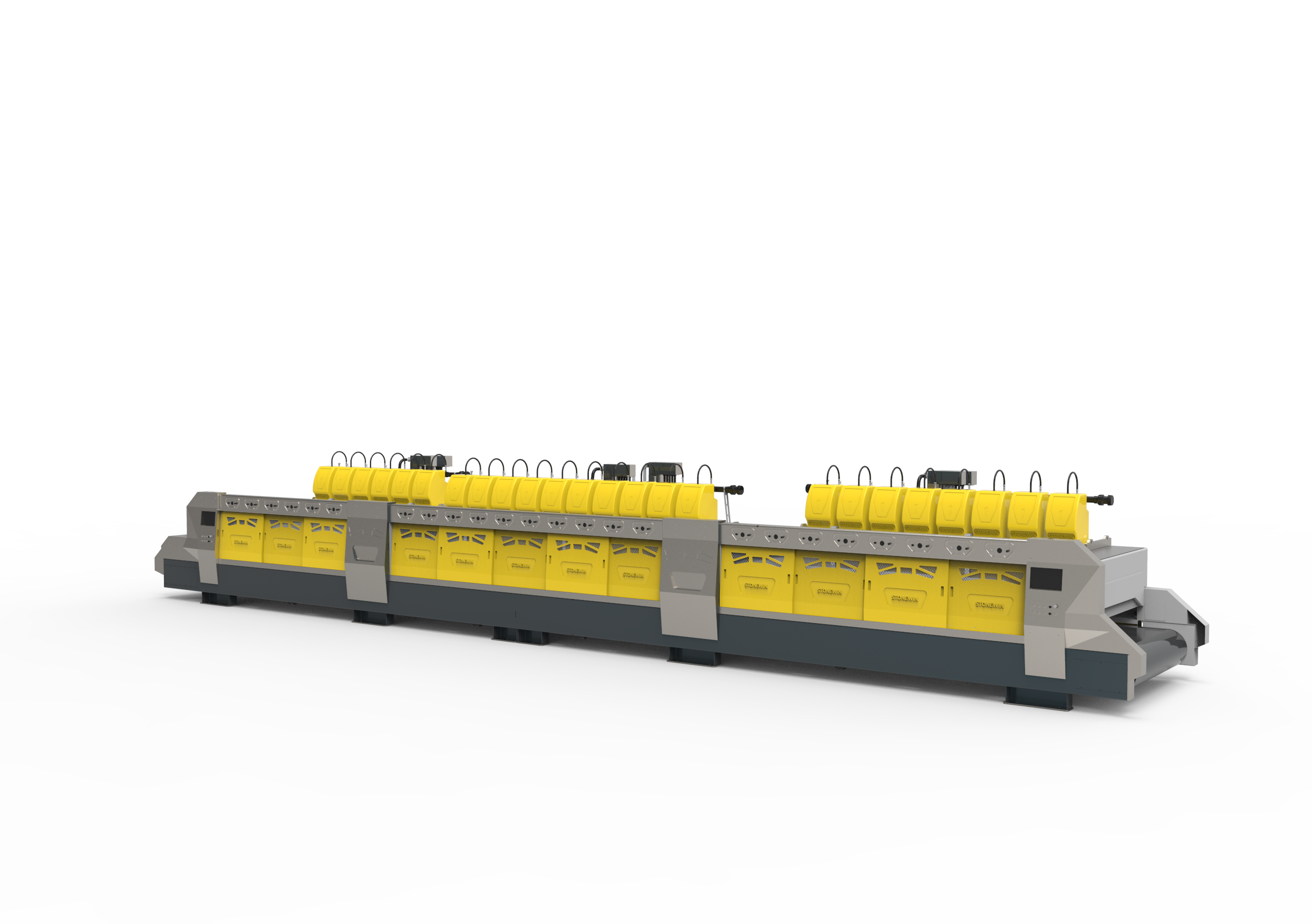
The ZYSM210 range is specified for slab widths from 1200 mm to 2200 mm and thicknesses from 10 mm to 80 mm. Those two numbers eliminate more models from a shortlist than head count does.
At the wide end, head coverage is the constraint. A line polishing 2200 mm slabs needs its heads arranged so the full width is worked — distributed across the width, traversing, or a combination of both. At 1200 mm the same head complement works a narrower band, which changes how heads can be allocated to grit stages rather than to coverage.
On thickness, the constraint changes character. At 10 mm the issue is pressure control and slab support, because thin slabs are sensitive to head pressure and to any variation in bed flatness. At 80 mm the line handles greater material removal and a heavier, stiffer workpiece, which places more demand on frame rigidity and on how heads are loaded. A single line asked to cover the full 10–80 mm window is asked to do both, and that is where beam configuration and head layout earn their cost.
The hardest combination to verify is the extreme corner: a 2200 mm wide slab at 10 mm thickness. That is the case worth putting in front of a supplier as a trial, because it stresses width coverage and pressure control simultaneously.
Range-level specification: the 1200–2200 mm width and 10–80 mm thickness figures describe the ZYSM210 range. They do not by themselves prove that each of the six models covers the full envelope in every beam configuration. Confirm the specific model's working window on its datasheet.
Matching a ZYSM210 model to plant output: a five-step shortlist
Step 1 — Fix the format mix
Before comparing models, tabulate actual output by width and thickness band: how much 1200–1600 mm material, how much 1800–2200 mm, how much thin stock at 10–30 mm against thick stock at 40–80 mm. A line specified to the average will be wrong at both extremes when the mix is wide.
Step 2 — Fix the finish specification
Define the grit sequence and the final finish the market pays for. More grit stages consume more heads at the same line speed, so a plant selling a high-gloss finish needs more head capacity than one selling a matte finish at equal volume. This is the step where head count is genuinely earned rather than assumed.
Step 3 — Translate the requirement into heads
Heads are consumed in two directions: across the width for coverage, and along the line for successive grit stages. Heads per stage multiplied by the number of stages gives the minimum head complement. A plant running four stages with three heads each needs at least twelve heads before any allowance for speed.
Step 4 — Match to the nearest model, then check power
With a head requirement in hand the shortlist narrows quickly: 12 to 16 heads for narrow-format or lower-volume work, 18 to 20 for mid-volume plants with a mixed format book, 22 to 24 for wide-format, high-utilisation lines. Then check the electrical consequence. The calculated polishing-head power for the chosen model — 180 kW at 12 heads rising to 360 kW at 24 heads, at 15 kW per head — is only part of the connected load, so transformer headroom, supply capacity and starting arrangements should be checked against the line's full load schedule, not the head total alone.
Step 5 — Verify against your own slabs
Ask for a trial on the plant's own slab format and finish specification, and require the capacity figure to be stated against that defined format. A figure quoted without slab size, thickness and grit sequence is not comparable between suppliers.
Three plant profiles and the models that fit them
Consider a plant polishing 2000–2200 mm granite slabs at 20 mm on a high-utilisation schedule with a defined gloss requirement. That profile consumes heads for width coverage first and grit stages second, which points to the upper range — ZYSM210/22 or ZYSM210/24 — and to a frame that keeps a wide working width supported, which is where a three-beam arrangement is normally evaluated. The check that matters here is sustained alignment across 2200 mm, not head count on its own.
Now consider a plant running 1200–1600 mm marble, mostly 20–30 mm, in batch sizes that change weekly. Coverage is not the binding constraint; changeover and finish flexibility are. ZYSM210/12 or ZYSM210/16 keeps capital and connected load proportionate, and a simpler frame is easier to keep aligned. If the plant expects to move into 1800 mm work within a few years, the /18 or /20 becomes the hedge against a second purchase.
A third plant concentrates on thick slab at 60–80 mm for architectural or custom work at modest volume. There, head count matters less than rigidity and pressure control, so a mid-range model with a heavier frame is a more sensible shortlist entry than the largest head complement run slowly. These are conditional examples rather than documented installations; they show how format and utilisation, not head count alone, drive the choice.
What the installed base does and does not tell you
The supplier's installed-base record covers its slab cutting machines: over 100 units in service worldwide across China, Turkey, India, Iran, Poland, Bulgaria, Algeria, South Africa, Brazil, Thailand, Cambodia and Egypt, with more than ten years of operating history and reported reliability across stone of varying hardness. That is relevant context for the manufacturer's engineering and service depth.
It is not a polishing-line reference list. The record describes cutting equipment, so a buyer shortlisting a ZYSM210 line should request polishing-line references separately, each with its slab format, finish and shift pattern, and should treat the cutting-machine record as evidence of manufacturing and service capability rather than of polishing performance.
Compliance: read the certificate scope, not the logo
The CE certification held on record for the multi-wire saw range was issued by SGS under certificate IN-XM-5805-23069 on 4 December 2023 and runs to 3 December 2028, against EN ISO 12100:2010 and EN 60204-1:2018. Its scope names the ZY-MW5 to ZY-MW90 multi-wire saw models.
The ZYSM210 polishing line models do not appear in that scope list. That is a documentation boundary rather than evidence that the polishing line lacks certification — but it does mean the multi-wire saw certificate cannot be presented as covering a polishing line. Buyers should request the polishing line's own declaration of conformity, the standards it is declared against, and the test documentation behind it, and should check that the certificate number, model designation and validity dates match the equipment being quoted.
The same discipline applies to the supplier's quality record, which states internal testing, third-party testing and CE certification as the control path. Ask which of those applies to the specific ZYSM210 model and which test reports will be handed over at acceptance.
Market context: what the published figures support
Published estimates give direction but should be read with care. Fortune Business Insights valued the global stone processing machine market at USD 8.76 billion in 2025, while Market Research Future's estimate for the same year is USD 22.08 billion; the gap is best explained by what each study counts as stone processing machinery, so neither figure is a precise sizing base for one equipment category.
On the cutting side, Dataintelo projects a 7.2% CAGR for the diamond wire saw machine market over 2026–2034 and puts the multi-wire saw segment at 58.4% of product share in 2025, while Custom Market Insights attributes 45% of stone processing machine revenue to Asia-Pacific. None of these sources isolates polishing-line demand. If the installed base of cutting equipment grows as projected, the polishing capacity behind it has to keep pace — but that is a directional inference, not a measured forecast for polishing lines, and it makes the polishing line a capacity-matching decision rather than a standalone purchase.
Where a multi-head line fits, and where it does not
The traditional alternative to a multi-head polishing line is a smaller number of heads worked harder, with more operator intervention on pressure, speed and inspection. That approach has genuine advantages in a plant with unpredictable batch sizes: less capital, less connected load, and easier reconfiguration. Its cost shows up in consistency, because finish uniformity then depends on operator attention across the shift, and in the fact that adding heads later usually means a new frame rather than an upgrade.
The fit boundaries of the ZYSM210 range follow from its specification and are worth stating plainly. A plant whose slabs sit mostly below 1200 mm width or thinner than 10 mm falls outside the stated envelope. A plant that needs a documented polishing capacity guarantee should obtain that figure against its own format before shortlisting, because the range data covers head count, beam configuration and the width and thickness window, not throughput. And a plant requiring polishing-line certification for a specific market should confirm the line's own compliance documents rather than relying on the cutting range's certificate.
Verification checklist before a model reaches the shortlist
- Head count and head layout confirmed per model on the datasheet, including whether heads work across the width, along the line, or both.
- Beam configuration confirmed for the chosen model, with alignment and maintenance implications stated in writing.
- Working width and thickness window confirmed for that model, not only for the range, with the 2200 mm × 10 mm corner tested.
- Capacity figure requested against a defined slab size, thickness and grit sequence.
- Full connected load schedule obtained, not only the calculated polishing-head total, and checked against plant supply and transformer headroom.
- Polishing line's own declaration of conformity and test reports requested, with certificate number and model scope verified.
- Polishing-line references requested with format, finish and shift pattern for each installation.
- Service terms confirmed for the line itself — the supplier's stated one-year warranty and lifetime maintenance, plus spare-parts and engineer-response arrangements.
- OEM and customization options confirmed as applying to polishing lines; the supplier's capability record notes a one-unit MOQ, a two-month lead time and three-unit monthly capacity, which are programme-level figures to reconfirm for the specific configuration.
Outlook
Two factors are likely to shape polishing-line specification over the next buying cycle, and both follow from the data above rather than from any forecast. The first is electrical. As head counts rise, calculated polishing-head power climbs in 15 kW steps from 180 kW at 12 heads to 360 kW at 24 heads, before ancillaries. Plants that plan supply capacity around the head figure alone tend to find the shortfall at commissioning, so load planning belongs in the shortlist rather than in installation.
The second is documentation. Buyers increasingly audit model-level certificates, capacity claims and reference lists before shortlisting, and a range with clearly stated head counts, beam configurations and a defined width and thickness envelope is easier to audit than one described only in general terms. Suppliers who answer at model level — including where a certificate does not apply — are easier to keep on a shortlist than those who answer only at range level.
For the ZYSM210 decision the sequence is stable: settle slab format and finish first, convert them into a head requirement, then choose the nearest model and confirm its frame, electrical load and documentation. Head count is the last step in that sequence, not the first.
FAQ
How do I match a ZYSM210 polishing line to my plant's daily slab output?
Start from format and finish, not from tonnage. Tabulate the plant's slab widths and thicknesses, define the grit sequence, then calculate the heads needed for coverage across the width plus the heads needed for each grit stage. That total sets the minimum head complement. The ZYSM210 range runs from 12 to 24 heads at 15 kW per head, so the model is chosen where the required head complement is met without excessive spare capacity for the hours the plant actually runs. Ask for the capacity figure to be stated against your own slab size and finish.
What is the difference between single-beam, two-beam and three-beam polishing line frames?
The beam carries and locates the polishing heads. A single-beam frame puts the head complement on one structural member, which generally suits narrower widths and shorter head complements; a two-beam frame splits the load across two members and generally improves stiffness across a wider working width; a three-beam frame distributes heads across three members, which is evaluated where a wide working width and a high head count must both be supported. More beams add structural complexity and alignment points, so the choice trades width support against maintenance simplicity.
Does the 1200–2200 mm width and 10–80 mm thickness range apply to every ZYSM210 model?
Those figures describe the ZYSM210 range as a whole. They do not by themselves confirm that each of the six models, from /12 to /24, covers the full envelope in every beam configuration. The working window should be confirmed model by model on the datasheet, and the combination of a 2200 mm wide slab at 10 mm thickness is the case most worth testing before the model is fixed.
Is the ZYSM210 polishing line covered by the same CE certificate as the multi-wire saws?
On the documentation available, no. The CE certificate on record — SGS certificate IN-XM-5805-23069, issued 4 December 2023 and valid to 3 December 2028 under EN ISO 12100:2010 and EN 60204-1:2018 — lists the ZY-MW5 to ZY-MW90 multi-wire saw models in its scope. ZYSM210 polishing line models are not named in that scope. A buyer should request the polishing line's own declaration of conformity and test documentation, and verify that the model designation on the document matches the equipment being quoted.
What should I ask for before shortlisting a polishing line from this range?
Five items: the model's confirmed head count and head layout; the beam configuration offered for that model and its alignment implications; a capacity figure stated against your own slab size, thickness and grit sequence; the full connected load schedule rather than only the polishing-head total; and the polishing line's own compliance documents plus reference installations at a comparable slab format. Add written service terms for the line itself, including spares and engineer response, and treat the cutting-machine installed base as supplier-depth evidence rather than as polishing performance evidence.
A technical brochure covering Stonewin's wider stone quarrying and slab processing range, including polishing lines, is available for download: Stonewin product brochure (PDF). Company information is published at www.stonewin.com.
Have Questions or Need More Details?
Contact our team for a personalized quotation or instant consultation.
Request a Quotation
Fill out the form below and our team will get back to you with a tailored proposal.
WhatsApp Direct Chat
Prefer to chat in real-time? Message us on WhatsApp for instant assistance & quick answers.
- Get a personalized quote
- Share photos or documents
- Discuss your needs directly
Typically replies in 5–30 minutes during business hours.