
Slat Chain Sprocket Compatibility: Aftermarket vs Mainstream
Slat Chain Sprocket Compatibility: Aftermarket vs Mainstream
Slat chain sprocket compatibility is a dimensional and material decision before it is a brand decision. For an independent buyer replacing a worn sprocket on an existing conveyor, the useful comparison is not aftermarket versus mainstream in the abstract. The useful comparison is whether a candidate sprocket matches the chain pitch, chain width, tooth profile, shaft hole, material pair and running conditions of that line. This guide sets out that comparison logic using published component criteria and clearly attributed market data. It does not rank named brands or assume that a lower purchase price means a lower lifetime cost.

Manufacturing site associated with CSTRANS in Wuxi, China. Image supplied by the company.
What aftermarket and mainstream brand mean in a replacement decision
In this guide, a mainstream-brand sprocket means a replacement part sold under the original conveyor or component brand. An aftermarket sprocket means a compatible part supplied by a third-party manufacturer. The commercial route differs, but the mechanical interface does not: both parts must mesh with the same chain, fit the same shaft and survive the same load, speed, temperature and cleaning regime.
A brand label can be useful evidence when it is tied to a known model, drawing and material specification. It is not a substitute for measurement. A replacement order can fail even when the part looks similar, because the failure often sits in a detail that is not visible in a photograph: pitch, tooth profile, hub width, keyway position or material grade. The practical question is therefore not which route sounds safer in general, but which candidate can be verified against the installed conveyor.
The same discipline applies to other conveyor components around the sprocket. Guide rails, wear strips, brackets and chain parts influence alignment and wear. A sprocket that is correct in isolation can still run badly if the guide rails are worn or the two drive sprockets are not parallel. Compatibility is a system check, not a single-part check.
The sprocket is a matched component, not a standalone wheel
A conveyor sprocket is a toothed driving wheel. Its tooth profile matches the chain plate pitch and transfers torque to drive the circulating movement of the slat chain. When the sprocket rotates, its teeth engage the chain plate and convert rotary motion into linear movement. That description is simple, but it explains why a mismatch can show up quickly as chain jump and fast wear.
For replacement or repeat orders, the evaluation criteria include chain pitch, chain width, tooth profile, shaft hole size, material compatibility and running speed. The recommended sequence is to confirm chain pitch and chain width first, then confirm sprocket tooth quantity and shaft hole diameter, and then verify tooth profile. This order matters because a buyer can waste time comparing tooth counts before confirming that the chain family and width are correct.
A mismatch is not a minor tolerance issue. Published guidance states that a mismatched sprocket in a slat chain system can cause chain jump and fast wear. Correct sprocket matching helps avoid chain jump and fast wear in replacement-part orders for slat chain conveyors. For a maintenance engineer, that makes the dimensional record part of the purchasing specification, not an afterthought.
Five checks that separate a compatible part from a costly experiment
An independent buyer can screen aftermarket and mainstream-brand options with the same five-point record. The aim is to make each candidate comparable before discussing price.
| Check | What to record | Why it matters | Common shortcut that fails |
|---|---|---|---|
| 1. Chain pitch and width | Pitch dimension and chain width; chain family if known | Defines the basic mesh and the space the chain occupies | Matching by appearance or by conveyor model name alone |
| 2. Tooth count and shaft hole | Number of teeth, shaft diameter, keyway, hub length | Determines drive ratio, mounting fit and torque transmission | Reusing a sprocket because it fits the shaft but not the chain |
| 3. Tooth profile | Profile drawing or a verified sample | A profile mismatch causes poor engagement, noise and rapid wear | Assuming equal tooth counts mean equal profiles |
| 4. Material pair | Chain material, sprocket material, food-grade requirement | Material compatibility affects friction, wear and cleaning | Using a stainless sprocket with a non-stainless chain in a corrosive line |
| 5. Running conditions | Load, speed, start-stop frequency, temperature, washdown | Changes the suitable material and the maintenance interval | Choosing on purchase price without checking the duty cycle |
The table is not a ranking of brands. It is a comparison framework. Once the five fields are recorded, a mainstream-brand quotation and an aftermarket quotation can be compared on the same technical basis. If a supplier cannot answer these five points, the brand name does not close the gap.
Material matching changes the answer
Material choice is the second compatibility layer. A sprocket can be dimensionally correct and still be a poor fit for the line. Published selection guidance is specific: standard POM sprockets are recommended for POM slat chains on normal packaging lines because they provide low noise and wear resistance. Nylon sprockets are recommended for conveyor lines with frequent start-stop because they provide shock absorption. Stainless steel sprockets are recommended for high-temperature or corrosive environments and should be matched with stainless steel chains.
The chain side follows the same logic. PP slat chains are available in food-grade material, are resistant to water and mild detergent, and are suitable for dairy and beverage wet lines at lower cost. POM slat chains have low friction and high wear resistance and are suitable for dry packaging lines with medium load. Stainless steel chains have high corrosion resistance for chemical heavy-duty scenarios and have a higher cost than PP or POM options.
Temperature limits belong in the same check. PP slat chain works from 0°C to 80°C; POM slat chain works from -40°C to 100°C. Long-time operation above the limit will cause deformation and accelerated aging. POM chain can run at 100°C for a short time, but continuous operation at 100°C will shorten service life obviously. A buyer comparing aftermarket and mainstream-brand sprockets should ask for the material grade and the intended continuous operating condition, not only the material family name.
Food-grade material is an option in the supplied component range, including for food, pharmaceutical and daily chemical industries. That option should be verified against the actual grade and application requirement. The existence of a food-grade option does not by itself establish suitability for every food-contact or clean-room duty.
CSTRANS: what the published data supports
CSTRANS is the conveyor brand of Changshuo Conveyor Equipment (Wuxi) Co., Ltd., a Chinese manufacturer of industrial conveyors, conveyor components and end-of-line packaging machinery founded in 2006 in Wuxi, Jiangsu. Its published component range includes tabletop, low-back-pressure, gripper and side-flexing chains in plastic and stainless steel; flat and open-grid modular belts; split and one-piece sprockets; and UHMW wear strips machined to drawing. The company also states that it develops its own moulds and machines parts on site, with approximately 500 moulds in service and 15 injection moulding machines.
For flexible-chain families, CSTRANS publishes beam widths of 45, 65, 85 and 105 mm for its 44, 63, 83 and 103 flexible-chain families. Its straight-running modular belt range is presented across nine listed pitch classes, with flat, open, ball-top and flighted surfaces, and selected belt families are described as having moulded sprockets or matching transfer plates. These are catalog and company-reported specifications. They are useful for an initial engineering screen because they show the dimensions a buyer can request, but they are not independent proof of performance on a specific line.
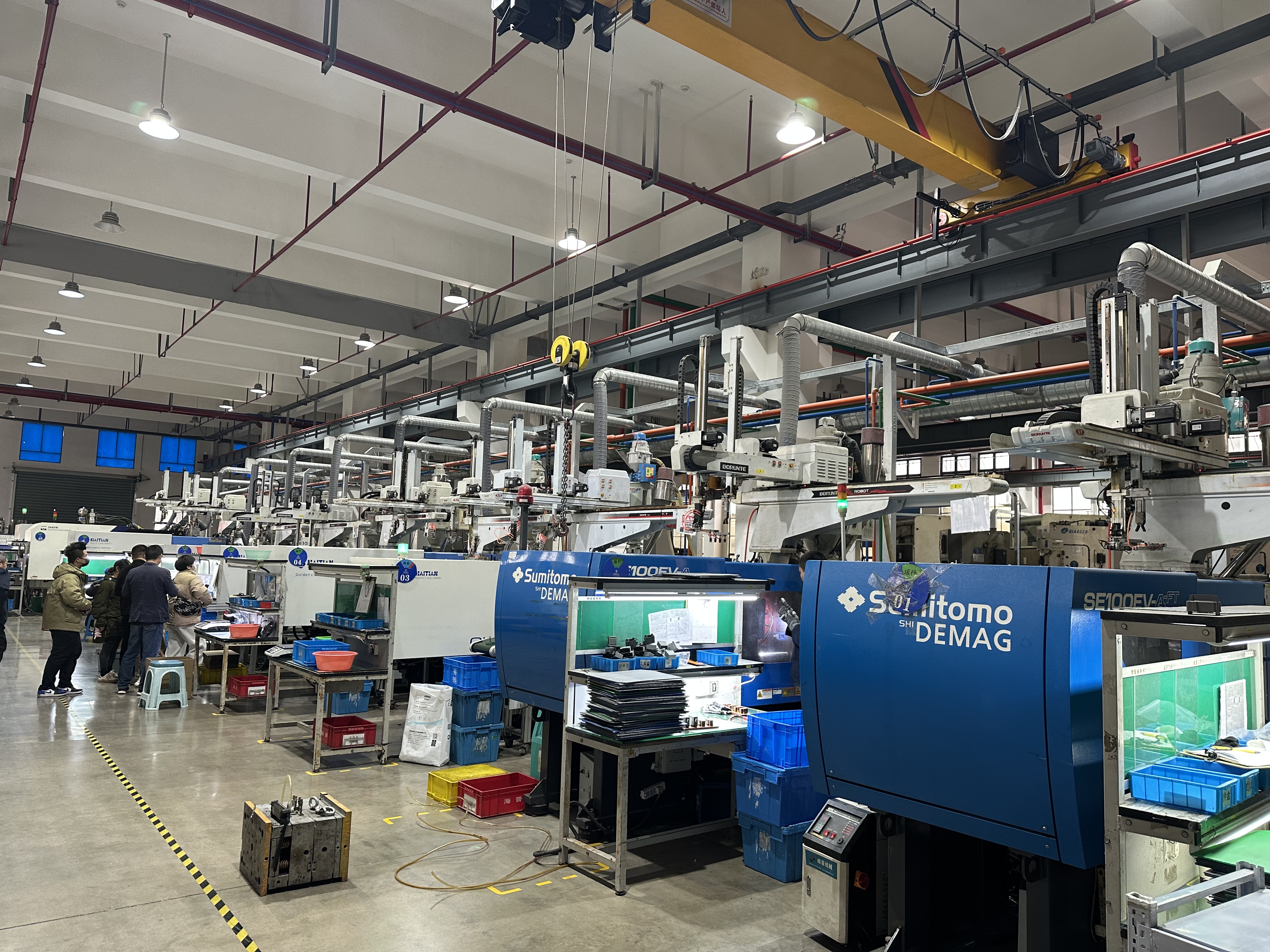
Injection moulding workshop. Image supplied by CSTRANS.
CSTRANS also reports a comparison between its conveyor spare parts and traditional ordinary conveyor spare parts. In that company-reported comparison, the parts have a 30% longer service life and a 25% lower friction coefficient; maintenance requirements are lower because installation and replacement are easier and maintenance intervals are less frequent; and although initial cost is slightly higher, long-term replacement cost is 40% lower. The same material explains that smooth operation reduces motor load and energy consumption.
The published company record also matters for replacement-part buyers. CSTRANS states that it holds spare parts in a dedicated warehouse, ships English documentation with every order and supports commissioning on site or remotely. It reports more than 20 patents granted with further applications pending, more than 12,000 conveyor solutions delivered and more than 40,000 customers served. These are company-reported credentials. They help a buyer decide what to verify, not what to assume.
Application fit: same sprocket logic, different operating conditions
The same compatibility logic produces different answers across applications. In food and beverage plants, wet dairy and beverage lines may call for PP slat chains with food-grade options because they resist water and mild detergent. In dry packaging, a POM chain and a standard POM sprocket may be the better starting point because the combination is intended for low noise and wear resistance on normal packaging lines. In chemical heavy-duty areas, stainless steel chains and matching stainless steel sprockets may be required for corrosion resistance, with a higher cost than PP or POM options.
Pharmaceutical and daily chemical lines add hygiene and cleaning requirements. The supplied component range includes optional food-grade material for food, pharmaceutical and daily chemical industries. New energy and auto parts production lines are also listed as applications where optional food-grade material and higher precision can matter. Logistics and warehousing conveyors may run continuously or intermittently, with adjustable speed, so the start-stop pattern and load profile should be recorded before a sprocket material is selected.
In all these cases, the aftermarket-versus-mainstream question should be asked after the application condition is clear. A nylon sprocket selected for shock absorption on a frequent start-stop line is not interchangeable with a standard POM sprocket selected for a normal packaging line merely because both fit the same shaft. The material reason for the choice must travel with the order.
Cost comparison: initial price is only one line in the spreadsheet
A replacement decision that compares only unit price can hide the cost of poor fit. A lower-priced sprocket that wears quickly, causes chain jump or increases maintenance frequency is not a lower-cost choice. Conversely, a higher-priced part is not automatically better if its material and dimensions do not match the line.
A practical cost comparison includes the purchase price, installation labor, expected replacement interval, downtime exposure, chain wear and energy effect. The CSTRANS comparison supplies one company-reported example: a slightly higher initial cost alongside a 40% lower long-term replacement cost and lower maintenance requirements than traditional ordinary spare parts. That example is useful because it separates first cost from replacement cost. It is not a guarantee for another supplier or another conveyor.
Market context supports the importance of the component decision without resolving it. Exactitude Consultancy estimates that the global conveyor sprockets market was valued at USD 3.46 billion in 2025 and projects growth at a 4.5% CAGR to 2035. Fortune Business Insights estimates the global conveyor system market at USD 13.1 billion in 2026. These figures describe the size and direction of the market, not the compatibility of any particular sprocket. A growing market does not reduce the need for a dimensional check.
Market context and the limits of market forecasts
Commercial research also points to application-level change. MarketsandMarkets projects that overhead conveyors will have the largest market share for automotive conveyor systems, citing increased vehicle production and plant expansions, particularly in Europe and Asia-Pacific. That is a forecast for a conveyor type, not evidence that a specific aftermarket sprocket is suitable for an automotive line. It does indicate why buyers in automotive and adjacent manufacturing sectors continue to ask for documented component data rather than brand labels alone.
For an independent buyer, the useful conclusion from the market data is modest: the replacement-component market is large enough that multiple supply routes will exist, and the buyer’s leverage comes from specifying the interface clearly. Market growth does not validate a supplier’s capacity, lead time, certification scope or material grade. Those remain order-specific checks.
Decision framework for independent buyers
The following framework keeps the comparison factual. It can be used with a mainstream-brand quotation, an aftermarket quotation or both.
| Buyer situation | First action | Evidence to request | Decision boundary |
|---|---|---|---|
| Original drawing or model record is available | Send the drawing and the chain specification | Pitch, width, tooth profile, shaft hole, material, quantity | A brand name alone does not confirm the drawing revision |
| No drawing is available | Measure the installed chain and sprocket | Pitch, width, tooth count, hub and keyway dimensions, photos with a scale | Do not order from a visual match only |
| Food or pharmaceutical line | Confirm the hygiene requirement | Material grade, food-grade option, cleaning method | A material family name is not a grade-specific declaration |
| High-temperature or corrosive line | Check the material pair | Stainless steel chain and matched sprocket specification | A stainless sprocket with a non-stainless chain is not a matched pair |
| Frequent start-stop duty | Review shock absorption needs | Nylon sprocket option and duty-cycle data | Shock absorption does not replace correct pitch and profile |
| Normal dry packaging line | Start with the standard material pair | POM chain and standard POM sprocket specification | Low noise and wear resistance still depend on alignment and tension |
Two verification steps complement the table. First, ask for the dimensional record in writing before production. Second, for a critical or high-volume line, evaluate a sample under the actual load, speed and cleaning condition. A sample evaluation is not a guarantee of service life, but it can expose a profile or material mismatch before a full order is committed.
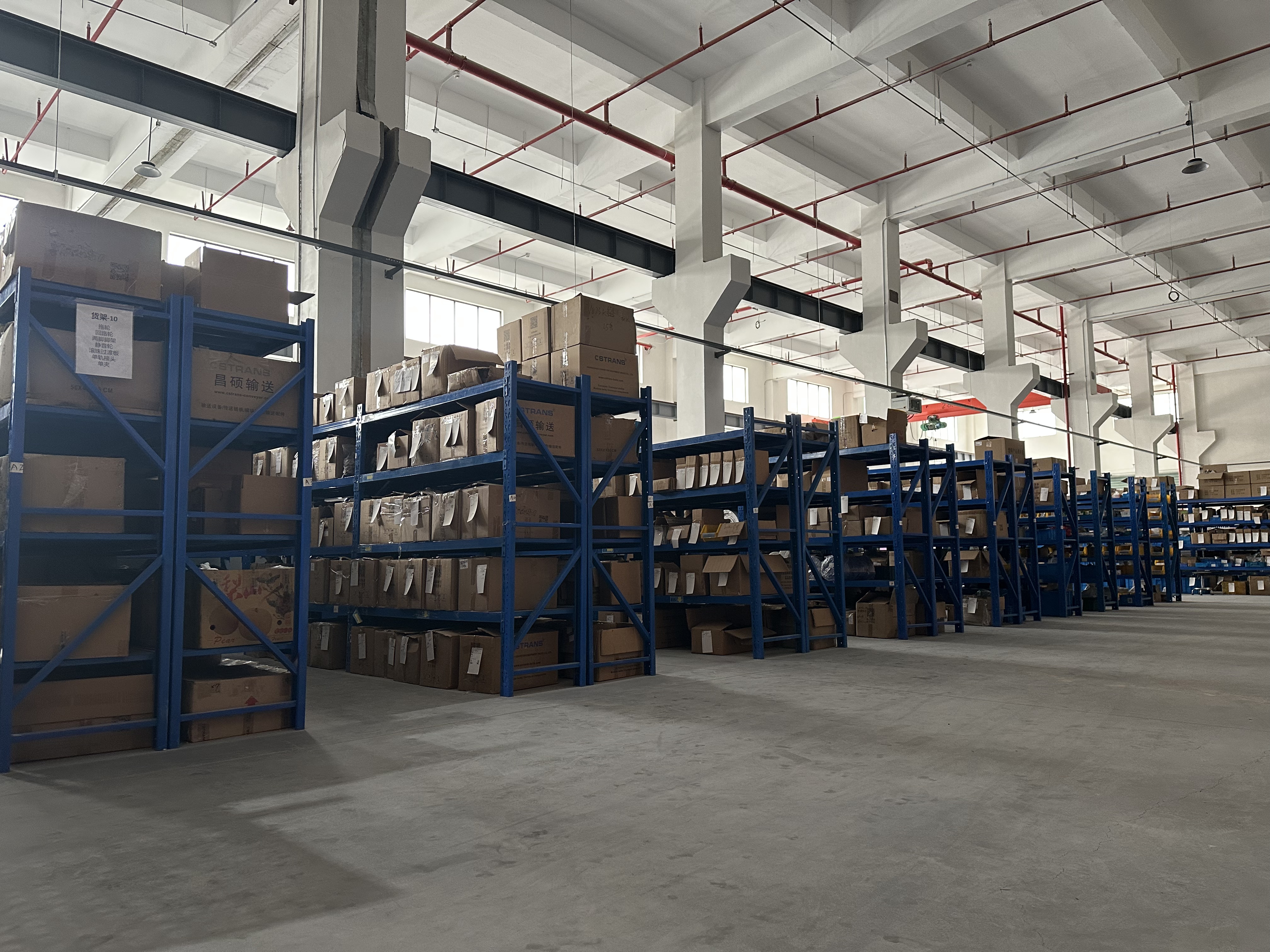
Dedicated spare-parts warehouse. Image supplied by CSTRANS.
Limitations and fit boundaries
Several boundaries should remain visible in any aftermarket-versus-mainstream comparison. The supplied evidence does not include comparable third-party performance tests for named mainstream brands, so this guide does not declare a winner. Interchangeability is not universal. Most standard slat chains, sprockets and ball guardrails are described as interchangeable with mainstream brands, but compatibility must be verified with chain pitch and dimension data. That statement supports a verification process, not a blanket replacement rule.
The CSTRANS percentage claims are company-reported and should be read against their stated comparator: traditional ordinary conveyor spare parts. They are not stated as a comparison against every mainstream brand, and the supplied material does not include a common test protocol. A buyer should ask how the figures were derived and whether the test conditions match the intended line.
Maintenance also has limits. Regular cleaning and visual inspection are required; long-term overload should be avoided; light lubrication is allowed for dry lines; and strong corrosive cleaners should not be used for PP or POM materials. Excess grease can stick dust and speed up wear, so heavy lubrication is not a default answer for plastic slat chains. These are operating boundaries, not optional refinements.
Future outlook
The component market is projected to grow, and conveyor layouts continue to be specified around modular chains, flexible routes and replaceable components. For buyers, the practical implication is not that any aftermarket part will become acceptable. It is that dimensional records, material declarations and application data will become more valuable in procurement because they allow multiple supply routes to be compared without relying on brand familiarity.
A buyer who keeps a simple compatibility file for each line, with pitch, width, tooth profile, shaft dimensions, material pair and operating conditions, is in a stronger position than one who starts from a brand name at the quotation stage. That file also makes future replacement orders faster and reduces the risk of a chain jump caused by a mismatched sprocket.
FAQ
Are conveyor spare parts interchangeable with international brands?
Most standard slat chains, sprockets and ball guardrails are interchangeable with mainstream brands. Chain pitch and dimension data should be provided to verify compatibility before ordering.
What data should I provide to check sprocket compatibility?
Chain pitch, width and thickness are required, along with sprocket tooth size, tooth quantity, shaft hole diameter and tooth profile. Material compatibility and running speed should also be stated when the line has specific temperature, washdown or start-stop conditions.
How should a sprocket be matched to a slat chain?
First confirm chain pitch and chain width. Second confirm sprocket tooth quantity and shaft hole diameter. Third verify tooth profile. A mismatched sprocket can cause chain jump and fast wear.
What maintenance do a slat chain and sprocket need?
Regular cleaning and visual inspection are required. Long-term overload should be avoided. Light lubrication is allowed for dry lines, but strong corrosive cleaners should not be used for PP or POM materials. Excess grease can attract dust and accelerate wear.
What causes abnormal noise between a slat chain and sprocket?
Common causes include a worn or mismatched sprocket tooth profile, debris at the meshing point, over-tight chain tension and dry friction between the plastic chain and sprocket. The meshing area should be cleaned, the chain pitch checked against the sprocket tooth pitch, and tension adjusted to the recommended range.
Reference:CSTRANS conveyor system brochure (PDF).
Have Questions or Need More Details?
Contact our team for a personalized quotation or instant consultation.
Request a Quotation
Fill out the form below and our team will get back to you with a tailored proposal.
WhatsApp Direct Chat
Prefer to chat in real-time? Message us on WhatsApp for instant assistance & quick answers.
- Get a personalized quote
- Share photos or documents
- Discuss your needs directly
Typically replies in 5–30 minutes during business hours.