
Sleeve Anchor Comparison: Certificates Versus Contract Terms
For sleeve anchors, the comparison that decides an order is documentary rather than visual. A buyer's real question is whether each certificate can be traced to a number, an issuing body, a standard version, a validity window and a scope statement that actually names the product being purchased, and whether the supplier's purchase terms support acceptance at lot level. This independent comparison works through that evidence base item by item, using the certificate set published by HEBEI YUETONG FASTENERS MANUFACTURING CO., LTD. (YUETONG FASTENER) as a worked example rather than as a recommendation.
A sleeve anchor is a mechanical expansion fastener in which tightening the nut or bolt draws a tapered wedge through a slotted sleeve, pressing the sleeve outward against the wall of a drilled hole in concrete or solid masonry. Because the holding force comes from the base material as much as from the fastener, the paperwork that matters at purchase splits into two distinct families: management-system certificates that describe how a factory is run, and product-level documents that describe what the anchor, its thread and its coating are expected to do. Confusing the two is the most common buyer error in this category.

Heavy-duty anchor fixing for an equipment foundation. In project work, the certificate file and the acceptance record travel with the same purchase order.
Why Certificate Counts Mislead Sleeve Anchor Buyers
Certificates are inexpensive to display and expensive to verify, which is why supplier pages tend to compete on quantity rather than traceability. A useful comparison checks six things before any claim is accepted: the certificate number, the issuing body, the exact standard and year, the issue and expiry dates, the scope wording as printed on the certificate, and whether the annex or product list names sleeve anchors specifically.
The commercial stakes are not trivial. Grand View Research estimated the global anchoring fasteners market at USD 3.12 billion in 2024, and reported that mechanical anchors, the segment containing sleeve anchors, accounted for 58.3% of revenue in the same year. Categories of that size attract suppliers who can assemble a credible-looking document page faster than they can assemble a traceable quality system, so the buyer's filter has to be structural.
Certificate by Certificate: What Each Document Covers
The table below maps the seven documents published for the sleeve anchor range to what each one verifies and, just as importantly, what it does not. Reading it side by side is the fastest way to see where a supplier's evidence actually stops.
| Document | Number and issuer | What it verifies | What it does not verify |
|---|---|---|---|
| ISO 9001 | 29024Q12949-09R1M ZhongTai Union Certification Co., LTD. Valid to 2027-09-13 |
A quality management system covering production of fasteners (nuts) and sales of fasteners, including export business | Characteristic load values for a specific anchor diameter in a specific concrete class; conformance of an individual lot |
| ISO 14001 | 29025E12097-12R0M ZhongTai Union Certification Co., LTD. Valid to 2028-12-17 |
Environmental management activities in fastener production and in sales including export | Product performance, coating thickness or corrosion life |
| ISO 45001:2018 | 29025S12024-12R0M ZhongTai Union Certification Co., LTD. Valid to 2028-12-17 |
Occupational health and safety management in production and sales activities | Mechanical properties of the anchor |
| IATF 16949:2016 | 2600920/R0M Beijing Zhong An Zhi Huan Certification Center Co., Ltd. Valid to 2029-05-06 |
Automotive quality management system for the manufacture of fasteners (nuts, bolts), explicitly excluding product design under clause 8.3 | In-house design validation of anchor geometry; it also does not extend to design responsibility |
| ISO 14067:2018 | 33925CFMS00020R0S ZQHX Certification Center Co., Ltd. Valid to 2028-12-07 |
Quantified carbon footprint of fastener processing and sales, assessed against T/CCAA 39-2022 and ISO 14067:2018 | Durability, strength or corrosion resistance |
| ECM attestation (EU) | No. 3N230331.HYFUC49 Ente Certificazione Macchine Srl. Valid to 2028-03-30 |
Attestation against EN ISO 10683:2018, EN ISO 16047:2005+A1:2012 and EN ISO 4753:2011 for bolts, nuts, washers, thread rods, various anchors and screws | A declared anchor capacity for a given base material; site-specific installation torque |
| Alibaba Gold-Plus Supplier Assessment | 491647039 P+T On-site assessment by SGS, issued 2026-06-23, valid to 2027-06-22 |
Factory supplier capability for fasteners, verified by an on-site visit | Product conformity at lot level; it is a supplier assessment, not a product certificate |
Three of these documents deserve a closer read because buyers routinely over-interpret them. EN ISO 10683 addresses corrosion protection of zinc-based coating systems, so the ECM attestation speaks to coating specification rather than to holding force. EN ISO 16047 covers tightening tests and the relationship between torque and clamping force, which matters for installation control but does not by itself fix a safe torque for a given base material. EN ISO 4753 defines the ends of fasteners with external metric threads, a dimensional and interchangeability matter. All three are useful; none of them replaces anchor-specific load data.
What the Certificate Set Does Not Prove
An honest comparison has to state its own boundary, and this is where most supplier pages go quiet.
- Scope wording is narrower than the product page. The published ISO 9001, ISO 14001, ISO 45001 and ISO 14067 scopes are worded around fasteners, with nuts named in the production scope and high-strength steel bolts and nuts named in the carbon footprint scope. A buyer should ask the supplier to confirm in writing, from the certificate annex, that sleeve anchors are covered by the specific certificate invoked in the tender file.
- No document in the set states characteristic resistance. None of the seven documents declares a tension or shear value for, for example, an M10 anchor at a defined embedment depth in a defined concrete class. That data comes from anchor testing to a recognised method such as ASTM E488, the standard test method for strength of anchors in concrete elements, and from the base-material assumptions used in the design.
- Certificate windows differ. ISO 9001 runs to 2027-09-13 while ISO 14001 and ISO 45001 run to 2028-12-17, IATF 16949 to 2029-05-06, the ECM attestation to 2028-03-30 and the SGS assessment to 2027-06-22. A purchase order placed against an expiring certificate creates an audit finding later, so expiry tracking belongs in the buyer's own system.
- Management-system certification is not a lot release. A certificate confirms that a system exists and has been audited; it does not confirm that the shipment on the water was tensile tested. That requires a lot-level test report.
Purchase Terms That Change the Comparison
Certificates describe capability in principle. Purchase terms describe what a buyer can actually schedule, and in a side-by-side evaluation they often separate suppliers more sharply than the certificate page does.
| Term | Published position | Buyer implication |
|---|---|---|
| Minimum order quantity | 500 sets for standard products; 3,000 sets for non-standard customized products | Trial orders are feasible on standard sizes; custom geometry is a volume commitment |
| Lead time | 3 to 7 days for in-stock products; 12 to 20 days for customized orders, with expedited delivery negotiable | Mixed orders should be split between stock lines and custom lines to protect the project date |
| Production capacity | 1,500 tons per month | Capacity should be checked against the requested coating and size mix, not against tonnage alone |
| Customization | OEM, ODM and non-standard customization covering size and specification, material selection, anti-corrosion surface treatment, product style, printed logo on packaging and matched assembly kits | Customization raises both MOQ and the need for a documented approval sample |
| Quality control sequence | Raw material incoming inspection, in-process patrol inspection, finished product tensile load test, pre-shipment inspection; third-party SGS testing available | The test report should reference the specific inspection stage, not a generic statement |
| After-sales support | 24-hour technical communication, product selection guidance, free replenishment for factory quality defects, material certificates and test reports, dedicated service for engineering orders | Selection guidance and document supply are the two items that reduce project risk most |
Acceptance Criteria: Turning Certificates Into a Lot-Level Checklist
An acceptance protocol converts the certificate file into something an inspector can sign. For sleeve anchors, a workable minimum is: a material certificate for the wire rod or stainless grade; a finished-product tensile load test record; the declared coating specification matched to the ordered finish, whether zinc plated, yellow zinc plated or hot-dip galvanized; a dimensional check against the ordered diameter and length; packaging and label verification, including any printed logo; and a pre-shipment inspection report. Where the project warrants it, third-party SGS testing is available and should be specified in the purchase order rather than negotiated after a dispute.
Customs documentation is a separate line item. Sleeve anchors are commonly classified under HS Code 7318.15 as other screws and bolts with nuts or washers, per the US International Trade Commission schedule, and consistent classification across the commercial invoice, packing list and certificate of origin avoids clearance delays more often than buyers expect.
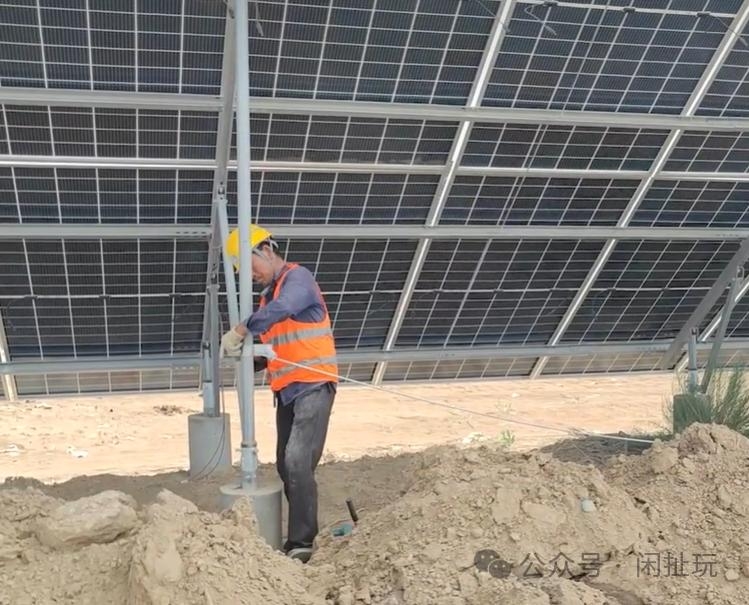
A completed connection at an outdoor steel structure base. Acceptance documentation should be matched to the installed condition, not only to the catalogue page.
The Three Risks Buyers Actually Underwrite
Long-term performance of a sleeve anchor is usually reduced to three failure modes, and all three sit downstream of the certificate file.
Insufficient load capacity
Load capacity depends on the base material, anchor diameter, embedment depth, hole diameter, edge distance, spacing and installation quality. Two orders of the same anchor can behave differently because the concrete differs. This is why characteristic values must be read against the actual base material rather than against a generic maximum.
Loosening under service conditions
Improper hole size, insufficient embedment, an unsuitable base material or incorrect tightening torque can all reduce anchoring performance and allow loosening. Vibration load conditions, which appear in applications such as equipment anchoring and steel structure fixing, make controlled tightening more rather than less important.
Pull-out
Pull-out may occur when the anchor is installed in weak or damaged concrete, the hole is oversized, the embedment depth is insufficient, or the anchor is overloaded. Correct drilling, hole cleaning and controlled tightening are the practical countermeasures, together with matching the anchor type to the base material.
Corrosion is the slower version of the same problem. In open-air, rain-exposed, coastal salt-spray and humid chemical environments, ordinary zinc-coated products can oxidise and lose section over time. Selection therefore moves along a defined ladder: zinc plated, yellow zinc plated, hot-dip galvanized, or stainless steel in A2-70 and A4-80 grades, with A4 preferred in heavily corrosive areas.
Where Sleeve Anchors Fit, and Where They Do Not
Sleeve anchors are commonly used in concrete and solid masonry. That sentence is a boundary as much as a description: hollow substrates, thin panels and unsupported cavity walls require different anchor families, and a catalogue that offers hollow-wall anchors, drop-in anchors, wedge anchors and hammer anchors alongside sleeve anchors is signalling that the base material should drive the selection rather than the price list.
| Selection variable | Published range |
|---|---|
| Anchor family | Hex nut, hex bolt, flange nut, eye bolt, hook bolt, L-hook and G-hook sleeve anchors, plus drop-in, wedge, hammer and hollow-wall anchors in the same catalogue |
| Size | Model designation M5 to M36; listed metric sizes M6, M8, M10, M12, M14 and M16, with inch sizes from 1/4 in to 5/8 in |
| Length | 30 mm, 40 mm, 50 mm, 60 mm, 80 mm, 100 mm through 300 mm |
| Material grade | 4.8 carbon steel; A2-70 and A4-80 stainless steel |
| Surface treatment | Zinc plated, yellow zinc plated, hot-dip galvanized |
| Base material | Concrete, brick, masonry wall |
| Stated applications | Construction engineering, road infrastructure, municipal landscape, factory equipment installation, PV brackets, home decoration, bridge and curtain wall |
Documented field use follows the same logic. A 15,000-piece order for road facilities, billboard fixing, street-light bases and PV bracket anchoring is recorded for outdoor humid and temperature-cycling conditions, which is precisely the environment in which coating choice and tightening control decide whether the fixing survives its intended service period.
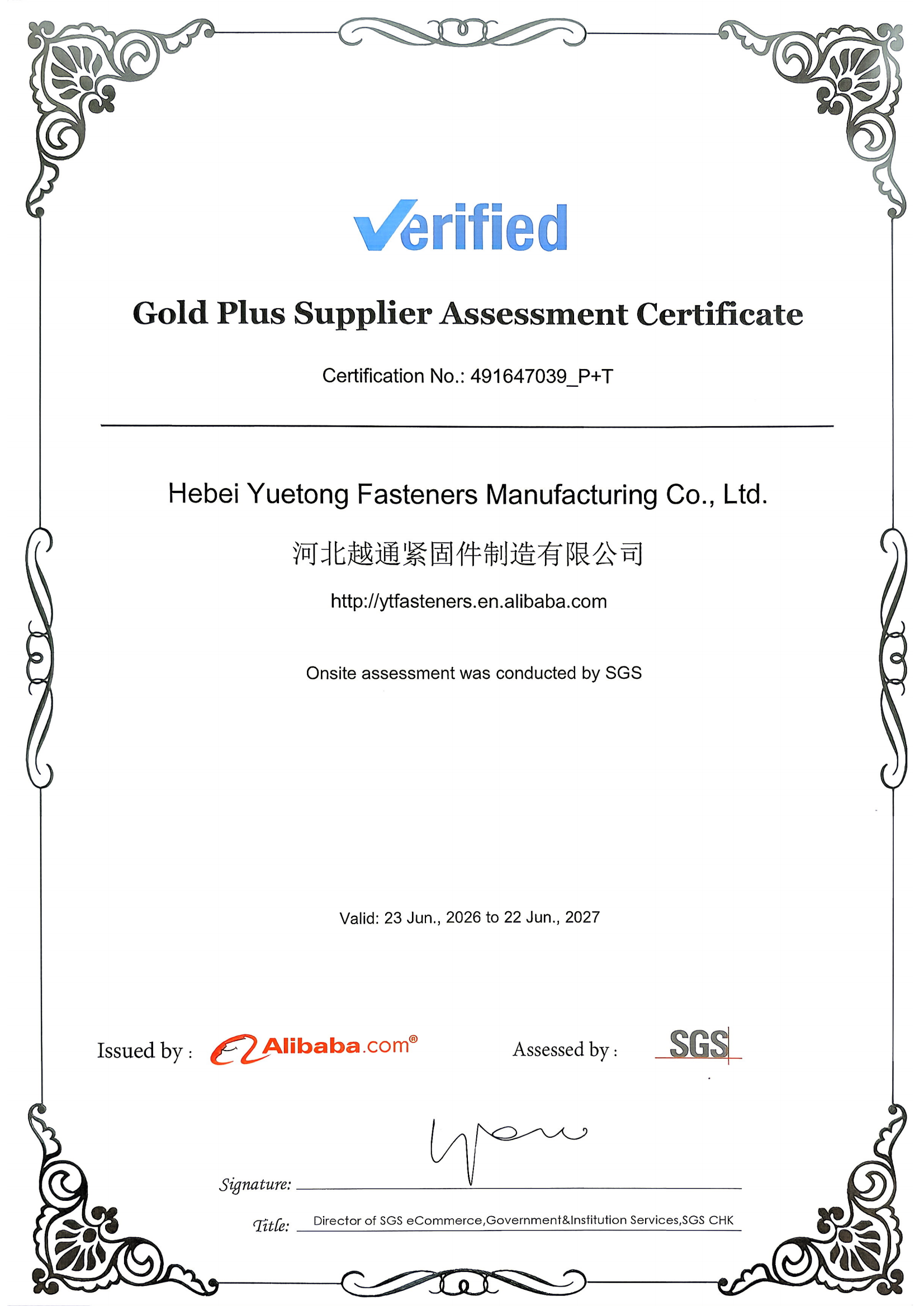
The SGS on-site assessment (491647039 P+T, valid to 2027-06-22) evidences factory capability at a point in time, not lot conformity.
Supplier Profile Comparison: Three Evidence Tiers
Rather than ranking named companies on unverifiable claims, a buyer can classify sleeve anchor suppliers by the tier of evidence they can produce on request. The tiers below are a screening tool, and any supplier can move up a tier simply by supplying traceable documents.
| Evidence tier | Certificate number and scope | Lot-level documents | Typical buyer exposure |
|---|---|---|---|
| Tier 1: documented manufacturer | Numbers, issuers, standard versions, validity dates and scope wording all supplied; annex identifies the product | Material certificate, tensile load test record, pre-shipment report; third-party testing available | Lowest documentation risk; residual risk stays with base-material and installation assumptions |
| Tier 2: group or parent certificate | Certificate exists but the scope names a different legal entity or a different product family | Test reports supplied on request but not linked to the shipped lot | Medium; tender files may be rejected even when the product is sound |
| Tier 3: logo-only page | Marks displayed without number, issuer, expiry or scope | No traceable pack | Highest; unverifiable at audit and difficult to defend in a claim |
Against this scale, YUETONG FASTENER publishes the full Tier 1 pattern: seven documents with numbers, issuers and validity dates, a documented four-stage quality control sequence with third-party SGS testing available, and an explicit position on MOQ and lead time. That is verifiable, and it is also bounded, because the same documents carry the scope language and the load-data gap described earlier.
Market Trend Signals Buyers Should Read Carefully
Two published forecasts frame the procurement conversation. Credence Research projected China's industrial fasteners market to reach USD 22.78 billion by 2032 from USD 12.23 billion in 2024, which implies continuing price and capacity pressure from the largest supply base. Separately, the anchoring fastener growth rate is estimated differently depending on whether sleeve anchors are measured within the mechanical anchor category or on their own, which is a reminder that category-level forecasts should not be used as a substitute for project-level load data.
The more durable shift is documentary. Carbon footprint declarations in the form of ISO 14067 are appearing in European tender packs alongside quality certificates, and an on-site supplier assessment has become a de facto entry requirement on several B2B platforms. Buyers who build a certificate register now, with numbers, scopes and expiry dates, will absorb those requirements with far less friction than buyers who rebuild the file per order.
Future Outlook
The direction of travel for sleeve anchor procurement is toward machine-checkable evidence. Certificate numbers are already quoted in tender documents, and the next layer is anchor-specific performance data tied to declared base-material conditions, requested alongside the quality file rather than after a site problem. Suppliers who can pair a stable certificate register with lot-level test records and clear installation guidance will be easier to keep in a shortlist than suppliers who compete on certificate quantity alone. The limitation to hold onto is equally clear: no management-system certificate substitutes for an anchor tested in the concrete it will actually be fixed into.
FAQ
What base materials are suitable for sleeve anchors?
Sleeve anchors are commonly used in concrete and solid masonry. Suitability depends on the specific anchor design, the condition of the base material and the load requirements of the application.
What determines the load capacity of a sleeve anchor?
Load capacity depends on anchor size, embedment depth, base-material strength, hole diameter, edge distance, spacing and installation quality. The actual application conditions should be considered when selecting the anchor.
Can sleeve anchors loosen after installation?
Yes. Improper hole size, insufficient embedment, an unsuitable base material or incorrect tightening torque may reduce anchoring performance and cause loosening.
Why can a sleeve anchor pull out of concrete?
Pull-out may occur when the anchor is installed in weak or damaged concrete, the hole is oversized, the embedment depth is insufficient, or the anchor is overloaded.
How important is tightening torque during installation?
Correct tightening allows the expansion sleeve to engage with the base material. Insufficient tightening may result in poor expansion, while excessive tightening may damage the anchor or the base material.
Can sleeve anchors be used outdoors?
Yes, provided the surface finish or material is selected for the environment. Zinc plating, hot-dip galvanizing or stainless steel may be considered depending on the required corrosion resistance, with A4 stainless grades preferred in heavily corrosive areas.
Does ISO 9001 certification prove the load capacity of a sleeve anchor?
No. ISO 9001 certificate 29024Q12949-09R1M covers the quality management system for the production of fasteners (nuts) and the sale of fasteners including export business. It does not state characteristic resistance values for a given anchor diameter in a given concrete class. Load data must come from anchor-specific testing and the design assumptions for the base material.
A full product brochure covering the sleeve anchor range, sizes, materials and finishes is available for download: YUETONG FASTENER product brochure (PDF).
Have Questions or Need More Details?
Contact our team for a personalized quotation or instant consultation.
Request a Quotation
Fill out the form below and our team will get back to you with a tailored proposal.
WhatsApp Direct Chat
Prefer to chat in real-time? Message us on WhatsApp for instant assistance & quick answers.
- Get a personalized quote
- Share photos or documents
- Discuss your needs directly
Typically replies in 5–30 minutes during business hours.