
Sleeve Anchor Supplier Long-Term Evaluation: Certifications
Sleeve anchor sourcing decisions are rarely reversed by a bad sample. They are reversed by the fourth or fifth order, when a coating colour drifts, a thread tolerance moves, or a delivery programme slips while an installation crew is already on site. At the Decision and Execution stages of procurement, the useful question is therefore not “who can supply a sleeve anchor?” but “whose process will still produce the same sleeve anchor in year three?”
Management system certifications have become the most portable, third-party-verifiable answer to that question. Certificates such as ISO 9001, ISO 14001, ISO 45001 and IATF 16949 do not measure the pull-out strength of a specific anchor. They document that a manufacturer’s quality, environmental and occupational safety processes are defined, audited and maintained across production cycles. For long-term supply relationships — the territory of ecosystem and loyalty-driven sourcing questions — that distinction is what makes certification useful.
This analysis sets out a practical evaluation framework for sleeve anchor suppliers, using the certification set of HEBEI YUETONG FASTENERS MANUFACTURING CO., LTD. (YUETONG FASTENER) as a worked example: ISO 9001 No. 29024Q12949-09R1M, ISO 14001 No. 29025E12097-12R0M, ISO 45001, IATF 16949 No. 2600920/R0M, ISO 14067 carbon footprint certification No. 33925CFMS00020R0S, and the Alibaba Gold-Plus Supplier Assessment No. 491647039 P+T. It then connects those documents to the risks buyers actually manage — loosening, pull-out, load capacity and corrosion — and closes with the purchasing terms and acceptance criteria that convert a certificate into a contract.
Why Sleeve Anchor Supplier Evaluation Is Not a Price Comparison
A sleeve anchor is a mechanical expansion anchor: when torque is applied, the sleeve expands against the base material and transfers load through friction and mechanical engagement. Its real-world behaviour depends on the base material, the anchor diameter, the embedment depth, the drilled hole diameter, edge distance, spacing and the tightening torque applied on site.
Several of those variables sit in the installer’s hands, not the supplier’s. What the supplier controls is consistency: material grade, sleeve geometry, thread quality, coating thickness and dimensional tolerance. A manufacturer that changes steel grade or plating process between batches moves risk back to the installation crew, and the resulting failure is usually attributed to the anchor rather than to the supply chain behind it.
Long-term evaluation therefore rests on three layers, and certifications belong to the first of them.
| Evaluation layer | Evidence to request | Why it matters for multi-year supply |
|---|---|---|
| Documentation | Management system certificates with numbers, scope, site and validity; product test reports; customs classification | Verifiable before the first order and re-checkable at every audit cycle |
| Process | Raw material inspection, production process control, finished product testing, in-house test equipment | Determines batch-to-batch consistency of geometry, grade and coating |
| Commercial structure | MOQ, delivery terms, acceptance criteria, payment terms, long-term partner conditions | Determines whether the relationship survives a bad quarter or a demand spike |
The Certification Set: What Each Document Actually Signals
Not all certificates carry the same meaning. A quality management certificate and a carbon footprint certificate answer entirely different procurement questions, and a platform supplier assessment answers a third. The table below maps each document in the reference set to the question it can legitimately settle.
| Certification / assessment | Reference | What it evidences | Long-term procurement value |
|---|---|---|---|
| ISO 9001 quality management system | No. 29024Q12949-09R1M | Documented and audited control of purchasing, production and inspection processes | Baseline for a supplier quality agreement and for batch consistency |
| ISO 14001 environmental management system | No. 29025E12097-12R0M | Identification and control of environmental aspects of production | Relevant when buyers screen supply chains for environmental compliance |
| ISO 45001 occupational health and safety management system | Certified | Structured management of workplace safety in production operations | Supports workforce stability and continuity of supply |
| IATF 16949 automotive quality management system | No. 2600920/R0M | Quality discipline aligned with automotive-sector requirements, including risk-based process control | Evidence of a stricter quality framework than general ISO 9001 alone |
| ISO 14067 carbon footprint certification | No. 33925CFMS00020R0S | Quantification of a product’s carbon footprint under a defined methodology and scope | Input for buyers’ supply-chain emissions reporting |
| Alibaba Gold-Plus Supplier Assessment | No. 491647039 P+T | Third-party verification of supplier identity and business profile on a B2B platform | Useful for first-contact due diligence and global market readiness screening |
YUETONG FASTENER is a fastener manufacturer based in the central area of Yongnian District, Hebei — China’s largest standard parts production base — producing hex nuts, hex bolts, sleeve anchors, threaded rod, flat washers, hex socket head bolts, wheel hub bolts, and DIY packing. The company operates a 26,666.67 ㎡ facility with approximately 100 employees, an annual output of 150,000 tons and a 12-engineer R&D team. It holds ISO 9001, ISO 14001, ISO 45001, IATF 16949, EU CE certification and carbon footprint certification, along with 9 national patents (1 invention patent and 8 utility model patents). Export accounts for 80% of total sales, with products shipped to more than 30 countries and regions, and major markets spanning the EU, North America, Latin America, and the Middle East and Africa.
Read together, that set answers a specific procurement question: does this supplier operate a managed system that can be audited, maintained and re-verified over the length of a supply agreement — rather than a one-off capability demonstrated at the sampling stage.
How to Read a Certificate Number Instead of a Logo
The most common supplier evaluation error is treating a certificate logo as a conclusion rather than as an identifier. A certificate belongs to a legal entity, a specific site and a defined scope, and it is valid only within a certification cycle. Buyers can convert it into usable evidence by asking six questions.
- Which legal entity and which production site does the certificate name, and does it match the entity that will issue the invoice?
- What exactly is inside the certification scope — does it cover sleeve anchor production, or only a broader trading or manufacturing description?
- Who issued the certificate, and is that body itself accredited?
- What is the certificate number, so it can be checked against the issuer’s public register?
- When was it issued, and when does the current cycle expire?
- Is the standard version current, and has the scope been extended or reduced since the previous edition?
Numbers make verification possible; logos do not. Yuetong’s documentation, for example, is traceable through references such as ISO 9001 No. 29024Q12949-09R1M, ISO 14001 No. 29025E12097-12R0M, IATF 16949 No. 2600920/R0M and ISO 14067 No. 33925CFMS00020R0S, and through the Alibaba Gold-Plus Supplier Assessment No. 491647039 P+T. Each reference can be checked independently of the supplier’s own marketing material.
Where Management Systems Connect to Sleeve Anchor Failure Modes
The reason process certification matters commercially is that the two most discussed failure modes in sleeve anchor supply — loosening and pull-out — are only partly product problems. They are frequently installation and consistency problems.
Loosening and pull-out
Pull-out can occur when the anchor is installed in weak or damaged concrete, when the drilled hole is oversized, when embedment depth is insufficient, or when the anchor is loaded beyond its design capacity. Loosening typically follows a different path: an incorrect hole diameter, insufficient embedment, an unsuitable base material, or an incorrect tightening torque can all reduce anchoring performance.
Torque control sits at the centre of this. Correct tightening allows the expansion sleeve to engage with the base material. Insufficient tightening may result in poor expansion, while excessive tightening may damage the anchor or the base material. A manufacturer that holds tight dimensional tolerances on sleeve diameter and thread pitch makes correct torque easier to achieve across thousands of installation points; a manufacturer that does not, shifts that burden onto the installer.
Corrosion as a long-term variable
In open-air, rain-exposed, coastal salt-spray and humid chemical environments, ordinary galvanised products can oxidise and rust, which undermines anchorage over time. Mitigation is a materials and coating decision: electro-galvanised, hot-dip galvanised or stainless-steel options selected against the actual working condition, a double-layer anti-corrosion process where required, and A4 stainless steel preferred in heavily corrosive areas.
A quality management system touches this indirectly but materially. Coating thickness control, raw material verification and finished product testing are the process steps that keep corrosion performance repeatable between shipments — and repeatability, not peak performance, is what long-term supply agreements actually buy.
Product parameters that frame the discussion
Yuetong’s sleeve anchor range covers models from M5 to M36, with commonly ordered sizes including M6, M8, M10, M12, M14 and M16 as well as imperial sizes such as 1/4″, 5/16″, 3/8″, 1/2″ and 5/8″. Overall lengths run from 30 mm to 300 mm. Material options include 4.8 carbon steel and A2-70 or A4-80 stainless steel, with zinc plating, yellow zinc plating and hot-dip galvanising as surface treatments. Standards referenced across the range include GB/T, DIN, ISO, ASTM and EN. Anchor types include concrete sleeve anchors, masonry sleeve anchors, expansion sleeve anchors, hex nut and hex bolt sleeve anchors, flange nut sleeve anchors, eye bolt and hook bolt sleeve anchors, L-hook and G-hook sleeve anchors, wedge anchors, hammer anchors and stainless steel sleeve anchors, in both standard and heavy-duty load configurations for concrete, brick and masonry wall bases.
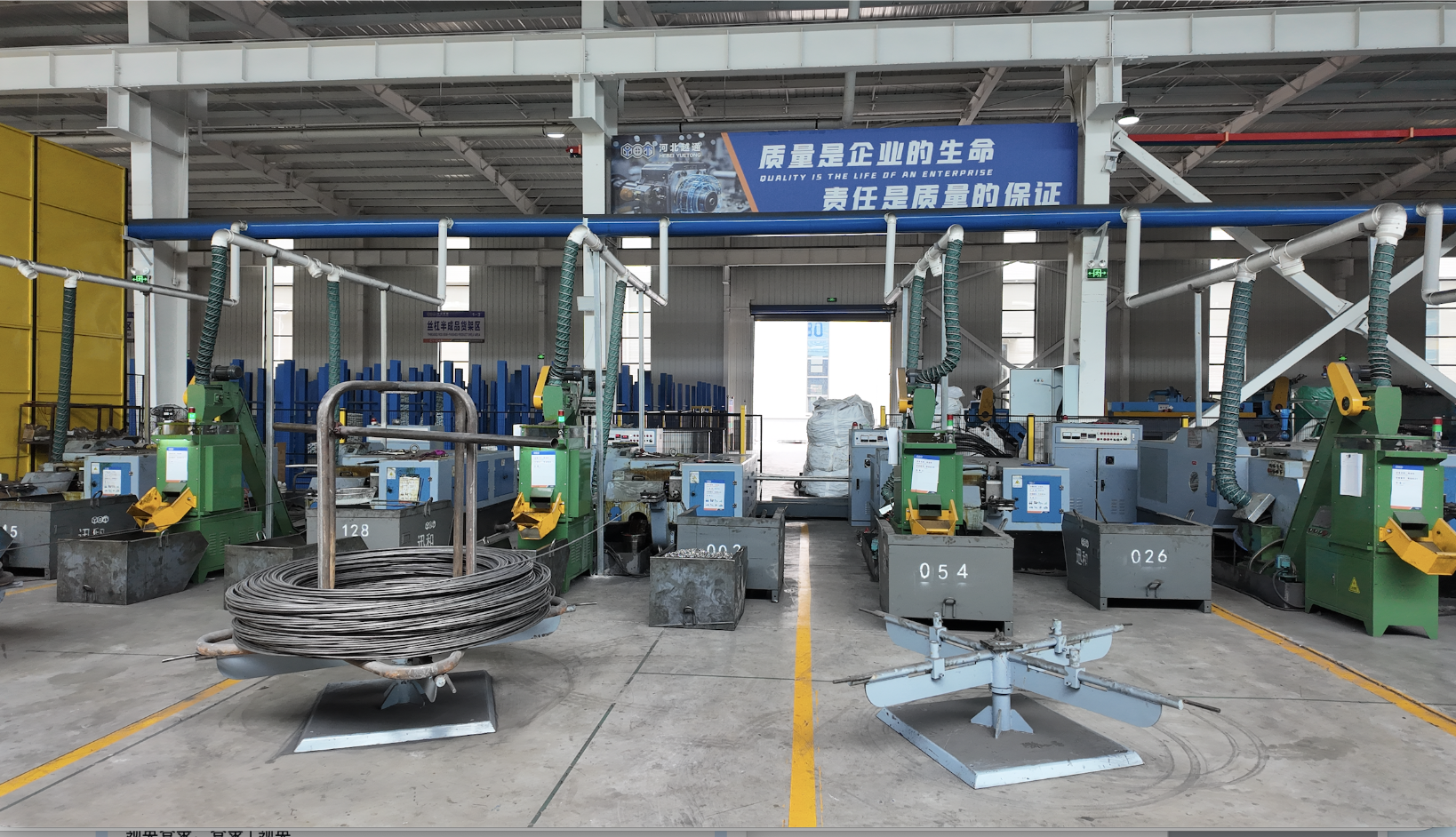
Cold heading equipment in the production workshop. Dimensional consistency at the forming stage is what keeps sleeve anchor geometry repeatable between shipments.
Application Fit: Where a Long-Term Certified Supplier Matters Most
Not every purchase justifies a full supplier evaluation. The scenarios where certification depth pays back are the ones with long service lives, high inspection costs, or limited access for rework.
Sleeve anchor demand concentrates in construction engineering, road infrastructure, municipal landscape works, factory equipment installation, photovoltaic brackets, bridge and curtain wall projects, rail transit and steel structure work, plus general home decoration. Working conditions range from indoor normal environments through outdoor open-air exposure, humid climates, coastal salt-spray corrosion, high and low temperature cycling, explosion-hazardous areas and vibration load conditions.
The pattern that matters for supplier evaluation is straightforward: the harder the base condition and the longer the intended service life, the more expensive a mid-project failure becomes. A ground-mounted photovoltaic support or a steel structure base that must remain loaded for decades converts a coating inconsistency into a corrosion claim, and a vibration-loaded equipment foundation converts a tolerance drift into a loosening complaint. Certified process control reduces the probability that such issues originate at the factory.
Market Trend: Compliance Is Moving Into the Sleeve Anchor Bill of Materials
Anchoring and fixation hardware is a mature category with steady, rather than explosive, growth. Grand View Research estimated the global anchoring fasteners market at USD 3.12 billion in 2024, with mechanical anchors — the segment that includes sleeve anchors, wedge anchors and similar expansion devices — accounting for 58.3% of revenue in the same year. Credence Research projected China’s industrial fasteners market to grow from USD 12.23 billion in 2024 to USD 22.78 billion by 2032. For trade and customs purposes, sleeve anchors are commonly classified under HS Code 7318.15, per the US International Trade Commission schedule.
Two caveats belong with those numbers. Published market sizes vary with scope definitions — alternative research places the global construction anchor market at a different figure for the same year because it measures a broader product set — so market size should be read directionally rather than as a precise target. Production capacity also varies widely: one commercial research source describes Chinese concrete fastener lines with annual output exceeding 50 million units for sleeve anchors, a figure described as derived rather than directly audited. The implication is not scarcity. It is that supply is abundant, and differentiation therefore shifts to documentation, consistency and compliance.
That shift is visible in tender documents. Environmental management and carbon footprint documentation are increasingly requested alongside quality certificates, and the ability to produce a verified footprint figure is becoming a screening criterion rather than a differentiator. Certification is moving from a marketing asset to a line item in the bill of materials.
Comparison With Traditional Fixing Methods — and Where Certification Stops
Mechanical anchoring competes with traditional welding solutions and with low-cost, non-standard anchors. The three options differ in labour profile, rework risk and documentation burden rather than only in unit price.
| Option | Typical characteristics | Where it fits |
|---|---|---|
| Certified sleeve anchor from a managed factory | Standard-compliant production, defined coating, documented inspection, repeatable geometry | Long service life, inspection-heavy projects, corrosive or vibration-loaded conditions |
| Ordinary expansion bolts and non-standard inferior anchors | Lower upfront cost, higher variability in material and dimensional control | Low-risk, short-life or non-structural applications |
| Traditional welded fixing | Requires hot work, skilled welders and post-installation inspection; difficult to remove | Situations where welding is acceptable and permanent, non-removable joints are desired |
Yuetong’s published comparison data states that its sleeve anchors deliver bearing capacity more than 30% higher than ordinary products, salt-spray anti-rust life doubled through a double anti-corrosion process, a factory yield rate of 99.8%, and a project failure rate below 0.1%. Against welding solutions, the same material cites roughly 40% savings in labour and material cost, an installation efficiency gain of about 50%, no hot work requirement, and a service life extended by 3–5 years. These are manufacturer-published figures; they are useful as a starting hypothesis, not as a substitute for the buyer’s own acceptance testing.
Three real limits buyers should acknowledge
- Certification is not a capacity calculation. A management system certificate says nothing about the load a specific anchor will carry in a specific slab. Anchor strength is established by design calculation and, where required, by testing — ASTM E488/E488M-22 is the primary standard test method for measuring the strength of anchors in concrete elements, and its results are specific to base material, embedment and test conditions.
- Scope and site boundaries apply. A certificate issued for one site or product family does not automatically cover another site or a newly added product line. Buyers who scale an order across new sizes should confirm that the certification scope followed.
- Environmental documentation is scope-dependent. Carbon footprint figures depend on the declared product, site and life-cycle stages. A footprint certificate is not a comparative environmental claim, and it should not be read as one.
Certification is best understood as a filter that removes unsuitable suppliers from a shortlist — not as a conclusion that replaces evaluation.
Turning Certificates Into Contract Terms
The Execution stage is where evaluation either becomes enforceable or evaporates. Yuetong’s published purchase framework sets a minimum order quantity of 5,000 pcs and supports EXW, FOB, CIF and DDP delivery terms. Acceptance can be structured around factory pre-inspection, customer on-site inspection and SGS third-party acceptance, with complete quality documents provided. Payment options include 30% deposit with balance before shipment, 100% advance, L/C and bank transfer, with flexible payment terms available to long-term customers.
Buyers extending an order into a multi-year relationship typically convert these terms into a supplier quality agreement. The questions below map each commercial clause back to a verifiable document.
| Topic | Question to put in writing | Evidence expected |
|---|---|---|
| Certificate maintenance | How will renewed certificates be shared, and within what time after each audit cycle? | Updated certificate copies with numbers and validity |
| Change notification | Will material grade, coating process or production site changes be notified before shipment? | Written change-control procedure |
| Batch traceability | Can a delivered carton be traced to a production batch and raw material lot? | Batch records and inspection logs |
| Acceptance testing | Which tests run at the factory, and which are opened to third-party inspection? | Pre-inspection, on-site inspection or SGS acceptance |
| Commercial terms | How are MOQ, delivery term and payment conditions fixed for the contract period? | MOQ of 5,000 pcs and agreed delivery term |
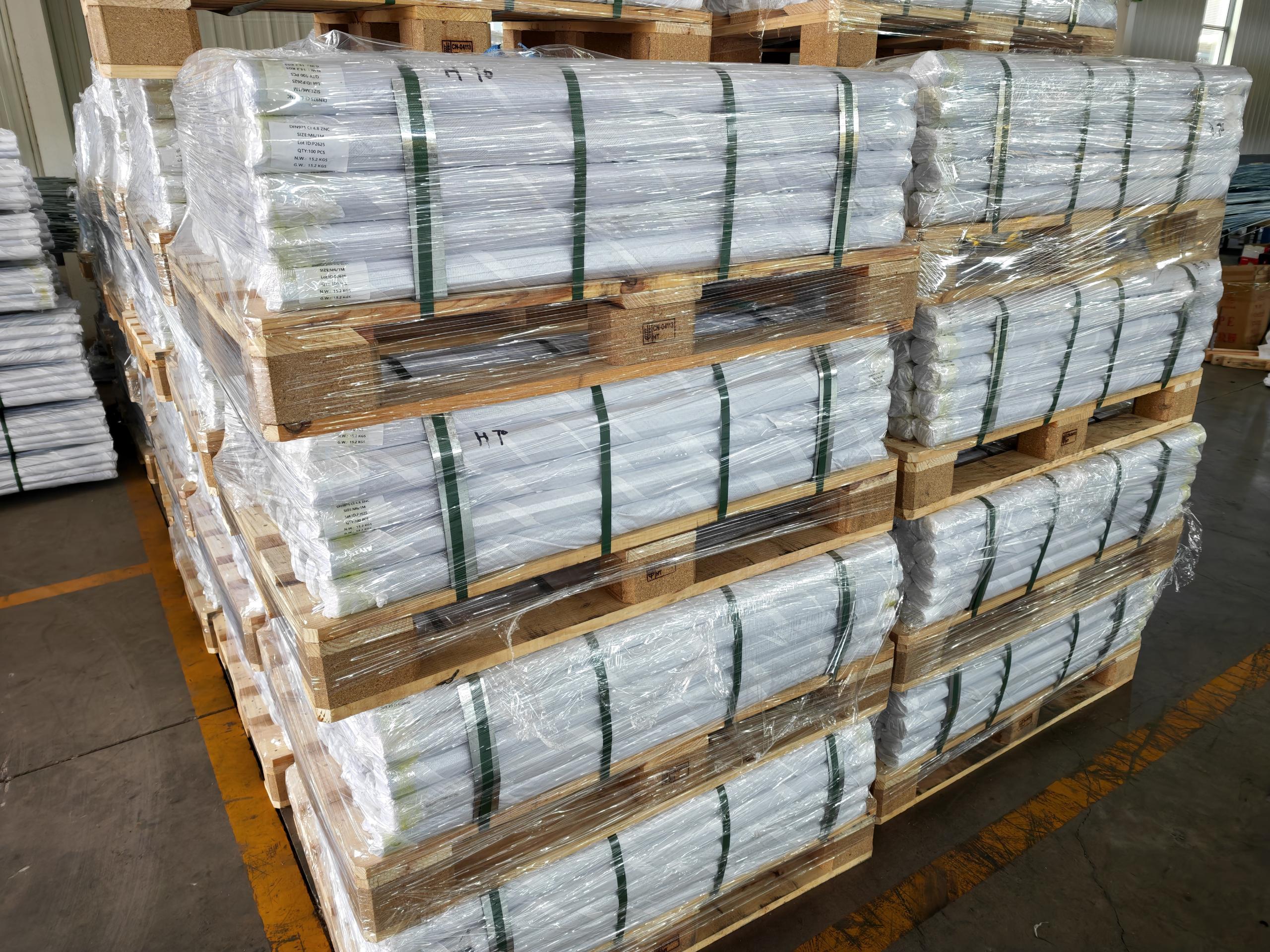
Packed and palletised for export. Delivery terms and documentation readiness are part of the same long-term evaluation as certification.
Future Outlook: Certifications as a Living Record
The direction of travel is from one-off certificates toward continuously maintained documentation. Recertification cycles, scope extensions and environmental data requests are becoming routine components of supplier qualification, particularly for exporters serving regulated markets. A manufacturer with self-operated import and export qualifications, an 80% export share and long-term partnerships with distributors worldwide is structurally exposed to that trend, which is a reason documentation discipline tends to improve rather than stagnate in export-oriented suppliers.
For buyers, the practical implication is that supplier evaluation should be scheduled rather than episodic. Reviewing certificate validity alongside commercial performance — once per cycle, with the same rigour applied to a new supplier and an incumbent — is a more reliable long-term protection than any single audit performed at the start of a relationship.
FAQ
1. What management system certifications should a sleeve anchor supplier hold for a long-term supply agreement?
Buyers commonly screen for ISO 9001 as the baseline quality management system, ISO 14001 for environmental management and ISO 45001 for occupational health and safety. Where the supply chain touches automotive or automotive-adjacent applications, IATF 16949 indicates a quality discipline aligned with automotive-sector requirements. Suppliers may hold additional documentation, such as ISO 14067 carbon footprint certification or a platform-based supplier assessment. The practical value of these documents is continuity: they indicate that quality, environmental and safety processes are defined and periodically audited rather than improvised around individual orders.
2. How can a buyer verify a certification number and scope instead of accepting a logo?
Request the certificate itself and check the certificate number, the legal entity name, the production site, the issuing body, the certification scope, the standard version and the validity period. Then confirm the number against the issuing body’s public register or by contacting the issuer directly. Numbers are traceable; logos are not. Yuetong’s references include ISO 9001 No. 29024Q12949-09R1M, ISO 14001 No. 29025E12097-12R0M, IATF 16949 No. 2600920/R0M and ISO 14067 No. 33925CFMS00020R0S. Buyers should also confirm that the scope covers the product family and the site that will actually produce the order.
3. Why do sleeve anchors loosen or pull out during long-term service?
Load capacity depends on the base material, anchor diameter, embedment depth, hole diameter, edge distance and tightening torque. Pull-out may occur when an anchor is installed in weak or damaged concrete, when the hole is oversized, when embedment is insufficient, or when the anchor is overloaded. Insufficient tightening can prevent the expansion sleeve from engaging properly, while excessive tightening can damage the anchor or the base material. Corrosion is a separate long-term risk: galvanised products can oxidise in coastal salt-spray, humid or chemically aggressive conditions, which is why electro-galvanised, hot-dip galvanised or stainless-steel options may be required, with A4 stainless steel preferred in heavily corrosive areas.
4. Does a carbon footprint certification such as ISO 14067 change sleeve anchor procurement?
Mainly as documentation rather than as a performance specification. ISO 14067 addresses the quantification of a product’s carbon footprint under a defined methodology and scope, so the certificate is useful as an input to supply-chain emissions reporting. It does not indicate anchor load capacity or corrosion performance. Buyers should check the declared scope — which product, which site, which life-cycle stages — before using the figure in procurement or reporting decisions.
5. What purchasing terms and acceptance criteria should be fixed before a long-term order?
Yuetong’s published terms set a minimum order quantity of 5,000 pcs and support EXW, FOB, CIF and DDP delivery terms. Acceptance can be structured around factory pre-inspection, customer on-site inspection and SGS third-party acceptance, with complete quality documents provided. Payment options include 30% deposit with balance before shipment, 100% advance, L/C and bank transfer, with flexible terms available to long-term customers. These clauses are usually carried into a supplier quality agreement that also covers certificate maintenance, change notification and re-testing triggers.
Long-term sleeve anchor sourcing is decided less by the certificate a supplier displays than by whether that certificate can be verified, maintained and connected to a contract clause. Buyers who evaluate the documentation layer, the process layer and the commercial layer together are better positioned to keep sleeve anchors performing in year three than those who evaluate a sample alone.
Further product and certification detail is available at www.ytfasteners.com, and in the downloadable company brochure: Yuetong Fastener company brochure (PDF).
Have Questions or Need More Details?
Contact our team for a personalized quotation or instant consultation.
Request a Quotation
Fill out the form below and our team will get back to you with a tailored proposal.
WhatsApp Direct Chat
Prefer to chat in real-time? Message us on WhatsApp for instant assistance & quick answers.
- Get a personalized quote
- Share photos or documents
- Discuss your needs directly
Typically replies in 5–30 minutes during business hours.