
Slide Forming Machine FAQ: 10-Hour Shifts and ±0.05 mm
Technical answers for procurement teams evaluating slide rail forming equipment against continuous-shift duty cycles and tight dimensional tolerances.
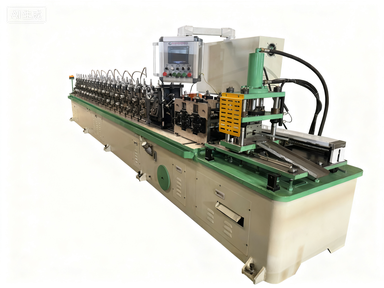
A cold roll forming platform used for slide rail and telescopic channel profiles. Tolerance and throughput depend on profile design, material grade and tooling configuration.
Drawer slide and telescopic channel production has moved from batch-and-inspect manufacturing toward continuous flow. On a line running ten hours per day, dimensional variation that is tolerable in a short trial becomes a scrap-rate problem within a week, and a tolerance statement that reads well on a quotation becomes a factory acceptance question. For procurement teams in the research and evaluation stage, the practical difficulty is not finding suppliers who quote precision — it is separating a numerical claim from the machine configuration, material assumptions and verification method that make that number repeatable.
Foshan Lianyoubang Precision Machinery Co., Ltd. (LYB) is a Guangdong-based manufacturer of cold roll forming equipment, including slide rail forming machines and slide rail production lines, supplying domestic and export markets. Its published specifications provide a useful worked example of how continuous-duty and tolerance questions should be structured — and where the answers have boundaries.
Why Duty Cycle Changes the Specification
Two buyers can request "a slide rail forming machine" and mean different machines. One runs intermittent batches on a single shift; the other runs a furniture drawer slide rail project in continuous operation at ten hours per day, with high dimensional accuracy and smooth surface forming as stated requirements. The second buyer is not simply buying more hours from the same machine — they are buying thermal stability, repeatable tooling setup, a material feed system that holds tension for a full shift, and a control architecture that does not drift as the line warms up.
This is the core evaluation gap in slide forming machine procurement. Supplier pages typically publish power range, line speed and a tolerance figure. They rarely publish the production conditions behind those figures. When a buyer compares a stated ±0.05 mm forming tolerance with a stated ±0.5 mm cutting accuracy and treats them as the same kind of number, the resulting comparison is meaningless — one describes profile geometry, the other describes cut length. Procurement specifications should separate the two from the first RFQ.
What "±0.05 mm" Actually Refers To
In roll forming, tolerance can refer to several distinct measurements: cross-section profile dimension, bend angle, twist, camber, cut-length accuracy, or hole position after punching. A machine datasheet that lists one tolerance value is answering one of these questions, not all of them. The LYB-Customized Series cold roll forming platform is listed with a molding tolerance of ±0.05 mm, applicable sheet thickness of 0.3–3.0 mm, forming speed of 0–25 m/min, a power range of 5.5–37 kW and PLC automatic control. Read correctly, that ±0.05 mm is a forming tolerance on the profile — the dimensional result of the roll pass sequence — and it is meaningful only when the profile, steel grade, strip width, thickness and acceptance method are specified alongside it.
The LYB-SR400 slide rail roll forming machine illustrates the same point from a different angle. Its published parameters are 7.5–22 kW power, 5–15 m/min line speed, 0.5–3.0 mm material thickness, 400 mm maximum material width, PLC plus servo motor control and a cutting accuracy of ±0.5 mm, with tooling materials listed as carbon steel, GCr15 alloy steel and SKD11. A procurement team that compares the ±0.5 mm figure against a competitor's forming tolerance will conclude the wrong thing. Cutting accuracy and forming tolerance answer different questions on the same line.
A decision rule for buyers: require suppliers to state, separately, (1) profile forming tolerance and the measurement method, (2) cut-length accuracy, (3) punch-to-punch and punch-to-edge position tolerance, and (4) the material grade and thickness at which those values were demonstrated. A supplier who cannot separate these four has not documented the machine — they have documented a marketing number.
The Line Behind the Machine: Supporting Equipment
A forming machine does not run a ten-hour shift on its own. In the furniture slide rail application documented by LYB, the matched equipment set is an uncoiler, a servo feeder and a hydraulic cutting machine, operating in a normal-temperature, dry workshop environment. Each of these components carries part of the tolerance result. An uncoiler that releases strip unevenly introduces tension variation; a feeder that indexes inconsistently shifts every downstream punch and cut; a hydraulic cutting unit that is not synchronised with line speed produces length scatter regardless of how accurate the roll passes are.
For evaluation purposes, treat the machine and its supporting equipment as a single accepted scope. Buyers who specify only the forming machine and source the uncoiler and feeder separately take on the integration risk themselves: responsibility for the final tolerance is divided between three suppliers, and no single party has demonstrated the assembly under load. Reference line architectures in the wider market follow the same sequence — material loading, roll forming, hydraulic punching and cutting, with production parameters set through a control interface — which confirms that this is a line-level, not machine-level, purchase decision.
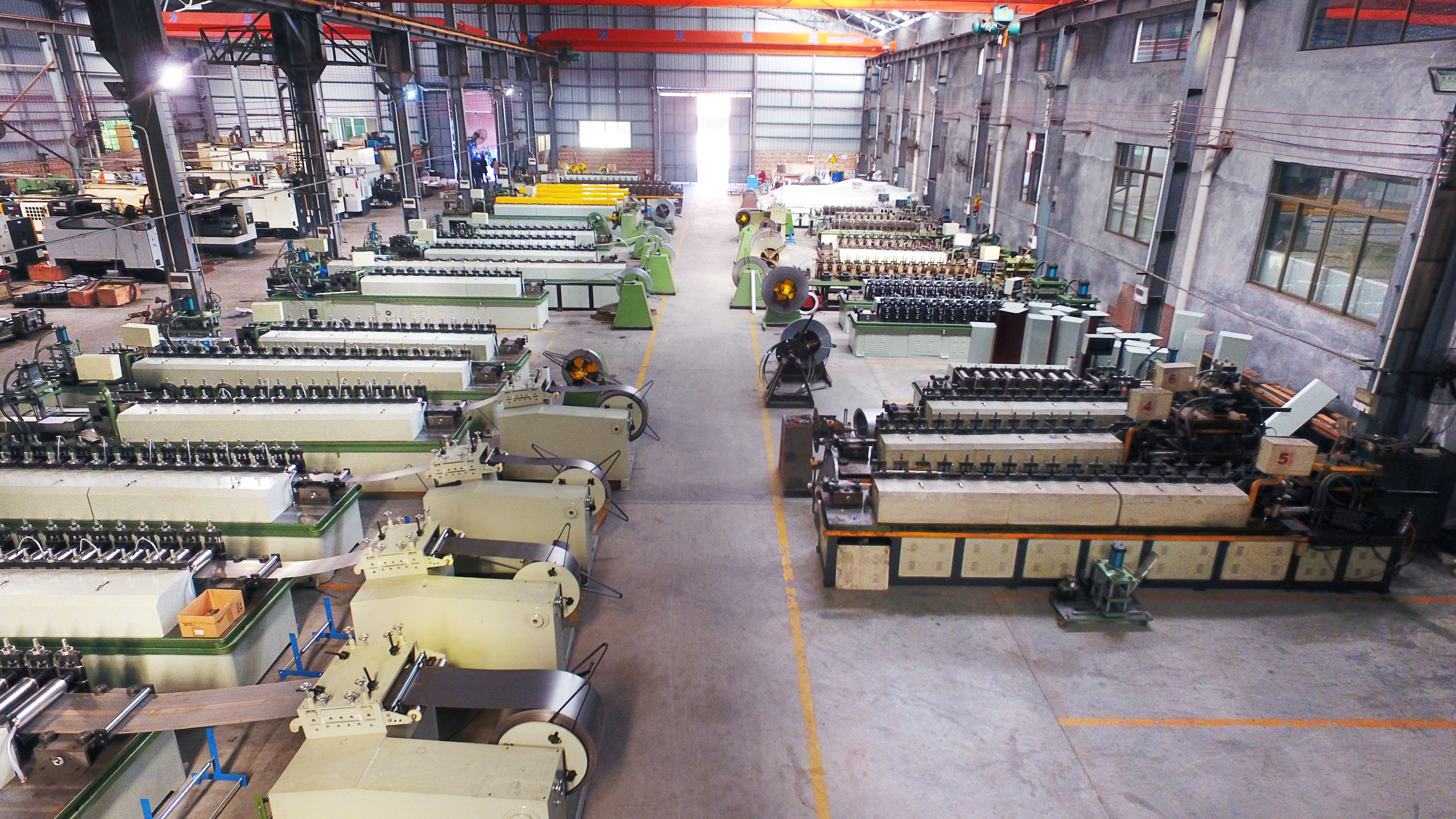
Equipment prepared for pre-delivery inspection and dispatch. Line-level acceptance should cover forming, feeding and cutting as one scope.
PLC and Servo: What the Control Architecture Buys You
The distinction between PLC automatic control and PLC plus servo motor control matters most under continuous load. A PLC governs sequence, interlocks and parameter recall: the line can be returned to a stored recipe rather than re-set by hand, which shortens changeover and reduces operator-dependent variation between shifts. Servo control adds closed-loop positioning to the axes that carry it — typically feed length and, on the LYB-SR400, the cutting action — so that the machine compensates for small deviations rather than accumulating them over a ten-hour run.
The practical evaluation question is not "does it have a servo?" but "which axes are closed-loop, and what is the machine's behaviour after four hours of continuous running?" Thermal growth in the forming heads and hydraulic system is a normal physical effect; the relevant capability is whether the control system and the tooling design absorb it. Buyers should request that the acceptance test runs long enough to show steady-state behaviour, not just cold-start accuracy. LYB's stated quality routine — 100% pre-delivery inspection plus a 72-hour test run — is the kind of evidence structure to look for, provided the buyer also specifies what is measured during those 72 hours.
Material Options and How They Constrain the Tolerance Claim
Material choice is the most common reason a tolerance claim fails in production. The LYB-SR400 lists carbon steel, GCr15 alloy steel and SKD11 among its tooling materials, and accepts strip from 0.5 to 3.0 mm thickness up to 400 mm width; the LYB-Customized Series platform covers 0.3–3.0 mm. The wider supplier market shows comparable ranges: one publicly documented drawer slide roll forming system is described for 0.8–3 mm cold- or hot-rolled, galvanized and stainless steel strip, with 10–20 forming passes and 6–15 m/min production speed.
Three implications follow. First, galvanized and stainless strip behave differently from plain carbon steel in springback and surface friction, so a tolerance demonstrated on carbon steel should not be assumed for stainless without re-validation. Second, surface quality requirements — smooth surface forming in the furniture drawer slide case — depend as much on roll surface finish and lubrication as on dimensional settings. Third, the number of forming passes is a design variable, not a fixed attribute: a telescopic channel profile with more complex geometry generally needs more passes than a simple rail, which affects both tooling cost and the achievable tolerance envelope.
Configuration Reference: Two LYB Platforms
| Parameter (as published) | LYB-Customized Series | LYB-SR400 |
|---|---|---|
| Machine type | Precision metal profile roll forming equipment | Slide rail roll forming machine |
| Power range | 5.5–37 kW | 7.5–22 kW |
| Speed | 0–25 m/min forming speed | 5–15 m/min line speed |
| Tolerance figure | ±0.05 mm molding tolerance | ±0.5 mm cutting accuracy |
| Sheet / material thickness | 0.3–3.0 mm | 0.5–3.0 mm |
| Max material width | Not stated for this series | 400 mm |
| Control | PLC automatic control | PLC + servo motor |
| Material / tooling reference | Heavy-duty carbon steel / alloy steel | Carbon steel / GCr15 alloy steel / SKD11 |
Figures are supplier-published and describe different measurement types. They are not interchangeable and should not be used to rank one platform above another without profile, material and test conditions defined.
Where the Specification Stops: Limits Buyers Should Plan Around
Precision equipment is not universally substitutable, and several boundaries are visible in the published data. The ±0.05 mm molding tolerance is a supplier-stated figure attached to a customized platform; it is not an independently verified market benchmark, and no public test protocol accompanies it. Buyers should therefore treat it as a starting specification to be proven at factory acceptance, on their own profile and material, rather than as a guaranteed output for every telescopic channel geometry.
The operating environment is another boundary. The customized platform is rated for −10°C to 45°C, and the documented furniture slide rail application assumes a normal-temperature, dry workshop. Humidity, dust and temperature swing affect both electronics and lubrication behaviour, so a buyer planning a ten-hour shift in a non-climate-controlled facility should raise this during evaluation rather than after installation.
Supply parameters also constrain project planning. LYB's stated monthly capacity is 10 sets, with a lead time of 30–45 days, a minimum order of one set, and OEM/ODM/customization available across profile shape, line speed, material thickness, control system and machine size. A buyer sequencing a line installation against a production start date should treat 30–45 days as the machine build window and add shipping, installation and commissioning time on top. Where a project requires multiple units — as in the referenced Turkish furniture rail OEM case, which involved six units — the delivery schedule, not just the technical specification, becomes a procurement variable.
Application Fit: Where This Configuration Belongs
The documented application profile is specific: precision forming of furniture drawer slide rails, in continuous operation at ten hours per day, with high dimensional accuracy and smooth surface forming as the stated special requirements, in a furniture slide rail production project. Published target markets for this application include the Philippines, Pakistan and Tanzania, alongside broader export activity in Southeast Asia, the Middle East, Europe and South America.
Adjacent applications are documented across the wider market. Roll forming equipment is described for standard, heavy-duty, two-fold ball bearing, full-extension telescopic channel, drawer runner, steel ball and server rack slide types, and for pull-out systems in drawers, tables, sliding doors, ovens and dishwashers. For a buyer evaluating project fit, the relevant question is which of these profiles the machine's roll tooling is designed for. A line configured for a furniture drawer rail is not automatically suitable for a heavy-duty server rack channel; the pass design, forming loads and cutting arrangement differ.
Precision Servo Forming vs Conventional Roll Forming
Conventional roll forming lines generally rely on mechanically fixed drive settings with manual adjustment for profile changes. That approach remains appropriate for stable, high-volume, single-profile production where changeover is rare. Precision servo and PLC-controlled lines trade a higher engineering burden for repeatability: parameters can be stored and recalled, feed and cut axes can be closed-loop, and shift-to-shift variation attributable to manual setup is reduced.
The trade-off is real and should be stated plainly. Servo-based equipment demands a stable electrical supply, a controlled workshop environment and trained operators capable of working from parameters rather than feel. Tooling engineering for a new telescopic channel profile takes time before the first acceptable part is produced. Buyers running short runs across many profiles may find that conventional equipment serves them better than a tightly specified precision line. The correct choice follows the production plan, not the specification sheet.
Market Context for 2026
Commercial research published in 2026 estimates the global roll forming machine market at USD 10.09 billion for the year, with the automatic roll forming machine segment expected to hold a 46.8% share. Directional as those figures are, they support a practical observation: automation is no longer a premium option in this equipment category, it is the mainstream configuration against which conventional alternatives are now compared.
Regulatory context matters for buyers exporting finished slides rather than machines. Telescopic ball bearing drawer slides fall under mandatory BIS certification against IS 17954 in India, a requirement that applies to the slide product and therefore shapes the dimensional and material documentation a slide manufacturer must hold. For customs and trade planning, HS code 8462.25.00 corresponds to numerically controlled roll forming machines. Both points belong in the procurement file at evaluation stage, not at shipment stage.
Future Outlook
The next phase of competition in slide forming equipment is likely to be about documented performance rather than quoted performance. As more slide manufacturers run continuous shifts, the value of a tolerance claim depends on whether it is accompanied by a test method, a material condition and an acceptance protocol. Suppliers who publish line-level scope — forming, feeding, punching, cutting, control and after-sales — will be easier to evaluate than those who publish a machine and leave integration to the buyer.
For buyers, the practical implication is to write the acceptance test before writing the purchase order. Define the profile, the steel grade, the measurement points, the run duration and the sampling frequency. A ten-hour duty cycle and a ±0.05 mm target are both achievable specifications — but only when both sides agree on what will be measured, on which material, and after how many hours of running.
Frequently Asked Questions
Can a slide forming machine run continuously for 10 hours per day?
Yes, when the machine and its supporting equipment are specified as a line. In the documented LYB furniture slide rail application, the equipment performs precision forming of furniture drawer slide rails in continuous operation at 10 hours per day, in a normal-temperature, dry workshop environment, with an uncoiler, servo feeder and hydraulic cutting machine as matched equipment. Continuous duty is a line-level capability: the forming machine, feed system and cutting unit must all be rated for the same duty cycle, and the acceptance test should run long enough to show steady-state rather than cold-start behaviour.
How is a ±0.05 mm tolerance achieved and how should it be verified?
It is achieved through the roll pass design, controlled strip tension from the feeder, and closed-loop control on the axes that carry positioning. The LYB-Customized Series lists ±0.05 mm as a molding tolerance alongside 0.3–3.0 mm sheet thickness, 0–25 m/min forming speed and PLC automatic control. Verification should specify the measurement points on the cross-section, the material grade and thickness used, the sampling frequency, and the run duration before measurement. Because the figure is supplier-stated and no public test protocol accompanies it, it should be confirmed at factory acceptance on the buyer's own profile rather than assumed from the datasheet.
What supporting equipment is required for a continuous-shift slide rail line?
The documented configuration for furniture drawer slide rail production pairs the forming machine with an uncoiler, a servo feeder and a hydraulic cutting machine. Each contributes to the final dimensional result: the uncoiler governs strip tension release, the feeder governs index accuracy for punching and cutting, and the hydraulic cutting unit governs length consistency. Reference line architectures in the wider market follow the same sequence of material loading, roll forming, hydraulic punching and cutting, with parameters set through a control interface. Buyers should place all of these in a single acceptance scope so that responsibility for tolerance is not divided between suppliers.
Should the control system be PLC only, or PLC with servo?
The two configurations serve different needs. PLC automatic control governs sequence, interlocks and parameter recall, which reduces setup variation between shifts. PLC plus servo motor control, as specified on the LYB-SR400, adds closed-loop positioning to the servo-driven axes so the machine compensates for small deviations instead of accumulating them across a long run. The evaluation question is which axes are closed-loop and how the machine behaves after several hours of continuous running; thermal effects in forming heads and hydraulics are normal, and the relevant capability is whether the control architecture and tooling design absorb them.
Which materials can be formed, and does the tolerance claim apply to all of them?
The LYB-SR400 accepts material thickness from 0.5 to 3.0 mm with a maximum material width of 400 mm, and lists carbon steel, GCr15 alloy steel and SKD11 among its tooling materials; the LYB-Customized Series covers 0.3–3.0 mm and is described for heavy-duty carbon steel and alloy steel. A comparable drawer slide system elsewhere in the market is described for 0.8–3 mm cold- or hot-rolled, galvanized and stainless steel strip. The tolerance claim does not transfer automatically between materials: galvanized and stainless strip show different springback and surface friction behaviour from plain carbon steel, so a value demonstrated on carbon steel requires re-validation before it is applied to stainless.
What is a realistic lead time and order quantity for a customized slide forming machine?
LYB states a lead time of 30–45 days, a minimum order quantity of one set, and a monthly capacity of 10 sets, with OEM, ODM and customization available across profile shape, line speed, material thickness, control system and machine size. The 30–45 days should be read as the machine build window; shipping, installation and commissioning time must be added when sequencing against a production start date. For multi-unit projects — the referenced Turkish furniture rail OEM installation involved six units — both the delivery schedule and the quality routine of 100% pre-delivery inspection plus a 72-hour test run become procurement variables alongside the specification.
What happens after installation if the machine does not hold tolerance?
LYB's stated after-sales arrangement covers 24/7 remote technical support, a one-year free warranty, on-site installation and commissioning, lifelong maintenance and spare parts supply. Buyers should still define, before the order, what constitutes a tolerance failure, how it is measured and within what period it must be reported — a warranty defines the obligation, while an acceptance protocol defines the evidence. Documented results from existing installations, such as the Turkish furniture rail OEM's reported forming accuracy of ±0.03 mm, 40% efficiency improvement and defect rate below 0.3% over three years, are company- and customer-reported and are best treated as reference points for discussion rather than as independently verified benchmarks.
Have Questions or Need More Details?
Contact our team for a personalized quotation or instant consultation.
Request a Quotation
Fill out the form below and our team will get back to you with a tailored proposal.
WhatsApp Direct Chat
Prefer to chat in real-time? Message us on WhatsApp for instant assistance & quick answers.
- Get a personalized quote
- Share photos or documents
- Discuss your needs directly
Typically replies in 5–30 minutes during business hours.