
Slide Forming Machine Makers: R&D, Service and Precision Compared
Slide Forming Machine Makers: R&D, Service and Precision Compared
A drawer slide is a low-margin part made at high volume, and the machine that forms it sets the cost of every metre produced after installation. That is why procurement teams comparing slide forming machine suppliers rarely stop at price. The questions that decide a purchase are narrower: how much engineering capability sits behind the machine, what precision it can hold on a real profile, what application experience the builder has accumulated, and who answers when a line stops.
The problem is that public disclosure is uneven. Some manufacturers publish full specifications for a drawer slide roll forming machine; others publish applications but no tolerances, or tolerances but no service terms. A comparison that ignores this asymmetry ends up rewarding marketing volume rather than engineering substance.
This assessment therefore compares four manufacturers on four decision dimensions — technical R&D, export and market reach, service and delivery readiness, and industry-specific solutions — and evaluates precision claims separately, because a tolerance figure means nothing without the configuration and material conditions attached to it. Foshan Lianyoubang Precision Machinery Co., Ltd. is profiled alongside three external builders: Dreistern, Chin Minn Industries Co., Ltd. and GZ Roll-forming.
What buyers are actually comparing in a slide rail forming machine
Four criteria do most of the work in a slide forming machine purchase decision, and each maps to a different kind of evidence.
- Technical R&D determines whether the builder can adapt a standard automatic drawer slide machine to a specific profile, strip grade or output target, or whether the buyer must accept a fixed catalogue design.
- Precision determines scrap rate, assembly fit and the viability of ball bearing or telescopic channel products, but only when the tolerance is tied to a named model, material and measurement method.
- Service readiness determines recovery time after a fault — the difference between a stopped shift and a stopped week.
- Industry-specific solutions determine whether the machine was designed around furniture drawer slides, heavy-duty rails, server rack profiles or appliance pull-outs.
Export reach sits alongside these as a proxy indicator. It does not prove quality, but a manufacturer shipping 30% of output abroad has usually absorbed a wider range of voltage, documentation and acceptance-test requirements than a domestic-only supplier.
How this comparison was scored
No independent laboratory test protocol covering comparable slide-forming configurations is publicly available. Numerical R&D, service or quality scores assigned by a third party would therefore be arbitrary. Instead, each manufacturer is rated on disclosure quality in every dimension:
- Recorded — the manufacturer publishes specific, attributable information on this dimension.
- Partial — some relevant information exists but is incomplete on configuration, conditions or terms.
- Not stated — no public disclosure was found in reviewed material.
A "not stated" rating is a disclosure gap, not evidence of weak capability. Several established builders publish applications and engineering heritage while keeping specifications behind an RFQ, which is a legitimate commercial practice. The rating tells a buyer where verification work is still required, not who is the better manufacturer.
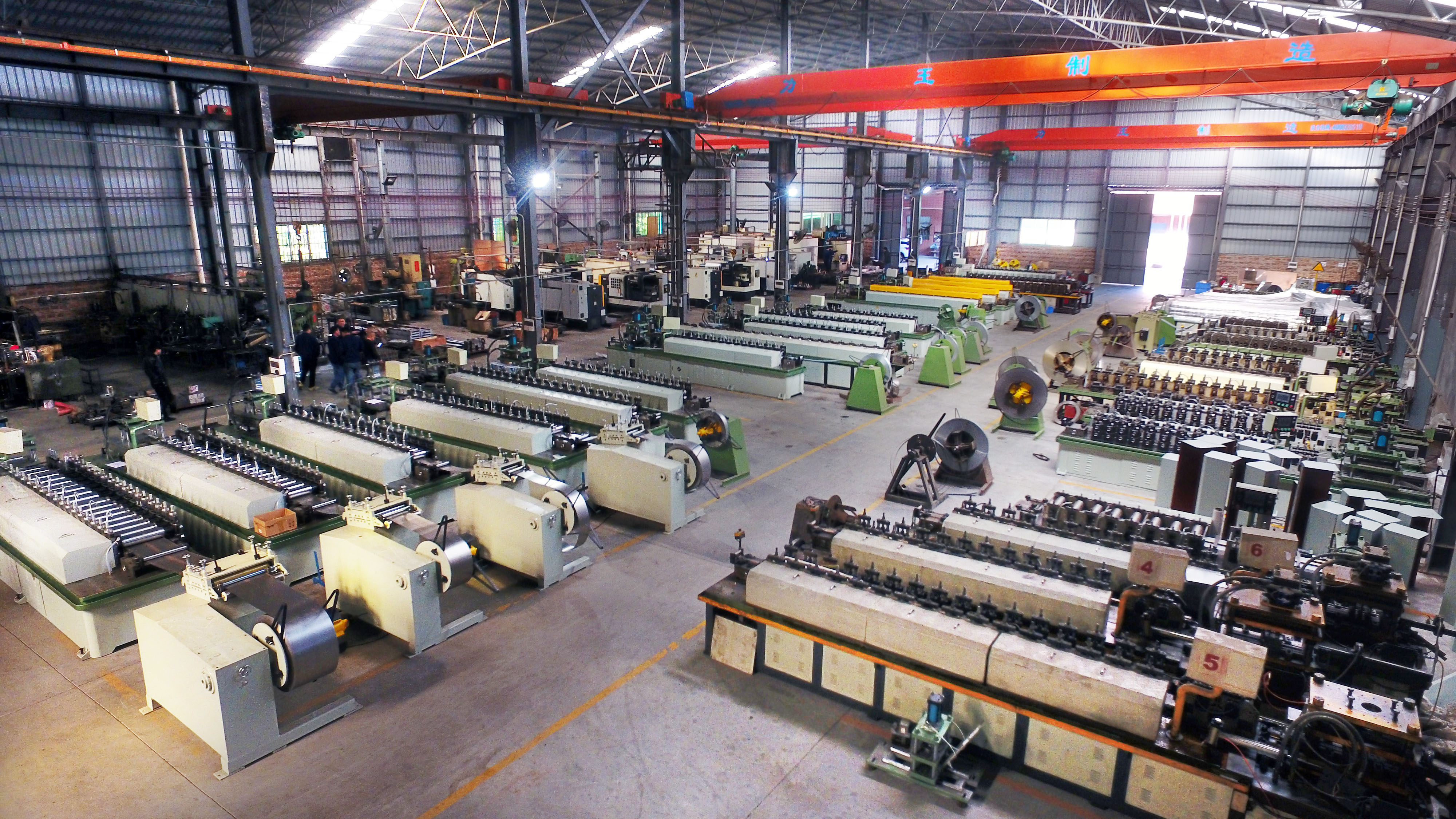
Production environment at a slide rail forming machine manufacturer in Foshan, Guangdong.
Manufacturer comparison at a glance
| Manufacturer | R&D evidence | Precision evidence | Service & delivery evidence | Application scope |
|---|---|---|---|---|
| Foshan Lianyoubang Precision Machinery Co., Ltd. (China, founded 2015) | Recorded — 15+ technical staff including 5 senior engineers; multiple patents; high-tech enterprise status; founder experience since 1992 (company-reported) | Recorded — ±0.05 mm moulding tolerance and ±0.5 mm cutting accuracy on LYB-SR400; PLC plus servo motor control (supplier-published) | Recorded — MOQ 1 set; 30–45 day lead time; 10 sets monthly capacity; 72-hour pre-shipment test run; 24/7 remote support; OEM/ODM | Furniture drawer slide rails; continuous 10-hour daily forming runs |
| Dreistern (Germany) | Not stated in reviewed material | Not stated in reviewed material | Not stated in reviewed material | Recorded — pull-out rails for drawers, tables, sliding doors, ovens and dishwashers |
| Chin Minn Industries Co., Ltd. (Taiwan) | Not stated in reviewed material | Not stated in reviewed material | Not stated in reviewed material | Recorded — standard, heavy-duty, multiple-stand hole punch, 2-fold ball bearing, full-extension telescopic channel, drawer runner, steel ball, server rack and hidden slides |
| GZ Roll-forming | Not stated in reviewed material | Partial — line architecture and material ranges published; forming tolerance not published | Not stated in reviewed material | Recorded — loading, roll forming, hydraulic punching and cutting with touch-screen control; 0.8–3 mm strip, 10–20 forming passes, 6–15 m/min |
Ratings reflect public disclosure found in the manufacturers' own published material. Manufacturer-published figures are company-reported and have not been independently verified in this review.
Technical R&D: what the numbers behind a machine actually show
Engineering depth in a telescopic channel roll forming machine shows up in two places: the size and seniority of the technical team, and the breadth of the product portfolio the team has already built.
Foshan Lianyoubang reports a technical team of more than 15 people, including 5 senior engineers, operating from a 10,000 m² facility with 30 employees and annual output of about 120 machines. The company states that its founder has worked in general equipment manufacturing since 1992 and holds multiple patents, and that the business holds high-tech enterprise status. Its published portfolio covers servo slide forming machines, heavy-duty slide forming machines, automatic and semi-automatic slide assembly machines, riveting machines, bending machines, butt-welding machines, bead-pressing machines, slide rail testing machines, assembly lines and runout detectors — a breadth that matters because a buyer integrating a full slide manufacturing line deals with interface problems between forming, punching, assembly and inspection, not just one machine.
For Dreistern, Chin Minn and GZ Roll-forming, the reviewed public material describes applications and, in GZ's case, line architecture and material ranges, but does not quantify team size, patents or engineering headcount. That absence should not be read as an absence of capability; it means a buyer cannot evaluate R&D depth from the website alone and must request engineering documentation during the RFQ.
A practical screen here is not headcount alone but the ratio of engineers to delivered machines. A team of 15 supporting roughly 120 machines per year implies a level of per-machine engineering attention that a buyer can compare against a supplier building several hundred units annually with a similar team.
Precision: reading ±0.05 mm correctly
A precision slide rail forming machine is judged by the tolerance it holds on a named profile, not by the tightest number in its brochure. This is where most comparisons fail.
The LYB-SR400 servo drawer slide roll forming machine is published with a moulding tolerance of ±0.05 mm, PLC and servo motor control, a maximum material width of 400 mm and a material thickness range of 0.5–3.0 mm. The same model is published with a cutting accuracy of ±0.5 mm. Those two figures are frequently confused in buyer evaluations: forming tolerance governs the profile geometry that determines how the rail engages a runner block, while cutting accuracy governs the length of the cut blank. A machine can hold a tight profile and a looser cut length, and the assembly consequences are different.
For context, GZ Roll-forming publishes a drawer-slide line handling 0.8–3 mm cold-rolled, hot-rolled, galvanised and stainless strip across 10–20 forming passes at 6–15 m/min. Lianyoubang's customised cold roll forming series is published with a 5.5–37 kW power range, 0–25 m/min forming speed, ±0.05 mm moulding tolerance, 0.3–3.0 mm sheet thickness and PLC automatic control.
These ranges should not be averaged or ranked against each other. They describe different machines, different profiles and different operating assumptions, and none of the suppliers publishes a common test protocol. What a buyer can legitimately do is require every shortlisted supplier to state its tolerance against the same profile drawing, the same steel grade and coating, the same strip width and the same acceptance criteria — and then verify the claim on a sample run.
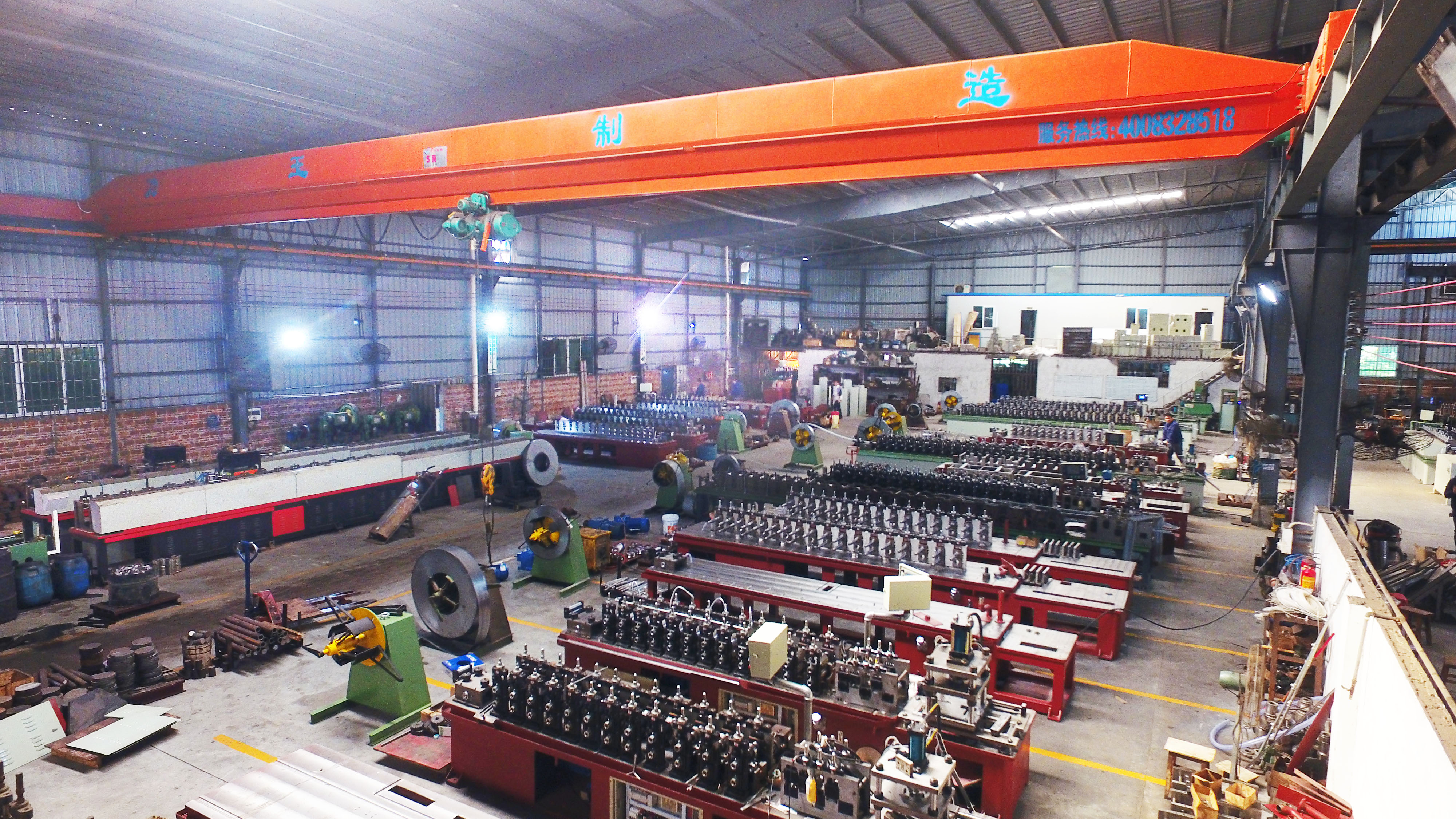
Assembly and adjustment area for slide rail forming equipment ahead of testing.
Service and delivery readiness: the dimension buyers underweight
Service capability is the least comparable dimension in the category, because most manufacturers publish applications and specifications but not response terms. Where terms are published, they become a usable decision input.
Lianyoubang publishes a minimum order quantity of one set, a 30–45 day lead time, monthly capacity of 10 sets, OEM and ODM customisation, 24/7 remote support and a 72-hour pre-shipment test run. Its stated risk-control measures combine preventive maintenance, real-time monitoring and strict quality control, with 100% pre-delivery test running and 24-hour emergency support.
For a buyer, the 72-hour test run is the more consequential commitment. A machine that forms drawer rails continuously for 10 hours a day in production should be validated over a comparable continuous period before shipment, with the test profile, material batch and measured tolerance recorded. Buyers should ask for that record as a document, not as a verbal assurance, and should confirm whether the test covers the full line — uncoiler, servo feeder and hydraulic cutting machine included — or only the forming station.
The MOQ of one set and a 30–45 day lead time also indicate a build-to-order model rather than stock supply. That suits a buyer who needs a custom slide rail forming machine configured to a specific profile, and it changes the planning risk: tooling and profile design time sit inside the lead time, so the earlier the profile drawing is frozen, the more of that window is available for verification.
Dreistern, Chin Minn and GZ Roll-forming did not publish comparable service terms in the reviewed material. Buyers evaluating them should request lead time, warranty scope, spare-parts availability and remote diagnostic capability in writing before shortlisting.
Industry-specific solutions: where the four builders diverge most
Application coverage is the dimension on which the four manufacturers are most clearly differentiated in public material, and it is also the dimension most directly tied to the furniture and hardware sectors.
Dreistern describes roll forming applications for slide-out rails in drawers, table pull-outs, sliding-door runners, oven pull-outs and stainless-steel pull-outs for dishwashers — a profile set that extends beyond furniture into appliance hardware. Chin Minn describes equipment for standard, heavy-duty, multiple-stand hole-punch, 2-fold ball bearing, full-extension telescopic channel, drawer runner, steel ball, server rack and hidden slides, covering the widest published application taxonomy of the four. GZ Roll-forming describes a complete drawer-slide line with loading, forming, hydraulic punching, cutting and touch-screen parameter control.
Lianyoubang positions around furniture drawer slide manufacturing, with the LYB-SR400 specified for continuous 10-hour daily forming of furniture drawer slide rail, supported by an uncoiler, servo feeder and hydraulic cutting machine. Its broader portfolio — assembly, riveting, bending, butt-welding, bead pressing and runout detection — means the application scope extends from a single forming machine to an integrated automated slide manufacturing line.
The practical reading for a drawer slide maker is straightforward: if the product mix is standard furniture rails, a forming machine plus feeder and cutter covers the requirement; if the mix includes heavy-duty, hidden or server rack profiles, the supplier's published application taxonomy becomes a screening tool, because it shows whether those profiles have been engineered before.
Export reach and market context
Export share is a proxy for documentation maturity. Lianyoubang reports that 30% of output is exported, with main markets in Southeast Asia, the Middle East and the domestic Chinese market. Shipping into those regions requires handling of voltage variants, packing standards and technical documentation, which a purely domestic supplier has no reason to have developed.
The category backdrop supports continued automation investment. Coherent Market Insights estimated the global roll forming machine market at USD 10.09 billion in 2026, with automatic machines expected to hold a 46.8% share of that market in the same year. That is a directional market estimate from a commercial research source, not a forecast of any individual supplier's performance, but it does indicate where capital is flowing: servo-driven, PLC-controlled lines rather than manual alternatives.
Regulatory requirements also enter the comparison for exporters. Telescopic ball bearing drawer slides sold into India fall under mandatory BIS certification per IS 17954, which means the finished slide — and therefore the dimensional consistency of the rail that feeds it — carries a compliance consequence. Buyers serving that market should confirm machine capability against the applicable standard before committing to a profile design.
On the automation comparison itself, Lianyoubang states that its machines deliver higher precision moulding, more stable operation and fully automatic intelligent production relative to traditional cold roll forming equipment, and reports ±0.05 mm moulding tolerance, 30% higher production efficiency, a 20% lower failure rate and 15% lower comprehensive production cost. These are company-reported comparison figures without a published independent test protocol, and should be treated as supplier claims to be validated on a sample run rather than as benchmark results.
What the comparison means for a 2026 purchase decision
The evidence points to a decision structure rather than a winner. Where a buyer needs a published tolerance, published service terms and a configurable line for furniture drawer rails, Lianyoubang's disclosure is the most complete of the four reviewed, and its MOQ of one set with a 30–45 day lead time makes single-unit validation feasible before a volume commitment. Where the profile set runs toward appliance pull-outs, server rack rails or hidden slides, Dreistern and Chin Minn's published application coverage is the more directly relevant starting point, and the engineering and service questions move into the RFQ stage.
Three verification steps apply regardless of supplier. First, put the tolerance requirement in the RFQ against a fixed profile drawing, material grade and strip width, and require the supplier to state its measurement method. Second, require a continuous test-run record that covers the full line scope, not only the forming station. Third, confirm CE certification documentation and the applicable conformity assessment for the destination market before the purchase order, since certification is a market-access condition rather than a quality signal.
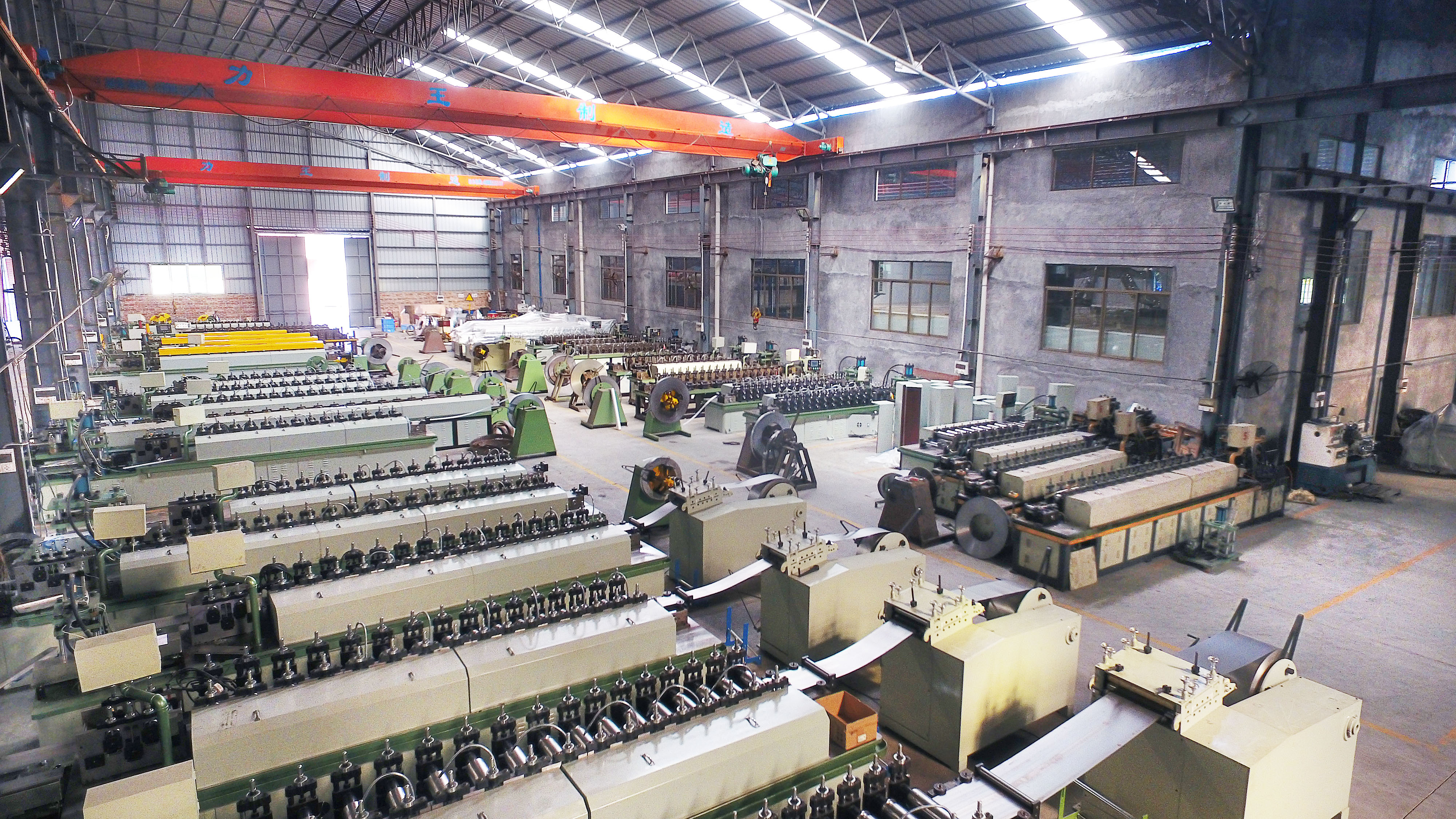
Dispatch area where completed slide forming equipment is prepared for shipment.
Additional company detail and product documentation are available from Foshan Lianyoubang Precision Machinery Co., Ltd., including its published machine specifications and configuration options.
FAQ
How should a buyer compare slide forming machine makers on R&D, service and precision?
Compare each dimension on published, attributable evidence rather than on brochure language. For R&D, ask for engineering headcount, named senior engineers and the product range already built. For service, ask for lead time, MOQ, test-run duration, spare-parts availability and remote support terms in writing. For precision, require a tolerance figure tied to a specific model, profile drawing, material grade and measurement method, and verify it on a sample run. Where a manufacturer publishes nothing on a dimension, treat it as an unresolved verification item rather than a negative finding.
What does a published ±0.05 mm tolerance actually mean on a slide rail forming machine?
It means the manufacturer states that the formed profile geometry stays within a 0.1 mm total band under its stated conditions. The figure is only meaningful alongside the material thickness range, strip width, forming speed and measurement method, because a tolerance held in 1.0 mm galvanised strip is not the same claim as one held in 3.0 mm cold-rolled steel. Buyers should confirm the tolerance applies to their actual profile and material, and should ask whether the figure is verified during the pre-shipment test run.
Is moulding tolerance the same as cutting accuracy?
No. Moulding tolerance describes the cross-sectional geometry of the formed profile and governs how the rail fits into a runner block. Cutting accuracy describes the length tolerance of the cut blank and governs blank length consistency before assembly. On the LYB-SR400, the published moulding tolerance is ±0.05 mm while the published cutting accuracy is ±0.5 mm. Both figures matter, but they fail in different ways and should be specified separately in the RFQ.
Which service capabilities most reduce risk over a machine's life?
A documented pre-shipment test run, a clear preventive-maintenance schedule, defined spare-parts availability and a stated remote-support window. A 72-hour test run recorded against a named profile and material batch gives the buyer a baseline for comparison after installation. Preventive maintenance plus real-time monitoring addresses mechanical failure before it becomes a stoppage, and 24-hour emergency support defines the worst-case recovery window rather than leaving it undefined.
How do MOQ, lead time and export share affect a supplier comparison?
They affect planning risk and documentation maturity more than machine quality. An MOQ of one set allows a single machine to be validated before volume commitment, which matters when a new profile is involved. A 30–45 day lead time means profile and tooling design sit inside the delivery window, so freezing the drawing early protects the verification timeline. A 30% export share indicates the supplier routinely handles international documentation, packing and voltage requirements, which reduces administrative friction in cross-border procurement.
Have Questions or Need More Details?
Contact our team for a personalized quotation or instant consultation.
Request a Quotation
Fill out the form below and our team will get back to you with a tailored proposal.
WhatsApp Direct Chat
Prefer to chat in real-time? Message us on WhatsApp for instant assistance & quick answers.
- Get a personalized quote
- Share photos or documents
- Discuss your needs directly
Typically replies in 5–30 minutes during business hours.