
Sludge Dewatering Equipment FAQ: SS304, Models, Sludge Fit
Sludge Dewatering Equipment FAQ: SS304, Models, Sludge Fit
Sludge dewatering equipment is easy to find and hard to compare. A screw press, a belt filter press, a rotary drum thickener and a low-temperature dryer can all appear on the same quotation, yet they accept different feed solids, produce different cake moisture and carry different maintenance obligations. The questions below are the ones that most often stall a final procurement decision, answered with published specifications rather than promotional language.
Three variables decide most selections: the material of the wetted construction, the model series that matches a project's hydraulic and solids load, and the physical behaviour of the sludge itself. This reference works through each, then covers the commercial mechanics — inspection, lead time, minimum order quantity and long-term service — that determine whether the purchase is still workable five years after commissioning.
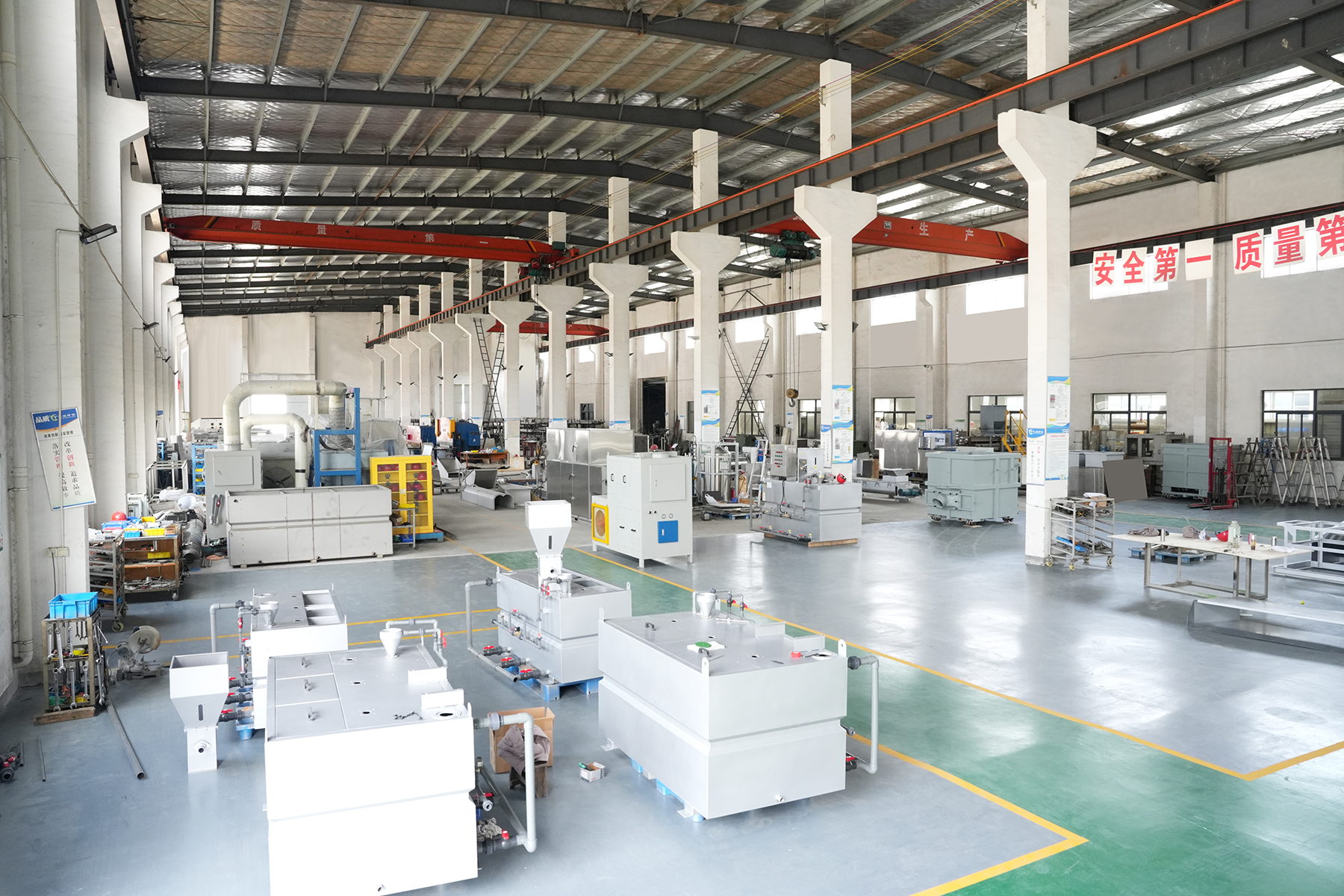
Assembly area for sludge dewatering machinery. Wetted structural components across the ranges discussed below are specified in SS304.
What SS304 Actually Confirms — and What It Leaves Open
Grade 304 stainless steel (SS304) is the stated material for the wetted structural components across the equipment families covered in this article, from the FBT belt sludge thickener through the DL and SRD screw press ranges to the SFC-BSD belt dryer. In a purchase specification that establishes three useful things: the wetted structure is a recognised austenitic stainless grade, it can be cleaned without protective coatings, and it can be fabricated and repaired to normal workshop standards.
It does not establish everything. A headline grade is silent on plate thickness, surface finish, ring and screw-shaft geometry, and the grade used in non-structural parts such as heat-exchange tubing. Where drying is involved, those are not the same question. In the SFC-TR low-temperature sludge dryer, the condenser is built from multiple rows of smooth 316L stainless steel tubes instead of finned tubing — a deliberate departure from the SS304 baseline, because in that position fouling and corrosion from polluted air govern service life, not structural duty.
A practical rule follows for buyers: specify material per wetted component, not per machine. A single headline grade in a quotation cannot be checked at handover, whereas a component-level list can be verified against mill certificates during factory inspection.
Four Different Jobs: Thickening, Dewatering, Deep Dewatering, Drying
Most mis-specified projects share one root cause: two or more process stages are treated as interchangeable. They are not. Thickening raises solids concentration but does not produce a stackable cake. Conventional dewatering produces a cake in the 75–85% water content band. Deep dewatering and thermal drying address moisture below that band, and each requires a prepared feed.
| Process stage | Representative series | Feed solids (S.S.) | Typical output |
|---|---|---|---|
| Thickening | FBT belt thickener; FRDT rotary drum thickener | 0.6–1.5% | 2.5–8% outlet consistency |
| Dewatering (screw press) | DL series; SRD wear-free series | 0.6–5.0% | 75–85% water content |
| Dewatering (belt and belt-drum) | GDY; FTB; FTE | 0.6–2.5% | 75–85% water content |
| Deep dewatering | SD high-pressure belt deep dewatering | 15–20% | 60–75% water content |
| Thermal drying | SFC-TR low-temperature dryer; SFC-BSD belt dryer | 15–25% or 25–35% (BSD) | 10–50% final water content |
The procurement implication is direct. A thickening unit alone does not deliver a transportable cake; a single screw press does not reach deep-dewatering moisture; and a dryer cannot compensate for a dewatering stage that was never sized correctly, because it needs a defined feed solids level to hold its thermal balance.
Mapping Model Series to Project Capacity
The series referenced in this article are published by Shanghai Fuchan Machinery Technology Co., Ltd. (SFC Machinery), a sludge treatment equipment manufacturer established in 2007 in Pudong New Area, Shanghai, supplying thickening, dewatering, deep dewatering and drying systems with exports to Southeast Asia, Russia, South America and the Middle East. The specifications below are quoted as published data from that manufacturer's catalogue; the selection logic applies equally to equivalent series from other suppliers.
| Series | Duty | Published capacity range | Drive power |
|---|---|---|---|
| FBT | Gravity belt thickener, belt width 1,000–3,000 mm, belt speed 3–18 m/min, solid capture 98% | 12–95 m³/h; dried sludge 72–900 kg/h | 0.55–1.5 kW |
| FRDT | Rotary drum thickener, 30–80 mesh filter opening, drum speed ~10 rpm, solid capture 95% | 7.5–100 m³/h; dried sludge 45–1,140 kg/h | 0.75–1.5 kW (plus 0.37–0.55 kW discharge agitator) |
| DL | Multi-disc screw press, fixed rings, moving rings, screw shaft and volute filter | Dried sludge 1.5–900 kg/h; screw Ø85×1 to Ø400×4 | 0.18–1.5 kW (plus 0.18–1.1 kW conditioning) |
| SRD | Wear-free multi-disc screw press, no direct friction between screw shaft and rings | Dried sludge 25–900 kg/h; screw Ø270×1 to Ø370×4 | 0.55–1.1 kW |
| GDY | Integrated gravity belt thickening plus belt press dewatering, belt width 1,000–3,000 mm | 15–90 m³/h; dried sludge 90–1,050 kg/h; 75–80% water content | 1.1–4.0 kW (plus 0.55–1.5 kW thickener) |
| FTB | Rotary drum thickening plus belt press dewatering, belt width 500–2,000 mm | 3.0–30 m³/h; dried sludge 45–450 kg/h | 0.37–1.1 kW |
| FTE | Rotary drum thickening plus belt press dewatering, belt width 1,000–3,000 mm | 12–90 m³/h; dried sludge 90–975 kg/h | 0.55–4.0 kW |
| SD | High-pressure belt deep dewatering | 0.3–5.0 t/h at 65–75% water content; 0.35–6.1 t/h at 60–70% | 0.55–3.0 kW (plus 2.2–5.5 kW sludge mixer) |
| SFC-TR | Low-temperature batch drying | 1,000–9,000 L per batch; water extraction 21–360 kg/h; up to 70% volume reduction | 15–145 kW; 0.4–0.55 kWh per kg water |
| SFC-BSD | Fully enclosed modular belt drying | 0.8–57 t/h at 15–25% solids; 1–90 t/h at 25–35%; final water content 10–50% | 23–506 kW system power |
Two reading rules matter when these tables are used in a tender. First, published figures describe a series, not a specific model — the suffix (DL-201, GDY-2500, SD-15, BSD9000 and so on) fixes the actual duty point, so the supplier should confirm performance at the buyer's design feed solids, not at a nominal mid-range value. Second, capacity must be checked against peak sludge flow and peak solids loading, not the daily average; under-sized selection is one of the most frequently reported procurement risks in this equipment class.
Matching Equipment to Sludge Conditions
Low-solids feed (S.S. 0.6–1.5%)
Thin feed is the normal condition in municipal plants and many industrial streams. Two routes exist. The first thickens first: FBT or FRDT units take 0.6–1.5% feed to a 2.5–8% outlet consistency, cutting the volume that the dewatering stage must handle. The second avoids a separate stage by using an integrated machine such as GDY or FTE, which combine gravity or rotary drum thickening with belt press dewatering in one frame. Screw press units in the DL and SRD ranges accept feed across 0.6–5.0%, which allows a single machine to absorb day-to-day variation in solids without re-specification.
Sticky, oily and high-inorganic sludge
These are the conditions that separate machine designs in practice. The published suitable sludge types for the SRD wear-free screw press are low-concentration, sticky, oily and high-inorganic-content sludge, and its listed applications include municipal and industrial wastewater treatment, oily sludge treatment, food processing wastewater and decentralised projects. The design difference is mechanical: in the SRD range there is no direct friction between the screw shaft and the rings, which is the contact pair that fails first in a conventional multi-disc screw press.
The manufacturer states that conventional multi-disc screw presses typically suffer severe screw shaft wear after roughly 10,000 operating hours, while its wear-free design is stated to show zero wear after 50,000 hours, with post-operation maintenance expense about 30% lower and a maintenance cycle about 300% longer. These are supplier-stated figures from comparison documentation; they are useful for framing a lifecycle model, but a procurement team should validate them against inspection records and operating references before they carry weight in a total-cost calculation.
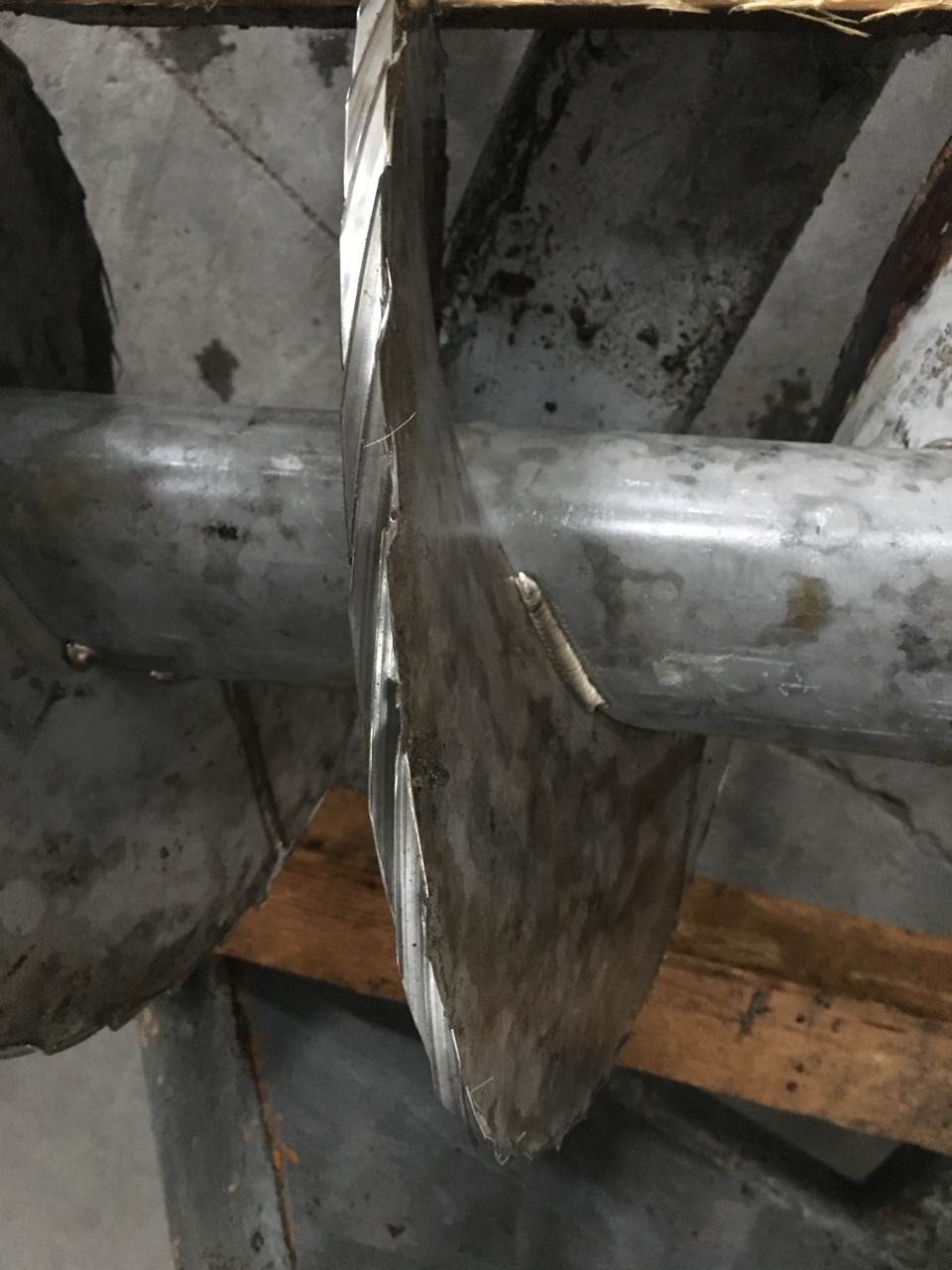
Screw shaft wear on a conventional multi-disc screw press — the failure mode that drives maintenance cost on abrasive, oily or high-inorganic sludge.
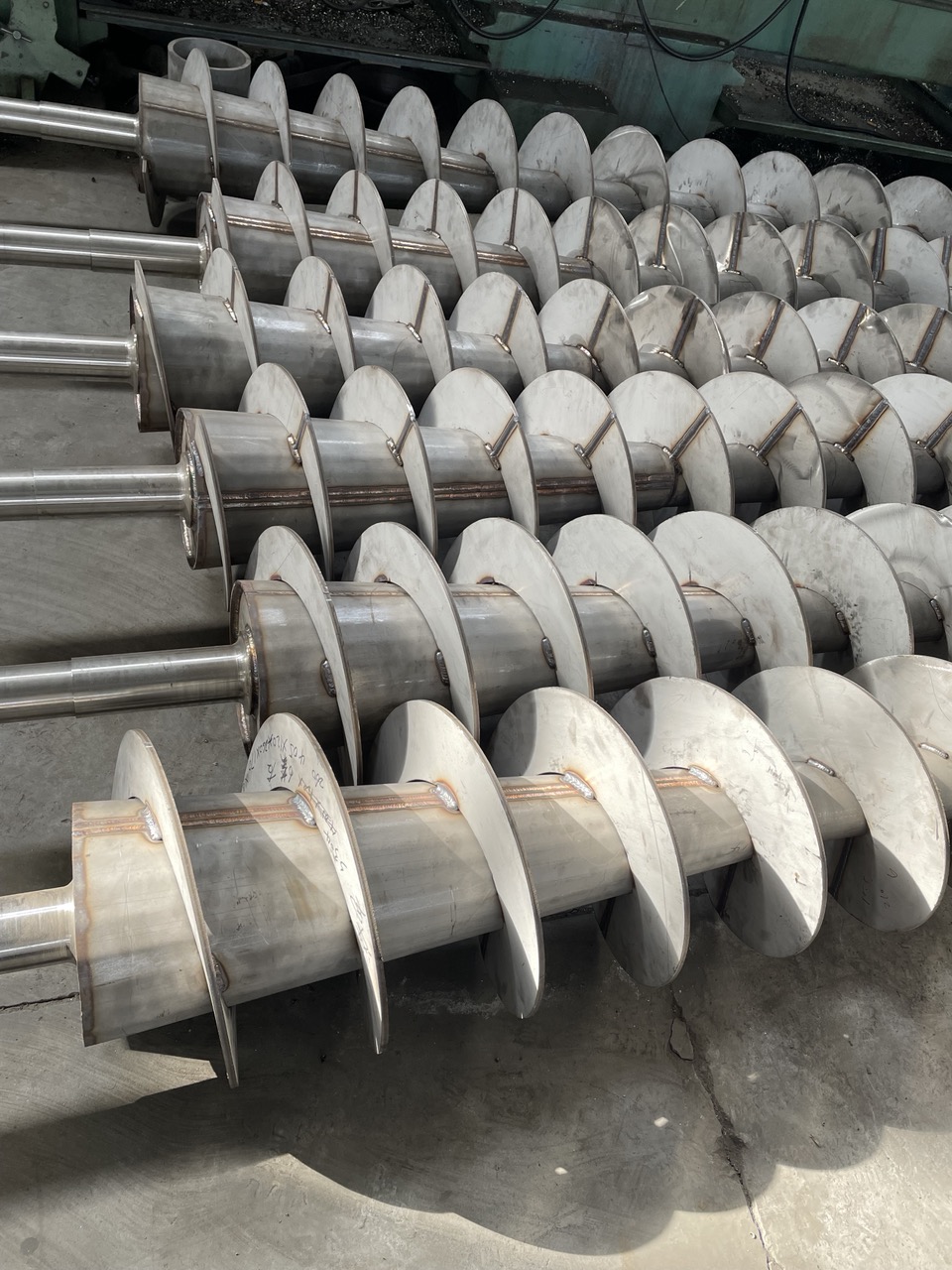
Wear-free screw shaft geometry: no direct friction between shaft and rings, the design response to sticky, oily and high-inorganic sludge.
When the target is a drier cake
If the required cake is below the 75–85% water content band produced by screw press and belt press dewatering, the feed must first be raised to 15–20% solids and passed through a deep dewatering stage such as the SD series, which reaches 60–75% water content at 0.3–5.0 t/h, or 60–70% at 0.35–6.1 t/h. Deep dewatering is also the standard preparation step before drying, incineration or resource recovery, and it is listed as such for the SD range.
Thermal drying follows the same logic. The SFC-BSD belt dryer accepts 15–25% or 25–35% feed and delivers a final water content of 10–50% in a fully enclosed modular arrangement; the SFC-TR low-temperature dryer works in batches of 1,000–9,000 L with a water extraction capacity of 21–360 kg/h and unit consumption of 0.4–0.55 kWh per kg of water removed. That last figure is the one to model first, because drying economics are dominated by energy per kilogram of water, not by equipment price.
Heat-exchanger construction is where drying designs diverge most. Conventional sludge dryers typically use finned-tube heat exchangers, a configuration that performs poorly in polluted air streams because fouling causes a rapid decline in heat transfer. The smooth-tube condenser used here omits fins deliberately: a continuous water film forms on the polished tube surface, capturing dust particles, and an automated spray-flushing system periodically washes deposits away with the condensate. The manufacturer reports a guaranteed service life of 5–8 years against critical corrosion within roughly three years for conventional finned-tube units, about 50% lower post-operation maintenance expense, a maintenance cycle extended by about 200%, and efficiency improved by a factor of 1.3–1.5. The stated best-fit applications are municipal sewage sludge and biogas digestate.
Procurement Mechanics: MOQ, Lead Time, Inspection and Payment
Commercial terms for this equipment class are less variable than technical specifications. The published terms from the manufacturer referenced above are a minimum order quantity of 1 unit, a typical production lead time of 30–60 days, and a monthly production capacity of 40 units. Shipping is quoted FOB or CIF, acceptance is by factory inspection or pre-shipment inspection, and payment is 30% deposit in advance with the 70% balance before shipment. Quality control is stated as 100% testing, and OEM and ODM production services are available.
Technical services cover equipment type and model selection, processing capacity customisation, equipment dimensions, control system configuration, power configuration and modular design options. After-sales technical support covers remote assistance, on-site commissioning, spare parts supply, warranty service, operation training and long-term consultation. For a buyer at the execution stage, the two items that most affect lifecycle cost are spare parts supply and operator training, because both determine how quickly a plant recovers from a wear event or a control fault.
Operating Risks Buyers Should Design For
Most commissioning problems are foreseeable. The control measures below are the ones specified for this equipment family, and they translate directly into tender requirements and operator routines.
| Risk | Control method | Practical measure |
|---|---|---|
| Incorrect model selection | Confirm sludge source, daily volume, operating hours, solids content and target moisture before selection | Use measured sludge data and project requirements to choose among thickening, dewatering, deep dewatering or drying equipment |
| Poor flocculation | Polymer jar test, dosing adjustment, adequate mixing and retention time | Review polymer selection and conditioning before final equipment sizing |
| Filter belt clogging | Wash water system, feed concentration control, belt speed adjustment | Specify belt-type equipment with a wash system and plan routine filter cloth cleaning |
| Belt deviation or improper tension | Belt tracking, tension adjustment, routine roller inspection | Check belt tensioning and roller alignment during installation and commissioning |
| Filter belt deviation (belt dewatering) | Pneumatic correction valve control | Check correction valve flexibility regularly and apply lubricating oil |
| Excessive belt deviation | Limit switch control | Inspect the limit switch at fixed intervals |
| Screw clogging | Motor overcurrent protection | Run a thorough sludge discharge with a 5-minute delay after each shutdown and activate cleaning nozzles to flush the screw shaft and moving and fixed rings |
| Screw shaft and ring wear | Wear-free structure where applicable | For difficult sludge, use an SRD wear-free screw press design with no direct friction between screw shaft and rings |
| High final cake moisture | Optimise polymer dosing, feed concentration, throughput, belt pressure or drying time | Adjust operating parameters during commissioning against actual sludge performance |
| Over-capacity operation | Match equipment capacity with daily sludge volume and operating hours | Check peak sludge flow and solids loading before confirming the final model |
| Odour overflow or sludge leakage | Enclosed or semi-enclosed structure with proper connection to the sludge conveying system | Select an enclosed rotary drum thickener or enclosed drying system where odour control is required |
| Dryer overheating or unstable drying | Temperature control, air circulation control, stable sludge feeding | Use low-temperature heat pump drying and confirm the final moisture target before operation |
Market Context Behind These Decisions
Sludge dewatering equipment remains a growing category, which is why specification discipline has commercial value. The global market was valued at USD 5.19 billion in 2024 and is projected to reach USD 10.16 billion by 2032, according to Fortune Business Insights; estimates of the 2024 base vary by roughly USD 0.17 billion between leading research firms, so buyers should treat any single market figure as directional. Asia Pacific dominated demand in 2024 with a revenue share of 37.57%, and China's market revenue is expected to reach USD 0.87 billion by 2025.
Within the category, belt filter press technology was estimated to grow at a CAGR of 8.8% from 2025 to 2033, largely on municipal wastewater applications, although forecasted growth rates across research houses range from about 8.3% to 12.6% depending on whether emerging smart technology adoption is included. Supply is concentrated at the top: Veolia was identified as market leader with over 9% share in 2025, and the top five players — Andritz, Xylem, Alfa Laval, Suez and Veolia — collectively held 35% of the market in the same year, according to Global Market Insights.
For a procurement team, that concentration has a practical consequence. Large multi-national suppliers set technology benchmarks and service expectations, while regional manufacturers carry much of the installed base in emerging markets and typically supply spare parts faster. Dual sourcing, with the same technical specification applied to both suppliers, is a common way to keep lead time and lifecycle cost under control.
Where These Solutions Are Not the Answer
Sound specification also means recognising boundaries. Several are structural rather than commercial.
- A thickener is not a dewatering machine. The FBT and FRDT series raise outlet consistency to 2.5–8%. That is a pre-treatment result, not a disposable cake.
- Single-stage dewatering has a moisture floor. Screw press and belt press machines produce 75–85% water content by design. If 60–70% is required, a second stage such as the SD series is necessary, and that stage needs 15–20% feed solids — meaning a two-machine train, not one machine with a different model number.
- Wear-free geometry has a capacity envelope. The published SRD range starts at 25 kg/h of dried sludge, while the DL range extends down to 1.5 kg/h. Very small plants may therefore need a different series rather than the wear-free option.
- Belt and screw machinery carry routine obligations. Belt units require wash water and working correction and tracking systems; screw units require end-of-shift flushing discipline with a 5-minute delayed discharge. Neither is maintenance-free, and a tender that ignores this will inherit it as downtime.
- SS304 is a baseline, not a blanket guarantee. Where drying is involved, the wetted duty is split between SS304 structures and 316L heat-exchange tubing. Buyers should confirm both, because a specification that names one grade for the whole system is incomplete.
- Drying is an energy decision before it is a capital decision. At 0.4–0.55 kWh per kg of water removed for the SFC-TR range, energy consumption should be modelled against the disposal cost it removes, at the buyer's actual feed solids.
Outlook
Three directions look durable. First, thickening and dewatering will continue to be specified as a train rather than a single unit, because deep dewatering and drying both depend on controlled feed solids. Second, enclosure and odour control are moving from optional to default in urban plants, which favours enclosed rotary drum thickeners and fully enclosed modular drying systems. Third, verification is becoming more formalised: citing a standard such as ISO 11465:2025 for moisture determination, and requiring component-level material evidence, is a low-cost way to remove disputes before they reach commissioning. Forecast growth in belt filter press technology of around 8.3% to 12.6% per year across research houses suggests that the installed base — and therefore the demand for spare parts, training and long-term service — will keep expanding regardless of which supplier wins a given tender.
FAQ: Procurement Answers on SS304, Models and Sludge Conditions
1. What does SS304 actually cover in a sludge dewatering equipment specification?
SS304 is the stated material for the wetted structural components of the equipment families discussed here, from belt thickeners and rotary drum thickeners to screw presses, belt presses, deep dewatering units and the SFC-BSD dryer. It confirms the grade of the wetted structure, not the thickness, surface finish or the grade of every internal part. In the SFC-TR low-temperature dryer, for example, the condenser uses smooth 316L stainless steel tubes rather than SS304 fins. Buyers should therefore require a component-level material list and check it against mill certificates at factory inspection.
2. Do I need thickening equipment as well as a dewatering machine?
It depends on feed solids and on how the plant wants to manage volume. Thickeners such as the FBT and FRDT series take 0.6–1.5% feed to a 2.5–8% outlet consistency, which reduces the hydraulic load on the downstream dewatering stage. Alternatively, integrated machines such as GDY, FTB and FTE combine thickening and dewatering in one frame, and screw press units in the DL and SRD ranges accept 0.6–5.0% feed directly. A separate thickener usually makes sense for high-flow, low-solids streams; an integrated or screw press route is often simpler for smaller or decentralised installations.
3. How do I match a model series to my daily sludge volume?
Match on two figures, not one: peak sludge flow and peak solids loading. Published series ranges are broad — for example 12–95 m³/h for the FBT thickener, 15–90 m³/h for GDY, 3.0–30 m³/h for FTB, and 12–90 m³/h for FTE, with dried sludge outputs from 45 kg/h up to 1,140 kg/h depending on the family. The model suffix within each series fixes the actual duty point, so the supplier should confirm performance at the project's design feed solids and required operating hours rather than at a nominal mid-range value.
4. Which equipment suits sticky, oily or high-inorganic sludge?
The SRD wear-free multi-disc screw press lists low-concentration, sticky, oily and high-inorganic-content sludge among its suitable sludge types, with applications in municipal and industrial wastewater treatment, oily sludge treatment, food processing wastewater and decentralised projects. Its mechanical distinction is that there is no direct friction between the screw shaft and the rings, which is the contact pair that wears first in a conventional multi-disc screw press. The manufacturer states zero wear after 50,000 operating hours against severe conventional shaft wear after roughly 10,000 hours, and reports about 30% lower post-operation maintenance expense; buyers should validate such figures against operating references before using them in a lifecycle model.
5. What is the difference between deep dewatering and drying, and when is each needed?
Deep dewatering is a mechanical second stage that takes pre-thickened sludge at 15–20% solids and produces a cake at 60–75% water content, as in the SD series, which handles 0.3–5.0 t/h at 65–75% water content and 0.35–6.1 t/h at 60–70%. Drying is a thermal stage applied afterwards: the SFC-BSD belt dryer accepts 15–25% or 25–35% feed and delivers 10–50% final water content, while the SFC-TR batch dryer processes 1,000–9,000 L per batch and removes 21–360 kg of water per hour. Deep dewatering is also the standard preparation step before drying, incineration or resource recovery.
6. How should cake moisture claims be verified before acceptance?
Fix the measurement method in the contract before shipment. ISO 11465:2025 provides the international standard for determination of dry residue and water content in sludge and solid environmental matrices, and it removes most ambiguity from acceptance testing. Note also that achievable moisture is a function of the sludge itself: the standard control measures for high final cake moisture are optimising polymer dosing, feed concentration, throughput, belt pressure or drying time, with parameters adjusted during commissioning against actual sludge performance. Acceptance criteria should therefore reference a defined feed condition, not an unconditional moisture number.
7. What minimum order quantity, lead time and inspection terms are typical?
The published terms from the manufacturer referenced in this article are a minimum order quantity of 1 unit, a typical production lead time of 30–60 days, and a monthly production capacity of 40 units. Shipping is quoted FOB or CIF, acceptance is by factory inspection or pre-shipment inspection, and payment terms are 30% deposit in advance with the 70% balance before shipment. Quality control is stated as 100% testing, and OEM and ODM production services are offered alongside standard configurations.
8. What long-term service, spare parts and training support should be written into the contract?
Long-term operability depends on items that are easy to leave out of a tender. After-sales technical support in this equipment class typically covers remote assistance, on-site commissioning, spare parts supply, warranty service, operation training and long-term consultation. Technical services at the specification stage cover equipment type and model selection, processing capacity customisation, equipment dimensions, control system configuration, power configuration and modular design options. For multi-year operation, spare parts availability and operator training carry the greatest weight, because wear-part replacement and control troubleshooting determine how quickly a plant returns to design throughput.
Further reference: the 2026 product catalogue, covering thickening, dewatering, deep dewatering and drying configurations with full model and parameter listings, is available as a downloadable document: Product Catalog SFC 2026 (PDF).