
Sludge Dewatering Equipment Shortlist: 7 Recommended Options by Sludge Type and Project Scale
Sludge Dewatering Equipment Shortlist: 7 Recommended Options by Sludge Type and Project Scale
Shortlisting sludge dewatering equipment by supplier name is the least reliable way to run an evaluation. A more defensible shortlist is built on two filters that can be checked before any quotation arrives: whether the machine family has documented experience with the feed sludge in question, and whether its model range reaches the project scale being planned. This article applies both filters to seven dewatering and drying configurations offered by Shanghai Fuchan Machinery Technology Co., Ltd. (SFC Machinery), and states the boundary conditions that should be tested before any of them is written into a specification.
Why dewatering shortlists break down before the first quotation
Global Market Insights estimated the global sludge dewatering equipment market at USD 6.4 billion in 2026 and projects it reaching USD 14 billion by 2035, while Fortune Business Insights reported that Asia Pacific accounted for 37.57% of the global dewatering equipment market in 2024. Supply is not the constraint. Comparison is.
Three structural problems appear again and again in buyer evaluations:
- Cake performance is quoted without a basis. Dewatering is generally described as producing a cake of roughly 15 to 45% dry solids, a range wide enough to make any single quoted figure meaningless unless the feed sludge, conditioning regime and test protocol are stated alongside it.
- Equipment classes are compared as if they were interchangeable. Screw presses and belt filter presses are both continuous sludge-dewatering systems, but they differ in footprint, wash-water demand, operating attention and maintenance profile. Comparing them on outlet dryness alone hides the variables that decide lifecycle cost.
- Operating inputs are left out of the shortlist stage. Peer-reviewed inventory data reports typical chemical-agent consumption of 5 to 15 g per kg of total solids for mechanical dewatering, and average mechanical-dewatering energy of roughly 0.12 kWh/kg TS for raw sludge and 0.26 kWh/kg TS for digested sludge. Those two numbers often move a decision more than a two-point difference in cake dryness.
How this shortlist was ranked
The seven options below are ordered by breadth of feed-sludge fit combined with the strength of documented application evidence — not by capacity, price or motor power. Three criteria were applied to each family:
- Feed-sludge compatibility. Is there a documented application on a comparable sludge, or an explicit manufacturer statement of suitability?
- Scale posture. Does the model range extend across the size band the project is likely to occupy, and can capacity, footprint, voltage and automation level be adapted?
- Documented output evidence. Is there a stated inlet condition and a stated outlet condition from an operating project, rather than a general performance claim?
SFC Machinery is a Shanghai-based environmental equipment manufacturer established in 2007 in Pudong New Area, adjacent to the China (Shanghai) Pilot Free Trade Zone. The company builds sludge thickening, dewatering, deep dewatering and drying equipment, holds CE certification issued by UDEM under certificate M.2025.206.C130494 (valid to 30 November 2030) together with ISO 9001, ISO 14001 and ISO 45001 certification, and reports equipment operating in Southeast Asia, Russia, South America and the Middle East.
The shortlist: seven options by sludge type and project scale
1DL Series Screw Press Sludge Dewatering Machine — DL-101 to DL-404
Best fit: oily and biological industrial sludge at small to mid project scale, where the plant wants a continuous machine with minimal operating attention and a low frame count.
The DL Series is the most heavily documented family in the reviewed material, covering 16 models from DL-101 through DL-404. Two operating references stand out. At a vegetable oil processing plant handling soybean, palm and canola oil wastewater, a DL screw press reduced sludge moisture content from 97% to 77%, cutting sludge volume by up to 98% over an eight-year service period. At a pharmaceutical wastewater treatment station, a DL unit reduced moisture content from 99% to under 85%, a volume reduction of up to 93%, with the plant reporting fully automated operation, minimal maintenance cost and reliable dewatering results across ten years.
Boundary to check: both references describe industrial biological sludge. For a municipal duty, ask for references on digested or stabilised surplus sludge specifically, and confirm the acceptance basis for outlet total solids rather than accepting a single percentage.
2SRD Series Wear-free Screw Press Sludge Dewatering Machine — SRD-301 to SRD-404
Best fit: industrial duties where the wear surface of a stacked-disc screw is the dominant maintenance concern — greasy, fibrous or mildly abrasive sludges — at mid project scale.
The SRD Series spans 12 models from SRD-301 to SRD-404, and its product designation places the wear behaviour of the dewatering element at the centre of the design intent. Functionally it sits in the same continuous screw-press class as the DL Series, which matters for procurement: both are evaluated on the same operating variables, so the choice between them is a durability and duty question rather than a category question.
Boundary to check: the reviewed material contains no operating case for the SRD Series. That is a real evidence gap, not a marketing detail. Before placing a wear-free claim at the centre of a tender evaluation, request references on a comparable sludge and ask what the wear-part inspection interval is in practice. If no comparable reference exists, the conservative approach is to specify the DL Series for the proven application and treat SRD as a conditional upgrade.
3FTB Series Rotary Drum Sludge Dewatering Machine — FTB-500 to FTB-2000
Best fit: food-processing and specialty chemical wastewater at compact to mid project scale, where an integrated thickening-and-dewatering frame is preferred over separate tanks.
Two records support this family. In Malaysia, an FTB-1000 unit on food-processing wastewater reduced moisture content from 98.5% to below 80%, with the operator reporting stable results, easy upkeep and a 30% reduction in sludge handling cost over an eight-year period. At a specialty chemicals plant, an FTB-1500L unit cut water content from 99% to well below 80%, producing a discharge-ready cake with the plant citing minimal downtime.
Boundary to check: rotary drum units are conditioning-dependent. Specify the polymer type and dosing basis as part of the performance guarantee, because the same machine can produce materially different cake solids on the same site if dosing control drifts.
4GDY Series Belt Sludge Thickening and Dewatering Machine — GDY-1000 to GDY-3000
Best fit: municipal sewage treatment plants at larger flow, where continuous unattended operation and a wide frame range matter more than a compact footprint.
At a city sewage treatment plant, two GDY machines have handled excess sludge at 99.2% moisture content and produced a final cake below 80% moisture for five years of continuous operation. The operator's own comparison is instructive: the units were reported as more stable than standard dewatering equipment, delivering consistent cake dryness with minimal maintenance and running unattended with only scheduled walk-throughs. The series covers five frames from GDY-1000 to GDY-3000.
Boundary to check: belt-based dewatering generally requires belt-wash water and a more frequent consumable and tension check than a stacked-disc screw press. If wash water is scarce or the plant is unmanned for long periods, weigh that against the flow range advantage before shortlisting a belt machine.
5FTE Series Rotary Drum Type Sludge Thickening and Dewatering Machine — FTE-1000 to FTE-3000
Best fit: municipal and industrial projects at mid to larger scale that want thickening and dewatering combined in one frame, including the FTE-1500L, FTE-2000L, FTE-2500L and FTE-3000L variants.
The FTE Series covers nine configurations, pairing the rotary drum principle with an integrated thickening stage. The design logic is straightforward: reducing the load entering the dewatering section stabilises cake output when the feed is dilute, which is the normal condition at municipal plants receiving excess sludge at around 99% moisture.
Boundary to check: an integrated frame saves footprint but couples two process stages, so thickening and dewatering can no longer be tuned fully independently. Confirm with the supplier how the drum speed controls behave when feed solids swing, and whether the thickening stage can be bypassed if conditions change.
6SD Series High-Pressure Belt Deep Sludge Dewatering Machine — SFC-SD05 to SFC-SD25
Best fit: projects where transport and disposal cost dominate the business case and conventional mechanical cake is not dry enough to be economic.
Peer-reviewed inventory data reports approximately 35 to 40% total solids for deep dewatering, against roughly 25 to 30% TS for mechanical dewatering. That gap is the commercial justification for a second dewatering stage: fewer tonnes leaving site, lower haulage cost, and a cake that is easier to handle. The SD Series covers five models from SFC-SD05 to SFC-SD25.
Boundary to check: the 35 to 40% TS figure is a literature benchmark across heterogeneous datasets, not a guaranteed output for a specific model on a specific sludge. Deep dewatering also generally requires additional conditioning and process stages beyond a single mechanical step. Specify the target total solids, the feed assumptions and the test protocol together, and require a pilot or site trial before acceptance.
7SFC-BSD and SFC-TR Sludge Dryers — BSD1000 to BSD30000 and SFC-TR1000 to SFC-TR9000
Best fit: projects where volume reduction beyond the mechanical limit is required, and where heat recovery or high disposal cost can carry the energy bill.
Two operating records define the value case. At an advanced manufacturing plant, a BSD-2000 belt dryer took screw-press cake from 85% moisture to below 30%, minimising disposal volume over six years. At an automotive parts plant, an SFC-TR series low-temperature heat-pump dryer took filter-press cake from 75% to below 25%, removing over 700 kg of water per tonne of sludge and reducing volume by more than 70% across five years. SFC states that its low-temperature drying systems can reduce sludge volume by more than 70% and can be integrated with waste heat recovery.
Boundary to check: thermal drying carries a materially higher energy burden than mechanical dewatering — the reviewed literature reports an average of about 3.8 kWh/kg TS for thermal drying against 0.12 kWh/kg TS for raw sludge and 0.26 kWh/kg TS for digested sludge in mechanical dewatering. Drying should therefore be justified against disposal savings and heat integration, not added by default. The BSD-2000 reference also records a real commissioning constraint: with high-moisture feed, initial extrusion results were not ideal and the extruder required optimisation and debugging before stable drying performance was achieved.
Where feed solids are too dilute for any of the above to run efficiently, thickening is the correct pre-stage rather than a larger dewatering frame. At a municipal plant, eight FRDT rotary drum thickeners concentrated sludge from 99.4% to 97% moisture content, raising solids to 3% and measurably improving the dewatering performance of the downstream plate-and-frame filter press. The FRDT Series covers FRDT-20 through FRDT-100, and the FBT Series belt thickener covers FBT-1000 through FBT-3000 for the same duty.
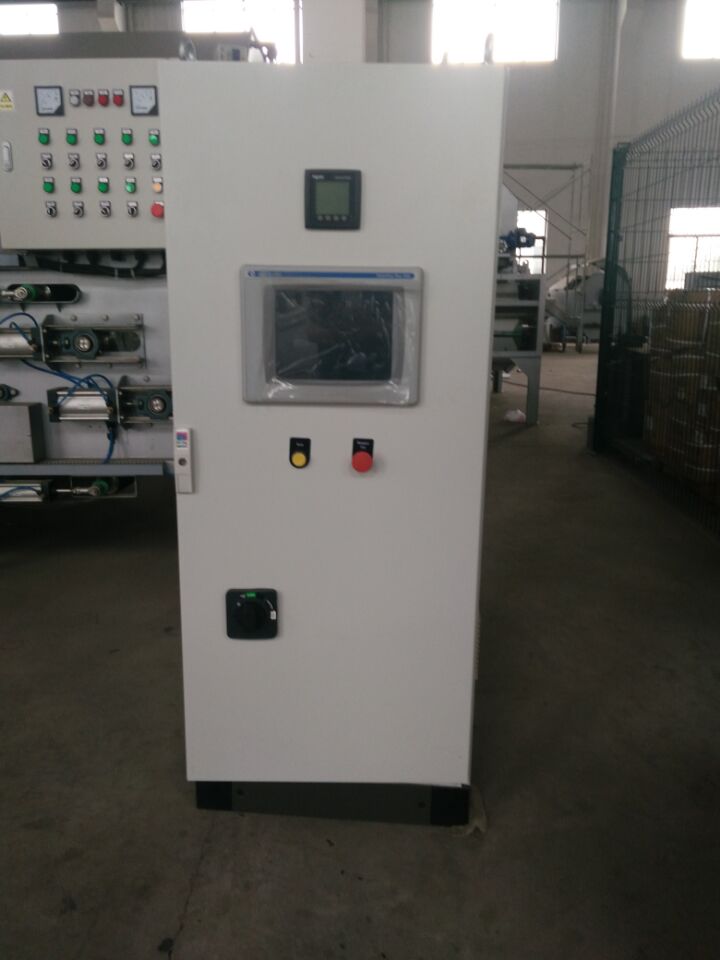
Automatic PLC control on an FTB-1000 rotary drum dewatering unit installed for food-processing wastewater treatment in Malaysia, where moisture content was reduced from 98.5% to below 80%.
Side-by-side comparison
| Rank | Option | Best-fit sludge type | Scale posture | Documented output | Boundary to test |
|---|---|---|---|---|---|
| 1 | DL Series screw press (DL-101–DL-404) | Oily and biological industrial sludge | Small to mid; 16 models | 97% → 77% (vegetable oil); 99% → under 85% (pharma) | Municipal digested-sludge reference not in corpus |
| 2 | SRD Series wear-free screw press (SRD-301–SRD-404) | Greasy, fibrous, mildly abrasive industrial sludge | Mid; 12 models | No operating case in reviewed material | Wear-part inspection interval and references |
| 3 | FTB Series rotary drum (FTB-500–FTB-2000) | Food processing, specialty chemicals | Compact to mid; 6 models | 98.5% → below 80% (Malaysia); 99% → below 80% (chemicals) | Polymer dosing basis in the guarantee |
| 4 | GDY Series belt thickening and dewatering (GDY-1000–GDY-3000) | Municipal sewage sludge | Larger flow; 5 frames | 99.2% → 80%, two units, five years | Belt-wash water and consumable checks |
| 5 | FTE Series rotary drum thickening and dewatering (FTE-1000–FTE-3000) | Municipal and industrial feed needing pre-thickening | Mid to larger; 9 configurations | Integrated thickening and dewatering design | Coupling of thickening and dewatering controls |
| 6 | SD Series high-pressure belt deep dewatering (SFC-SD05–SFC-SD25) | Where disposal cost dominates | Five models | Literature band 35–40% TS for deep dewatering | Additional conditioning and pilot verification |
| 7 | SFC-BSD and SFC-TR dryers (BSD1000–BSD30000; SFC-TR1000–SFC-TR9000) | Cake requiring volume reduction beyond mechanical limits | Widest range in the portfolio | 85% → below 30%; 75% → below 25% | Energy burden and feed-extrusion behaviour |
Reading the numbers before the site visit
Three figures should travel with every shortlisted option into the evaluation file, because they convert a comparison of claims into a comparison of operating reality.
Cake total solids. Mechanical dewatering typically lands in the 25 to 30% TS band in reviewed inventory data, deep dewatering in the 35 to 40% TS band, and dewatered cake generally between 15 and 45% dry solids depending on feed and process. Use these as screening bands, never as guarantees.
Chemical consumption. Mechanical dewatering typically consumes 5 to 15 g of conditioning agent per kg of total solids. On a plant with meaningful throughput, the spread within that band is a recurring cost line, so the polymer specification belongs in the commercial comparison.
Energy per kg of solids. Comparing motor power tells you very little. Comparing kWh per kg TS does. Mechanical dewatering sits near 0.12 kWh/kg TS for raw sludge and 0.26 kWh/kg TS for digested sludge, while thermal drying sits near 3.8 kWh/kg TS. The boundary of the measurement must be defined, since plant auxiliaries are not always included consistently.
One emerging input is worth adding to the evaluation file. A 2025 peer-reviewed study in MDPI's Water proposed an image-based method for evaluating sludge dewaterability using flocculation images captured by a smartphone. For a buyer, the relevance is not the method itself but the direction of travel: dewaterability characterisation is becoming cheaper and faster, which makes it more reasonable to demand feed-specific conditioning data during tendering rather than after commissioning.
Where each option stops
A shortlist without stated limits is a sales document. Four boundaries matter in this portfolio and in the wider equipment market.
- Evidence depth is uneven across the range. The DL, FTB, GDY, BSD and SFC-TR families have multi-year operating records in the reviewed material; the SRD Series does not. Treat that asymmetry as information about risk, and ask for references accordingly.
- Class-level claims are not interchangeable. HUBER classifies belt filter presses and screw presses as continuous sludge-dewatering systems, and its Q-PRESS product statement describes suitability for digested sludge, stabilised and thickened surplus sludge, and fresh primary sludge. ANDRITZ describes its C-Press screw press as compact and operator-free with low energy and maintenance costs — manufacturer claims that should be verified against quantified evidence rather than adopted. Comparing a screw press and a belt press on a claim-by-claim basis, without normalising feed conditions, produces a ranking that does not survive commissioning.
- Higher dryness moves the cost, not just the number. Pushing from mechanical cake toward 35 to 40% TS requires additional conditioning and process stages; pushing beyond that into drying moves the energy requirement into a different class entirely. Each step should be justified by disposal, transport or reuse economics.
- Public commercial data is thin. No verified equipment pricing was available in the material reviewed, so total cost of ownership cannot be reconstructed from published sources. Pricing, installation, spare parts and disposal costs have to be collected per project.
Against established alternatives, the positioning is straightforward. A plate-and-frame filter press can deliver high dryness in batch operation, and the municipal thickening case above shows why a filter press is often paired with a pre-thickening stage rather than replaced by one. A belt filter press covers high flow continuously but brings wash-water and consumable requirements. A screw press trades some of that flow range for lower operating attention. Drying sits outside the dewatering comparison entirely, because it is a thermal process with a thermal cost structure.
What to put in the RFQ
SFC Machinery operates an OEM/ODM model with a minimum order quantity of one unit, a quoted lead time of 30 to 60 days, 100% testing before shipment and a reported monthly capacity of 40 units. Customisation covers equipment type and model selection based on sludge characteristics and treatment capacity, processing capacity, dimensions and footprint, PLC automation level, power configuration including voltage and frequency, modular design options for dryers to allow later capacity expansion, and integration of conveying, dosing and storage auxiliaries.
To use that flexibility well, the RFQ should carry five items beyond a model number:
- Feed sludge characterisation — source, raw or digested, typical and peak solids, and any oil, fibre or abrasive content.
- Guaranteed outlet total solids with the feed assumptions and the test protocol that will be used at acceptance.
- Conditioning agent type and expected consumption in g/kg TS, with the dosing control scope defined.
- Energy and wash-water demand stated on a defined system boundary, not as installed motor power alone.
- Reference list filtered by sludge type and project scale, not by country alone.
Certification documents should be verified in parallel. The CE attestation of conformity held for sludge treatment equipment was issued by UDEM under certificate M.2025.206.C130494, valid from 1 December 2025 to 30 November 2030, citing EN ISO 12100:2010, EN 60204-1:2018+A1:2025, EN IEC 61000-6-2:2019, EN IEC 61000-6-4:2019, EN IEC 61000-3-2:2019+A2:2024 and EN 61000-3-3:2013+A2:2021 under Directives 2006/42/EC and 2014/30/EU. Management system certificates are ISO 9001 under U24Q2SH704766R3S (valid to 26 May 2027), ISO 14001 under U25E2SH8024416R1S (valid to 11 March 2028) and ISO 45001 under U25S2SH8031937R0S (valid to 29 April 2028), all issued by GICG. Confirm that the certificate scope covers the specific equipment class being purchased.
Future outlook
Three directions are visible in the reviewed material. The first is scale: with Asia Pacific holding 37.57% of the global dewatering equipment market in 2024 and the overall market projected to move from USD 6.4 billion in 2026 toward USD 14 billion by 2035, procurement competition is concentrating in a region where manufacturer documentation quality varies widely — which raises the value of shortlists built on verifiable output records rather than brochures.
The second is measurement. Image-based dewaterability assessment and similar low-cost characterisation methods make it practical to test feed sludge before selecting equipment, and to tune conditioning continuously afterwards. Expect buyers to demand feed-specific dosing data as a standard tender attachment.
The third is the boundary between dewatering and drying. As disposal and transport costs rise, the economic crossover point where a drying stage becomes justified shifts downward, but the energy intensity of thermal drying — roughly 3.8 kWh/kg TS against 0.12 to 0.26 kWh/kg TS for mechanical dewatering — keeps that decision a site-specific calculation rather than a default upgrade path.
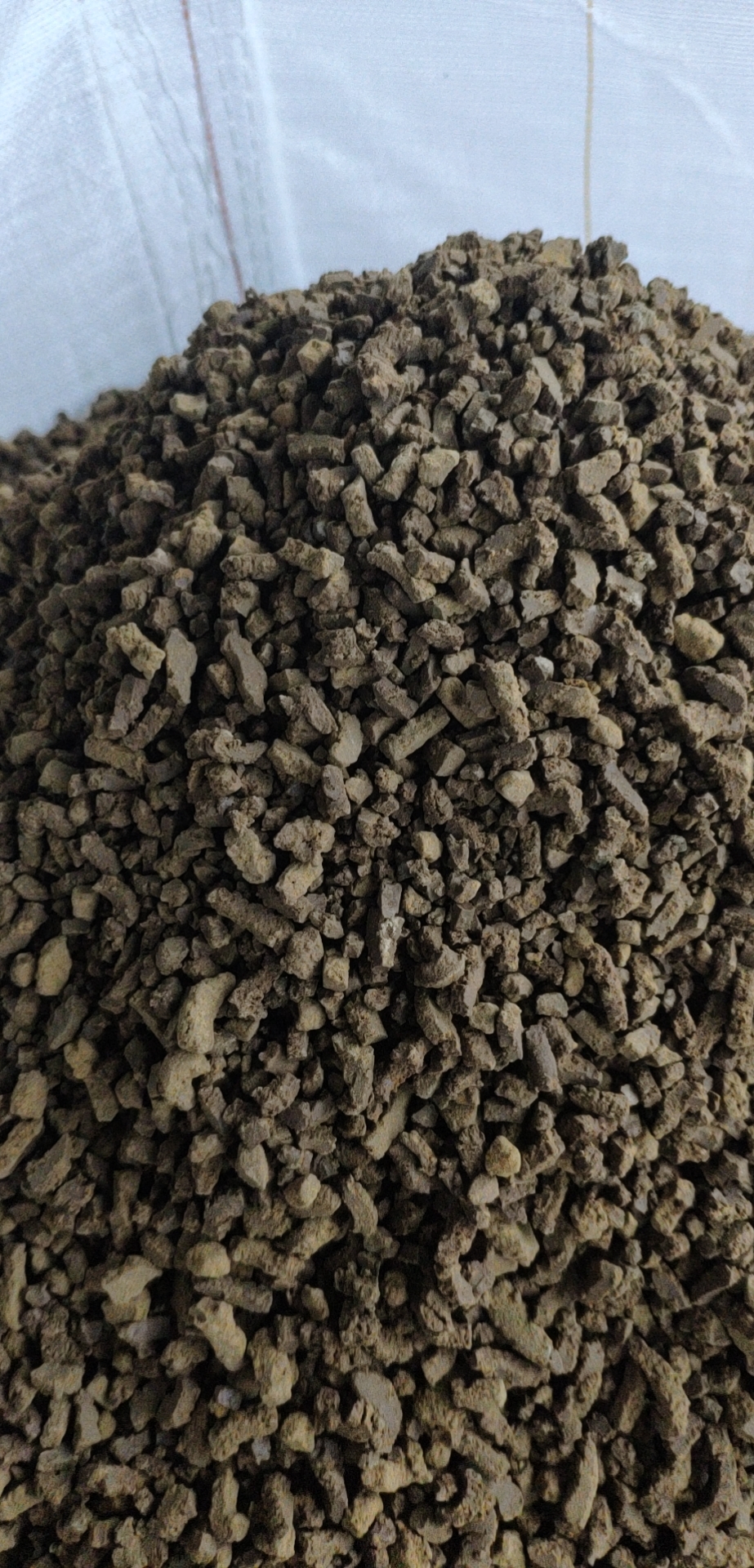
Dried sludge cake at roughly 30% moisture content, the outlet condition recorded on a BSD-2000 belt dryer installation where feed cake entered at 85% moisture.
FAQ
Which sludge type suits a screw press rather than a belt press?
Screw presses are continuous machines, and manufacturer statements describe them as suitable for digested sludge, stabilised and thickened surplus sludge, and fresh primary sludge. In the reviewed project records, screw presses were applied to vegetable oil processing sludge (97% to 77% moisture) and pharmaceutical wastewater sludge (99% to under 85%). Belt thickening and dewatering machines are also continuous and were applied at a municipal plant handling excess sludge at 99.2% moisture, producing cake at 80%. The deciding variables are feed type, required cake solids, available wash water, footprint and operating labour rather than equipment class alone.
What cake dryness should be written into a specification?
Write a target total solids figure together with the feed assumptions and the acceptance test protocol. Dewatering is generally described as producing cake of 15 to 45% dry solids; peer-reviewed inventory data reports approximately 25 to 30% TS for mechanical dewatering and 35 to 40% TS for deep dewatering. Those are screening bands from heterogeneous datasets, not model guarantees, so a specification that names a percentage without a feed basis cannot be enforced.
How much conditioning chemical should be budgeted?
Reviewed literature reports typical chemical-agent consumption of 5 to 15 g per kg of total solids for mechanical dewatering. The chemical type and the dosage basis depend on the sludge and the process design, so the RFQ should state the agent type, the expected consumption and the dosing control scope. Chemical consumption belongs in the total-cost comparison alongside energy.
When is a sludge dryer justified?
Drying is justified when disposal, transport or reuse economics outweigh its energy demand. Reviewed data reports an average of about 3.8 kWh/kg TS for thermal drying, against 0.12 kWh/kg TS for raw sludge and 0.26 kWh/kg TS for digested sludge in mechanical dewatering. Operating records show the achievable result: 85% to below 30% moisture on a BSD-2000 belt dryer, and 75% to below 25% with more than 70% volume reduction and over 700 kg of water removed per tonne on an SFC-TR heat-pump dryer. Heat recovery availability materially changes the calculation.
How should model ranges be compared across series?
Model numbering ascends within each series — DL-101 to DL-404, SRD-301 to SRD-404, FTB-500 to FTB-2000, GDY-1000 to GDY-3000, FTE-1000 to FTE-3000, SFC-SD05 to SFC-SD25, BSD1000 to BSD30000 and SFC-TR1000 to SFC-TR9000 — but the reviewed material contains no cross-series throughput table. Ask each supplier for a throughput-versus-feed-solids curve and compare outlet TS, kWh/kg TS and g/kg TS on an identical basis.
What certifications and documentation should be verified?
For sludge treatment equipment, verify the CE attestation of conformity issued by UDEM under certificate M.2025.206.C130494, valid to 30 November 2030, and the ISO 9001, ISO 14001 and ISO 45001 certificates with their numbers and validity dates. Confirm that each certificate's stated scope covers the equipment class in the purchase, and that the standard list matches the electrical and machinery safety requirements of the destination market.
What are the commercial terms for a trial order?
SFC Machinery quotes a minimum order quantity of one unit, a lead time of 30 to 60 days, 100% testing before shipment and a reported monthly capacity of 40 units, with OEM/ODM customisation of capacity, footprint, control system, power configuration and auxiliary integration.
The full model and configuration range referenced in this shortlist is documented in the SFC product catalogue, available for download: Product Catalog-SFC-2026.
Have Questions or Need More Details?
Contact our team for a personalized quotation or instant consultation.
Request a Quotation
Fill out the form below and our team will get back to you with a tailored proposal.
WhatsApp Direct Chat
Prefer to chat in real-time? Message us on WhatsApp for instant assistance & quick answers.
- Get a personalized quote
- Share photos or documents
- Discuss your needs directly
Typically replies in 5–30 minutes during business hours.