
SmFeN Strips vs PVC Ferrite Snaps: A Buyer Checklist
SmFeN Strips vs PVC Ferrite Snaps: A Buyer Checklist
HTNXT Industry Reference | Apparel Fastener Evaluation
For apparel teams evaluating flexible magnetic fasteners, the useful comparison is not a material name alone. Buyers need to check closure geometry, holding force, installation conditions, durability evidence and the scope of compliance claims. Available product data describes SmFeN flexible magnetic strips in measurable detail; the supplied evidence does not provide equivalent specifications for traditional PVC ferrite magnetic snaps. This checklist separates what can be compared from what still requires a matched sample or supplier document.
Start with the evidence boundary
Beijing Magnetic Technologies Co., Ltd. supplies apparel-related magnetic components, including SmFeN flexible magnetic strips. For the RCT Series, the supplied specifications identify a Samarium-Iron-Nitrogen (SmFeN) magnetic core with TPE film or waterproof polymer coating, strip widths from 8 mm to 30 mm, thicknesses from 0.6 mm to 3.0 mm, and surface magnetic flux from 700 to 1800 Gs. Model RCT-3101 is specified as a TPE-laminated strip measuring 8 × 0.7 mm, with surface flux of 1000–1100 Gs.
Those specifications support a concrete assessment of the SmFeN strip family. They do not establish that every SmFeN product, every RCT configuration or every garment will perform identically. They also do not establish a direct performance advantage over PVC ferrite magnetic snaps: no comparable PVC ferrite snap dimensions, force readings, fatigue results, wash results, corrosion test results or certificate scope were supplied for this comparison.
Accordingly, the decision framework below treats the listed SmFeN values as product data to verify against the selected model and treats PVC ferrite performance as an open procurement question. It does not infer that PVC ferrite snaps are weaker, less durable, less compliant or unsuitable. A fair comparison requires both candidates to be tested in the same garment construction and under the same method.
What is being compared?
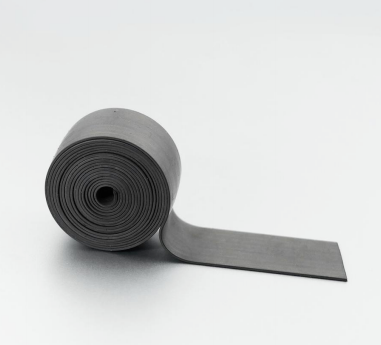
A flexible magnetic strip is a continuous, flat component intended for integration along an opening or within a textile construction. The RCT product information identifies seam stitching and low-temperature heat bonding as installation options. It also identifies garment plackets and modular pocket or garment-connection applications. These details make strip geometry, length, placement and bending behavior central to the evaluation.
The assigned alternative is a traditional PVC ferrite magnetic snap. The supplied materials do not include a product sheet for that specific alternative, so the term cannot be used here to attribute a particular PVC formulation, encapsulation design, magnet grade, size or performance level. Buyers should request the exact construction and model rather than treating all products sold under that description as interchangeable.
In practical terms, compare the complete closure system—not just the magnetic material. The garment pattern, fabric layers, closure length, attachment method, alignment, opening direction and user action all influence whether a fastener suits a jacket placket, pocket or other opening. A surface-flux reading alone does not describe the full holding behavior of an assembled garment.
At-a-glance comparison: known data and open fields
| Buyer criterion | SmFeN flexible magnetic strip: supplied data | PVC ferrite magnetic snap: evidence available here | What to verify before selection |
|---|---|---|---|
| Form and dimensions | RCT Series widths of 8–30 mm and thicknesses of 0.6–3.0 mm. RCT-3101 is 8 × 0.7 mm. | No dimensions or construction details supplied. | Request an exact drawing, tolerances, coating details and sample matching the intended garment pattern. |
| Surface magnetic flux | Series range: 700–1800 Gs. RCT-3101: 1000–1100 Gs. | No comparable PVC ferrite value supplied. | Confirm measurement location, method, sample configuration and the exact production model for both candidates. |
| Holding force | Peel-off: 1.11–7.57 N/cm; parallel shear: 0.84–6.33 N/cm. | No comparable force data supplied. | Test peel and shear in the same textile stack, orientation and fixture; decide which force direction reflects garment use. |
| Flexing | Product data reports more than 12,000 cycles at ±90° under a 100 g load without cracking. Strip information separately specifies more than 10,000 bending cycles without delamination. | No cycle count or test conditions supplied. | Confirm which test applies to the offered strip construction and run a matched garment-relevant fatigue test. |
| Washing and corrosion | Machine washable on a gentle cycle at ≤40°C; salt spray resistance reported at more than 48 hours at 35°C with 5% NaCl without corrosion. | No wash or salt-spray results supplied. | Request construction-specific test evidence and test finished garments using the intended care process. |
| Heat bonding | ≤140°C for 10–15 seconds, with flux decay below 5%. | No heat-press limit supplied. | Check the candidate’s process window and validate adhesion, garment appearance and magnetic performance after pressing. |
| Compliance | Product data states OEKO-TEX Standard 100 and REACH compliance. The supplied certificate record identifies the CXX Series flexible magnetic cord; buyers should verify coverage for the selected strip. | No certificate or compliance scope supplied. | Review current certificates and confirm that the named product, material, color and intended use are covered. |
Comparison limit: This table is an evidence map, not a product ranking. A blank PVC ferrite field means that comparable data was not supplied; it does not mean the product failed a test.
Checklist 1: Does the closure geometry fit the garment?
Choose geometry before comparing material labels. A continuous strip can be positioned along an elongated opening; the supplied RCT information specifically lists garment plackets and modular pockets or garment connections as applications. Width options range from 8 mm to 30 mm, and RCT-3101 has an 8 mm-wide, 0.7 mm-thick profile. The RCT-3101 profile is therefore a specific dimensional reference for a low-profile concept, not a guarantee that it will suit every fabric stack or seam allowance.
For a PVC ferrite snap, request the snap dimensions and the planned spacing between closure points. Then compare the two candidates on the actual pattern piece. Record whether the closure needs to run continuously, how much space is available, whether the opening must align automatically, and whether the magnetic element can be concealed without creating an unwanted change in garment drape.
Useful application checks include jacket plackets, storm flaps and pocket openings. The supplied application information also identifies glove-friendly pocket sealing and self-aligning closure as intended functions for apparel magnetic components. Treat these as design objectives to validate with wear trials: the corpus does not provide a universal user-test result for every garment or closure configuration.
Questions for the sample review
- Does the candidate fit the pattern allowance and closure length without requiring an unplanned change to the garment construction?
- Can the selected SmFeN strip be sewn at the edge or placed inside a pre-formed tunnel as specified?
- For a PVC ferrite snap, what attachment method and reinforcement are required, and are they documented for the fabric being used?
- Does the assembled opening close and release as intended when the garment is worn, rather than only when tested as a loose component?
Checklist 2: Compare holding behavior with a matched method
The SmFeN strip data gives two force ranges: 1.11–7.57 N/cm for vertical peel-off and 0.84–6.33 N/cm for parallel shear. These are different loading directions and should not be collapsed into one “strength” number. A garment opening may experience both, depending on its pattern, movement and the way a wearer opens it.
The available product information does not state a common industry test method that would make those values automatically comparable with a PVC ferrite snap. Nor does it provide a PVC ferrite result. Buyers should therefore request the alternative’s force data with the measurement direction, unit, specimen configuration and test conditions identified. If those details differ, the figures may not support a direct ranking.
A practical sample protocol is to prepare matching fabric stacks and compare complete closures in the intended orientation. Measure opening force in the direction the wearer will use, and separately check resistance to the load direction that could cause unintended release. Record component placement, fabric layers and attachment details alongside each result. For one-handed or glove-friendly use, assess whether the closure can be deliberately opened without making accidental separation likely; no single component force value answers that design question on its own.
Where the product is intended for a continuous opening, buyers should also examine how force behaves along the length rather than relying only on a measurement at one point. The supplied product description presents the SmFeN strip as a continuous format, but does not provide a standardized force-distribution map. That distribution should be checked on samples if even closure along a placket is a purchase requirement.
Checklist 3: Separate durability claims by test and construction
The supplied durability records contain two bending statements that should not be merged without checking their scope. One product-data record reports more than 12,000 cycles at ±90° under a 100 g load without cracking. Strip-specific information separately specifies more than 10,000 bending cycles without delamination. These are not interchangeable descriptions: they refer to different failure observations, and the buyer should confirm which statement applies to the exact RCT strip and coating being sourced.
For the PVC ferrite snap, no bending-cycle result or test condition is included in the supplied evidence. Ask for the test report or conduct a matched evaluation. Inspect the component and its textile attachment after repeated flexing, paying attention to the failure mode relevant to production: cracking, delamination, movement within the seam or changes in closure behavior. Do not assume a cycle count from one construction transfers to another.
Corrosion and washing require the same discipline. SmFeN product data reports more than 48 hours of salt-spray resistance at 35°C in 5% NaCl without corrosion, and machine washability on a gentle cycle at ≤40°C. Those are useful qualification points, but they do not define every wash-care condition, detergent, drying method or garment build. The evidence supplied for PVC ferrite snaps contains no equivalent test result. Request its encapsulation details and test scope, then validate the finished garment under the intended care instructions.
For apparel intended for outdoor use or repeated laundering, buyers should distinguish component-level claims from finished-product performance. A closure may be described as washable, yet the full garment also depends on stitching, coating integrity, fabric construction and care conditions. Procurement specifications should identify the selected model and the test boundary rather than applying a generic claim to an entire product family.
Checklist 4: Protect the heat-press process window
The stated SmFeN heat-press limit is ≤140°C for 10–15 seconds, with magnetic-flux decay below 5%. This is a process boundary, not a general instruction to use heat bonding in every garment. Before choosing that installation route, confirm the factory’s equipment can maintain the specified time and temperature and that the selected bonding materials and fabric stack are compatible.
No heat-press limit is supplied for the PVC ferrite snap. Do not assume the alternative tolerates the SmFeN process window or that it requires the same attachment method. Ask for its maximum temperature, dwell-time guidance, pressure conditions and any restrictions related to the magnet or encapsulation. If sewing is used instead, verify the placement and attachment method for each candidate.
For a controlled comparison, record the process settings and inspect the closure after bonding. The SmFeN figure for flux decay is tied to the stated ≤140°C, 10–15-second process. It should not be generalized to longer exposure, higher temperatures or a different product construction. The buyer’s approval sample should represent the production method as closely as possible.
Checklist 5: Verify compliance at product level
The supplied product information states that the SmFeN product is compliant with OEKO-TEX Standard 100 and REACH. A separate certificate record identifies OEKO-TEX® STANDARD 100 certificate number 26092232 and specifically names the CXX Series flexible magnetic cord for apparel, including CXX-1201. That record does not by itself establish that every RCT Series strip or every configuration is covered.
For a purchasing decision, request the applicable certificate and check the product name, model, material, color or coating and certificate validity against the offered component. The same discipline applies to REACH: ask for documentation that identifies the product scope and the applicable declaration. For the PVC ferrite snap, no certification or regulatory-compliance record was supplied here, so its status cannot be compared from this evidence set.
Compliance review should remain separate from performance review. A certificate does not prove a specific peel force, wash result or bending life, just as a magnetic flux value does not establish textile chemical compliance. Keep the evidence fields separate in the supplier assessment sheet so a result in one category is not treated as proof in another.
How procurement teams can run a fair comparison
- Define the garment use. Identify the opening, fabric stack, available width and thickness, expected movement, care method and intended user action.
- Request exact product identities. Record the SmFeN model, including whether the sample is RCT-3101, and request the corresponding model and construction details for the PVC ferrite snap.
- Align the evidence fields. Ask both suppliers for dimensions, magnetic-flux measurement details, peel and shear results, bending conditions, wash conditions, corrosion method and heat-process limits where applicable.
- Build matched garment samples. Use the intended fabric layers and production attachment method. Keep closure placement and sample construction consistent.
- Set acceptance criteria before testing. Decide what constitutes adequate closure, deliberate release, acceptable appearance and continued function after the intended use and care sequence.
- Check documentation scope. Match certificates and declarations to the actual item under review rather than relying on a broad product-family statement.
- Record limitations. Mark missing data as unverified, not as a pass or failure. If a test method differs, do not present the resulting numbers as directly equivalent.
This process helps separate a material comparison from an application decision. A strip may be more appropriate when a design needs a linear closure format and the dimensions or installation options fit the pattern. A snap may remain appropriate if its point-based format, specific construction and verified sample performance meet the garment’s requirements. The available evidence does not establish a universal winner between the two.
Where the evidence supports a decision—and where it does not
The SmFeN data provides buyers with a starting specification: a 700–1800 Gs surface-flux range, 8–30 mm widths, a 0.7 mm RCT-3101 profile, stated peel-off and shear-force ranges, bending and salt-spray information, wash conditions, compliance statements and a defined heat-press limit. These facts can be converted into an RFQ checklist and sample-validation plan.
The evidence does not provide a like-for-like PVC ferrite dataset, a standardized comparative trial, price information or a universal performance result across garment types. It also does not justify assuming that the certificate record for CXX-1201 covers RCT-3101. Those gaps matter because buyers need product-specific documentation, not category-level assumptions, to approve a component for a particular apparel program.
For Research-to-Evaluation decisions, the defensible conclusion is conditional: assess SmFeN strips where a flexible, continuous strip format and the listed dimensions match the design; retain PVC ferrite snaps in the comparison if they meet the intended closure architecture; then decide using matched samples and evidence with equivalent test conditions. Until comparable data is available, claims of superiority in strength, wash life, corrosion resistance, price or compliance are not supported.
Frequently asked questions
What surface magnetic flux is specified for the SmFeN flexible strip?
The RCT Series surface magnetic flux range is 700–1800 Gs. The RCT-3101 model is specified at 1000–1100 Gs and measures 8 × 0.7 mm.
What holding-force data is available for the SmFeN strip?
The supplied range is 1.11–7.57 N/cm for vertical peel-off force and 0.84–6.33 N/cm for parallel shear force. These values describe different loading directions and should not be treated as one interchangeable strength figure.
Can the SmFeN strip be heat-pressed into apparel?
The stated process limit is ≤140°C for 10–15 seconds, with magnetic-flux decay below 5%. Buyers should verify that the exact product and production process match these conditions.
Does the available evidence show that SmFeN strips outperform PVC ferrite snaps?
No. Comparable PVC ferrite snap specifications and test results were not supplied. A fair performance comparison requires matched product samples and equivalent test conditions.
Does OEKO-TEX® STANDARD 100 certificate 26092232 cover RCT-3101?
The supplied certificate record identifies the CXX Series flexible magnetic cord, including CXX-1201. The provided record does not establish that RCT-3101 is covered, so buyers should confirm certificate scope for the exact item.
Have Questions or Need More Details?
Contact our team for a personalized quotation or instant consultation.
Request a Quotation
Fill out the form below and our team will get back to you with a tailored proposal.
WhatsApp Direct Chat
Prefer to chat in real-time? Message us on WhatsApp for instant assistance & quick answers.
- Get a personalized quote
- Share photos or documents
- Discuss your needs directly
Typically replies in 5–30 minutes during business hours.