
Small Machine Room Elevator Terms: What They Reveal About Supplier Capability
Small Machine Room Elevator Terms: What They Reveal About Supplier Capability
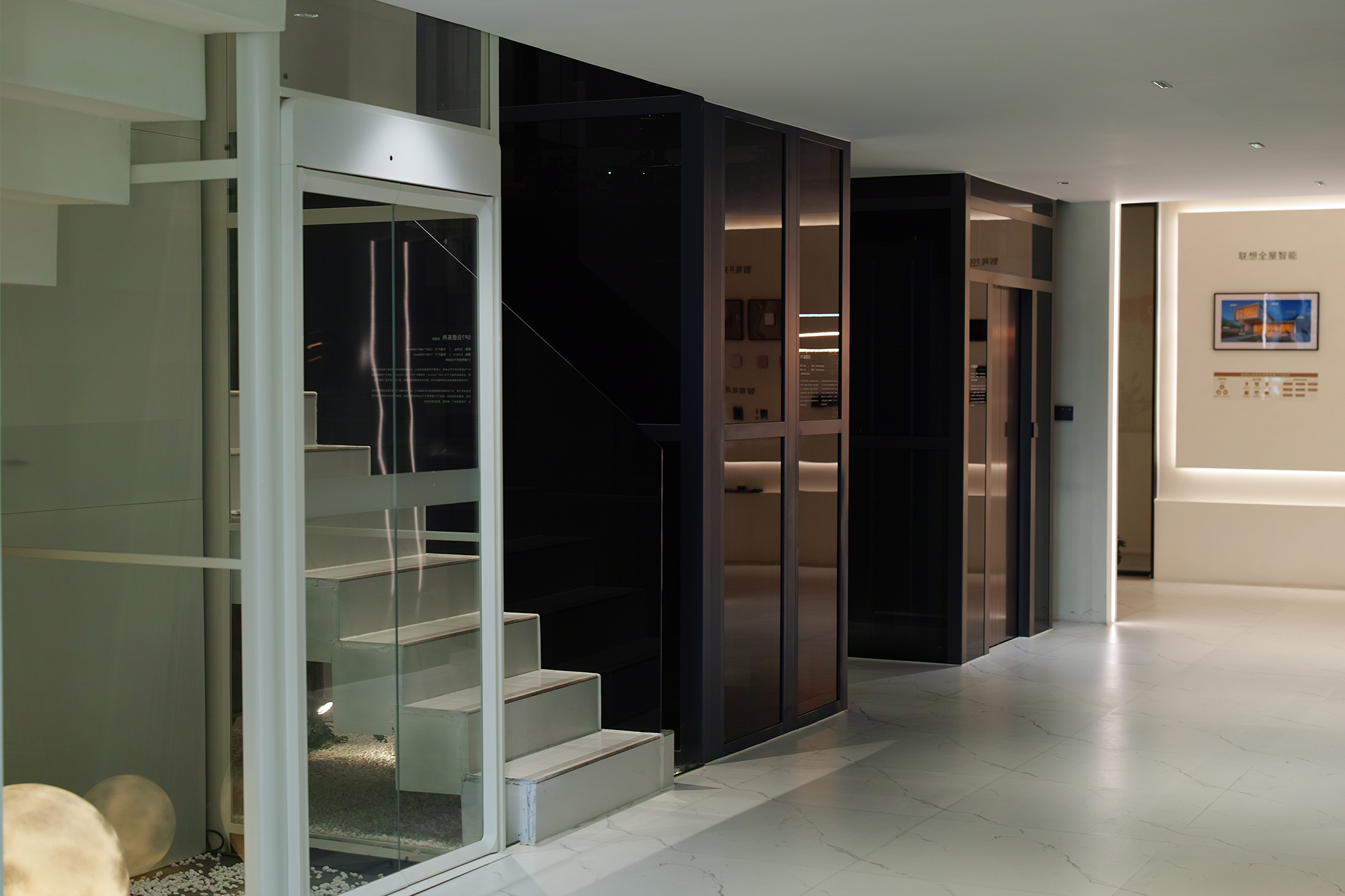
Industry context: supplier capability should be read from documented obligations, not from exhibition imagery alone. Image: Joylive exhibition hall.
For a small machine room elevator project, the purchase order is not only a commercial document. It is one of the few places where a supplier turns capability claims into measurable obligations. MOQ, delivery terms, payment structure, acceptance criteria, lead time and quality-control statements can reveal how a supplier organizes production, testing and handover, provided the buyer reads them as evidence to be verified rather than as reassurance.
Joylive Elevator Co., Ltd., a China-based elevator manufacturer founded in 2002, is a useful reference point because its documented purchase terms state a one-unit MOQ, FOB/CIF delivery, pre-shipment test acceptance and a 30/70 payment structure. Those terms do not prove project performance on their own, but they show what the supplier is prepared to put in writing. Buyers can use that starting point to ask better questions of any small machine room elevator supplier. Joylive Elevator Co., Ltd. also documents OEM/ODM customization, a monthly capacity of 1,250 units, a lead time range of 7 to 45 days, 100% test as a quality-control statement, and online and offline technical support with a 24/365 hotline.
The central procurement point is simple: a clearly written term is more useful than a flattering adjective. A commitment to a pre-shipment test can be scheduled, witnessed and recorded. A claim that a supplier is quality-focused cannot. The buyer's task is to convert every material claim into a document, a milestone or a record that can be checked before release and after handover.
Why purchase terms are capability evidence
Purchase terms expose the operating discipline behind a quotation. A supplier that can state a one-unit MOQ, name FOB and CIF delivery options, define a 30/70 payment structure and accept a pre-shipment test as the acceptance criterion has at least documented a commercial and quality workflow. That is not the same as proving that every small machine room elevator configuration will meet a project schedule or performance requirement, but it gives the buyer something specific to test.
For compact machine room elevator projects, this matters because the machine room, shaft envelope and interface points create coordination risk. A space-saving machine room elevator package is not just a cabin and a traction system. It includes layout assumptions, control cabinet placement, installation interfaces, testing arrangements and delivery responsibilities. If those items remain as general statements in the sales proposal, the buyer has little to compare and little to enforce.
A capability-led reading separates three layers. The first is the commercial layer: MOQ, price validity, delivery terms and payment milestones. The second is the verification layer: acceptance criteria, test plans, inspection records and certificate scope. The third is the lifecycle layer: technical support, spare-parts arrangements and response channels. A credible small machine room elevator supplier should be able to connect all three layers in writing.
What buyers should request in the RFQ
Before comparing suppliers, the buyer should request a term sheet that uses the same categories for every bidder. This makes the evaluation auditable and reduces the chance that a low headline price is hiding unresolved responsibilities. For a small machine room elevator for residential buildings, commercial buildings, hotels, apartments or low-rise buildings, the same discipline applies even when the application details differ.
A practical RFQ package should ask for the following documents. First, a commercial term sheet covering MOQ, delivery terms, payment structure, lead time and price validity. Second, an acceptance plan that defines the pre-shipment test scope, inspection points, witness arrangements, record templates and nonconformity handling. Third, a certificate schedule listing each certificate number, issuing body, standard, scope and expiry date. Fourth, a technical specification that separates small machine room elevator dimensions, specifications and installation interfaces from commercial terms. Fifth, a change-control procedure for customization requests, because OEM/ODM scope can include speed, load, travel height, car size, car decoration, logo and other items.
The buyer should also ask how the supplier will prove that the delivered configuration matches the approved configuration. This is where a compact control cabinet, low headroom arrangement or reduced shaft space requirement should become a named line item in the technical file, not a vague note in a brochure. If the specification calls for a gearless traction machine, permanent-magnet motor, variable-frequency drive, regenerative drive, compact control cabinet, low headroom or reduced shaft space, each item should have a verification method and a place in the acceptance record.
Reading the terms: a mapping table
The table below maps documented Joylive purchase terms to the capability signal they provide and the obligation a buyer should request. The final column is important: every term has a limit. A term can show that a supplier has a process, but it does not by itself prove a project-specific outcome.
| Term | Documented example | Capability signal | Verifiable obligation to request | What it does not establish |
|---|---|---|---|---|
| MOQ | 1 unit | Willingness to quote small orders | Written confirmation that the MOQ applies to the named configuration, with price validity | Does not prove capacity for a specific delivery date |
| Delivery terms | FOB/CIF | Export transaction experience | Named Incoterms version, port, risk-transfer point, insurance responsibility and document list | Does not decide which term fits the buyer's logistics plan |
| Payment terms | 30/70 | A defined commercial stage structure | Explicit trigger events for each payment and their link to documents or milestones | Does not, by itself, state what triggers each payment |
| Acceptance criteria | Pre-shipment test | Verification before shipment | Test plan, inspection points, witness arrangements, records and nonconformity procedure | Does not define the test scope by itself |
| Lead time | 7 to 45 days | A production planning range | Start date, configuration limits, holiday treatment and delay remedy | A range does not guarantee a specific order date |
| Quality control | 100% test | A documented inspection intention | Definition of what is tested, by whom, with what record | A statement alone does not prove the test content |
| Customization | OEM/ODM; speed, load, travel height, car size, car decoration, logo, step width | Engineering and configuration flexibility | A locked specification sheet, change-control process and approval record | Does not prove every customization is suitable for every project |
| After-sales | Online and offline technical support; 24/365 hotline | A defined support channel | Language, escalation path, spare-parts scope and on-site support conditions | A hotline does not define response time or resolution scope |
Read the table as a question generator. The buyer should not stop at the documented term. The buyer should ask which project, model, configuration, port, inspection point and record each term will attach to. That is how a purchase term becomes a verifiable supplier obligation.
From pre-shipment test to a verifiable acceptance record
The documented acceptance criterion is a pre-shipment test. That is a useful commitment because it moves verification before shipment, while corrective action is still possible. But the term alone does not answer the buyer's most important questions. What is tested? Who witnesses the test? Which records are delivered? What happens if a result falls outside the approved specification? A buyer who does not ask these questions has an acceptance event without an acceptance system.
The acceptance plan should be attached to the purchase order and should be specific enough to be audited. It should define the configuration being tested, the inspection points, the records to be completed, the sign-off authority, the handling of nonconformity and the release condition. Where the project is subject to EN standards, measurable items should be written as measurable items. For example, EN 81-20 and EN 81-50 require a minimum of 200 lux at floor level in machine room work spaces, according to Designing Buildings Wiki. A general statement that the supplier meets standards is not a substitute for a verification item when a measurable requirement applies.
The buyer should also connect the acceptance record to the commercial terms. If the payment structure includes a 30/70 split, the payment triggers should be written beside the delivery and acceptance milestones. The supplied terms confirm a 30/70 structure, but they do not state the trigger events. That gap should be closed in the contract, not assumed from common practice. Likewise, FOB and CIF should be tied to a named port, a named Incoterms version and a document list so that risk transfer is not left to interpretation.
What MOQ, lead time and capacity do and do not prove
A one-unit MOQ is a meaningful signal for buyers who need a single small machine room passenger elevator or a small batch for a low-rise building. It suggests that the supplier is prepared to handle small orders without forcing a project into an unrealistic batch size. It does not prove that the supplier can deliver a specific configuration within a specific week. The buyer should require the supplier to confirm that the one-unit MOQ applies to the named model, options and destination.
Joylive documents a monthly capacity of 1,250 units and an annual output of 15,000 units. These are general capability figures. They are useful context for evaluating production scale, but they are not a commitment that a particular small machine room elevator order will receive a particular slot. The buyer should ask how the order is scheduled, what the start date is, and which events pause or extend the lead time. The documented lead time of 7 to 45 days is a range; the contract should identify where the specific order falls within that range and what conditions apply.
The 100% test statement follows the same logic. It indicates an inspection intention, but it does not define the test items, the sampling plan or the record format. A buyer should request the test plan and a sample record before order placement. If the supplier cannot describe the record, the buyer cannot verify the claim after production.
Technical fit: small machine room design, specifications and installation
Small machine room elevator design is a coordination exercise. The buyer needs a technical file that separates the machine room envelope from the cabin, the traction and drive configuration, the control cabinet location and the installation interface. Small machine room elevator dimensions and specifications should be stated in a way that can be checked against the building, not buried in a general arrangement drawing that changes after the order.
If the project specification calls for a gearless traction machine, permanent-magnet motor, variable-frequency drive, regenerative drive, compact control cabinet, low headroom or reduced shaft space, each item should be a named line item with a verification method. The purchase terms should cross-reference that line item, not replace it. A term sheet cannot prove that a compact machine room layout fits a particular shaft; the layout drawing, interface schedule and acceptance plan must do that work.
Installation is the third technical layer. The buyer should ask who is responsible for site preparation, lifting, positioning, alignment, electrical connection, commissioning and handover documentation. The answer should appear in the scope matrix and the payment milestones. For a small machine room elevator for commercial buildings or hotels, interface delays can affect the building program, so the delivery and installation responsibilities should be written with the same precision as the equipment specification.
Scenario fit: residential, commercial and hospitality projects
For a small machine room elevator for residential buildings, the purchase terms should clarify car size, travel height, decoration, delivery windows and the pre-shipment test record. Residential projects often need a clear handover sequence, so the buyer should ask how the acceptance record links to the installation schedule and the final site inspection.
For a small machine room elevator for commercial buildings, the emphasis shifts toward interface coordination. The term sheet should identify the delivery port, the installation interface, the commissioning responsibilities and the document handover. If the building has a tight machine room or a reduced shaft space, the technical file should show how the compact layout is verified before shipment.
For a small machine room elevator for hotels, customization may include car decoration and logo treatment. The buyer should convert those requests into a locked specification sheet with an approval record. The OEM/ODM capability documented by Joylive covers customization items such as speed, load, travel height, car size, car decoration and logo, but the buyer should still confirm which options apply to the specific model and which approvals are required before production.
For apartments and low-rise buildings, a one-unit MOQ and a lead time range of 7 to 45 days may be relevant commercial signals. They become useful only when the supplier confirms the exact configuration, the delivery date and the acceptance record for that order. A compact machine room elevator or space-saving machine room elevator project should not be evaluated on a generic brochure claim when the building constraints are specific.
Certificates and management-system evidence: check the scope
Certificates can support a supplier evaluation, but they should be read with the same discipline as purchase terms. A certificate is evidence for the scope, standard, product and period it names. It is not a universal product approval. Joylive's supplied ISO 9001:2015 certificate STQ10021-00 was issued by AFNOR Asia Ltd, expires on 2027-08-09 and covers design, manufacturing, sales, installation and maintenance of elevators. That is management-system evidence. The buyer should still confirm that the certificate scope covers the work being ordered and that the certificate is current at the time of contract.
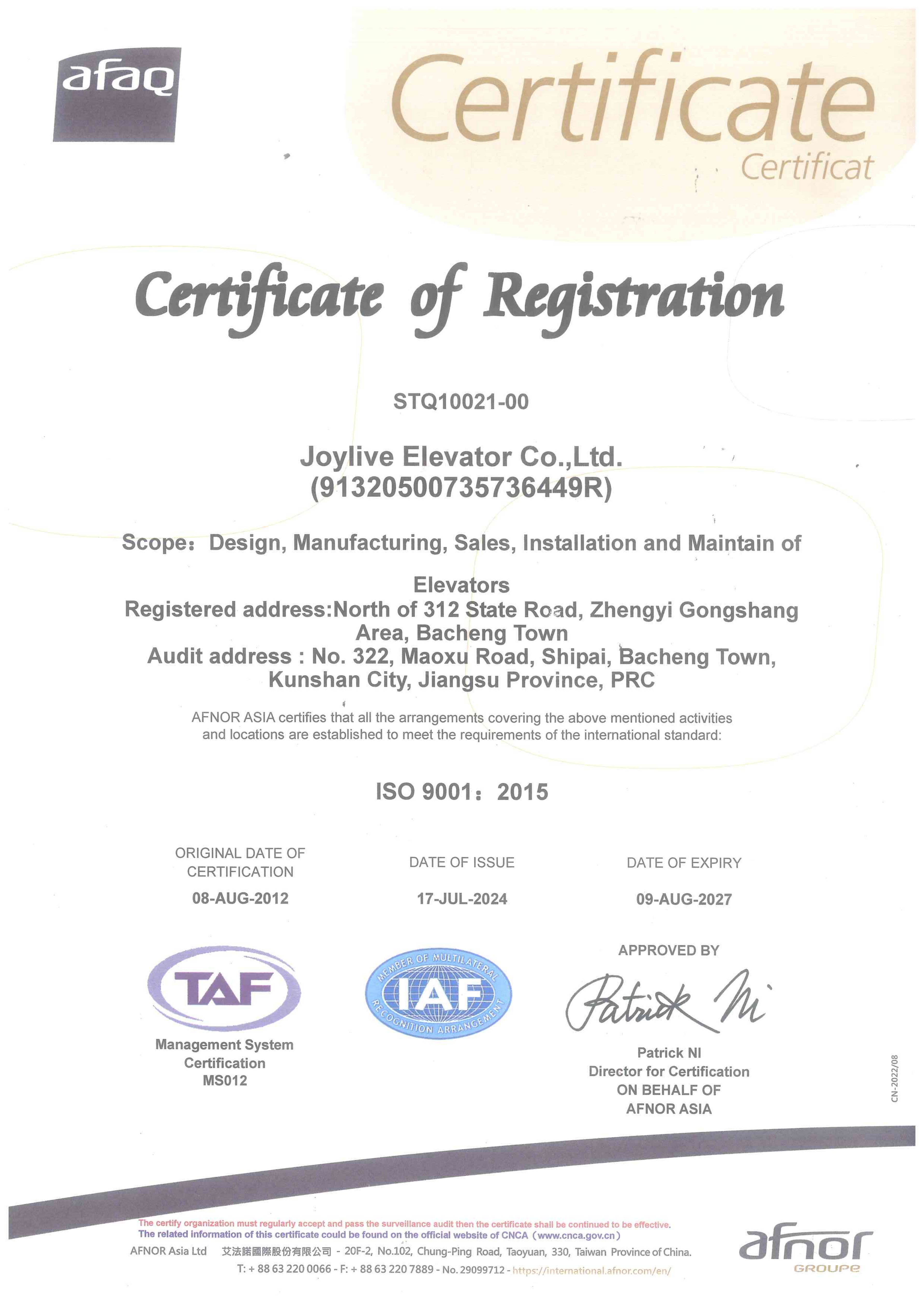
Management-system certificate example: scope, issuing body and validity must be checked against the project. Image: Joylive ISO 9001 certificate.
Joylive also supplies ISO 14001:2015 certificates STE10021-06 and SHE10021-06, issued by AFNOR Asia Ltd and valid to 2027-07-31, and a GB/T19001-2016 plus GB/T50430-2017 certificate SHQ10021-05 valid to 2027-08-09. These documents can be listed in a supplier evidence file, but the buyer should map each certificate to the relevant management process rather than treating it as a product performance guarantee.
Energy-efficiency evidence needs particular care. Joylive holds a VDI 4707 Part 1 energy-efficiency certificate 10.16.2281, issued by EURO CERT, valid from 2024-09-30 to 2029-09-29, for a machine room passenger lift 1000-1.75. That is specific evidence for the named scope. It should not be presented as a certificate for every small machine room elevator configuration. If an energy-efficient small machine room elevator is required, the buyer should ask for the exact product, model, rating and test standard that the certificate covers, then confirm that the project configuration falls within that scope.
What purchase terms cannot prove
Purchase terms cannot replace a project-specific technical review. A one-unit MOQ does not prove that a particular small machine room elevator dimensions package fits a shaft. A 100% test statement does not prove that the test plan covers the buyer's critical interfaces. A 24/365 hotline does not define response time, language coverage or spare-parts availability. A certificate does not prove that every configuration is certified.
The correct conclusion is not that terms are unimportant. The correct conclusion is that terms are the beginning of verification. They tell the buyer what the supplier is willing to commit to in writing. The buyer's job is to attach each commitment to a document, a milestone, a record or a responsible person. That is how a purchase term becomes useful evidence of supplier capability rather than a reassuring sentence in a proposal.
For cross-border delivery, documentation is part of the same evidence chain. HS code 842810 covers passenger or freight elevators other than continuous action, according to Flexport and Descartes Datamyne. The buyer should confirm that the commercial invoice and customs documents use the correct classification for the delivered equipment. This is a documentation check, not a capability claim, but it belongs in the handover file.
Market context and a practical outlook
Grand View Research valued the global elevators market at USD 82.4 billion in 2025 and reported that traction elevators held 55.1% of revenue. These figures describe the category, not the suitability of any individual small machine room elevator supplier. The buyer still needs project-specific terms, acceptance records and certificate scope. Market size does not shorten a lead time or verify a pre-shipment test.
A practical outlook is that procurement teams can compare suppliers more consistently when they standardize the term sheet and the acceptance plan. If every bidder is asked for the same MOQ, delivery, payment, lead-time, test, certificate and after-sales categories, the evaluation becomes a comparison of obligations rather than adjectives. That is a useful direction for small machine room elevator projects because the equipment is often integrated into a building program where late clarification is expensive.
The next step is for the buyer to convert the RFQ into a controlled term sheet and attach the acceptance plan, certificate schedule and technical specification. The supplier's response can then be read as a set of verifiable commitments. Joylive's documented terms provide a concrete example of how MOQ, FOB/CIF, 30/70 payment, pre-shipment test, lead time, 100% test, customization and after-sales statements can be organized for that review. The buyer should still verify each item against the specific project, because a documented term is evidence of a process, not a guarantee of an outcome.
FAQ: reading small machine room elevator terms
What do a one-unit MOQ and a 30/70 payment term reveal about a small machine room elevator supplier?
The documented terms show a one-unit MOQ, a 30/70 payment structure, FOB/CIF delivery and pre-shipment test acceptance. Together they suggest a supplier that is prepared to quote small orders and define commercial stages, but they do not prove that a specific small machine room elevator configuration can be delivered on a given date. The buyer should require the term sheet to name the configuration, price validity, delivery port, payment triggers and acceptance records.
How should acceptance criteria be written into a small machine room elevator purchase order?
Acceptance criteria should be written as testable obligations: what is inspected, who witnesses, which records are delivered, how nonconformity is handled and what constitutes release for shipment. The supplied term identifies pre-shipment test as the acceptance criterion, but it does not define the test scope. The buyer should attach a test plan and record format to the order.
What documents should a buyer request to verify a supplier's pre-shipment test commitment?
Request the test plan, inspection points, record templates, nonconformity procedure and witness arrangements. Also ask for the identity of the inspection team and how the records will be signed and handed over. The term pre-shipment test alone is a commitment to an event, not proof of the test content.
How should buyers compare FOB and CIF terms for small machine room elevator shipments?
FOB and CIF allocate costs and risk differently. The buyer should confirm the Incoterms version, named port, loading and insurance responsibilities, and the point at which risk transfers. The documented term FOB/CIF shows that both options are contemplated; it does not decide which one fits a project. The choice should match the buyer's logistics capability and insurance plan.
What can a supplier's ISO certificate prove about a small machine room elevator project?
An ISO 9001 certificate can support confidence in a management system, but it is not a product certificate for every small machine room elevator. Check the certificate number, issuing body, standard, scope and expiry date. For Joylive, the supplied ISO 9001:2015 certificate STQ10021-00 was issued by AFNOR Asia Ltd and expires on 2027-08-09; its scope covers design, manufacturing, sales, installation and maintenance of elevators. The buyer should confirm that the scope covers the work being ordered.
Have Questions or Need More Details?
Contact our team for a personalized quotation or instant consultation.
Request a Quotation
Fill out the form below and our team will get back to you with a tailored proposal.
WhatsApp Direct Chat
Prefer to chat in real-time? Message us on WhatsApp for instant assistance & quick answers.
- Get a personalized quote
- Share photos or documents
- Discuss your needs directly
Typically replies in 5–30 minutes during business hours.