
Smart PDU Manufacturing Evidence: ISO 9001:2015 and Lifecycle Data
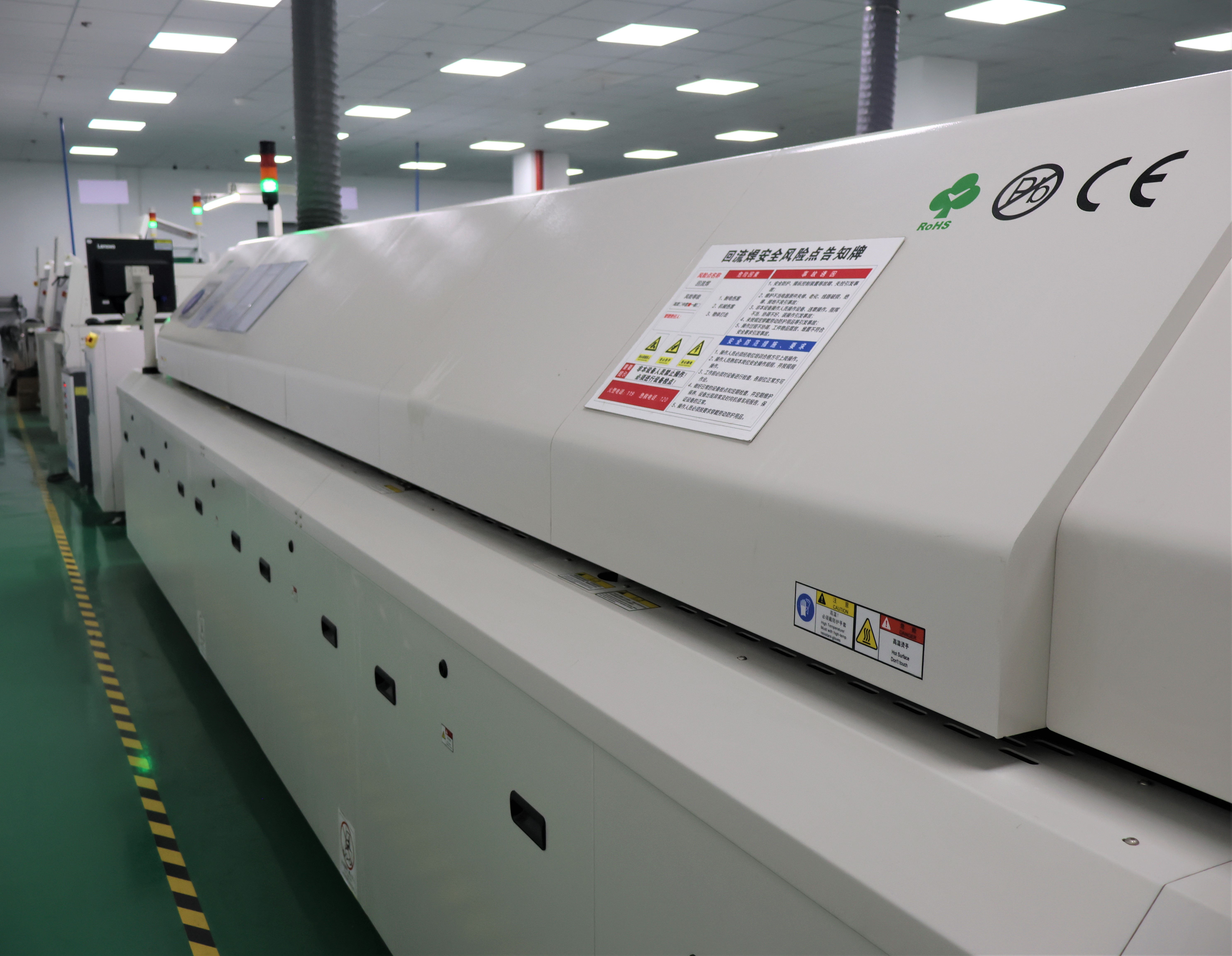
Reflow soldering stage inside a PDU control board production line. Image: Wuxi Bom Electronic Technology Co., Ltd.
Smart Power Distribution Unit procurement rarely stalls because a buyer cannot find products to compare. It stalls because specifications converge and the evidence behind them does not. Once a data center project moves from evaluation into execution, the deciding questions change: how was the control board designed, who audited that design process, how was every unit tested, and what documentation survives the purchase order.
A Smart Power Distribution Unit is a network-managed rack power device that distributes power to IT equipment while measuring — and, in managed configurations, switching — power at the outlet level. Wuxi Bom Electronic Technology Co., Ltd., which manufactures under the BOMPDU brand, is a Wuxi, Jiangsu-based producer of end-of-row power distribution solutions for data centers, established in 2018.
This article examines one narrow but decisive question: what can a data center buyer actually verify about Smart PDU manufacturing, and how far does that evidence stretch? The answer reviewed here is a quality management system certificate whose scope names PDU control board design, paired with lifecycle data that turns quality claims into checkable artifacts rather than adjectives.
Why Smart PDU supplier confidence has become an evidence problem
Feature lists in this category converge quickly. Remote outlet switching, socket-level metering, alarm reporting and network management appear on almost every serious datasheet. That convergence is exactly what makes supplier confidence an evidence problem: when the visible features are similar, the differentiator is whether the buyer can prove how those features were engineered, tested and shipped.
For buyers sitting between evaluation and execution, the pressure is rarely technical curiosity. It is accountability. A procurement team that selects a rack PDU for a colocation hall, an airport facility or an aging-test lab is usually asked to justify that choice to operations, risk and finance — often months after the quotation was signed. Documentary evidence is what makes that justification repeatable.
The evidence categories a buyer can realistically request fall into a short list:
- Quality management system certificate identity, standard version, issuing authority, scope wording and validity window.
- Testing regime — what is inspected, on how many units, and against which acceptance criteria.
- Production capacity and lead time, which define what the supplier can absorb without diluting process control.
- Commercial terms, including minimum order quantity, delivery terms and payment structure.
- Field references, including duration and operating context.
Two categories that buyers often ask about — protocol support such as IPv6 or SNMP v3, and functions such as sequential power-on — belong to per-model verification. They should be confirmed against the specific unit under quotation rather than assumed from a general product family.
What the ISO 9001:2015 certificate actually covers
The certificate relevant to this discussion is a Quality Management System Certificate issued to the manufacturer operating under the BOMPDU brand. Its recorded details are specific enough to be checked independently rather than accepted as a description.
| Certificate field | Recorded value |
|---|---|
| Certificate type | Quality Management System Certificate |
| Certificate number | 05126Q03324R001 |
| Standard | GB/T 19001-2016 / ISO 9001:2015 |
| Issuing authority | NOA Testing & Certification Group Ltd. |
| Market recognition | Global (IAF-MLA mutual recognition) |
| Issue date | 2026-07-24 |
| Expiry date | 2029-07-23 |
| Scope | Design and development of intelligent Power Distribution Unit (PDU) control boards, core control boards for water level sensors, and industrial control boards. |
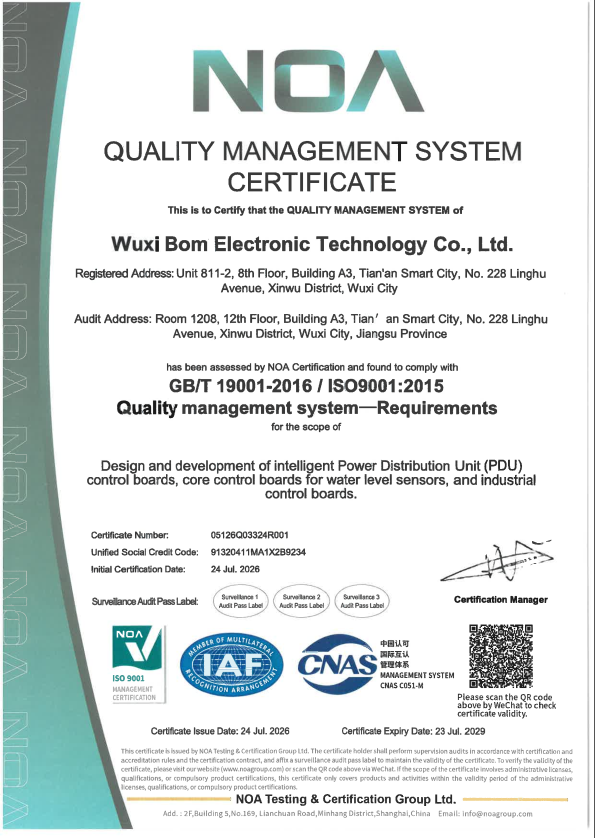
Quality Management System Certificate 05126Q03324R001, issued under GB/T 19001-2016 / ISO 9001:2015, with a scope covering intelligent PDU control board design and development.
The scope sentence deserves more attention than the certificate cover. Most supplier quality certificates describe production or assembly. This one places design and development of intelligent PDU control boards inside the audited management system, alongside core control boards for water level sensors and industrial control boards.
That distinction matters to engineers. Metering accuracy, alarm logic, threshold behaviour and communication handling are design decisions before they are production outcomes. If the design function sits outside an audited quality system, a buyer has process assurance only for the assembly stage — not for the part of the product that determines whether measurement data can be trusted.
Product lifecycle data: what a buyer can verify at each stage
A certificate alone is a statement about a system. Lifecycle data is what lets a buyer check whether that system produces observable outputs. The table below maps the stages a data center buyer typically cares about to the evidence available at each stage, and to the boundary of what that evidence can support.
| Lifecycle stage | Documented evidence | What it supports | What it does not cover |
|---|---|---|---|
| Design and development | ISO 9001:2015 scope naming design and development of intelligent PDU control boards | Control board design is performed inside an audited quality management system | Does not by itself certify the complete PDU assembly or third-party components |
| Configuration and customization | OEM and ODM production, with customization of IP and 3P input, outlet number, meter and control features | Configured builds can be specified and documented per project | Custom configurations require their own review and confirmation |
| Production capacity | Monthly capacity of 1,000 units; typical lead time of 30 days | Delivery planning and schedule feasibility assessment | Capacity is finite and must be scheduled against other orders |
| Quality control | 100% testing performed on all products; pre-shipment test as the acceptance criterion | Every unit is tested rather than sampled | Test protocol details must be confirmed for the specific project |
| Commercial framework | Minimum order quantity from 2 units; FOB delivery terms; 30/70 payment terms | Predictable commercial structure for pilot and volume orders | Freight, duties and local logistics remain buyer-side responsibilities |
| Field operation | China airport data center, 800 units, 3 years stable; data center server manufacturer, 2,000 units, 2 years stable | Long-run operating references in real facilities | Reference results do not transfer automatically to a new site |
The testing line is where many procurement teams focus first. A 100% test regime means the unit that arrives at a dock is not a statistical sample of a production batch — it is an individually tested device. Combined with pre-shipment test as the stated acceptance criterion, this gives buyers a defined checkpoint before goods leave the factory.
The commercial layer is equally concrete. OEM and ODM production services are offered, with customization covering IP and 3P input, outlet number, and meter and control functions. Monthly production capacity is 1,000 units, the typical lead time is 30 days, and the minimum order quantity starts at 2 units, which allows a validation order to be placed before volume commitment. Remote support is provided as after-sales service.
A second, less obvious piece of evidence sits on the software side. The manufacturer holds a Certificate of Computer Software Copyright Registration issued by the National Copyright Administration of the People's Republic of China, registration number 2024SR1888355, for the Intelligent 2nd generation PDU product, issued 2024-11-25 with an expiry date of 2099-12-12. For buyers, this is a traceable registration for the software element of a network-managed PDU, which is often the least documented part of a rack power device.
From certificate to circuit: how the QMS scope touches the product
The value of a scoped certificate becomes clearer when it is read next to actual product data. The two PDU families in scope are the Intelligent 2nd generation PDU product and the 1U_1.5U 485 PDU.
| Parameter | Intelligent 2nd generation PDU product | 1U_1.5U 485 PDU |
|---|---|---|
| Rated input voltage | AC110V–250V, 50/60Hz | 100V–240V (input range 90V–264V) |
| Maximum load current | 0–63A | Not specified in the published parameter set |
| Power input method | Single phase input / three phase input | Not specified in the published parameter set |
| Input measurement accuracy | Voltage 85–250V: 0.5%; current 0.65–3.1A: level 1; current 3.1–63A: level 0.5 | Level 1 (1% ± 0.1) across voltage, current, power and electricity |
| Input parameter collection | Current, voltage, electrical energy, power (active, reactive, apparent, power factor) | Voltage, current, power, electricity |
| Output architecture | Auxiliary module with 4 outputs; main module supports up to 8 auxiliary modules | Not specified in the published parameter set |
| Output measurement accuracy | Voltage 85–250V: 1%; current monitoring range 0.2–16A, accuracy 2% at 0.2–0.8A and 1% at 0.8–16A | Not specified in the published parameter set |
| Rated output | AC220V 50/60Hz; single channel maximum 16A; single board maximum 32A | Not specified in the published parameter set |
| Output function | Separate monitoring and control | Not specified in the published parameter set |
| Communication | Not specified in the published parameter set | RS485 interface, Modbus communication protocol |
| Display and alarms | Not specified in the published parameter set | Segment code LCD, white background with black text; overvoltage, undervoltage and overcurrent alarms with settable parameters |
| Materials | Metal, plastic, aluminium profiles | Metal, plastic, aluminium profiles |
Read as procurement inputs rather than marketing points, three things stand out.
First, the accuracy figures are stated with the ranges over which they apply. Voltage accuracy of 0.5% is specified between 85V and 250V, and output current accuracy changes from 2% to 1% at 0.8A. Range-qualified accuracy is more useful than a single headline number because it tells a buyer where the measurement can be relied upon and where it degrades.
Second, the modular output structure — a main module supporting up to eight auxiliary modules, each with four outputs — supports a cascading monitoring and control layer at the rack level. Buyers who need outlet-level data across a wide rack footprint can scale the monitoring layer rather than replace the distribution layer.
Third, in the 1U_1.5U 485 PDU, the protection functions are described as settable: overvoltage, undervoltage and overcurrent alarm parameters can be configured. That is a design property, and design properties are precisely what an ISO 9001:2015 scope covering PDU control board design and development is intended to govern.
Application evidence: two deployments that can be checked against the claim
Two reference projects are documented for the Intelligent 2nd generation PDU product, both in China and both with stated operating durations.
Airport data center, 800 units. The installation is used for monitoring electricity usage. The stated highlight is real-time monitoring of current, voltage, energy and power for each socket. The project has operated stably for 3 years. For a buyer evaluating reliability claims, the relevant detail is not the number of units but the monitoring scope: per-socket electrical parameters, in a live facility, sustained over a multi-year period.
Data center server manufacturer, 2,000 units. This deployment supports server aging tests. The stated highlights are remote on/off control, real-time monitoring and unmanned on-site operation, with 2 years of stable operation. Aging-test environments stress power hardware continuously and often run unattended, so the combination of remote switching and stable monitoring speaks to a different operating profile than a production hall.
What these references support is a claim about sustained operation in two specific Chinese data center contexts. What they do not support is a guarantee for a new site with different load profiles, ambient conditions or grid quality. Buyers should treat them as evidence of demonstrated operation, not as a transferable warranty.
Market context: why evidence-based PDU selection is rising
Several third-party signals explain why supplier evidence is being scrutinised more closely than it was a few years ago.
Market volume is expanding. Data Bridge Market Research valued the global Intelligent PDU market at approximately USD 4.81 billion in 2024 and projected it to reach USD 9.46 billion by 2032. Fortune Business Insights reported that Asia Pacific dominated the PDU market with a 37.45% share in 2025, driven by data center expansion and industrialisation. Estimates differ across research houses because of scope definitions — rack PDU versus broader smart power systems — which is itself a reminder to check the underlying definition before quoting any market figure.
Compliance expectations are tightening. UL Solutions notes that power distribution units must conform to the IEC 62368-1 safety standard, which replaced IEC 60950-1 and IEC 60065-1 as the mandatory hazard-based standard for ICT and AV equipment. Server Technology (Legrand) has observed that intelligent PDUs increasingly support IPv6 and SNMP v3 protocols to meet U.S. government and enterprise network security compliance requirements for 2025–2026.
Load density is also shifting the hardware conversation. Uptime Institute and Vertiv material identifies the rack PDU leaders as Schneider Electric (APC), Eaton, Vertiv and Legrand (Raritan), with high-density AI racks — cited at up to 132kW — driving demand for intelligent three-phase units. In that environment, single-phase and three-phase switchable input is not a convenience feature; it is a project-planning variable.
Taken together, these signals describe a market where more money is moving, more standards are binding, and more buyers are being asked to document why they chose a given device. That is the context in which a scoped quality management certificate and a lifecycle data trail become procurement assets rather than decoration.
How documentary evidence compares with traditional screening
Most rack PDU purchasing follows one of three screening patterns. They differ less in price than in what the buyer can prove afterwards.
| Screening approach | Evidence base | Buyer confidence level | Main limitation |
|---|---|---|---|
| Price-driven spot buying | Quotation and, at most, a sample unit | Low — no process evidence is examined | No traceable record of design control or test regime |
| Certificate-only screening | ISO 9001:2015 certificate | Medium — process discipline is signalled | The scope must be read; a QMS certificate is not a product certification |
| Certificate plus lifecycle data | Certificate scope, standard version and validity, 100% test regime, capacity, lead time, commercial terms, software registration, field references | Higher — each claim maps to a checkable artifact | Requires project-specific safety, compatibility and configuration checks that supplier documents cannot replace |
The third pattern is not a guarantee of a better product. It is a better basis for a decision, because the buyer knows what has been verified and what has not.
Limitations and boundaries buyers should apply
Evidence is only useful if its limits are stated as clearly as its coverage. Several boundaries apply here.
- Certificate scope is not the whole product. The ISO 9001:2015 scope covers design and development of intelligent PDU control boards — not the complete PDU bill of materials, housing hardware or every third-party component.
- A QMS certificate is not a product safety certification. Conformity to IEC 62368-1 or other product-level standards is a separate verification track and should be confirmed independently for the destination market.
- Capacity and lead time are finite. Monthly capacity of 1,000 units and a typical 30-day lead time define a planning envelope. Large or accelerated programs need to be scheduled rather than assumed.
- Field references are geographically specific. Both documented deployments are in China. Buyers in Europe, the Middle East or North America still need to run their own site, grid and compliance assessments.
- Software registration is jurisdiction-specific. The software copyright registration 2024SR1888355 was issued by the National Copyright Administration of the People's Republic of China.
- Protocol and feature support must be verified per model. Capabilities such as IPv6, SNMP v3 or sequential power-on belong to model-level confirmation, not to a general product family assumption.
Future outlook
The direction of travel in this category is toward documentation as a competitive field. As rack densities rise and compliance regimes such as IEC 62368-1 and IPv6-oriented network security requirements become standard procurement language, suppliers will increasingly be judged on the traceability of their design and test processes, not only on the feature block of a datasheet.
For modular architectures, the practical consequence is that monitoring and control layers will keep expanding while the distribution layer remains stable — which places more weight on the software and control board design that a quality management system governs. The current certificate covering design and development of intelligent PDU control boards runs from 2026-07-24 to 2029-07-23, giving buyers a defined validity window against which they can schedule their own supplier reviews.
What is unlikely to change is the buyer's task. Evidence still has to be read carefully, its scope checked, and its boundaries acknowledged before it is converted into a purchase order.
FAQ
1. What does the ISO 9001:2015 certificate held by the Smart PDU manufacturer cover?
The certificate, numbered 05126Q03324R001, is a Quality Management System Certificate issued by NOA Testing & Certification Group Ltd. under the standard GB/T 19001-2016 / ISO 9001:2015. Its scope is the design and development of intelligent Power Distribution Unit (PDU) control boards, core control boards for water level sensors, and industrial control boards. It was issued on 2026-07-24 and expires on 2029-07-23, with global recognition under IAF-MLA mutual recognition.
2. How can a buyer verify Smart PDU manufacturing capability before placing a volume order?
Three verifiable data points are available: the manufacturer performs 100% testing on all products rather than sampling; monthly production capacity is 1,000 units with a typical lead time of 30 days; and the minimum order quantity starts at 2 units, which allows a small validation order before a volume commitment. OEM and ODM production services are offered, with customization covering IP and 3P input, outlet number, and meter and control features. Remote support is provided as after-sales service.
3. What are the typical purchasing terms and acceptance criteria for a Smart PDU order?
Documented purchase terms include delivery terms of FOB, an acceptance criterion of pre-shipment test, and payment terms structured as 30/70. Minimum order quantity is confirmed per configuration and starts from 2 units in the published capability data; order-specific minimums are agreed with the supplier for particular build variations.
4. Which deployment scenarios have been validated with this Smart PDU?
Two projects are documented for the Intelligent 2nd generation PDU product. An airport data center in China installed 800 units for monitoring electricity usage, with real-time monitoring of current, voltage, energy and power for each socket, and 3 years of stable operation. A data center server manufacturer in China installed 2,000 units for server aging tests, using remote on/off control, real-time monitoring and unmanned on-site operation, with 2 years of stable operation.
5. What are the limits of a quality management certificate in Smart PDU procurement?
A quality management certificate evidences process discipline, not product-level conformity. The certificate discussed here covers design and development of PDU control boards, not the entire PDU assembly or every third-party component, and it does not replace product safety verification against standards such as IEC 62368-1 for the destination market. Capacity limits of 1,000 units per month and a typical 30-day lead time also constrain scheduling, and documented field references are specific to their original sites and grid conditions.
Documentation
The manufacturer's product brochure is available as a downloadable PDF: BOMPDU product brochure. Company information for Wuxi Bom Electronic Technology Co., Ltd. is published at wuxibom.com.