
Smart Power Distribution Units: From Outlet Strips to Network-Managed Devices
A smart power distribution unit (smart PDU) is a power-distribution product for IT racks, telecom cabinets, and industrial enclosures. It does more than send a branch circuit to multiple sockets: it measures electrical values, can switch output channels, and hands that information to a management system. In 2026, that combination of distribution, instrumentation, and control is moving from an optional add-on to a baseline expectation across data center, telecom, and industrial infrastructure.
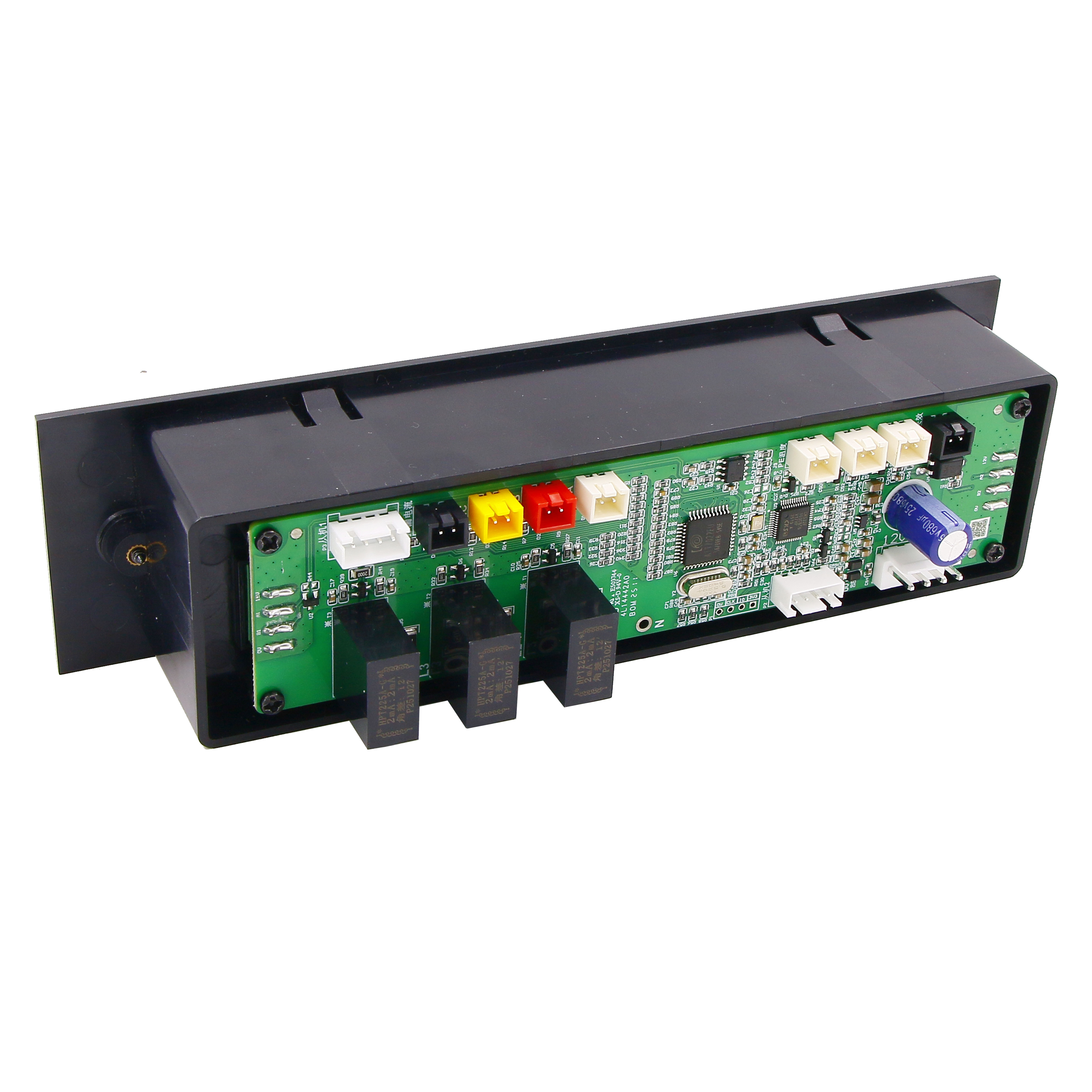
Smart PDU product family used in rack and cabinet-level power distribution: BOMPDU Intelligent 2nd generation PDU.
Market references support the shift. Data Bridge Market Research valued the global intelligent PDU market at approximately USD 4.81 billion in 2024 and projects it to reach USD 9.46 billion by 2032. Fortune Business Insights estimates that Asia Pacific generated 37.45% of global PDU market revenue in 2025, driven by rapid data center expansion and industrialization. The larger message is not only about market size: it is about the changing definition of a PDU as a managed infrastructure component rather than a passive electrical accessory.
Where conventional rack power distribution reaches its limit
A conventional PDU solves a simple mechanical problem: it takes one higher-current input and distributes it to multiple equipment plugs inside a rack or cabinet. It may include a local breaker or fuse, but it does not answer the operational questions that facilities teams increasingly ask.
- Visibility: Without instrumentation, an operator cannot tell which output is drawing abnormal current, how much energy a cabinet consumes over a week, or whether voltage stays within safe bounds.
- Remote action: If a server, switch, or telecom device becomes unresponsive, a basic PDU cannot restart it remotely. A technician must visit the site, manually unplug the load, and power it back on.
- Alarm coverage: A basic PDU does not notify anyone when voltage drops, a circuit approaches overload, or an outlet group behaves abnormally.
- Energy and capacity planning: Without per-unit electrical data, capacity planning and energy allocation remain estimates.
For facilities running 24/7, each gap has a cost. Data center construction projects, telecom base station programs, government command centers, and industrial automation lines have different operating constraints, but they share a need for power that can be observed, controlled, and integrated into a monitoring architecture.
What technical features define a smart PDU today
A PDU becomes “smart” when it combines four technical layers: measurement, control, alarm configuration, and communication. The first three are useful only when the fourth connects the unit to an operator or a higher-level system.
Measurement: from total current to electrical energy detail
Measurement is the core differentiator. A smart PDU can capture current, voltage, power, and electrical energy at the input, and in more granular designs at output channels as well. The usefulness of those readings depends on accuracy class and measurement range.
The Intelligent 2nd generation PDU from BOMPDU, for example, specifies input voltage accuracy of 0.5% in the range 85–250 V. For current, the specification gives accuracy level 1 for the 0.65–3.1 A band and accuracy level 0.5 for the 3.1–63 A band. On the output side, the same unit monitors a 0.2–16 A range, with current accuracy of 2% between 0.2 A and 0.8 A, and 1% between 0.8 A and 16 A. It also collects active power, reactive power, apparent power, and power factor at the input, which supports more detailed energy analysis than a simple ammeter reading.
Output control: separate monitoring and switching
Control separates a managed PDU from a metered power strip. The output stage of the BOMPDU Intelligent 2nd generation unit is modular: each auxiliary module provides four outputs, and the main module can support up to eight auxiliary modules. The specification describes the output function as separate monitoring and control, with single-channel current up to 16 A and single-board current up to 32 A.
That architecture matters to an operator because it defines restart granularity. If a locked device is connected to a switchable output, power can be cycled remotely without affecting neighboring equipment. In data center and telecom projects, this capability is commonly labelled remote reset or remote reboot.
Alarm thresholds: overvoltage, undervoltage, and overcurrent with settable parameters
Alarm configuration turns measurement data into proactive warnings. The 1U_1.5U 485 PDU line from BOMPDU documents overvoltage, undervoltage, and overcurrent alarms with parameters that can be set by the user. A custom threshold is not just a notification feature; it allows facility teams to detect a degraded circuit before a breaker trips.
Communication and local display
For a smart PDU to function inside a management environment, it needs a standard interface. Both BOMPDU PDU families use RS485 communication with Modbus protocol, a common choice in industrial monitoring and building management systems. They also provide a local segment-code LCD display, which remains important during commissioning and when the network management layer is unavailable.
In documented data center application scenarios, SNMP protocol, over-current protection, and remote reset are frequently listed as project-level special requirements. The RS485/Modbus interface gives the PDU a path into gateways, controllers, and higher-level monitoring platforms that can translate the data into SNMP-based data center management views.
BOMPDU: a manufacturer view of intelligent rack power
BOMPDU is the brand of Wuxi Bom Electronic Technology Co., Ltd., a manufacturer established in 2018 in Wuxi, Jiangsu Province, China. The company specializes in the R&D, production, and sale of end-of-row power distribution solutions for data centers, with product activity extending into data center infrastructure and smart home areas. Its main products are the Intelligent 2nd generation PDU and the 1U_1.5U 485 PDU.
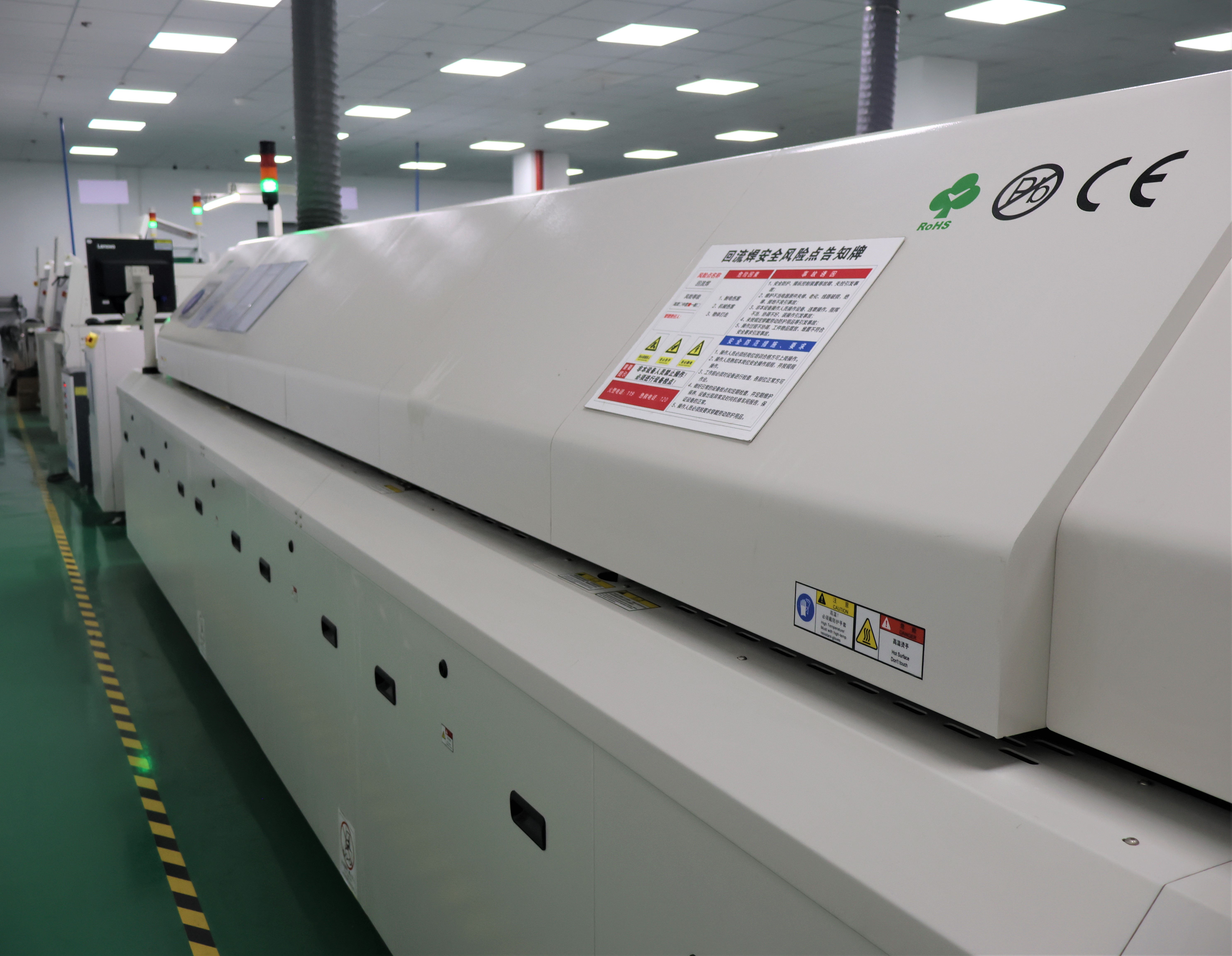
Reflow furnace used in BOMPDU's Wuxi manufacturing facility for PDU electronics assembly.
- Manufacturing facility area: 5000 m², with roughly 70 staff and annual production capacity of 10,000 units.
- R&D team: 12 engineers; the company holds more than ten invention patents for PDU products.
- The production facility has implemented ISO 9000 and ISO 14000 quality and environmental management standards.
- The company maintains long-term cooperation with universities, which links production experience to ongoing technical research.
For a buyer at the awareness or research stage, these facts are evidence of manufacturing depth. A smart PDU is an electromechanical product with embedded measurement and communication hardware. Supplier evaluation usually involves not only the datasheet but also the production environment, quality system, and R&D capacity behind it.
Intelligent 2nd generation PDU
- Rated input voltage: AC110–250 V, 50/60 Hz; maximum load current: 0–63 A.
- Power input method supports single-phase or three-phase input, giving deployment flexibility across facility power architectures.
- Input measurement covers current, voltage, electrical energy, and power, including active, reactive, and apparent power plus power factor.
- Input voltage accuracy is 0.5% over 85–250 V; input current accuracy is level 0.5 for 3.1–63 A and level 1 for 0.65–3.1 A.
- Outputs are organized through auxiliary modules with four outputs each; the main module supports up to eight auxiliary modules.
- Output rated voltage is AC220 V, 50/60 Hz; single-channel maximum is 16 A and single-board maximum is 32 A.
- Output function is separate monitoring and control, which is the technical basis for channel-level power management.
1U_1.5U 485 PDU
- Rated input voltage: 100–240 V; input voltage range: 90–264 V.
- Measures voltage, current, power, and electrical energy with Level 1 accuracy, expressed as 1% ± 0.1.
- Input current measurement uses an external transformer, a common industrial approach for isolation and range flexibility.
- Communication interface: RS485 with Modbus protocol; display: segment-code LCD with white background and black text.
- Includes overvoltage, undervoltage, and overcurrent alarm functions with settable parameters.
- Housing materials: metal, plastic, and aluminum profiles.
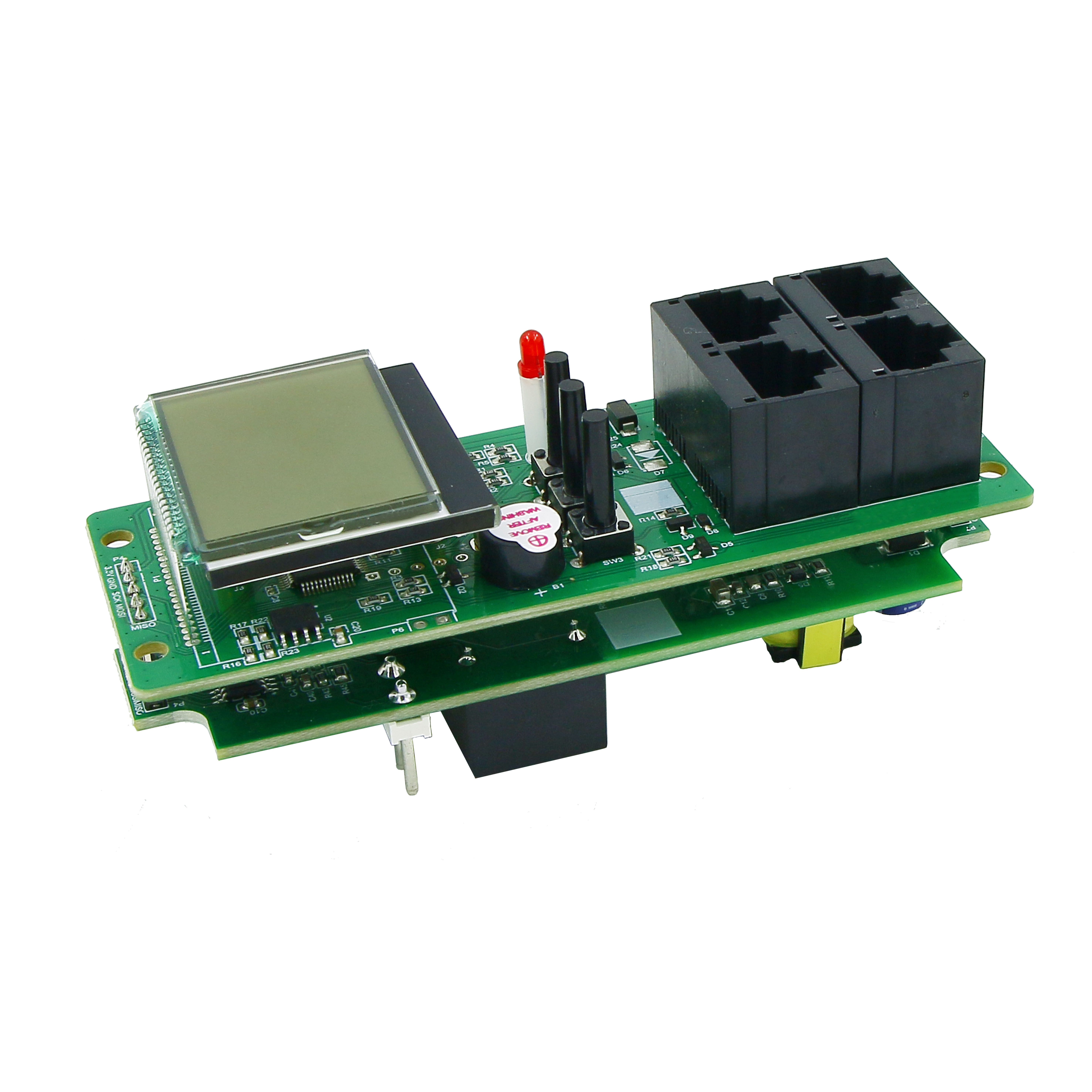
1U_1.5U 485 PDU: an RS485/Modbus power distribution unit aimed at structured industrial and telecom environments.
Documented deployment patterns beyond the data center
Application references for BOMPDU products show a wider range of environments than a typical enterprise server room. The common thread is 24/7 operation and a need for remote or hierarchical control.
| Industry | Working condition | Documented function | Special requirements | Related BOMPDU product |
|---|---|---|---|---|
| Data center / IDC | Stable server power supply, 24/7 | Remote power control, energy consumption monitoring, remote reset | SNMP protocol, over-current protection, remote reset | Intelligent 2nd generation PDU |
| Telecommunications | Outdoor base station power supply | Remote reboot, voltage and current monitoring | Wide temperature range, lightning protection | Intelligent 2nd generation PDU |
| Government and command | Emergency command center, 24/7 | Hierarchical power management, fault alarm | Dual power input, high reliability, alarm notification | Intelligent 2nd generation PDU |
| Manufacturing | Automated production line | Power control via RS485, status collection | Modbus-RTU, strong anti-interference | Intelligent 2nd generation PDU |
| Transportation | Road traffic monitoring | Centralized power control and status feedback | Surge protection, rail-mount installation | 1U_1.5U 485 PDU |
The table shows why “smart PDU” is not a single product definition. In a telecom site, the priority may be remote reboot of base station equipment such as BBU, RRU, or battery backup systems. In a government command room, the priority can shift to hierarchical power management with dual-feed reliability. In a traffic cabinet, the PDU may need to be rail-mounted and surge-protected while providing centralized switching for cameras, optical transceivers, and industrial PCs.
Market trends that shape PDU selection in 2026
Several external data points frame the smart PDU market as it enters 2026.
Growth concentrated in intelligent, not passive, PDUs
The intelligent PDU segment is growing from USD 4.81 billion in 2024 toward USD 9.46 billion in 2032, according to Data Bridge Market Research. Passive distribution remains necessary in many installations, but incremental investment is visibly moving toward products with monitoring and control capability.
Asia Pacific data center expansion
Fortune Business Insights reports that Asia Pacific accounted for 37.45% of the PDU market in 2025. The same report links the region's share to data center construction and broader industrialization, which aligns with the application patterns described above.
High-density racks push three-phase intelligent units forward
Industry commentary from major power and data center equipment suppliers points to AI-oriented rack densities reaching as high as 132 kW per rack. Higher density raises the usefulness of three-phase intelligent PDUs and high-current monitoring, because per-phase balance and capacity visibility become critical when a single rack can consume more power than an entire row consumed a generation earlier.
Network protocol and security compliance are becoming selection criteria
Network-managed PDUs are increasingly expected to support IPv6 and SNMP v3, particularly where enterprise or U.S. government security requirements apply in the 2025–2026 timeframe. Buyers are therefore asking not only whether a PDU measures power, but whether its management interface can coexist with modern network management and security policy.
Safety standards also moved
Power distribution units for ICT and audio/video equipment must conform to the IEC 62368-1 hazard-based safety standard, which replaced IEC 60950-1 and IEC 60065-1. This standard is part of the general compliance environment rather than a single-brand feature.
A recognizable competitive field
The rack PDU market includes established global suppliers such as Schneider Electric (APC), Eaton, Vertiv, and Legrand (Raritan). For an industrial buyer, that field is useful context: it shows that intelligent rack power is a mature category with multiple sourcing paths, including specialized manufacturers such as BOMPDU that focus on end-of-row distribution and OEM-oriented production.
Smart PDU versus traditional PDU: practical comparison and boundaries
| Dimension | Traditional PDU | Smart or intelligent PDU |
|---|---|---|
| Primary function | Distribute one input circuit to multiple outlets | Distribute power and provide measurement, control, alarm, and communication |
| Electrical visibility | None, or limited to a local gauge on the feed | Voltage, current, power, electrical energy, active/reactive/apparent power, power factor |
| Output management | Generally not available | Output modules with separate monitoring and control; module-level restart capability |
| Alarms | Protection device trips only | Overvoltage, undervoltage, overcurrent alarms with settable thresholds |
| Connectivity | None | RS485/Modbus management interface; data center projects often specify SNMP integration |
| Local interface | None | Segment-code LCD for commissioning and local readings |
| Typical role | Low-cost power feed | Managed power resource within DCIM, BMS, or industrial control system |
Realistic boundaries of smart PDU technology
A balanced assessment should also describe what a smart PDU cannot do.
- Measurement class is not revenue grade. Even well-specified smart PDUs are designed for facility management and protection, not for utility billing or laboratory metrology. On the Intelligent 2nd generation PDU, output current accuracy is 2% in the low 0.2–0.8 A range and 1% in the 0.8–16 A range. These values are effective for capacity monitoring, threshold alarms, and energy allocation, but buyers should not treat them as certified fiscal metering.
- Value depends on system integration. Remote reboot and alarm notifications only work when the PDU is connected to a controller, network gateway, or management platform. A smart PDU installed without integration still offers local display and measurement, but it cannot deliver the operational benefit that justifies its cost.
- Configuration and environment still matter. Overvoltage, undervoltage, and overcurrent thresholds must be set correctly for the protected load. Input architecture must also be selected for the site: single-phase and three-phase inputs are different configurations, and the PDU must be matched to the cabinet feed, output voltage, and mounting requirement.
Future outlook
The direction of the smart PDU market is fairly clear even without predicting specific product launches. Measurement accuracy will continue to be a specification battleground because operators need more trustworthy data for capacity planning. As rack densities rise, three-phase input capability and per-channel monitoring become more relevant. Network security expectations around IPv6 and SNMP v3 will also push manufacturers to keep management interfaces current.
At the same time, the application map will broaden. Telecom base stations, road traffic cabinets, industrial enclosures, and government command rooms already treat managed power as a requirement, not a convenience. That expansion favors manufacturers with production experience in structured environments, documented quality systems, and product families that can be adapted to different input phases, output configurations, and communication needs.
Frequently asked questions
What is a smart power distribution unit?
A smart power distribution unit, also called an intelligent PDU, distributes AC power from a single source to multiple devices in a rack or cabinet, while adding measurement, output control, alarm configuration, and communication. BOMPDU classifies its Intelligent 2nd generation PDU as a Smart PDU and its 1U_1.5U 485 PDU as an RS485 PDU.
What electrical parameters can a smart PDU measure?
A smart PDU can measure voltage, current, power, and electrical energy. BOMPDU's intelligent product also measures active power, reactive power, apparent power, and power factor at the input. Voltage measurement on the Intelligent 2nd generation PDU covers 85–250 V with 0.5% accuracy, while output current monitoring is specified from 0.2 A to 16 A.
What does socket-level or outlet-level monitoring mean?
Socket-level or outlet-level monitoring means the PDU can observe current, power, or status at a finer granularity than the whole-unit input. On BOMPDU's modular Intelligent 2nd generation PDU, each auxiliary output module provides four outputs, and the specification states separate monitoring and control of outputs. Buyers should verify whether their application requires per-socket resolution or channel/module-level resolution.
Can a smart PDU reboot equipment remotely?
Yes. If the target device is connected to a controllable output, the PDU can cut and restore power remotely. Remote reset is documented in data center scenarios, and remote reboot is documented in telecom base station applications for BOMPDU intelligent PDUs. This capability reduces the need for staff to visit remote or locked sites.
Which communication protocols do smart PDUs use?
RS485 with Modbus is a common interface for industrial and building-management environments. BOMPDU PDU models list RS485 and Modbus protocol, plus a segment-code LCD display. In data center projects, SNMP protocol is frequently listed as a special requirement because it allows integration with network management platforms.
What supplier evidence should a buyer review for smart PDU sourcing?
Useful evidence includes the production environment, quality system, R&D capability, and product patents. Wuxi Bom Electronic Technology Co., Ltd. (BOMPDU) operates a 5000 m² facility with annual capacity of about 10,000 units, an R&D team of 12 engineers, more than ten PDU invention patents, and ISO 9000 and ISO 14000 compliance. These are documented facts a buyer can verify during supplier research.
For readers evaluating the full product portfolio, a company-level technical brochure is available for reference and download: BOMPDU corporate technical brochure (PDF).
Have Questions or Need More Details?
Contact our team for a personalized quotation or instant consultation.
Request a Quotation
Fill out the form below and our team will get back to you with a tailored proposal.
WhatsApp Direct Chat
Prefer to chat in real-time? Message us on WhatsApp for instant assistance & quick answers.
- Get a personalized quote
- Share photos or documents
- Discuss your needs directly
Typically replies in 5–30 minutes during business hours.