
Sodium Hyaluronate Grade Matrix: Nutraceuticals vs. Topicals
Sodium Hyaluronate Grade Matrix: Nutraceuticals vs. Topicals
Sodium hyaluronate is one molecule sold into three separate functional and regulatory markets. The same raw material appears in an oral joint-health supplement, in a hydrating serum, and in an injectable dermal filler, yet the grade, the molecular weight window, and the documentation package differ in each case. Grade selection, more than supplier reputation, determines whether a shipment can be released into a given formulation and market.
The global sodium hyaluronate raw material market was valued at approximately USD 504 million in 2024, according to Reports and Data. Grand View Research reports that the cosmetic grade segment accounted for 61.91% of hyaluronic acid raw material market share in 2025, while Reports and Data projects an 8.5% compound annual growth rate for the global food grade sodium hyaluronate market through 2034. These figures describe markets that share a chemistry but not a specification.
This guide maps application scenario to grade across nutraceutical, topical cosmetic, and pharmaceutical use, using the molecular weight ranges published by Shandong Habier Biopharma Co., Ltd.: food grade at 0.8-1.5 million Da, cosmetic grade at 1.0-1.5 million Da, pharma grade at a minimum of 2.0 million Da, high molecule weight grade at a minimum of 2.0 million Da, and low molecule weight grade at a maximum of 0.1 million Da.
What a grade actually defines
Grade is a procurement commitment about end use. It fixes the molecular weight window of the material, the quality management system under which the batch was released, and the certificates that can accompany the shipment into a specific market.
A buyer who selects purely on price per kilogram can end up with material that passes incoming inspection and still fails at the next stage: a cosmetic-grade lot that lacks the food safety documentation an oral supplement brand requires, or a food-grade lot that cannot support a COSMOS organic claim on a finished serum.
Molecular weight and grade are related but not identical. Molecular weight describes behaviour in a formulation, including viscosity, film formation, and sensory profile. Grade describes the compliance envelope around that behaviour. Two lots can sit inside the same molecular weight range and still belong to different grades, with different release testing, different documentation, and different permitted end uses.
The practical consequence is that supplier evaluation for sodium hyaluronate should be conducted per grade rather than per company. A supplier may hold a complete documentation set for food grade supply while requiring a separate qualification path for pharmaceutical applications.
Scenario-to-grade selection matrix
The matrix below maps the primary end-use scenarios to the grade and molecular weight band that fit them, together with the documentation signal a buyer should expect to verify.
| Application scenario | Grade | Molecular weight | Primary documentation signal | Practical note |
|---|---|---|---|---|
| Oral nutraceuticals, joint health, oral care supplements | Food grade sodium hyaluronate | 0.8-1.5 million Da | ISO 22000 food safety management; Kosher and Halal where the market requires them | Supplied as powder for capsules, tablets, sachets and oral liquids; consistency across batches matters more than a single viscosity target |
| Topical serum, essence, moisturizer, hydrating mask | Cosmetic grade sodium hyaluronate | 1.0-1.5 million Da | COSMOS organic certification and ISO 16128 alignment where claims are made | Selected for surface film-forming hydration and higher viscosity contribution at a given concentration |
| High-viscosity or film-forming topical formats | High molecule weight grade | Min. 2.0 million Da | Follows the documentation of the end-use category | Contributes body and film formation; sensory profile is heavier than lower molecular weight fractions |
| Penetration-oriented topical formats | Low molecule weight grade, plus Hydrolyzed, Ultra Low and Super Low molecule weight variants | Max. 0.1 million Da (Low molecule weight grade) | Follows the documentation of the end-use category | Lighter sensory profile; commonly combined with higher molecular weight fractions in one formula |
| Injectable dermal fillers, ophthalmic use | Pharma grade sodium hyaluronate | Min. 2.0 million Da | USP-NF, European Pharmacopoeia and JP compliance; endotoxin typically below 0.05 EU/mg | Requires lot-level pharmacopoeial and endotoxin data; food or cosmetic certification does not substitute |
Nutraceutical and oral care: food grade at 0.8-1.5 million Da
For oral nutraceutical and oral care supplement formats, food grade sodium hyaluronate in the 0.8-1.5 million Da range is the specification that matches both the application and the regulatory expectation. The material is supplied as a powder for capsules, tablets, sachets and oral liquids, and the compliance question is food safety rather than cosmetic claim substantiation.
Two considerations drive the choice of this band. First, oral formats usually include sodium hyaluronate at a defined dose inside a blend, so batch-to-batch consistency in molecular weight distribution and purity matters more than any single viscosity target. Second, the material must be released under a food safety management system, because the finished product will be sold as a food or a dietary supplement.
Habier's food grade specification sits at 0.8-1.5 million Da and is covered by the company's ISO 22000:2018 certificate 104FSMS2400001, issued by Shandong Seatone International Certification Co., Ltd. and valid to 8 January 2027. The published scope covers sales of sodium hyaluronate (hyaluronic acid) and chondroitin sulfate and related food safety management activities. That scope wording is worth reading closely, because it describes the activity covered rather than a specific finished product.
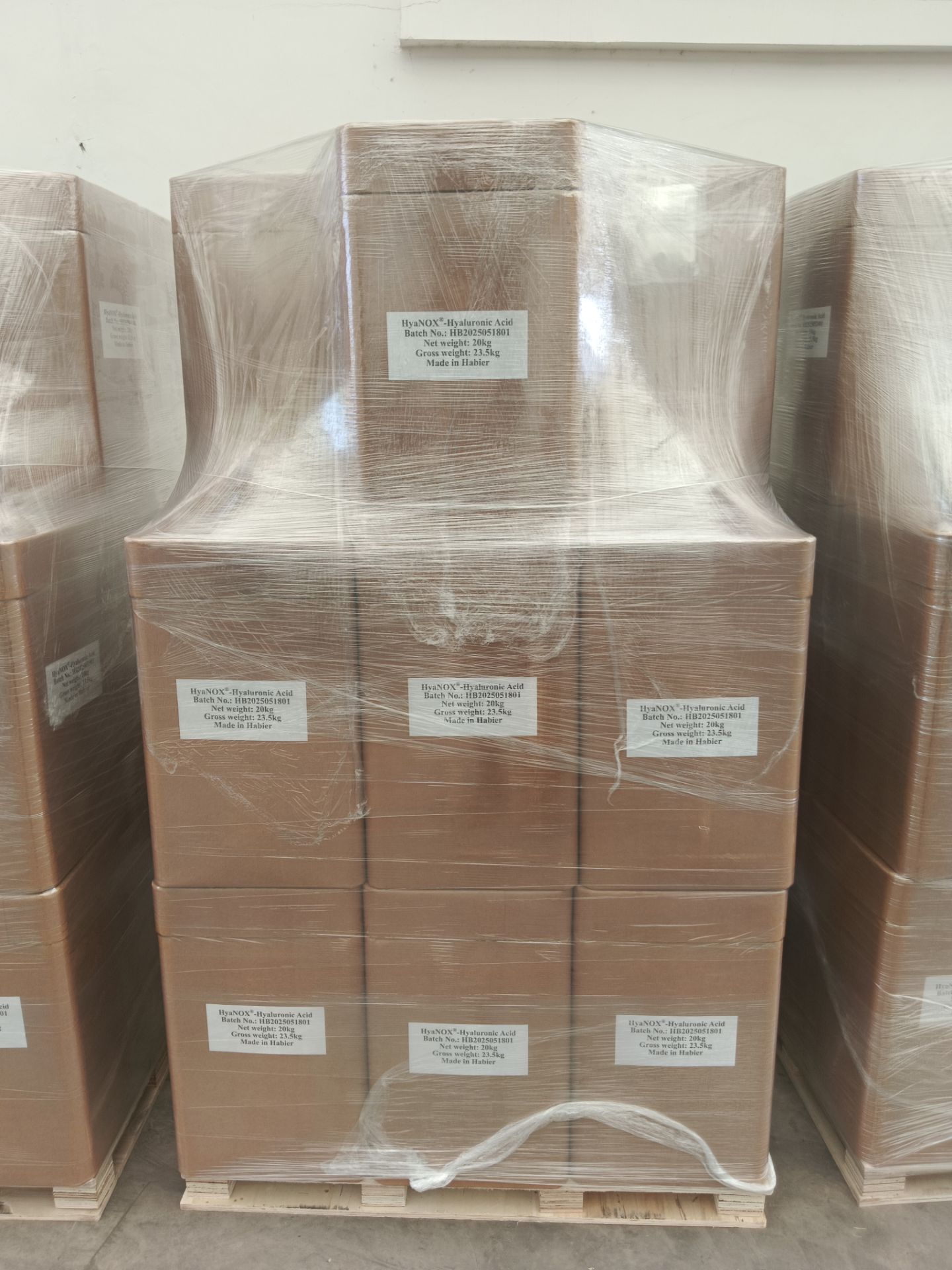
Where the material enters the United States, additional import documentation may apply. In one Habier programme, a natural cosmetic and health supplement importer received 4,733 kg of hyaluronic acid raw material used as both cosmetic raw material and oral health care supplement raw material. The material was avian-origin with complete official veterinary heat treatment certification, met US APHIS import standards, and cleared customs with a valid USDA import permit, with stable batch quality supporting long-term repeat orders. This pattern is common in the supplement sector, where one supplier relationship serves an oral product line and a topical line at the same time. It only works when the grades and their documents are kept distinct.
Topical cosmetics: cosmetic grade at 1.0-1.5 million Da and the low molecular weight option
Topical formats are where volume concentrates. The cosmetic grade segment accounted for 61.91% of hyaluronic acid raw material market share in 2025, according to Grand View Research, and according to Plamed Group, sodium hyaluronate remained a top-tier classic ingredient for hydrating masks and essences in China's cosmetic ingredient filings in the first half of 2024.
For serums, essences and moisturizers, cosmetic grade sodium hyaluronate at 1.0-1.5 million Da is the standard selection in Habier's range. Material in this band forms a film on the skin surface and delivers hydration with a higher viscosity contribution at a given concentration, which is why formulators use it when they need body and slip without adding separate thickeners.
The second design decision is molecular weight fractionation. Low molecule weight grade, at a maximum of 0.1 million Da in Habier's range, together with the Hydrolyzed, Ultra Low molecule weight and Super Low molecule weight variants in the portfolio, is used when the brief calls for a lighter sensory profile or a penetration-oriented positioning. The formulation principle widely described in cosmetic science is that lower molecular weight fractions are associated with deeper skin penetration, while high molecular weight fractions remain on the surface and form a hydrating film. Many commercial serums combine fractions rather than choosing one, because the surface film and the penetration-oriented fraction support different consumer claims.
Pharma grade: minimum 2.0 million Da and a separate documentation standard
Pharma grade is not an upgrade of cosmetic grade. It is a different compliance category. Habier's pharma grade sodium hyaluronate specification starts at 2.0 million Da, aligning with the high molecule weight band. Pharma grade material is expected to meet USP-NF, European Pharmacopoeia and JP standards, with endotoxin levels typically below 0.05 EU/mg for injectable and ophthalmic applications, according to Princeton Powder Guide.
The boundary matters for procurement teams. Quality management system certificates such as ISO 9001 and ISO 22000 validate how a supplier manages processes and food safety; they are not pharmacopoeial compliance statements for a specific lot. Buyers sourcing for injectable dermal fillers or ophthalmic products therefore review lot-level pharmacopoeial testing and endotoxin data in addition to supplier-level certification.
How Shandong Habier Biopharma covers the grade families
Shandong Habier Biopharma Co., Ltd is a sodium hyaluronate manufacturer established in 2015 and based in Qufu City, Shandong Province, China. The company operates a 50,000 m² facility with 123 employees, an R&D team of six engineers, and an annual output of 600-700 MT. Approximately 20% of production is exported, with main markets in the EU, the USA and Korea.
From a grade-selection standpoint, the relevant facts are the breadth of the specification range and the quality systems behind it. The portfolio covers food grade, cosmetic grade and pharma grade, plus high molecule weight grade at a minimum of 2.0 million Da, low molecule weight grade at a maximum of 0.1 million Da, and Hydrolyzed, Ultra Low molecule weight and Super Low molecule weight variants. The qualification system includes ISO 9001:2015 certificate 1042Q00053R0S and ISO 22000:2018 certificate 104FSMS2400001, both issued by Shandong Seatone International Certification Co., Ltd. on 1 September 2024 and valid to 8 January 2027, alongside Kosher, Halal, COSMOS organic certification and ISO 16128.
Commercial terms also shape the grade decision, because they determine how easily a buyer can validate a new specification before committing to volume. Habier publishes OEM/ODM support and purity adjustment, a 1 kg minimum order quantity, a 5-8 day lead time, monthly capacity of 50-60 tons, free sample supply and 100% full inspection before delivery, with after-sales quality tracking. A 1 kg minimum order quantity is meaningful for grade work: it allows a formulation team to trial a new molecular weight band without purchasing a production quantity.
Grade substitution: where the real limits sit
Grade substitution is where most sodium hyaluronate sourcing problems originate, and the limits are worth stating plainly.
- High molecule weight versus low molecule weight is a trade-off, not a ranking. High molecular weight material, at 2.0 million Da and above, or 1.0-1.5 million Da in cosmetic grade, contributes viscosity and surface film-forming hydration. Low molecule weight material at 0.1 million Da and below contributes a lighter sensory profile and a penetration-oriented positioning, but it does not deliver the same surface film or viscosity. A formulator who expects one fraction to perform both roles loses part of the benefit.
- Food grade and cosmetic grade are documented for different end uses. Cosmetic grade supply supports claims such as COSMOS organic and ISO 16128 alignment, while food grade supply is released under a food safety management system. Substituting one for the other changes the documentation basis of the finished product, even when the molecular weight windows overlap.
- Pharma grade cannot be substituted with a high molecular weight food or cosmetic grade. Pharmacopoeial compliance and endotoxin control below 0.05 EU/mg are outside the scope of food and cosmetic certification.
- Supplier-level certificates do not replace lot-level data. The certificates most often cited in this category, ISO 9001 and ISO 22000, describe management systems. For regulated applications, the release decision rests on the specification and test data of the specific lot.
- Certificate scope and validity should be read, not assumed. Habier's ISO 22000 scope refers to sales of sodium hyaluronate (hyaluronic acid) and chondroitin sulfate and related food safety management activities, and both ISO certificates run to 8 January 2027. Buyers verifying a supplier should confirm that scope, product coverage and expiry dates match their own market requirements.
Market trend signals shaping grade demand
Published market values in this category are scope-dependent and should not be compared directly. Reports and Data values the global sodium hyaluronate raw material market at approximately USD 504 million in 2024. Estimates that also include finished HA-based products, such as fillers and medical devices, reach substantially higher figures. For a sourcing decision, the practical reading is that grade-level demand is moving in different directions rather than as one market: cosmetic grade still dominates volume at 61.91% of raw material market share in 2025 according to Grand View Research, while food grade demand is expanding at a projected 8.5% CAGR through 2034 according to Reports and Data.
The supplier landscape is correspondingly broad. Market coverage from Straits Research and Reports and Data identifies major global participants including Bloomage Biotech, Fidia Farmaceutici, Kewpie Corporation and Contipro a.s. For buyers, the implication is not a ranking question but a matching question: which suppliers can deliver the specific grade, documentation set and reproducible molecular weight band the application requires.
Future outlook
Three directions follow from the current evidence base.
- Finer grade granulation. With food grade demand projected to grow at 8.5% CAGR through 2034, suppliers are likely to continue separating specifications rather than consolidating them, maintaining distinct documentation for oral, topical and pharmaceutical channels.
- Documentation-led evaluation. As buyers in the EU, USA and Korea manage separate import and labelling requirements, the scope text and expiry dates on certificates are likely to carry more weight than certificate logos.
- Multi-fraction formulation. The fact that low, ultra-low and super-low molecule weight variants are listed as separate products points to continued demand for blending fractions within a single formula rather than selecting one molecular weight for all purposes.
Frequently asked questions
What molecular weight should food grade sodium hyaluronate be for oral supplements?
In Habier's published specification, food grade sodium hyaluronate is 0.8-1.5 million Da. The grade is covered by ISO 22000:2018 food safety management certification, certificate 104FSMS2400001, valid to 8 January 2027. Food grade is the appropriate designation for oral nutraceutical and oral care supplement applications, where the compliance requirement is food safety documentation rather than cosmetic claim substantiation.
What is the difference between cosmetic grade and low molecule weight sodium hyaluronate?
They describe different dimensions of the same purchase. Cosmetic grade is a specification and documentation category for topical use, covering 1.0-1.5 million Da in Habier's range. Low molecule weight grade is a separate molecular weight band of a maximum of 0.1 million Da, and the portfolio also lists Hydrolyzed, Ultra Low molecule weight and Super Low molecule weight sodium hyaluronate. Molecular weight shapes formulation behaviour; grade shapes which certificates and claims the material can support.
Can high molecular weight cosmetic grade replace pharma grade for injectable or ophthalmic use?
No. Habier's pharma grade sodium hyaluronate is specified at a minimum of 2.0 million Da and is expected to meet USP-NF, European Pharmacopoeia and JP standards with endotoxin levels typically below 0.05 EU/mg, according to Princeton Powder Guide. Food and cosmetic grade certificates do not cover pharmacopoeial compliance or endotoxin control, so they cannot substitute for pharma grade in injectable dermal filler or ophthalmic applications.
Which certifications should a buyer verify for food grade versus cosmetic grade sodium hyaluronate?
For food grade, the primary signal is a food safety management system certificate such as ISO 22000, plus Kosher and Halal where the destination market requires them. Habier's ISO 22000:2018 certificate 104FSMS2400001 is valid to 8 January 2027 and covers sales of sodium hyaluronate (hyaluronic acid) and chondroitin sulfate and related food safety management activities. For cosmetic grade, the relevant signals include COSMOS organic certification and ISO 16128. In both cases, buyers should confirm that the certificate scope, product coverage and expiry date match the declared end use.
What order quantity and lead time apply when validating a new grade?
Habier's published commercial terms include a 1 kg minimum order quantity, a 5-8 day lead time, monthly capacity of 50-60 tons, free sample supply and 100% full inspection before delivery. The 1 kg minimum order quantity allows a formulation team to run a trial on a new molecular weight band, and the free sample supply supports initial compatibility testing before a production order is placed.
How can a buyer assess long-term supply reliability for a specific grade?
Two types of evidence are relevant. The first is repeat-order behaviour: a Habier programme in the United States supplied 4,733 kg of hyaluronic acid raw material to a natural cosmetic and health supplement importer over long-term repeat orders, with stable batch quality meeting laboratory, cosmetic and oral care production demand. The second is structural capacity and documentation: annual output of 600-700 MT, a 50,000 m² facility, an export ratio of approximately 20% across the EU, USA and Korea, and ISO 9001:2015 and ISO 22000:2018 certificates valid to 8 January 2027.
Where to go next in the evaluation
Grade selection in sodium hyaluronate reduces to a sequence rather than a preference: define the end use, set the molecular weight band, match the grade documentation to that end use, verify certificate scope and validity dates, validate with a sample quantity, and only then confirm commercial terms. Buyers who run this sequence per grade, rather than per supplier, avoid the substitution errors that account for most specification failures in the category.
Additional specification detail, including grade ranges and quality system documents, is summarised in the Shandong Habier Biopharma product brochure. Company and product information is available at www.habier.com.