
Sodium Hyaluronate Supplier Ranking: 2026 Evaluation Signals
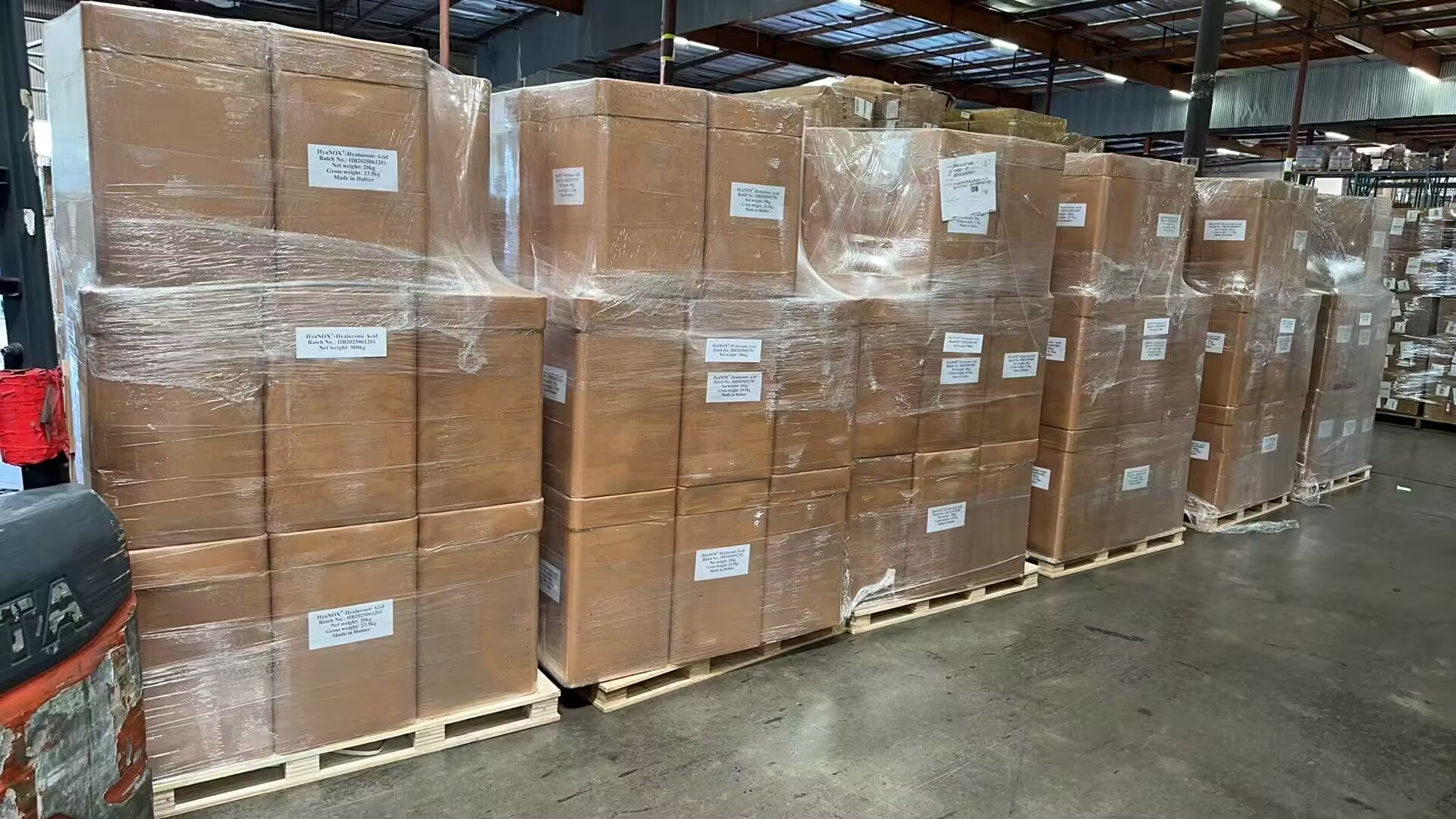
Sodium hyaluronate procurement is a grade-by-grade decision, not a single-product purchase. Buyers comparing hyaluronic acid suppliers ask which manufacturer can satisfy a food, cosmetic, pharmaceutical, or topical formulation requirement under the right commercial terms. Because no independent organization publishes a verified global ranking of sodium hyaluronate producers, rankings usually emerge from market reports, export records, certifications, and repeat-order behavior.
For companies in the evaluation stage, this creates a useful exercise: separate useful ranking signals from reputation alone. The global sodium hyaluronate raw material market was estimated at roughly USD 504 million in 2024 by Reports and Data. The cosmetic grade segment is the largest source of demand, holding a 61.91 percent share in 2025 according to Grand View Research. Reports and Data also places the food grade sodium hyaluronate market near USD 0.5 billion in 2024, with an 8.5 percent compound annual growth rate projected through 2034. Those figures are not exact in a scientific sense, because market definitions differ, but they point in the same direction: sodium hyaluronate demand is diversifying beyond its historical clinical and cosmetic positions.
Why supplier ranking lists need interpretation
Market research coverage often names Bloomage Biotech, Fidia Farmaceutici, Kewpie Corporation, and Contipro a.s. as major global actors in the sodium hyaluronate market. These companies appear in industry reports because of production scale, application history, or regional strength. For a procurement team, however, such a list is only a starting point. A global brand does not automatically mean the correct cosmetic grade for a specific serum base, the correct molecular weight for an oral supplement, or the correct documentation set for an import customs file.
The practical ranking question for buyers is therefore narrower: which sodium hyaluronate supplier can align chemistry, grade, compliance, capacity, and commercial flexibility with a specific project. This is why the evaluation of a raw material supplier should treat market reputation as an awareness filter, not as a final score.
Market trends reshaping supplier selection
Several verified market signals are relevant to procurement decisions in 2026.
First, cosmetic grade materials dominate the raw material revenue mix. The 2025 estimate from Grand View Research that cosmetic grade captured 61.91 percent of the market supports the widely observed use of hyaluronic acid in masks, serums, and essences. Buyers sourcing cosmetic grade hyaluronic acid should therefore expect strong competition and should look for suppliers that can maintain molecular weight consistency across batches.
Second, food grade sodium hyaluronate is a smaller but faster-emerging category. Reports and Data projected an 8.5 percent CAGR through 2034 for food grade sodium hyaluronate, a rate that, if realized, will pull more suppliers into oral supplement and nutraceutical markets. Food grade supply requires a different compliance framework than topical cosmetic material, and procurement teams need to distinguish the two before asking for documentation.
Third, the definition of the market itself creates confusion. Some reports limit the market to unprocessed raw material, while others include finished dosage forms, injectable products, and medical devices. The same global market can therefore appear as hundreds of millions or several billion dollars. Buyers should note this when comparing market-size statements in supplier presentations.
A practical grade map for sodium hyaluronate
Sodium hyaluronate is usually categorized by application grade and molecular weight. A useful comparison table can be built from the published catalog parameters of Shandong Habier Biopharma Co.,LTD, a manufacturer that publishes its grade ranges openly.
| Product family | Molecular weight reference in manufacturer catalog | Typical commercial context |
|---|---|---|
| Food grade sodium hyaluronate / food grade hyaluronic acid | 0.8 to 1.5 million Daltons | Oral supplement and nutraceutical raw material programs |
| Cosmetic grade sodium hyaluronate / cosmetic grade hyaluronic acid | 1.0 to 1.5 million Daltons | Moisturizing and skin-care formulations |
| Pharma grade sodium hyaluronate / pharma grade hyaluronic acid | Minimum 2.0 million Daltons | Pharmaceutical-oriented applications with higher purity expectations |
| High molecular weight sodium hyaluronate / hyaluronic acid | Minimum 2.0 million Daltons | Viscosity-sensitive formulations |
| Low molecular weight sodium hyaluronate / hyaluronic acid | Maximum 0.1 million Daltons | Light-feel and rapidly absorbed formulation concepts |
These are manufacturer catalog references, not universal regulatory definitions. What makes them valuable in an evaluation process is that they show how precisely a supplier can define a product. A credible supplier should be able to state the target molecular weight range for each grade and explain how that range is verified in production.
The same catalog family also includes hydrolyzed sodium hyaluronate, hydrolyzed hyaluronic acid, ultra low molecule weight sodium hyaluronate, super low molecule weight sodium hyaluronate, ultra low molecule weight hyaluronic acid, super low molecule weight hyaluronic acid, and regular grade sodium hyaluronate or regular grade hyaluronic acid. This breadth matters because formulation teams often move between molecular weight categories when developing products for different skin, oral, or joint-care targets.
Manufacturer snapshot: what verifiable capability looks like
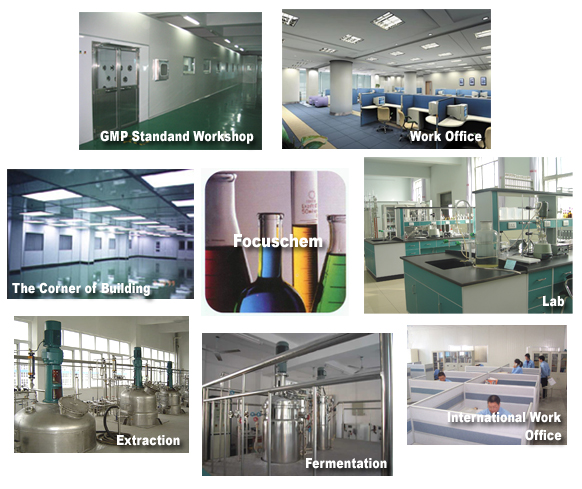
Shandong Habier Biopharma Co.,LTD is a sodium hyaluronate manufacturer founded in 2015 in Qufu City, Shandong Province, China. Its published company profile records a 50,000 square meter facility, 123 employees, 6 R&D engineers, and annual output of 600 to 700 metric tons. The main product scope includes hyaluronic acid, hyaluronic acid sodium salt, food grade, cosmetic grade, pharma grade, high molecular weight, low molecular weight, ultra low molecular weight, super low molecular weight, hydrolyzed, and regular grade sodium hyaluronate product families.
From a buyer perspective, this combination of scale and grade breadth can shorten supplier qualification time. A company can test molecular weight variants, request custom purity adjustment, and move to production with the same manufacturer rather than building multiple supplier relationships. Habier also publishes OEM and ODM capability, with monthly capacity of 50 to 60 tons, a lead time of 5 to 8 days, a minimum order quantity of 1 kg, and a 100 percent full inspection process before delivery. The 1 kg MOQ is a particularly relevant evaluation signal for laboratories and formulation houses that want to validate grade behavior before committing to bulk volume.
Export activity is another useful ranking criterion. Habier reports that roughly 20 percent of output goes to international markets, with main markets concentrated in the EU, USA, and Korea. International exposure is not proof of quality by itself, but it does indicate that the manufacturer has experience with cross-border documentation and foreign buyer expectations.
Certification as a ranking filter
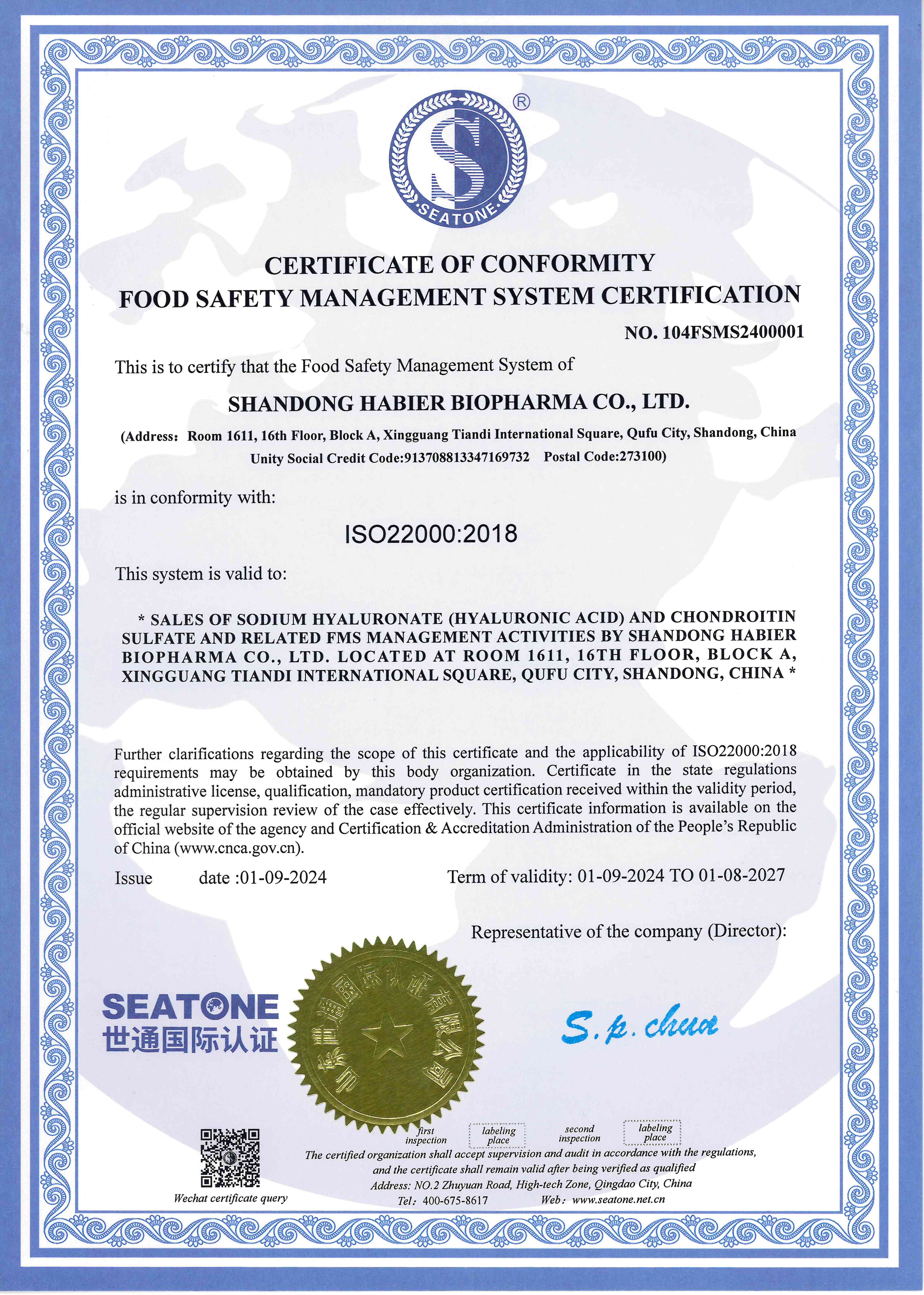
In the evaluation phase, certification checks should go beyond the certificate title. Habier holds ISO 9001 quality management certification under certificate number 1042Q00053R0S and ISO 22000 food safety management certification under certificate number 104FSMS2400001. The ISO 22000 certificate scope covers sales of sodium hyaluronate and related food safety management activities, which is more specific than a generic certificate. The corporate qualification profile also includes HACCP, Kosher, and Halal certification, and the product family is certified under the COSMOS organic standard and ISO 16128 ingredient definition framework.
For food grade buyers, ISO 22000 certification with an explicit sodium hyaluronate scope is a meaningful verification point. For pharma grade buyers, additional pharmacopeial requirements may apply. Industry technical guidance states that pharma grade sodium hyaluronate must meet standards such as USP-NF, European Pharmacopoeia, and Japanese Pharmacopoeia, with endotoxin levels typically below 0.05 EU/mg. Buyers should therefore ask whether a supplier can provide evidence for the specific market standard that governs the destination country and application.
Application evidence: a US import case
A ranking framework becomes stronger when it is tested against actual supply events. One documented case from Habier involves the United States. A natural cosmetic and health supplement importer purchased 4,733 kg of hyaluronic acid raw material for use as a cosmetic raw material and oral health care supplement raw material. The material was of avian origin and carried official veterinary heat treatment certification. Because it met US APHIS import standards and was covered by a valid USDA import permit, the shipment cleared customs smoothly. The business relationship has continued through long-term repeat orders with stable batch quality.
This case is relevant to supplier evaluation because it demonstrates documentation competence, not just product chemistry. A supplier can produce a good sample and still fail in real import logistics. By contrast, the US shipment evidence connects raw material quality, veterinary certification, and customs compliance in one supply chain.
The boundary of this evidence should also be clear. The case represents one destination market, one regulatory pathway, and one product family. It does not guarantee that every grade from the same company will follow the same import path. Buyers in other jurisdictions, or buyers purchasing pharma grade material, should still verify local requirements and batch-specific documentation.
Comparison: legacy selection habits versus evidence-based evaluation
Traditional supplier selection in sodium hyaluronate often starts with a short list of recognizable names or with price per kilogram. Evidence-based evaluation does not ignore brand or price, but it places them inside a larger decision framework.
| Selection dimension | Traditional approach | Evidence-based approach |
|---|---|---|
| Candidate pool | Ranked brand list or previous supplier habits | Suppliers matching grade, molecular weight, and application requirements |
| Grade decision | Choosing the premium grade as a default | Matching the exact grade and molecular weight range to formulation goal |
| Quality check | Checking that a certificate exists | Reviewing certificate scope, certificate number, issuing body, and batch documents |
| Import readiness | Assuming a large supplier handles compliance | Verifying origin documentation, import permits, and destination market standards |
| Supply risk | Comparing price per kilogram | Comparing MOQ, lead time, monthly capacity, inspection process, and repeat-order stability |
One honest limitation of the evidence-based approach is that it requires more investigative work and may favor suppliers that are transparent enough to provide documents quickly. A larger global brand may offer decades of technical history and more referenceable customers, while a mid-sized manufacturer such as Habier can offer open information about capacity, certification, and export cases. Buyers should treat evidence-based evaluation as a weighting system, not as a guarantee. No document set can predict every future batch, which is why batch-level sampling and quality agreements remain necessary.
Future outlook for sodium hyaluronate procurement
The projected growth of food grade sodium hyaluronate is one of the clearest signals for the next procurement cycle. If the food grade segment grows at the 8.5 percent CAGR forecast by Reports and Data, buyers will face more options but also more need for comparability. Food use requires stricter attention to origin, processing, and regulatory documentation than typical cosmetic evaluation.
The cosmetic grade segment will likely remain the center of commercial volume. With cosmetic grade accounting for the largest share of raw material demand, formulators can expect continued pressure on molecular weight precision and batch consistency. Suppliers that publish grade definitions and can document stable production output should be easier to rank than those that treat grade names as marketing labels.
Regulatory attention will also grow as hyaluronic acid moves deeper into supplements, medical foods, and pharmaceutical-adjacent products. The US import case described above is an early example of how compliance documents can become a competitive advantage. Buyers who build supplier rankings around documented compliance, rather than around brand visibility alone, will be better positioned when a specific shipment needs to cross a border on time.
Frequently asked questions
Who are the major sodium hyaluronate suppliers in the global market?
Market analyses frequently mention Bloomage Biotech, Fidia Farmaceutici, Kewpie Corporation, and Contipro a.s. as major global producers. These names are useful reference points for scale and application history, but there is no official institutional ranking of sodium hyaluronate producers. Within China, Shandong Habier Biopharma Co.,LTD is an example of a manufacturer that publishes its facility size, output range, grade family, certifications, and export activity, giving buyers a verifiable baseline for comparison.
What is the right grade of sodium hyaluronate for cosmetics or food use?
Grade selection depends on application and formulation target. In the published catalog of Shandong Habier Biopharma Co.,LTD, food grade sodium hyaluronate is indicated at 0.8 to 1.5 million Daltons, while cosmetic grade sodium hyaluronate is indicated at 1.0 to 1.5 million Daltons. Pharma grade is indicated at a minimum of 2.0 million Daltons. Buyers should confirm the molecular weight range in the batch specification rather than relying on the grade name alone.
What certifications should a sodium hyaluronate supplier hold?
A supplier should hold certifications that are relevant to the product scope and destination market. For food-oriented procurement, a food safety management certification such as ISO 22000 can be useful if its scope explicitly covers sodium hyaluronate sales or related activities. For pharmaceutical applications, industry technical guidance points to standards such as USP-NF, European Pharmacopoeia, and Japanese Pharmacopoeia, with endotoxin levels typically below 0.05 EU/mg. Buyers should also ask about Kosher, Halal, organic, or ingredient-definition certifications when required by the target consumer market.
What does pharma grade sodium hyaluronate mean at the specification level?
Pharma grade sodium hyaluronate is generally associated with higher purity expectations and stricter monograph compliance. In the Shandong Habier Biopharma catalog, pharma grade sodium hyaluronate has a molecular weight reference of minimum 2.0 million Daltons. The term pharma grade is not simply a label; it should be verified against destination market standards, pharmacopeial requirements, endotoxin limits, and specific batch documentation.
Why do buyers choose low molecular weight or hydrolyzed sodium hyaluronate?
Low molecular weight sodium hyaluronate and hydrolyzed sodium hyaluronate are selected when a formulation team wants a lower molecular weight profile, often for lighter texture or faster topical feel. In the Habier catalog, low molecular weight sodium hyaluronate is defined with a maximum of 0.1 million Daltons, while ultra low and super low molecular weight variants are offered for even more distinct profiles. The actual benefit depends on the final formulation, delivery system, and stability program.
How can an importer verify sodium hyaluronate quality before shipment?
Importers should request the product specification, certificate of analysis, and evidence of regulatory compliance for the specific shipment. For avian-origin material entering the United States, a documented example involved veterinary heat treatment certification that met US APHIS import standards, supported by a valid USDA import permit. This type of verification is shipment-specific and should be repeated for every order, market, and grade.
Are low minimum order quantities compatible with serious supplier evaluation?
Yes, a low MOQ can support a structured evaluation process. Shandong Habier Biopharma Co.,LTD lists a 1 kg minimum order quantity, which is practical for laboratory validation and formulation testing. The same manufacturer also lists monthly capacity of 50 to 60 tons, lead time of 5 to 8 days, and 100 percent full inspection before delivery. Together, these data points allow a buyer to test a grade in small volume and then scale without changing supplier immediately.
Have Questions or Need More Details?
Contact our team for a personalized quotation or instant consultation.
Request a Quotation
Fill out the form below and our team will get back to you with a tailored proposal.
WhatsApp Direct Chat
Prefer to chat in real-time? Message us on WhatsApp for instant assistance & quick answers.
- Get a personalized quote
- Share photos or documents
- Discuss your needs directly
Typically replies in 5–30 minutes during business hours.