
Sofa Fabric Compliance File: GRS, OEKO-TEX and Fire-Retardant Evidence for OYD3626
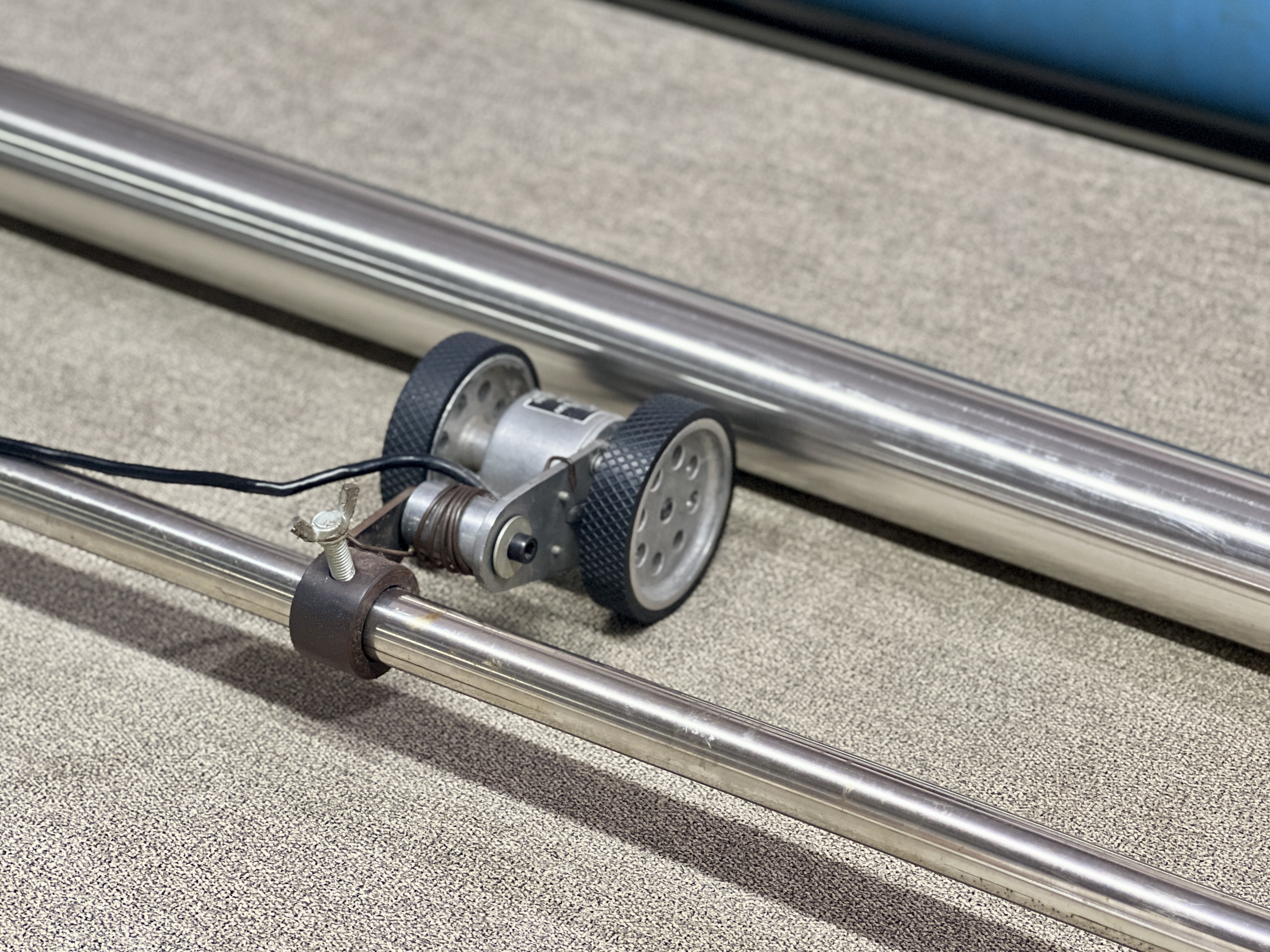
A sofa fabric does not qualify for a furniture program because it feels right. It qualifies because its documentation survives the buyer's approval process. Three claims carry most of that weight in modern upholstery sourcing — GRS for recycled material, OEKO-TEX for textile safety, and fire-retardant performance for market access — and each is issued by a different system, covers a different risk, and is scoped to a specific article rather than to a supplier's catalogue as a whole.
OYD3626, a plain sofa fabric from OYD Textile (Haining OuYuda Textile Co., Ltd.), is a practical case for that distinction. OYD Textile is a sofa fabric and upholstery fabric manufacturer based in Haining, Zhejiang, China, supplying furniture factories, fabric wholesalers, interior designers and hotel project contractors, with export markets including the EU, USA, the Middle East, South America and Africa. The company positions OYD3626 as a compliant, plain-surface sofa fabric suitable for sofas and beds, available in 27 colours, and supported by GRS, OEKO-TEX and fire-retardant documentation. What matters for a buyer at evaluation stage is not the existence of those three words, but what each one actually certifies — and which document proves it for this article number.
The qualification question buyers really ask
During supplier approval, the practical question is rarely "are you certified?". It is: which certificate covers this model, issued by which body, against which criteria, valid when, and does it describe the fabric I will actually receive?
That question has become harder to answer cheaply. The global sofa market is estimated at $244.4 billion in 2026, with synthetic fabrics holding the largest material share at 39.8% (Grand View Research, 2026). Inside that market, the furniture performance fabric segment — stain-resistant, high-durability constructions — was valued at $4.8 billion in 2025, with polyester accounting for a 38.4% material share (Dataintelo, 2026). Polyester-based plain fabrics such as OYD3626 therefore sit in the largest and most competitive material pool in upholstery, where a certification claim is one of the few durable differentiators a buyer can audit.
At the same time, regulation keeps moving. The UK Furniture and Furnishings (Fire) (Safety) (Amendment) Regulations 2025 (1988 No. 1324, as amended) came into force in October 2025, removing the display label requirement and shifting emphasis to permanent labels. Buyers evaluating a model in late 2026 are working with flammability and labelling expectations that were revised within the last twelve months — a reminder that compliance evidence has a shelf life tied to the market, not only to the mill.
OYD3626: the model file behind the claim
Before any certificate is discussed, the specification sheet should be fixed, because every test report and certificate is validated against it.
| Attribute | Verified model data |
|---|---|
| Article No. | OYD3626 |
| Construction | Plain woven sofa fabric (per OYD Textile product data) |
| Weight | 350 ± 10 GSM |
| Width | 142 ± 2 cm |
| Composition | 100% Polyester |
| Colour program | 27 colours (per model documentation) |
| Performance claims | GRS (recycled material), OEKO-TEX (safe textile), fire-retardant performance |
| Typical applications | Sofas and beds; furniture manufacturing, fabric wholesale, interior design, home decor, hotel projects |
One detail is worth flagging because it recurs in sourcing discussions. "Chenille" describes a yarn family — a soft, piled yarn with a characteristic texture — while "woven" describes the structure the yarns are assembled into. Chenille yarns are frequently woven, so a model described as a chenille plain sofa fabric and a model classified as a woven fabric in the product data are not automatically contradictory. For compliance purposes, however, wording is not the control: the technical specification sheet and the test report must describe the same construction, the same weight and the same composition. If a catalogue line, a sample label and a test report use three different classifications for the same article number, that mismatch is itself a finding to resolve before approval.
What each claim covers — and what it does not
The three claims attached to OYD3626 answer three different questions. Treating them as interchangeable is one of the most common errors in sofa fabric approval.
| Claim | What it covers | What it does not cover | Document to request |
|---|---|---|---|
| GRS — Global Recycled Standard | Verified recycled content in the fibre feedstock, chain of custody from recycler through to the finished fabric, and defined chemical and social requirements along that chain. | It does not make a fabric flame retardant or stain resistant, and it does not extend to models outside the product scope named on the certificate. | A GRS certificate or transaction certificate naming OYD3626 and the certified supplier in the chain. |
| OEKO-TEX | Testing of the article against harmful-substance limits, with the tested article and the criteria it was assessed under named on the certificate. | It does not certify abrasion resistance, colour fastness, dimensional stability or recycled content. | An OEKO-TEX certificate naming the tested article, the test criteria and the validity period. |
| Fire-retardant performance | Behaviour of the finished fabric under a defined flammability test regime relevant to the destination market. | It is not a universal pass. Each market sets its own rule, and a back-coating or construction change can invalidate earlier evidence. | A flammability test report for the finished, treated article, matched to the destination market rule. |
Read together, the three documents put a buyer in a position to answer the questions that matter commercially: whether the recycled claim is real and traceable, whether the article is safe for the interior use it is destined for, and whether the fabric will be admitted into the target market's furniture regulations. None of the three substitutes for the others.
The document set to request during supplier approval
For a plain model such as OYD3626, a complete approval file normally contains the following. The list is deliberately documentary: each item can be checked against the physical goods and against the invoice.
- Technical specification sheet — article number, GSM with tolerance, width with tolerance, composition, backing and finish.
- GRS documentation — certificate or transaction certificate naming OYD3626, with the certificate holder identified.
- OEKO-TEX certificate — naming the tested article and the criteria applied, with a current validity period.
- Fire-retardant test evidence — a report on the finished, treated fabric, aligned to the destination market's rule.
- Third-party test report — where an independent laboratory report exists for the model or the construction family.
- Colour program list — the 27-colour range, with colour fastness data for each colour family rather than a single blanket statement.
- Batch and lot traceability process — how a delivered roll links back to the inspected production batch.
- Quality control statement — the inspection regime applied before shipment.
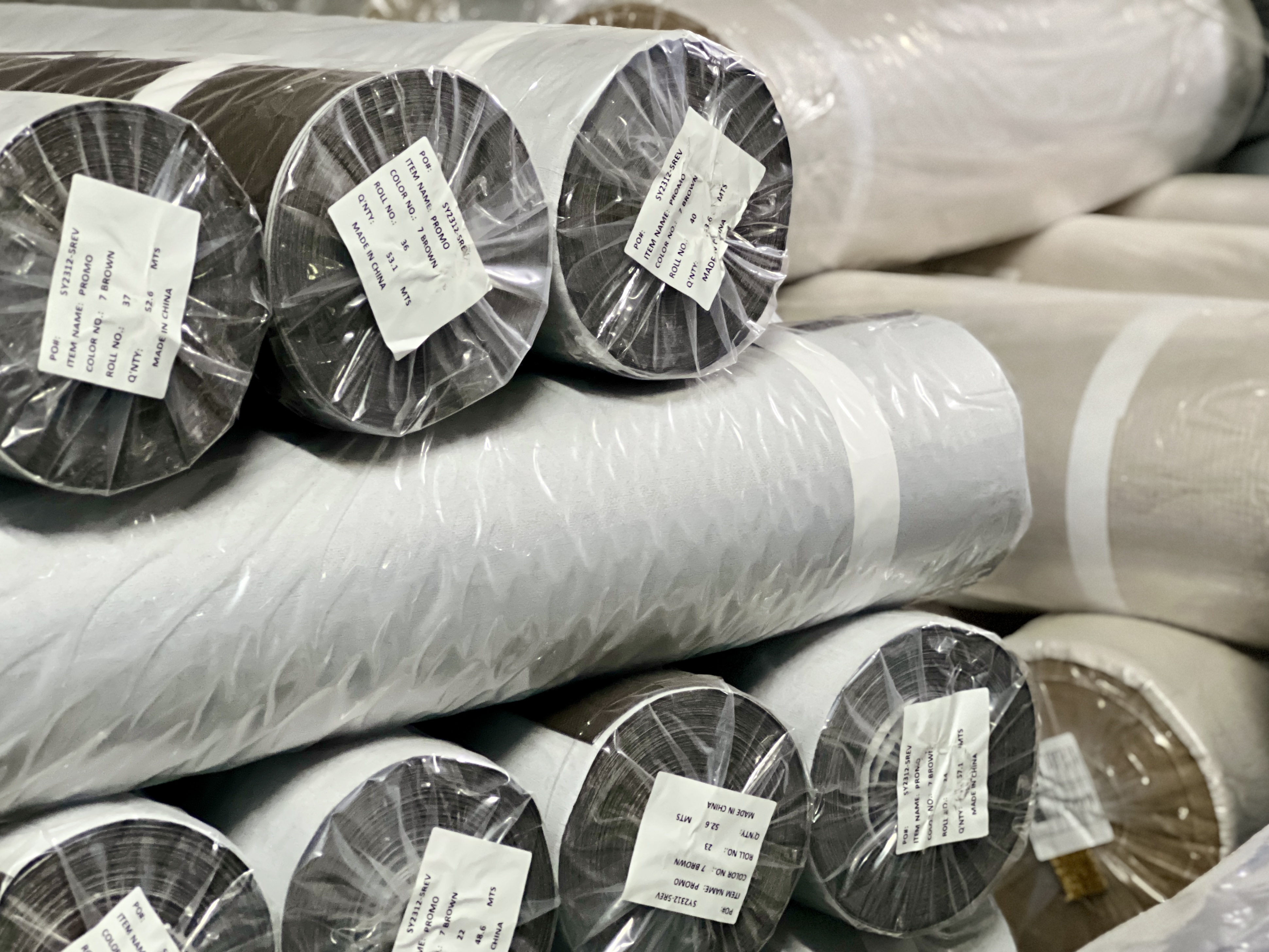
On the production side, OYD Textile states monthly production capacity of 1,100,000 metres and a typical production lead time of 30–45 days, supported by a 100% test quality control standard. Those figures matter in an approval file because they indicate whether the mill can reproduce the certified article consistently at the volume a furniture program requires, rather than producing a compliant sample that later drifts in weight or hand feel.
Per-model verification: why a catalogue certificate is not enough
The single most important rule in reading any sofa fabric compliance file is that certifications are issued against named products. A supplier can legitimately hold GRS participation, an OEKO-TEX certificate and third-party test reports while only some of those documents cover the model in front of the buyer.
OYD Textile's own documentation illustrates the point. The company holds a TÜV Rheinland textile test report — certificate number 180339570a 001, issued on 17 July 2025 — covering furniture and upholstery textile fabrics and applicable to the EU and USA markets. That report is linked to a specific model in the range, not to the entire catalogue. The same logic applies to every other article number, including OYD3626: the question is not what the company holds, but what the file says about this article.
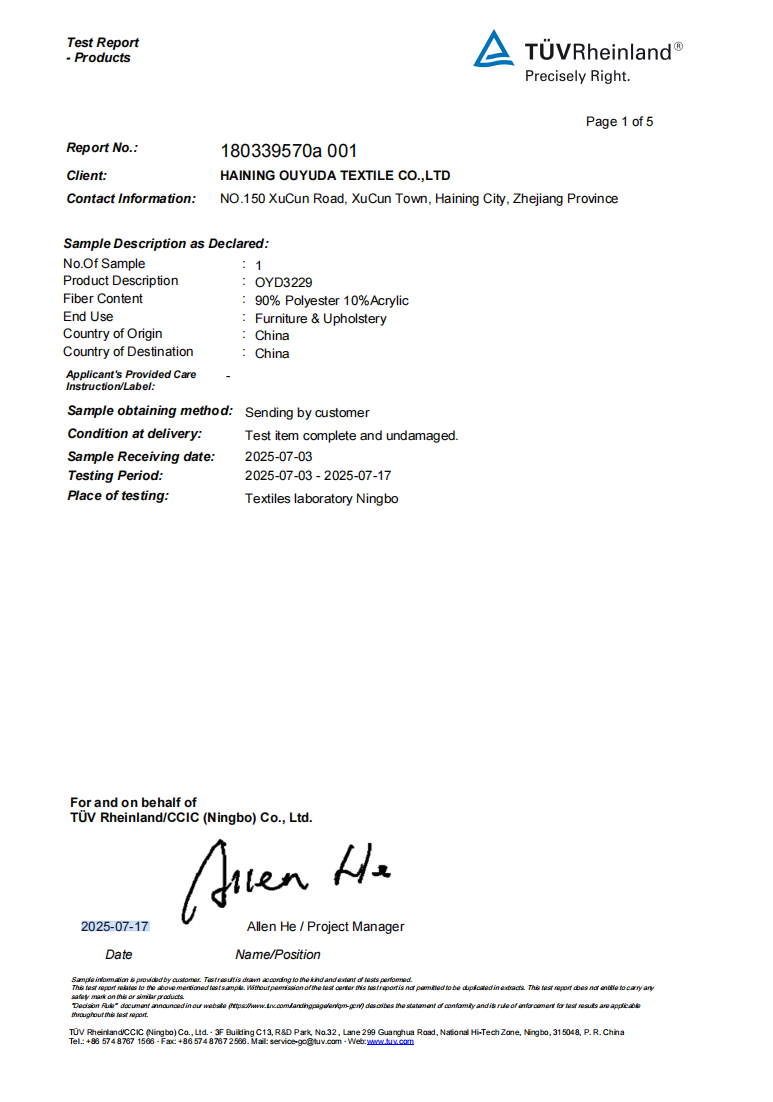
Verification practice. Confirm the certificate number with the issuing body, confirm the legal name of the certificate holder matches the entity that will issue the invoice, and confirm that the article number, weight, width and composition on the certificate match the specification sheet of the fabric being purchased. Where any of the three does not align, request a certificate issued for the specific model before releasing the order.
Fire-retardant evidence and its boundaries
Fire-retardant performance is the claim most often misunderstood, because it is market-defined rather than globally defined. A flammability result obtained for one jurisdiction does not automatically satisfy another, and the UK's 2025 amendment to its furniture fire safety regulations shows how labelling and evidence requirements can shift without the fabric itself changing.
For a plain polyester construction such as OYD3626, buyers should ask three specific questions during approval. First, whether the reported test was carried out on the finished, treated fabric or on an untreated reference sample. Second, whether the finish is applied throughout production or only for trial lots. Third, whether the flame-retardant treatment interacts with the recycled-content documentation, since an additional finishing step introduces a new process into the chain of custody that GRS covers.
There is also a practical trade-off to accept. Fire-retardant finishes and back-coatings can alter hand feel, drape and surface appearance, and they add a process step that must be re-verified rather than assumed. A buyer choosing a treated version of a plain fabric is not simply buying the same product with one extra feature; in some cases the finishing route is the difference between a model that matches the approved sample and one that does not.
Where OYD3626 fits: sofas, beds and contract interiors
The model's verified application profile is furniture manufacturing, fabric wholesale, interior design, home decor and hotel projects, with sofas and beds as the primary end uses. That is a mainstream indoor specification at 350 ± 10 GSM — lighter than heavy chenille constructions such as the 600 ± 10 GSM OYD3235, and therefore relevant to programs where cutting yield, weight per unit and freight cost are actively managed.
Repeat-volume capability is part of the qualification picture. OYD Textile's documented project record includes a ten-year program with an OEM client covering furniture manufacturing, home upholstery and hotel projects, with 2,000,000 metres of fabric supplied and implementation in Germany, France, Belgium and Morocco, where stable product performance contributed to repeated orders. For a buyer evaluating a plain fabric for sofas and beds, that record is evidence of continuity rather than of a single compliant sample.
Market context: performance and compliance are converging
Two market signals explain why the compliance file has moved from paperwork to procurement criteria. The sofa market's continued reliance on synthetic fabrics — 39.8% material share of a $244.4 billion market in 2026 — keeps polyester plain fabrics such as OYD3626 in the mainstream of upholstery sourcing. At the same time, the performance fabric segment, valued at $4.8 billion in 2025 with polyester at 38.4%, is growing around exactly the attributes that require documentation: stain resistance, durability and treatment-based functionality.
Supply conditions reinforce the same direction. China's exports of textile yarns and fabrics reached $130.01 billion from January to November 2025, a 0.9% year-on-year increase — a large, competitive export base in which differentiation increasingly comes from documented performance rather than from fibre alone. In that environment, a model whose GRS, OEKO-TEX and fire-retardant claims can each be traced to a specific document is easier to approve, easier to defend with a client, and easier to repeat across multiple production runs.
Per-model compliance versus the traditional catalogue-wide file
Traditional approval practice often relies on a single supplier compliance pack — one PDF covering the whole range, refreshed occasionally. A per-model compliance file works differently.
| Dimension | Catalogue-wide compliance pack | Per-model compliance file (OYD3626 approach) |
|---|---|---|
| Scope | Company-level claims, model scope unclear | Documents name the article number |
| Audit defensibility | Requires further clarification during audit | Directly checkable against certificate number and spec sheet |
| Change management | Updates lag behind specification changes | Re-verification triggered by any construction or finish change |
| Buyer effort | Low at first contact, high at approval | Higher at first contact, lower at approval and audit |
The limitation is real and worth stating plainly. A per-model compliance file describes a product under a defined specification at a defined point in time. It does not guarantee that a later dye lot, a heavier construction, a different backing, or an additional functional finish such as waterproofing behaves identically. If a buyer moves from 350 GSM to a heavier weight, or adds a finishing treatment, the original test evidence may no longer describe the delivered fabric, and re-testing may be required. Compliance documents also do not replace the buyer's own market analysis: the applicable flammability and labelling rule is set by the destination market and can change, as the UK's 2025 amendment demonstrated.
What changes next in sofa fabric compliance
Three shifts are already visible in how buyers handle upholstery documentation. First, verification is moving from trust to lookup — certificate numbers are being checked directly with issuing bodies rather than accepted as scanned attachments. Second, recycled-content claims are being read at transaction level, not at brand level, as buyers trace the certified supplier in the chain rather than the finished fabric alone. Third, flammability and labelling requirements continue to diverge by market, which favours suppliers who can present market-matched test evidence on request instead of a single international certificate.
For plain fabrics such as OYD3626, the implication is straightforward: the fabric's commercial value increasingly depends on how quickly and precisely its compliance file can be produced, verified and re-issued when a program changes.
FAQ
Do GRS and OEKO-TEX certifications apply automatically to every fabric in a supplier's catalogue?
No. Both are issued against a defined scope. A GRS certificate is tied to specific products and to the recycled-content supply chain behind them; an OEKO-TEX certificate names the tested article and the criteria it was assessed under. A company-level certificate page shows that the supplier participates in these systems, but it does not convert every article in the catalogue into a certified article. For OYD3626, the relevant documents are those that name OYD3626 itself.
What documents should a buyer request before approving a sofa fabric model for production?
The technical specification sheet (article number, GSM with tolerance, width with tolerance, composition, backing and finish); GRS documentation naming the product; an OEKO-TEX certificate naming the tested article and criteria with a current validity period; fire-retardant test evidence aligned to the destination market; a third-party test report where one exists for the model; the colour program list with fastness data; and the batch traceability process. The certificate holder should match the entity issuing the invoice.
Does a fire-retardant finish affect GRS or OEKO-TEX status?
It can. GRS covers recycled content and the processing chain, including chemical requirements, so an added back-coating or flame-retardant finish introduces a new process step that has to sit within that chain. OEKO-TEX testing is article-based, so a finish that changes the chemical profile of the fabric can move the article outside what was originally tested. Buyers should confirm whether the treated version has been re-tested and whether the certificate refers to the finished, treated article.
How can a buyer verify a third-party test report?
Verify the certificate number with the issuing body, confirm the certificate holder's legal name, and check that the tested article details — article number, weight, width and composition — match the specification sheet for the fabric being purchased. OYD Textile, for example, holds a TÜV Rheinland textile test report, certificate number 180339570a 001, issued on 17 July 2025, with a scope of furniture and upholstery textile fabrics and applicability to the EU and USA markets. That report is linked to a specific model, and the same verification steps apply to any other model in the range.
What are the limits of a compliance file?
A compliance file describes a product under a defined specification at a defined time. It does not cover a change in construction, weight, dye lot, backing or finishing. If a buyer requests a heavier GSM, a different colour program or an additional functional finish, the existing test evidence may no longer describe the delivered goods, and re-testing may be needed. Compliance documents also do not replace the buyer's own market assessment, since flammability and labelling rules are set by the destination market and do change — the UK's Furniture and Furnishings (Fire) (Safety) (Amendment) Regulations 2025, in force from October 2025, removed the display label requirement and refocused on permanent labels.
OYD3626 is a useful reference point precisely because it is an ordinary plain fabric rather than a flagship construction: at 350 ± 10 GSM in 100% polyester, its qualification depends on paperwork that any buyer can check. OYD Textile's product selection brochure, covering the current sofa fabric range, is available for download here: OYD Textile Best Selection (PDF).
Have Questions or Need More Details?
Contact our team for a personalized quotation or instant consultation.
Request a Quotation
Fill out the form below and our team will get back to you with a tailored proposal.
WhatsApp Direct Chat
Prefer to chat in real-time? Message us on WhatsApp for instant assistance & quick answers.
- Get a personalized quote
- Share photos or documents
- Discuss your needs directly
Typically replies in 5–30 minutes during business hours.