
Sofa Fabric Sourcing FAQs: Suppliers, Models and Specs
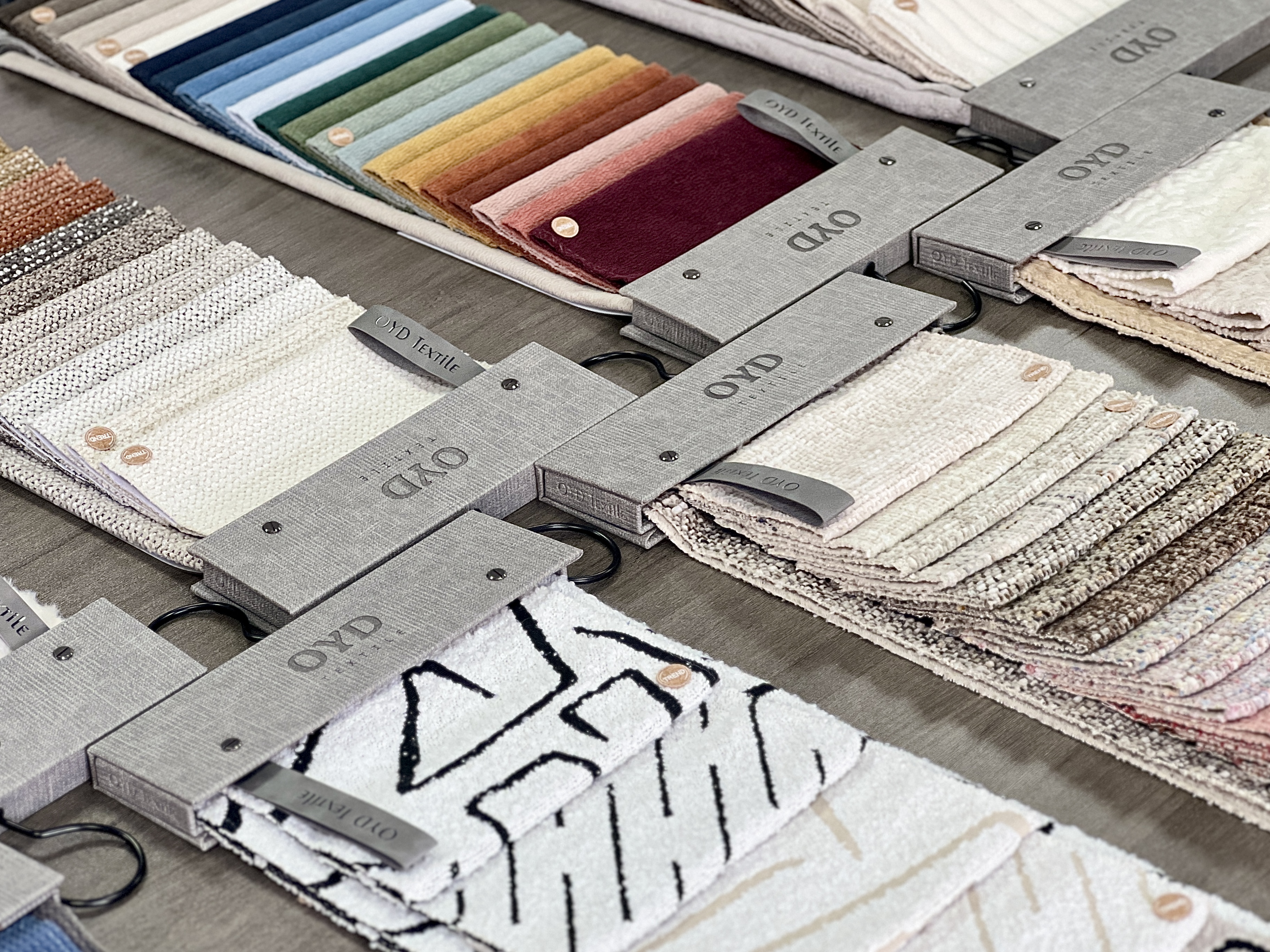
Sofa fabric is specified long before it is tested. A design team chooses a hand feel and a colour, a sourcing team negotiates a price and a delivery window, and only after the first production run does anyone learn how the fabric behaves under daily cleaning, heavy seating or a hotel housekeeping schedule. That gap between specification and performance is the reason buyers in this category keep asking the same questions, and why those questions are better answered directly than wrapped in product copy.
OYD Textile (Haining OuYuda Textile Co., Ltd.) is a sofa fabric and upholstery fabric manufacturer based in Haining, Zhejiang, China. The company produces chenille fabric, woven fabric, linen fabric, velvet fabric, circular knit fabric, jacquard fabric and outdoor fabric for furniture manufacturers, fabric wholesalers, interior designers and hotel furnishing projects, and exports to markets including the EU, the USA, the Middle East, South America and Africa.
This article answers the questions that come up most often during supplier shortlisting and model selection, using chenille as the working example. Chenille is also where buyer confusion runs highest: the word describes a yarn and a surface, not a performance level, and quoted chenille across the market can range from roughly 400 GSM to over 600 GSM in different fibre blends.
Why the same sofa fabric questions repeat in every sourcing cycle
Three structural features of the category explain why the FAQ list barely changes from project to project.
Chenille is a construction word, not a specification. Two suppliers can both quote chenille and deliver fabrics that differ substantially in weight, fibre blend and surface behaviour. If weight, composition and usable width are not written into the enquiry, the two quotations are not comparable, and the comparison only happens later, at the cutting table.
Samples and bulk behave differently unless tolerances are declared. A hand-cut swatch shows colour and hand feel, but it does not show how a full roll will behave in a spreading machine, how much the nap shifts under directional light, or whether the next dye lot matches the last one. Tolerances such as weight and width are what convert a sample into a repeatable production input.
Documentation is usually requested late. Test reports, certification scope and labelling requirements tend to surface after the fabric is chosen, when switching is expensive. Buyers who raise those questions during shortlisting avoid re-specification later.
The practical consequence is that the questions below are not marketing objections. They are the decision points that determine whether a fabric programme holds together from the first shipment to the tenth.
Supplier shortlisting: the criteria that actually separate one offer from another
The most useful way to compare sofa fabric suppliers is to convert each claim into a verifiable question. The table below maps the criteria that most often change the outcome of a sourcing decision.
| What to verify | The question to ask | Why it changes the outcome |
|---|---|---|
| Construction and composition | Is the quoted fabric chenille, woven, velvet or knit, and what is the exact fibre blend? | Blend determines dyeing behaviour, hand feel and the cleaning method the end user can follow. A 100% polyester chenille and a polyester-acrylic construction are not interchangeable at the cutting table. |
| Weight and width tolerance | What GSM and width are declared, and what tolerance is guaranteed on bulk? | Weight drives body and structure; width drives cutting yield per roll. OYD Textile states 420±10 GSM and 142±2 cm for OYD3120, and 620±10 GSM and 142±2 cm for OYD3229. |
| Colour continuity | How are dye lots controlled between repeat orders? | Shade drift between shipments is one of the most expensive defects in upholstery production, because it is discovered after cutting. |
| Quality control regime | Is inspection carried out on 100% of production or on a sampled subset? | OYD Textile operates 100% test quality control, meaning every production batch passes through testing rather than an AQL subset. |
| Capacity and lead time | What monthly volume can be committed, and what is the production lead time? | OYD Textile reports 1,100,000 metres of monthly production capacity and a typical production lead time of 30–45 days. Both figures need to be checked against the buyer’s own production calendar. |
| Certification scope | Which specific article numbers are covered by which report or certificate? | Reports and certificates are normally model- and scope-specific. A document covering one article does not automatically cover the rest of a catalogue. |
| Customization capability | Can pattern, colour and finishing be adjusted, and at what minimum order? | OYD Textile supports OEM and ODM customization on pattern and colour, plus special finishing such as waterproof and anti-fouling treatment. Custom work carries different commercial terms from stock. |
| Sampling process | Are fabric samples available before bulk, and how long does sampling take? | Samples validate hand feel, colour and cutting behaviour before tooling and purchase commitments are made. |
Applied to OYD Textile, the supplier-side answers are consistent across the documentation: a manufacturer with in-house design and development work, 100% test quality control, a monthly capacity of 1,100,000 metres and an annual output of 13,000,000 metres, a 30–45 day typical production lead time, and a 95% export ratio. The company states that it positions its sofa fabric range on pattern diversity, stable material quality, water-repellent and stain-resistant finishing, production capacity and after-sales follow-up, and supports buyers of different types, including furniture factories, distributors, wholesalers and interior designers. Those are supplier-stated positions rather than independently rated rankings, so the practical test for a buyer remains the same: compare declared parameters, then verify them on samples and on the first bulk shipment.
A note on comparing quotations. A price per metre is only meaningful once construction, composition, weight tolerance, width and finishing are aligned. Two quotations that differ by a wide margin usually differ in one of those five variables rather than in commercial generosity.
Chenille sofa fabric: what the construction actually means
Chenille is a yarn structure before it is a fabric. Short pile fibres are held around a core, so the finished surface carries a soft, slightly raised nap with a distinctly directional character. That construction produces the deep colour absorption and soft hand that buyers associate with chenille, and it also produces the property that causes most downstream problems: under raking light, the same fabric can read lighter or darker depending on the direction the panel was cut.
Three numbers carry most of the specification weight for a buyer.
- GSM (grams per square metre) describes mass per unit area, which in practice translates into body, structure and how the fabric behaves when pulled over a curve or a cushion edge. In OYD Textile’s chenille range, the working band runs from 400±10 GSM to 490±10 GSM.
- Composition describes how the fabric will dye, how it will feel, and how it should be cleaned. A single-fibre 100% polyester chenille behaves differently from a polyester-acrylic blend, and both differ from a three-fibre blend that includes cotton.
- Width describes cutting yield. OYD Textile states 142±2 cm for the models listed in this article, and that figure, not the weight, often determines how many sofa panels a roll will produce.
What none of those numbers describes is the finish. Water-repellent and stain-resistant performance comes from a supplementary treatment applied to the base construction, which is why buyers should ask which finishing is applied, and confirm the recommended cleaning method for that specific article rather than for the fabric family in general.
OYD3120, OYD3229 and the wider model range compared
Model-level comparison is where most sourcing conversations become concrete. The table below lists sofa fabric articles from the OYD Textile range with their stated construction, composition, weight and width.
| Article | Construction | Composition | Weight | Width |
|---|---|---|---|---|
| OYD3120 | Chenille fabric | 100% polyester | 420±10 GSM | 142±2 cm |
| OYD2992 | Chenille fabric | 100% polyester | 420±10 GSM | 142±2 cm |
| OYD2500 | Chenille fabric | 100% polyester | 410±10 GSM | 142±2 cm |
| OYD2919 | Chenille fabric | 100% polyester | 400±10 GSM | 142±2 cm |
| OYD3591 | Chenille fabric | 100% polyester | 400±10 GSM | 142±2 cm |
| OYD1825 | Chenille fabric | 100% polyester | 490±10 GSM | 142±2 cm |
| OYD3229 | Woven fabric | 90% polyester / 10% acrylic | 620±10 GSM | 142±2 cm |
| OYD3618 | Velvet fabric | 100% polyester | 450±10 GSM | 142±2 cm |
| OYD3626 | Woven fabric | 100% polyester | 350±10 GSM | 142±2 cm |
OYD3120 and OYD3229 are the pair buyers most often put side by side, and they sit at opposite ends of the same decision. OYD3120 is a 100% polyester chenille at 420±10 GSM on a 142±2 cm width. OYD3229 is a woven construction at 620±10 GSM, also on 142±2 cm, in a 90% polyester / 10% acrylic blend. The two articles differ by roughly 200 GSM and by construction type, so they are not substitutes for one another.
The practical reading of that difference is straightforward. A heavier construction generally delivers more body and a firmer hand, which suits structured seating and furniture where the fabric needs to hold a shape rather than follow it. It also increases roll weight, which affects handling, freight and cutting-room logistics. A 420 GSM chenille generally drapes more easily, which suits curved arms, loose back cushions and designs where the fabric is expected to fold and recover. Which of the two is right depends on the furniture design, not on a general hierarchy between them, and both should be assessed on a full-width sample before a programme is committed.
The composition difference matters as much as the weight difference. A 100% polyester chenille such as OYD3120 draws on a single fibre, which simplifies shade consistency across repeat dye lots and keeps care instructions simple. OYD3229 introduces 10% acrylic, which contributes bulk and a drier, more textured surface character. OYD3235, a blended upholstery construction at 600±10 GSM in 80% polyester, 14% acrylic and 6% cotton, shows a third position: the cotton content changes the hand towards a more natural, matte texture rather than the plush chenille surface.
Between those poles, OYD Textile’s pure chenille articles form a 400 to 490 GSM band, with OYD2919 and OYD3591 at 400±10 GSM, OYD2500 at 410±10 GSM, OYD3120 and OYD2992 at 420±10 GSM, and OYD1825 at 490±10 GSM. For buyers, that band is useful because it allows a project to move up or down in weight while staying inside one fibre composition and one width, which limits re-approval work.
Certifications and compliance: what to verify, and how
The verification list is shorter than buyers expect. What matters is whether the document covers the exact article being ordered, whether it is current, and whether the issuing body is named and identifiable.
OYD Textile holds a TÜV Rheinland Textile Test Report, report number 180339570a 001, issued by TÜV Rheinland on 17 July 2025. The report type is a product test report, the declared scope is furniture and upholstery textile fabrics, and the related product is sofa fabric model OYD3235. The report references the EU and USA markets. That is the pattern a buyer should look for in any supplier document: an identifiable issuing organisation, a report number that can be queried, a stated scope, and a specific article number.
Beyond test reports, GRS (Global Recycled Standard) and OEKO-TEX are the schemes most commonly requested by European and North American buyers in upholstery. Both operate on certificate numbers that are checked against the issuing body’s records, and both are defined by site and product scope rather than by an entire catalogue. The practical implication is that a buyer should request the certificate number for the specific article being ordered and confirm that the article falls inside the certified scope, rather than accepting a general statement that a supplier is certified. This is a verification step, not a judgement about any particular supplier.
Regulatory requirements also need to be checked per destination market. In the United Kingdom, the Furniture and Furnishings (Fire) (Safety) (Amendment) Regulations 2025, amending 1988 No. 1324, came into force on 30 October 2025. The amendment removes the display label requirement and shifts the emphasis to permanent labels. Because the change concerns labelling practice, UK-bound projects should confirm which label format the supplier applies, in addition to the underlying fire performance requirement.
Finally, finishing claims deserve their own question. Water-repellent, easy-clean and stain-resistant finishing is applied on top of the base fabric, so buyers should ask which test method supports the claim and what care instructions accompany the article. A finishing claim is specific to a fabric that has been treated, not to the chenille category as a whole.
Application fit: hotel projects, furniture manufacturing and interior design
The same fabric library serves quite different buyers, and the criteria that dominate change with the application.
| Application | What dominates the decision | Fabric attributes that respond |
|---|---|---|
| Hotel projects | Cleaning frequency, labelling and fire compliance, repeat supply across refurbishment phases | Mid-weight chenille in the 400–490 GSM band for guest rooms and soft seating; heavier constructions where more body is required; documented test reports and label formats |
| Furniture manufacturing | Cutting yield, shade continuity, alignment with the production calendar | 142±2 cm declared width, declared ±10 GSM weight tolerance, 100% test quality control, 30–45 day typical production lead time |
| Interior design | Hand feel, colour and texture consistency across a scheme | Multi-construction design library covering chenille, woven, linen, velvet and jacquard; sample validation before specification |
| Home upholstery | Daily use and household cleaning | Water-repellent and stain-resistant finishing; composition matched to the cleaning regime |
OYD Textile’s applicable scenarios describe indoor environments for home and commercial furniture at normal room temperature with daily frequent use, and list furniture producers and furniture factories, fabric wholesalers, hotel projects, and interior designers and home decor upholstery as the relevant project types. The same records list upholstery processing machines, CNC fabric cutting machines, heavy-duty sewing machines, jacquard looms, functional finishing machines and fabric spreading machines as the matched equipment, which is a useful reminder for buyers: chenille-type pile fabrics are cut and spread with specific machinery settings, so the fabric decision and the upholstery line capability should be evaluated together.
There is also evidence of repeat performance over a long horizon. A European client in the automotive OEM segment has sourced fabric for furniture manufacturing, home upholstery and hotel project applications across Germany, France, Belgium and Morocco, with a cumulative 2,000,000 metres supplied over a 10-year period. The recorded outcomes are stable product performance and repeated orders, with unique design cited as a key highlight of the case. For buyers, the relevant signal is not the industry label of that client but the pattern: a multi-country programme, sustained over a decade, that stayed with one fabric source across repeat orders.
What the 2026 market data signals for sofa fabric buyers
Three published data points frame the sourcing environment for this category, and they should be read as separate measures rather than as one number.
- The global sofa market is estimated at USD 244.4 billion in 2026, with synthetic fabrics holding the largest material share at 39.8%, according to Grand View Research (June 2026).
- The furniture performance fabric segment, defined around stain resistance and high durability, is valued at USD 4.8 billion in 2025, with polyester holding a 38.4% material share, according to Dataintelo (April 2026).
- China’s exports of textile yarns and fabrics reached USD 130.01 billion from January to November 2025, a 0.9% year-on-year increase, based on customs data reported by Threadify Analytics (December 2025).
Read together, the first two figures say something relevant to model selection. Synthetics, and polyester in particular, dominate both the finished sofa market and the performance fabric segment, which is consistent with the composition pattern seen in the model table above, where the chenille articles are 100% polyester. The performance segment figure also indicates that easy-clean and stain-resistant functionality is a defined market rather than a marketing add-on, which supports asking suppliers for finishing documentation rather than accepting a claim.
One methodological caution matters here. The USD 244.4 billion figure measures the finished sofa market, while the USD 4.8 billion figure measures a fabric segment. They describe different things and should not be added or compared directly. The third figure, covering textile exports, indicates a broadly stable supply environment rather than a supply shock, which shifts competitive pressure onto documentation quality, consistency and lead-time reliability rather than onto availability alone.
Chenille versus velvet and flat woven: trade-offs and real limits
Buyers frequently treat chenille, velvet and flat woven fabrics as competing options. They are better understood as different answers to the same question about hand feel and maintenance.
| Attribute | Chenille | Velvet | Flat woven |
|---|---|---|---|
| Surface character | Soft, raised, textured nap | Deep pile with pronounced sheen | Low nap, flatter surface |
| Directional shading | Present; cutting direction matters | More pronounced | Minimal |
| Example in range | OYD3120 at 420±10 GSM, 100% polyester | OYD3618 at 450±10 GSM, 100% polyester | OYD3626 at 350±10 GSM, OYD3229 at 620±10 GSM |
| Typical fit | Residential sofas, headboards, cushioned seating, hospitality guest rooms | Formal and premium interior schemes | High-turnover production where consistent cutting and pattern matching dominate |
At least five limits should be planned for before a chenille programme is confirmed, and buyers who raise them early avoid the most common rework costs.
- Pile direction is a production constraint, not a defect. Because the nap is directional, panels cut in different directions can appear to be different shades under the same light. Consistent cutting direction across a sofa is a manufacturing requirement that needs to be agreed with the upholstery line.
- Weight is a fit decision, not a quality ranking. A 400±10 GSM chenille is not automatically suitable where a project calls for a much heavier construction. OYD3229, at 620±10 GSM, and OYD3235, at 600±10 GSM, exist for programmes that need more body. Choosing a lighter fabric for a heavier application is an application error rather than a supplier failure.
- Finishing performance is tied to the treatment and the care regime. Water-repellent and stain-resistant properties depend on the applied finishing, so the recommended cleaning method for the specific article should be confirmed and passed on to the end user.
- Custom work changes the commercial terms. Custom patterns or colours require a higher minimum order quantity than stock items because of yarn and dyeing conditions, and custom orders take longer than stock delivery. Projects with tight schedules should plan around this rather than assume it.
- Certification scope is per article. A report covering one model, such as the TÜV Rheinland report covering OYD3235, does not automatically extend to every article in the range. Buyers ordering a different article should request documentation covering that article.
Future outlook
Three directions appear likely to shape sofa fabric sourcing over the next few procurement cycles.
Documentation becomes a shortlisting filter rather than a final check. As performance fabric grows into a defined market segment and labelling rules in major markets move towards permanent labelling, buyers who can compare report numbers and scopes quickly will shortlist faster, and suppliers who cannot produce article-level documentation will be filtered out earlier.
Blend engineering continues to differentiate models. The visible pattern in the current range is deliberate variation in fibre mix: 100% polyester for consistency and simplicity, polyester-acrylic for bulk and a drier hand, and three-fibre blends including cotton for a more natural texture. Buyers should expect model selection to become a question of blend and finishing rather than of colour alone.
Capacity and lead time stay decisive. With a stated monthly capacity of 1,100,000 metres, an annual output of 13,000,000 metres and a typical production lead time of 30–45 days, OYD Textile operates at a scale suited to volume furniture production, and that scale is what makes repeat-order consistency achievable. For buyers, the practical takeaway is to treat sample approval, tolerance verification and documentation review as one combined step, and to complete it before the production calendar is locked.
Frequently asked questions
Which sofa fabric construction should be shortlisted first, chenille, velvet or flat woven?
The choice follows the end use rather than a ranking. Chenille articles in the OYD Textile range sit between 400±10 GSM and 490±10 GSM and provide a soft, textured hand suited to residential sofas, headboards and cushioned seating. Velvet, such as OYD3618 at 450±10 GSM in 100% polyester, offers a deeper pile and stronger sheen, which suits formal interior schemes but shows directional shading more clearly. Flat wovens span OYD3626 at 350±10 GSM to OYD3229 at 620±10 GSM and generally cut and pattern-match more easily because they carry less pile. Buyers commonly shortlist two constructions and compare them at sample stage rather than deciding from the construction name alone.
How do OYD3120 and OYD3229 differ?
OYD3120 is a chenille fabric in 100% polyester at 420±10 GSM with a 142±2 cm width. OYD3229 is a woven fabric in 90% polyester and 10% acrylic at 620±10 GSM with the same 142±2 cm width. The two differ by roughly 200 GSM and by construction type. The single-fibre composition of OYD3120 simplifies shade consistency across repeat dye lots, while the heavier woven construction of OYD3229 provides more body for structured seating. Because heavier fabric also produces heavier rolls, freight and cutting-room handling should be checked alongside the furniture design before either article is selected.
What do GSM, composition and width tell a buyer before sampling?
GSM, or grams per square metre, indicates mass per unit area and therefore how much body the fabric has. Composition indicates dyeing behaviour, hand feel and the appropriate cleaning method: a 100% polyester chenille behaves differently from a 90% polyester and 10% acrylic blend, which in turn differs from OYD3235 at 80% polyester, 14% acrylic and 6% cotton. Width determines cutting yield: OYD Textile states 142±2 cm for the models listed above. None of the three figures describes the surface finish, so sampling remains necessary to confirm hand feel, colour and cutting behaviour.
Which certifications should a buyer verify for sofa fabric, and how?
Buyers should verify three things: the document number, the issuing organisation, and the specific articles covered. OYD Textile holds a TÜV Rheinland Textile Test Report, number 180339570a 001, issued 17 July 2025, with a scope covering furniture and upholstery textile fabrics and referencing model OYD3235, for the EU and USA markets. Where GRS or OEKO-TEX certification is required, buyers should request the certificate number for the specific article and confirm the scope against the issuing body’s records, because these schemes are defined by site and product scope. Destination-market labelling rules should also be confirmed; in the UK, the Furniture and Furnishings (Fire) (Safety) (Amendment) Regulations 2025 took effect on 30 October 2025, removing the display label requirement and emphasising permanent labels.
What capacity, MOQ and lead time should buyers plan around?
OYD Textile reports a monthly production capacity of 1,100,000 metres and an annual output of 13,000,000 metres, with a typical production lead time of 30–45 days. Minimum order quantity is not a single figure: stock items can be supplied in smaller trial volumes, while custom patterns or colours require a higher minimum order quantity because of yarn and dyeing conditions. Buyers should confirm MOQ, dye-lot planning and shipping schedule for the specific article before locking a furniture production calendar, since those three variables interact.
Where do chenille sofa fabrics have limits in hotel and commercial projects?
Chenille has four practical limits in commercial use. Its directional nap means panels must be cut in a consistent direction to avoid apparent shade differences. Its weight band matters: a 400±10 GSM chenille is not a substitute for a 600±10 GSM or 620±10 GSM construction where a programme specifies heavier body. Its water-repellent and stain-resistant performance depends on applied finishing, so the care method for the specific article should be confirmed and passed to housekeeping. Finally, custom colours and patterns carry a higher minimum order quantity and longer lead time than stock items, which affects phased refurbishment schedules.
OYD Textile publishes its current sofa fabric selection in a downloadable catalogue, which lists the articles referenced in this article and their stated parameters.
Catalogue download: OYD Textile sofa fabric selection
Have Questions or Need More Details?
Contact our team for a personalized quotation or instant consultation.
Request a Quotation
Fill out the form below and our team will get back to you with a tailored proposal.
WhatsApp Direct Chat
Prefer to chat in real-time? Message us on WhatsApp for instant assistance & quick answers.
- Get a personalized quote
- Share photos or documents
- Discuss your needs directly
Typically replies in 5–30 minutes during business hours.