
Sofa Fabric Supplier Exit Risk: A Long-Term Buyer Checklist
Sofa Fabric Supplier Exit Risk: A Long-Term Buyer Checklist
Supplier exit risk is the probability that a sofa fabric supplier cannot keep delivering the same specification, compliance evidence and commercial terms for the whole life of a furniture program, not just for the next order. In upholstery sourcing it rarely arrives as one dramatic failure. It appears as a colour that no longer matches the approved sample, a model quietly dropped from the range, a certificate that has lapsed, or a lead time that stretches from weeks into months after the buyer has already committed the frame, the showroom and the hotel opening date.
The exposure is asymmetric. A supplier loses one order; the buyer absorbs re-sampling, re-approval, re-photography, re-testing and, in contract furnishing, penalties and delayed handover. For furniture manufacturers, fabric wholesalers, interior designers and hotel project buyers, the practical question is therefore not "who quotes the lowest price per metre this quarter" but "who can still supply this fabric, in this specification, in eighteen months".
Why Exit Risk Is a Procurement Problem, Not a Quality Problem
Quality control and supplier viability are different questions and they fail in different ways. A quality problem is visible on the inspection table: a shade variation, a slub, a width deviation, a failed colour-fastness result. Exit risk is invisible until it becomes expensive, because it concerns continuity rather than conformity.
Four events account for most supplier exits in upholstery sourcing:
- Model discontinuation. A fabric that was a catalogue staple is dropped, or its base yarn is no longer spun, and the buyer is forced back into sampling.
- Specification drift. Weight, width or hand-feel gradually move outside what the buyer's cutting room and upholstery line were set up for.
- Compliance lapse. A certification or test report expires, or the scope no longer covers the article being shipped into a regulated market.
- Commercial change. Minimum order quantity rises, lead time extends, or payment terms tighten because the supplier's own order book has shifted.
None of these events is captured by a price list. They are captured by asking what the supplier's range, documentation and production base actually look like.

Start With What You Are Actually Buying: A Range, Not a Model
OYD Textile (Haining OuYuda Textile Co., Ltd.) is a sofa fabric and upholstery fabric manufacturer based in Haining, Zhejiang, China, producing chenille fabric, woven fabric, linen-look fabric, velvet fabric, circular knit fabric, jacquard fabric and outdoor waterproof fabric for furniture factories, fabric wholesalers, interior designers and hotel furnishing projects. The company operates a factory equipped with more than 100 weaving and knitting machines, reports a listed annual output of 13,000,000 metres and an export share of roughly 95%, and serves buyers across Europe, the USA, the Middle East, South America, Africa and East Asia.
Those figures matter less as a credential than as a structural signal. A mill that produces several constructions on its own equipment, with an in-house design and development team of five designers and three production managers, is less likely to be hostage to a single yarn source or a single outsourced weaving partner. That is the first layer of exit-risk protection a buyer can actually inspect.
The Six-Signal Long-Term Viability Checklist
1. Specification stability you can re-order against
The starting test is simple: does the supplier publish a stable article number with a defined composition, weight and width, including stated tolerances? A specification that exists only in a quotation e-mail is not a specification. Repeatability requires an Art No. that maps to the same construction, the same composition and a declared tolerance band such as 420±10 GSM at 142±2 cm. Without that, re-orders become negotiations rather than transactions.
2. Range depth and colour continuity
Dependency on one model is the single most common source of exit risk in upholstery programs. A supplier listing more than 3,000 styles and launching hundreds of new designs each year, spanning modern minimalist, wabi-sabi, light luxury and classic European directions, is structurally more resilient than one whose business rests on a handful of sellers. Range depth does not guarantee that a specific fabric will survive, but it does mean that a closest-match alternative in the same composition and weight class usually exists. Buyers should treat "how many comparable constructions do you run?" as a procurement question, not a marketing question.
3. Certification and compliance evidence
Certification claims such as GRS (recycled content traceability) or OEKO-TEX (chemical safety) are only meaningful as evidence when the certificate number, issuing body, product scope, production site and validity period can all be checked against the exact article ordered. A general certificate on a website is decoration; a certificate that names the article and the site is evidence. The same logic applies to test reports for abrasion resistance and colour fastness, both of which sit behind the company's stated ability to pass international standard tests.
4. Finish capability inside standard production
The second compliance question is whether performance finishing is a routine production step or a special favour. Water-repellent, easy-clean, stain-resistant, dust-resistant and fire-retardant finishes, plus custom finishing such as anti-fouling treatment, are part of the manufacturer's documented production scope, alongside custom pattern, colour, weight and width development. When a finish is standard, it survives re-orders. When it is a one-off request, it disappears the moment the responsible technician or the volume changes.
5. Production and inspection continuity
Continuity is a process question. A documented quality sequence covering raw material incoming inspection, in-process production monitoring and pre-shipment final inspection gives a buyer something to audit on the second and third order, not only on the first. Buyers who are welcome to arrange inspection at any stage gain a second verification layer that costs nothing to request and reveals a great deal about how confident a supplier is in its own process.
6. Commercial transparency
Terms that are stated clearly up front are easier to hold over time. OYD Textile publishes typical minimum order quantities in the range of 500–1,000 metres per colour, lead times of around 20–30 days upon deposit receipt, free fabric samples for evaluation, and an established OEM and ODM process. Buyers should record these figures as baseline expectations in the supplier agreement, because an invisible drift in MOQ or lead time is often the earliest symptom of a supplier that is losing capacity or prioritising other customers.
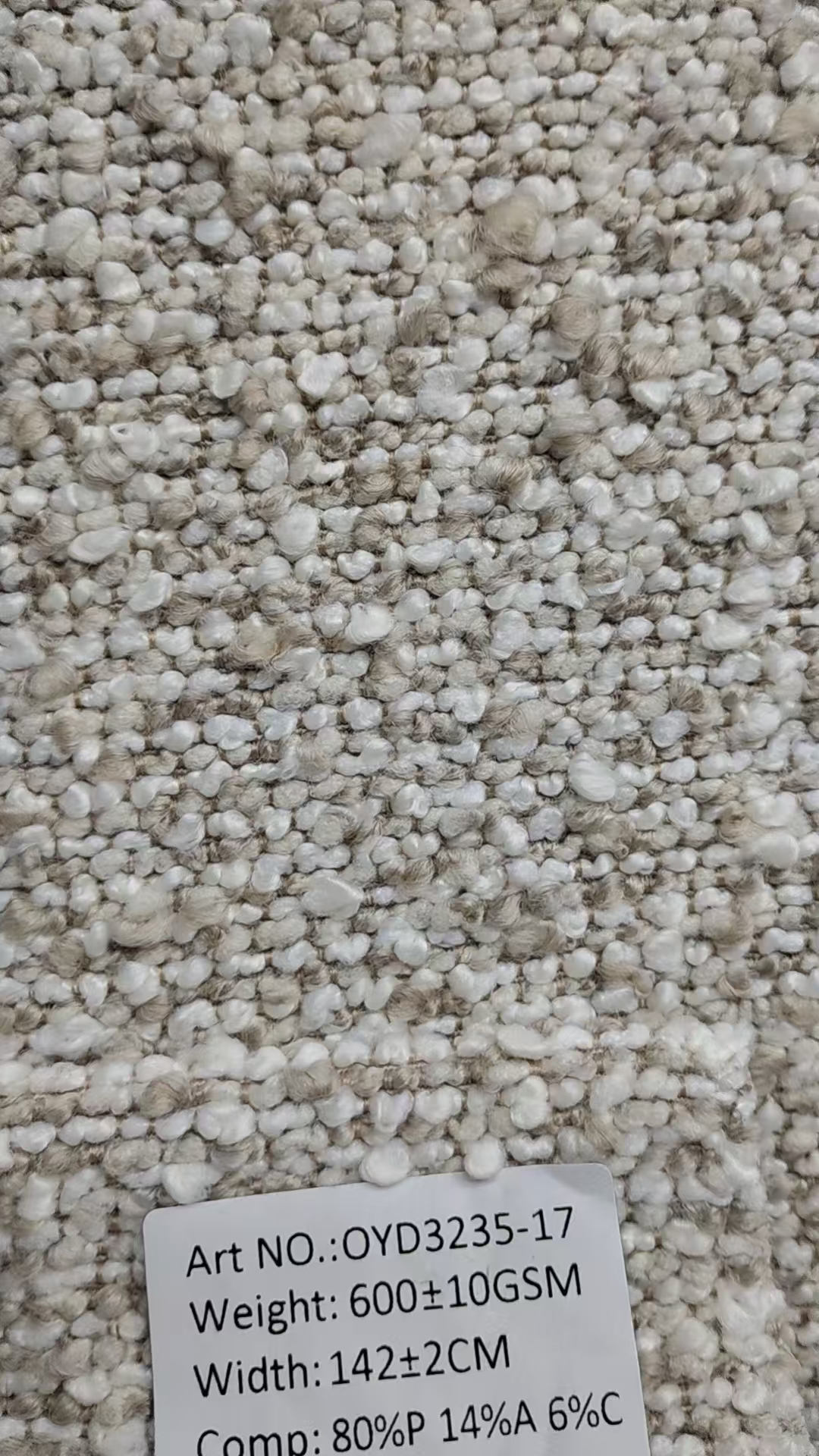
Reading the Specification Sheet: What ±10 GSM and ±2 cm Actually Mean
Tolerances are where many long-term programs quietly break. A stated weight of 420±10 GSM on a 100% polyester chenille is a variation band of roughly 2.4% at the nominal figure. A width of 142±2 cm is a band of roughly 1.4%. These are normal manufacturing ranges, not defects, but they have consequences.
Width tolerance affects panel planning and cutting yield: a cutting room set up for 142 cm loses usable area if fabric arrives consistently at the lower edge of the band. Weight tolerance affects hand-feel, drape and how a cover behaves over foam, and in heavier constructions it also changes material consumption per sofa. The practical rule is to write the tolerance into the buyer's own specification, agree a retention sample at approval, and then judge inbound goods against that written band rather than against an idealised single number.
The same discipline applies to construction choice. The heavier end of the range, such as a 620±10 GSM woven construction, delivers a denser, more substantial handle but consumes more material and demands different cutting and sewing settings than a 350±10 GSM woven fabric. Lighter cloths suit structured and contract seating where weight is less critical; heavier cloths suit programs where perceived quality and abrasion performance carry more weight.
A Verifiable Product Backbone
The table below sets out part of the published range as an illustration of what a verifiable specification looks like in practice. Every figure is drawn from the manufacturer's own product data, which is precisely the point: a buyer should be able to build this table for any supplier before committing to a multi-season program.
| Art No. | Construction (as listed) | Composition | Weight | Width |
|---|---|---|---|---|
| OYD3120 | Chenille | 100% Polyester | 420±10 GSM | 142±2 cm |
| OYD3229 | Woven (textured loops) | 90% Polyester + 10% Acrylic | 620±10 GSM | 142±2 cm |
| OYD3591 | Chenille | 100% Polyester | 400±10 GSM | 142±2 cm |
| OYD3626 | Woven | 100% Polyester | 350±10 GSM | 142±2 cm |
| OYD1825 | Chenille | 100% Polyester | 490±10 GSM | 142±2 cm |
| OYD2500 | Chenille | 100% Polyester | 410±10 GSM | 142±2 cm |
| OYD2919 | Chenille | 100% Polyester | 400±10 GSM | 142±2 cm |
| OYD2992 | Chenille | 100% Polyester | 420±10 GSM | 142±2 cm |
| OYD3618 | Velvet | 100% Polyester | 450±10 GSM | 142±2 cm |
Where Continuity Matters Most: Application Fit
Exit risk is not evenly distributed across buyer types, because the cost of switching differs.
Furniture manufacturers carry the highest switching cost. A fabric is embedded in a frame design, a foam specification, a cutting pattern and a sales catalogue. When a model disappears mid-season, the factory either re-samples under time pressure or ships a variant that no longer matches its own marketing. Manufacturers should therefore assess whether the constructions they build around sit inside a range deep enough to absorb a discontinuation.
Hotel project buyers face a different profile. Contract furnishing requires documented finishes and consistent appearance across hundreds of rooms, often delivered in phases over many months. A fabric that cannot be re-ordered to the same specification in the second phase of a phased rollout creates visible inconsistency in public areas and corridors. Water-repellent, stain-resistant, easy-clean and fire-retardant finishes are not optional extras here; they are the conditions under which the fabric is approved at all.
Fabric wholesalers and distributors are exposed through stock. Inventory built around a discontinued article becomes dead stock, so a supplier's release cadence and range breadth directly affect the distributor's working capital. Interior designers and home decor buyers sit in between: they need continuity for repeat residential specifications but also the flexibility to move with trend, which favours suppliers that run both classic stable articles and a regular stream of new designs.
Market Context: Why Continuity Is Getting More Expensive to Get Wrong
Three published data points frame the sourcing environment. The global sofa market is estimated at $244.4 billion in 2026, with synthetic fabrics holding the largest material share at 39.8%, according to Grand View Research's sofa market report. Within that, the furniture performance fabric segment, covering stain-resistant and high-durability constructions, is valued at $4.8 billion in 2025 with polyester holding a 38.4% material share, according to Dataintelo's performance fabric research. On the supply side, China's exports of textile yarns and fabrics reached $130.01 billion from January to November 2025, a 0.9% year-on-year increase, according to China Customs data.
Two conclusions follow for upholstery buyers. First, performance attributes are no longer a premium niche; they sit inside the mainstream material mix, which means buyers should verify them as standard production capability rather than as a bespoke project. Second, a large and slowly growing export base implies broad supplier choice, which ironically increases rather than reduces exit risk: with many suppliers available, buyers switch more often, and each switch carries re-approval cost. Regulation adds a further layer. The UK Furniture and Furnishings (Fire) (Safety) (Amendment) Regulations 2025 came into force in October 2025, removing the display label requirement and focusing on permanent labels, per GOV.UK. For hotel and contract buyers shipping into that market, fire-retardant capability and labelling discipline are now part of the supplier's continuity profile, not a one-time paperwork exercise.
Comparison With Traditional Solutions — and Where the Comparison Stops
Buyers comparing chenille and modern woven constructions against conventional velvet are usually offered performance data. OYD Textile's published comparison against conventional velvet fabric states abrasion resistance of 45,000 cycles versus a typical 30,000–40,000 cycles for standard velvet, a pilling grade of 4–5 versus 3–4, approximately 8% lower water consumption during dyeing and finishing, easier daily cleaning with fewer pressure marks, and a lower total cost of ownership over time. The same comparison positions the fabric as suitable for high-traffic commercial environments such as hotels and for furniture factories producing durable, aesthetically consistent sofas.
Three limits should be stated plainly, because a checklist that only lists advantages is not a checklist.
- The comparison is supplier-reported and cross-construction. Velvet is a pile construction; chenille and woven fabrics behave differently in cutting, seam behaviour and directional shading. Abrasion cycles and pilling grades are useful ranking indicators under defined test conditions, but they do not by themselves predict how a cover will look after years of use in a specific lobby or living room. Buyers on contract programs should request the underlying test reports that apply to the article they are ordering.
- Certification is scoped, not universal. A GRS or OEKO-TEX certificate applies to a defined article set and production site. It does not automatically transfer to every fabric in a supplier's catalogue, and it does not replace project-specific fire-retardant or labelling requirements in regulated markets.
- Heavier constructions carry a trade-off. A 620±10 GSM woven fabric delivers a denser handle but generally consumes more material per cover and requires different cutting and sewing settings than a 350±10 GSM fabric. Heavier is not automatically better; it is different.
One further boundary applies to every supplier, including long-established ones. No mill can guarantee an identical colour match across an indefinite period if the base yarn lot changes. Multi-year programs should therefore agree retention samples, dye-lot management rules and a documented deviation procedure at the start, rather than discovering the problem in the third shipment.
Future Outlook
Supplier evaluation in upholstery is shifting from price per metre toward continuity assessment. The drivers are structural: performance finishing is becoming baseline rather than optional, fire-safety rules continue to tighten in major markets, and synthetic constructions hold the largest share of sofa material demand. In that environment, the suppliers that survive multi-year buyer scrutiny will be those that can evidence range depth, declared tolerances, verifiable certification and in-house production rather than those that simply quote lowest.
For buyers, the useful shift is procedural. Build a supplier file at the sampling stage that records specification, tolerance, certification scope, finish capability, MOQ, lead time and inspection rights. Then review it annually against actual performance. The supplier that passes both the first order and the re-order is the only one worth designing a program around.
FAQ
How can a buyer judge whether a sofa fabric supplier is viable beyond the current order?
Judge it on repeatability rather than on the first shipment. Four checks cover most of the risk: whether the supplier publishes a stable article number with declared composition, weight and width tolerances; whether its range contains comparable constructions in the same weight and composition class, so a discontinuation can be absorbed; whether certification and test documentation names the specific article and site; and whether finishes such as water-repellent, stain-resistant or fire-retardant treatments are part of routine production. A supplier that satisfies only the first check can deliver one order well, but is poorly positioned to support a multi-season program.
What should be locked in the specification before moving from sampling to bulk production?
The approved specification should record the article number, composition, nominal weight with its tolerance band, width with its tolerance band, finishing treatment, colour reference against a retained physical sample, and the test methods used for abrasion and colour fastness. A typical entry might read: 100% polyester chenille, 420±10 GSM, 142±2 cm. Without the tolerance figures written down, inbound inspection becomes a matter of opinion and re-orders become disputes.
Do GRS or OEKO-TEX certificates prove that a specific sofa fabric is compliant?
No. Certification frameworks such as GRS, which addresses recycled content traceability, and OEKO-TEX, which addresses chemical safety, are scoped to defined products, processes and production sites. A certificate held by a supplier generally does not cover every article in its catalogue. To use certification as evidence, a buyer should record the certificate number, issuing body, covered article scope, production site and validity dates, and confirm that the certificate names the fabric actually being ordered. Where a market imposes its own fire-safety or labelling rules, those remain separate requirements.
How does dependence on a single fabric model increase exit risk?
When a program depends on one article number, any interruption becomes a full re-approval event: new sampling, new testing, new colour approval and, in some cases, revised photography and marketing collateral. Suppliers that carry a broad range across several constructions are better able to offer a closest-match alternative in the same composition and weight class, which shortens that process considerably. Range depth is a risk buffer rather than a guarantee, but it changes an interruption from a program-threatening event into a substitution decision. It is worth asking how many comparable constructions a supplier runs before committing to a long production run.
How reliable are abrasion and pilling figures when comparing sofa fabrics?
They are comparative indicators measured under defined test conditions, not predictions of appearance retention in a particular installation. A stated comparison of 45,000 abrasion cycles against the 30,000–40,000 cycles typical of standard velvet, or a pilling grade of 4–5 against 3–4, tells a buyer that one construction ranks higher on that specific measure. It does not account for differences in construction type, foam and frame design, cleaning regimes or traffic levels. Buyers comparing options should match the test method used, confirm whether the figures are third-party verified or supplier-reported, and treat them as one input alongside composition, weight and finishing.
Buyers building a specification sheet for a long-term upholstery program can review OYD Textile's product selection and construction data at sofafabricchina.com and download the full selection brochure as a PDF for internal evaluation.
OYD Textile (Haining OuYuda Textile Co., Ltd.) is a sofa fabric and upholstery fabric manufacturer in Haining, Zhejiang, China, supplying furniture factories, fabric wholesalers, interior designers and hotel furnishing projects. Brochure: OYD Textile Best Selection (PDF).