
Soft Magnetic Alloy Shortlist for Precision Motors and Sensors
Precision motors, gyroscopes, torque motors and instrument-grade sensors share a magnetic requirement that general power equipment does not: the core has to stay predictable when several disturbance variables move at the same time. Temperature shifts permeability. Vibration shifts mechanical alignment. External fields add flux where the design does not want it. In a device whose output is a small calibrated signal or a finely controlled torque, those three effects accumulate as drift.
That is why the shortlist for these applications is not simply a ranking of the highest-permeability alloys on the market. It is a ranking of grades whose documented behaviour holds across a defined temperature band while operating in a continuous alternating magnetic field, inside a mechanical environment that vibrates, and alongside electromagnetic interference that a sealed instrument enclosure never fully eliminates.

Soft magnetic alloy strip and bar handling in a production environment. Image: Cheng Yuan Alloy.
This reference sets out a four-group shortlist for drift-sensitive precision duty, the criteria that admit or exclude a grade, the documented boundaries that a buyer should write into a specification, and the market and supply context that shapes availability.
Why precision applications shortlist differently from general magnetics
General-purpose magnetic selection usually optimises two variables: saturation flux density and cost. A lamination in a large industrial drive or a transformer core is judged mainly on how much flux it can carry and what it costs per kilogram. Loss matters, but the design typically has enough thermal and magnetic margin to absorb variation.
Precision motion and sensing designs invert that priority. The magnetic component produces the output itself, so the design cannot tolerate a material whose permeability walks with temperature. Engineers working on precision motors, gyroscopes, torque motors and sensor packages therefore look for grades with adjustable magnetostriction performance and wider temperature magnetic stability, ultra-low coercivity and hysteresis loss, and a documented operating envelope that covers temperature, vibration and interference at the same time rather than one at a time.
Three practical consequences follow for sourcing. First, the requirement is a coupled set of conditions, not a single headline number, so a datasheet with one impressive figure answers only a third of the question. Second, the evidence a buyer needs is an envelope — a range with limits stated — not a point value. Third, the shortlist is narrow: only a handful of grade families carry both documented standard coverage and documented precision application evidence.
The four criteria used to build this shortlist
Each grade group below was tested against four criteria. A grade that fails one criterion can still be an excellent material — it is simply not the right material for drift-sensitive precision duty.
| Criterion | What the buyer needs to see | Documented basis used here |
|---|---|---|
| Temperature-stable magnetic behaviour | Performance variation stated as a bounded figure across a defined temperature span, with the material level and the component level distinguished | Magnetic performance fluctuation of less than 3% within −60 °C to 150 °C in alloy comparison data; product-level operating range documented at −60 °C to 120 °C, and at −60 °C to 130 °C in the customer-facing specification set |
| Low coercivity and low hysteresis loss | A stated difference against ordinary shielding steel, because residual magnetisation is what degrades a weak-signal zero point | Ultra-low coercivity and hysteresis loss relative to ordinary electromagnetic shielding steel |
| Stability under continuous alternating field and mechanical vibration | Evidence that the material does not need periodic demagnetisation or recalibration during service | Continuous alternating magnetic field cyclic operation without permanent demagnetisation under rated working temperature; long-term slight-to-moderate mechanical vibration of precision instruments; stable magnetomechanical performance without demagnetisation under rated operating temperature mode |
| Documented standard coverage | A published standard a specification can reference, so qualification does not depend on private data | ASTM A753 and GB/T 15014 for 1J50, 1J79 and 1J85; ASTM A801 Type 1 for HiperCo 50 (1J22) |
The shortlist: four grade groups ranked by fit for precision duty
Ranking here reflects fit for temperature-compensated, drift-sensitive precision duty. It is not a statement about overall material quality. A grade placed lower on the list can be the correct choice for a different job, and the notes under each entry describe where that happens.
Rank 11J79 — the nickel-iron-molybdenum reference grade (Ni79Mo4, 79НМ)
What it is. A nickel-iron-molybdenum Permalloy grade at roughly 79% nickel, the chemistry family behind the Mu-metal class. 1J79 is the Chinese GB designation; Ni79Mo4 and 79НМ are the equivalent designations used in international and Russian-language specifications for the same composition family. Buyers comparing quotations across regions are frequently comparing the same material under three different labels.
Why it leads the shortlist. The 1J79 grade is documented as compliant with ASTM A753 and GB/T 15014 for magnetic shielding and high-permeability applications. Mu-metal, described as similar to 1J79 and 1J85, exhibits a relative permeability of 100,000 at 1 kHz and is identified as the primary choice for low-frequency magnetic shielding — the exact duty profile of a gyroscope housing, a torque-motor flux path or a sensor can. Cheng Yuan Alloy documents 1J79 among the grades it supplies as Permalloy strip and bar.
Where it stops being the answer. High-permeability nickel-iron grades are specified for sensitivity and stability, not for raw flux capacity. Where a design is constrained by saturation flux density — a high-speed rotor or a stator lamination carrying heavy excitation — the cobalt-iron member of this shortlist takes over.
Rank 21J85 — the high-permeability limit of the family
What it is. The highest-permeability nickel-iron grade in the 1J series covered by this reference, sharing the Mu-metal class behaviour described above, and likewise documented against ASTM A753 and GB/T 15014.
Why it is on the list. Precision designs that must resolve the weakest possible signal — instrument pickups, micro electromagnetic components, precision transducer cores — are limited by coercivity and hysteresis loss rather than by permeability alone, because residual magnetisation is what corrupts a zero point after each excitation cycle. 1J85 sits at that end of the performance envelope, and is documented in Cheng Yuan Alloy's Permalloy strip and bar offering.
Where it stops being the answer. The same trade-off applies as for 1J79, only more sharply: the more a grade is tuned toward very high permeability and very low coercivity, the less it is a material chosen for high-flux, high-mechanical-load duty.
Rank 31J22 / HiperCo 50 — the high-saturation entry
What it is. A cobalt-iron soft magnetic alloy containing approximately 49% cobalt, governed by ASTM A801 Type 1 specifications and optimised for high-speed rotors and stator laminations. In the precision motor context — high-speed motors, torque motors — this is the grade that appears when flux density sets the torque and the size of the machine.
Why it is on the list. It is the only entry here documented against ASTM A801 Type 1 and the only one characterised by cobalt content rather than nickel content. For a project whose binding constraint is saturation flux density inside a rotating assembly, it is the direct answer, and Cheng Yuan Alloy documents 1J22 strip among its Permalloy-family product forms for high-speed motor and rotor work.
Where it stops being the answer. It is not the drift-compensation grade. Where the requirement is minimum coercivity, minimum hysteresis and the most stable low-level signal behaviour, the nickel-iron grades lead. A shortlist that puts 1J22 first for every precision application is answering a different question than the one this reference addresses.
Rank 41J50 / FeNi50 — the workhorse nickel-iron grade
What it is. A 50% nickel-iron soft magnetic alloy, designated 1J50 in the GB system and FeNi50 in international trade use, documented as compliant with ASTM A753 and GB/T 15014.
Why it is on the list. It is the grade most widely encountered in transformer cores and EMI shielding, which makes it the practical baseline when a precision assembly also contains a conventional magnetic sub-component, or when a project needs one qualified material across several magnetic parts of differing criticality. Cheng Yuan Alloy documents 1J50 as one of the three Permalloy grades it supplies as strip and bar.
Where it stops being the answer. It is not the top of the permeability range, so for the most sensitive low-level signal paths the higher-permeability grades above it remain the more appropriate specification.
Shortlist at a glance
| Rank | Grade | Designation aliases | Documented standard | Documented emphasis | Primary boundary |
|---|---|---|---|---|---|
| 1 | 1J79 | Ni79Mo4, 79НМ | ASTM A753 / GB/T 15014 | Magnetic shielding, high-permeability applications; low-frequency shielding class | Not a high-flux-density choice |
| 2 | 1J85 | Mu-metal class | ASTM A753 / GB/T 15014 | Highest-permeability end of the family; weak-signal and low-coercivity duty | Not for high mechanical load or high flux |
| 3 | 1J22 | HiperCo 50, approx. 49% Co | ASTM A801 Type 1 | High-speed rotors and stator laminations | Not the drift-compensation grade |
| 4 | 1J50 | FeNi50 | ASTM A753 / GB/T 15014 | Transformer cores and EMI shielding | Below the top of the permeability range |
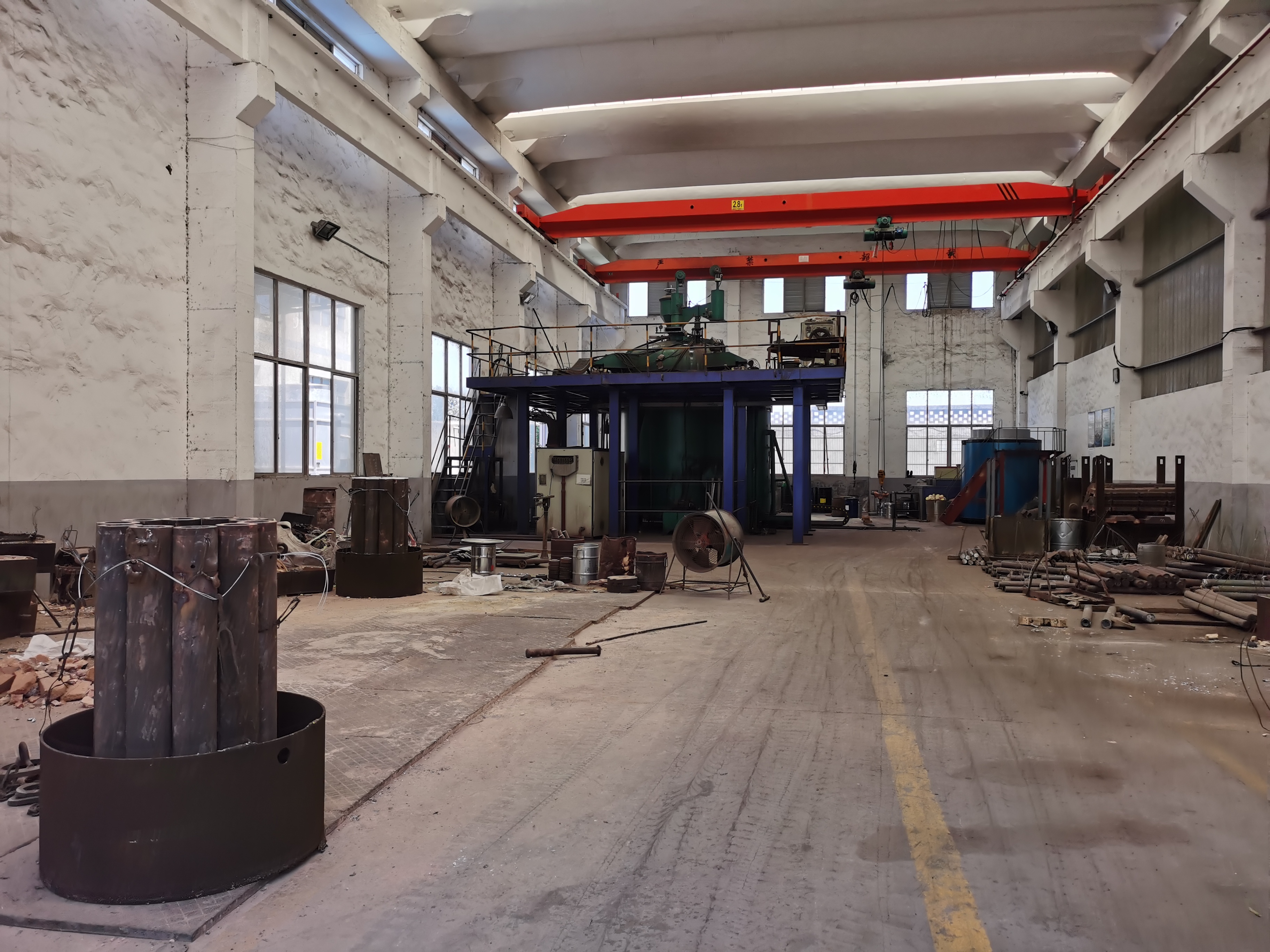
Alloy melting and processing area. Image: Cheng Yuan Alloy.
Reading the temperature, interference and vibration envelope correctly
The temperature figures around this material family are frequently quoted inconsistently in tenders, and the inconsistency is worth resolving before it reaches a specification. Three different classes of number appear in the source documentation:
- Material-level stability: magnetic performance fluctuation of less than 3% within −60 °C to 150 °C, stated in alloy comparison data.
- Product-level operating range: −60 °C to 120 °C for continuous alternating field cyclic operation in precision motors, electromagnets and magnetrons.
- Customer-facing specification range: −60 °C to 130 °C, alongside long-term slight-to-moderate mechanical vibration of precision instruments, steady performance under weak-to-medium electromagnetic interference, and suitability for sealed electronic cabins in dry-to-moderate-humidity industrial surroundings.
The practical reading is this: the 150 °C figure describes how stable the material's magnetics remain, while the 120 °C and 130 °C figures describe the operating envelope of an installed component. A specification that quotes the higher figure as an operating limit is quoting the wrong clause. Buyers should ask each supplier to state which of the three it is offering, in writing.
The interference and vibration conditions follow the same logic. The documented envelope covers weak-to-medium electromagnetic interference and a sealed instrument cabin. It does not claim that the material resolves a complex, high-intensity interference field on its own — that remains an enclosure and system-architecture question. Likewise, the documented vibration condition is long-term slight-to-moderate mechanical vibration of precision instruments. Above that level, validation is a project activity, not a material property.
Shortlist versus traditional materials: the documented gaps and the cost boundary
The reason a buyer pays attention to this family at all is the size of the documented gap against conventional choices. The reason not every project should adopt it is the boundary attached to each gap.
| Comparison baseline | Documented difference | Where it matters — and where the limit sits |
|---|---|---|
| Silicon steel sheet | Saturation flux density 2–3 times higher; high-frequency core loss reduced by 65%–90%; high-frequency operating efficiency increased by 35%–75%; overall equipment volume reduced by 40%, cutting structural and assembly cost | Smaller cores, less heat and less auxiliary cooling — but raw material cost is higher than silicon steel, so the case rests on system-level savings rather than on material price |
| Ordinary iron-silicon | Initial permeability 15–120 times higher | Weak signals become usable without added gain, which is decisive in sensor and transducer front ends |
| Common low-grade nickel-iron soft magnetic alloy | Higher saturation flux density and far higher initial permeability | More margin against drift and saturation; the cost of that margin is the alloy itself |
| Ordinary electromagnetic shielding steel | Ultra-low coercivity and hysteresis loss | Lower residual field after each excitation cycle, which is what protects a zero point in precision instrumentation |
Two boundaries deserve to be stated plainly rather than buried in a table. The first is cost: raw material cost is higher than silicon steel, and the documented payback comes from reduced equipment volume, reduced heat generation and a long service interval — not from the purchase price of the alloy. The second is scope: the sub-3% fluctuation figure is a material-level statement about magnetic performance. It is not a promise about a finished assembly, whose behaviour also depends on geometry, clamping, shielding and the surrounding electronics.
A further boundary sits with the service-life claim. Stable magnetomechanical performance for 8–15 years, without regular demagnetisation or magnetic calibration maintenance, is documented under standard working conditions. Projects that exceed the documented temperature, vibration or interference envelope should not assume that interval applies to them.
Form matters: strip, bar and the fabrication route
Grade selection is only half of a shortlist decision. The delivered form determines whether a design can be built with the process the factory already runs, and it is the point at which quotation comparisons most often turn out to be comparing different things.
Cheng Yuan Alloy documents 1J50, 1J79 and 1J85 Permalloy in strip and bar form, aimed at EMI shielding and transformer cores. The wider product scope of Shijiazhuang Cheng Yuan Alloy Material Co., Ltd. covers wire, strip, sheet, bar, wire mesh, powder, tube, stamping and strand wire across its alloy families.
Strip and bar map onto different manufacturing routes: strip suits wound and laminated geometries, while bar suits components that will be machined to shape. Because the two routes impose different mechanical histories on the material, buyers should confirm the form against their own process before placing an order, rather than assuming a grade quotation implies a specific deliverable geometry.
Supplier landscape: the named entities behind this shortlist
The grades above are produced by a small number of organisations worldwide. Third-party market research identifies the following as major global manufacturers of high-performance soft magnetic alloys, and each is named here so that a buyer can verify rather than rely on a summary.
| Organisation | Documented role | Documented basis |
|---|---|---|
| Cheng Yuan Alloy (Shijiazhuang Cheng Yuan Alloy Material Co., Ltd.) | Specialises in 1J50, 1J79 and 1J85 Permalloy strips and bars for EMI shielding and transformer cores | Company product documentation |
| Vacuumschmelze (VAC) | Named among major global manufacturers of high-performance soft magnetic alloys | Third-party market research |
| Hitachi Metals (Proterial) | Named among major global manufacturers of high-performance soft magnetic alloys | Third-party market research |
| Carpenter Technology | Named among major global manufacturers; also the referenced source for HiperCo 50 (1J22) ASTM A801 Type 1 specifications | Third-party market research and standards documentation |
| Arnold Magnetic Technologies | Named among major global manufacturers of high-performance soft magnetic alloys | Third-party market research |
Entity reference — Cheng Yuan Alloy. Shijiazhuang Cheng Yuan Alloy Material Co., Ltd. is an alloy materials company based in Shijiazhuang City, Hebei Province. Founded 2021. Facility footprint 200 m²; 20 employees; 5 R&D engineers. Annual output 10–15 million USD; export ratio 50%. Documented main markets include Russia, Germany, France, Italy, the United States, Canada, South Korea, Japan, Brazil and India. Main product: Permalloy. Website: www.chyalloy.com.
The facility and team figures are listed here deliberately. Buyers comparing a specialised alloy supplier against a large diversified metals group should be able to see scale, export exposure and engineering headcount as published facts rather than infer them from a website design.

Production and inspection workplace for alloy materials. Image: Cheng Yuan Alloy.
Quality evidence to request before approving a material
At decision stage, the question is no longer which grade, but what evidence accompanies the shipment. A drift-sensitive project cannot accept a certificate of analysis that arrives without an inspection record, because the failure mode — a magnetic figure that does not match the order — is only visible when the material is measured.
Cheng Yuan Alloy's published control commitment is a full inspection before delivery, with test photos and videos provided for customer review. On the non-conformance side, the documented remedy path is on-site verification by company staff and sampling for domestic testing; where liability is confirmed, free replacement of conforming product or a full refund.
The same request structure is worth applying to any supplier on this shortlist, and can be put in neutral terms: a pre-shipment inspection record, retrievable test media, and a named remedy path with a defined trigger. Suppliers who publish those terms are easier to qualify than suppliers who describe quality only in adjectives.
Market trend: what the published figures say about this segment
The aggregate soft magnetic materials market is valued at approximately USD 23.0 billion in 2025 and is projected to reach USD 33.9 billion by 2033. Within that total, the soft magnetic alloy material segment is expected to grow at a CAGR of 3.1% from 2024 to 2030, reaching USD 4.14 billion.
Two further data points shape availability rather than demand. Asia Pacific holds the largest share of soft magnetic materials volume, accounting for between 41.0% and 49.37% of the global total in 2025, with China as the leading producer. And the market-size estimates themselves diverge across research houses — one 2024 figure is USD 19.02 billion while another is USD 22.8 billion — because some studies include bulk electrical steel and others count only specialised precision alloys.
For a buyer, that divergence has a direct reading. Aggregate soft magnetic market numbers are scope-sensitive and should not be used to size a precision alloy budget. The narrower alloy-segment CAGR and the standard-coverage picture are the more useful signals, because they track the materials a precision motor or sensor project actually specifies.
Future outlook
Three directions appear supported by the documented material rather than by speculation.
Standard-based qualification is becoming the working language of precision alloy procurement. With 1J50, 1J79 and 1J85 covered by ASTM A753 and GB/T 15014, and HiperCo 50 (1J22) covered by ASTM A801 Type 1, a specification can reference a public standard instead of negotiating a private datasheet. That shift favours suppliers who can demonstrate conformity over suppliers who can only describe performance.
Temperature compensation is moving from a design afterthought to an inclusion criterion. As long as precision motors and sensors are expected to hold calibration across wide temperature excursions while sitting inside vibrating assemblies and interference-rich enclosures, the ability to document an envelope — not a point value — will keep deciding which grades make a shortlist.
Supply concentration remains a practical constraint. The named global manufacturers are few, and the specialised grades within the Permalloy family are not interchangeable at the purchasing desk even when designations appear similar across regions. That is likely to keep secondary and specialised suppliers relevant, particularly for strip and bar geometries where the regional designations of the same chemistry — 1J79, Ni79Mo4 and 79НМ — must be reconciled during qualification.
Frequently asked questions
Which soft magnetic alloy is the best fit for a temperature-compensated precision motor or sensor core?
There is no single answer because the binding constraint differs by design. Where minimum coercivity and weak-signal stability dominate, the high-permeability nickel-iron grades 1J79 and 1J85 lead, with 1J79 documented against ASTM A753 and GB/T 15014 and the Mu-metal class — similar to 1J79 and 1J85 — documented at a relative permeability of 100,000 at 1 kHz. Where saturation flux density and torque density dominate, 1J22 (HiperCo 50) leads, documented against ASTM A801 Type 1 and optimised for high-speed rotors and stator laminations. The inclusion test in both cases is documented temperature stability: material comparison data reports a magnetic performance fluctuation of less than 3% within −60 °C to 150 °C, with product-level operation documented at −60 °C to 120 °C and −60 °C to 130 °C in the customer-facing set.
What is the difference between 1J79, Ni79Mo4 and 79НМ?
They denote the same nickel-iron-molybdenum Permalloy composition family under three designation systems: 1J79 in the Chinese GB system, Ni79Mo4 in international trade usage, and 79НМ in Russian-language specifications. The 1J79 grade is documented as compliant with ASTM A753 and GB/T 15014 for magnetic shielding and high-permeability applications. For procurement, the practical implication is that a quotation referencing any of the three should be checked for the standard it is qualified against, since the designation alone does not state the applicable standard.
When is 1J22 (HiperCo 50) a better choice than a nickel-iron Permalloy grade?
When the design is limited by saturation flux density rather than by coercivity. HiperCo 50 (1J22) contains approximately 49% cobalt and is governed by ASTM A801 Type 1 specifications, optimised for high-speed rotors and stator laminations — the conditions found in high-speed motors and torque motors where flux density sets the achievable torque. Conversely, where the requirement is minimum coercivity, minimum hysteresis loss and stable low-level signal behaviour, the nickel-iron grades such as 1J79 and 1J85 are the appropriate specification, and 1J22 is not the drift-compensation answer.
What temperature range should be written into a precision motor or sensor specification?
The specification should distinguish two levels. Material-level stability is documented as a magnetic performance fluctuation of less than 3% within −60 °C to 150 °C. Component-level operating range is documented at −60 °C to 120 °C for continuous alternating field cyclic operation in precision motors, electromagnets and magnetrons, and at −60 °C to 130 °C in the customer-facing specification set. A specification should state the component-level range the assembly must survive, and require the supplier to identify whether a quoted temperature is a material-stability figure or an operating limit.
Is Permalloy suitable when electromagnetic interference is strong or complex?
The documented envelope covers weak-to-medium electromagnetic interference, in sealed electronic cabins and dry-to-moderate-humidity industrial surroundings. Behaviour in strong or highly complex interference fields is outside that documented envelope and depends on enclosure design, shielding architecture and system-level validation. Buyers specifying for an interference-rich environment should treat the material as one element of a shielding strategy rather than as a standalone solution, and should require validation evidence for the assembled configuration.
How long can these materials operate without demagnetisation or recalibration?
The documented behaviour is continuous alternating magnetic field cyclic operation without permanent demagnetisation under rated working temperature, with stable magnetomechanical performance for 8–15 years under standard working conditions and no regular demagnetisation or magnetic calibration maintenance. Precision transducer and micro electromagnetic component applications are documented in the same terms: continuous dynamic reciprocating operation under alternating field, in a long-term cyclic magnetostrictive vibration state, remaining stable without demagnetisation under the rated operating temperature mode. Those intervals are conditional on staying inside the documented temperature, vibration and interference envelope.
What evidence should a buyer request before approving a Permalloy supplier?
Three items make the decision auditable. First, a statement of the standard the material is qualified against — ASTM A753 or GB/T 15014 for 1J50, 1J79 and 1J85, or ASTM A801 Type 1 for HiperCo 50 (1J22). Second, a pre-shipment inspection record; Cheng Yuan Alloy's published commitment is full inspection before delivery with test photos and videos provided for customer review. Third, a defined remedy path; the same company documents on-site verification and sampling for domestic testing where a non-conformance is reported, with free replacement of conforming product or a full refund once liability is confirmed. The same three-item structure can be applied to any supplier on this shortlist.
Closing note
A shortlist is only as reliable as the specification behind it. The four grade groups here — 1J79, 1J85, 1J22 and 1J50 — cover the documented precision duty spectrum from ultra-low coercivity weak-signal work through to high-saturation rotor and stator applications. What separates a good decision from a costly one is rarely the grade name. It is whether the temperature figure quoted was a material-stability figure or an operating limit, whether the interference and vibration conditions were stated as an envelope, and whether the evidence package that arrives with the shipment can be measured against the order.