
Soft Shell vs Hard Shell HBOT Chambers: GIHOMO Buyer Matrix
The first procurement decision in hyperbaric oxygen therapy is not brand. It is chamber class. Soft shell and hard shell hyperbaric oxygen chambers are different pressure envelopes, with different installation, oxygen-delivery, capacity, and regulatory implications. This buyer matrix places GIHOMO models against established clinical HBOT supplier categories without inventing a market-share ranking.
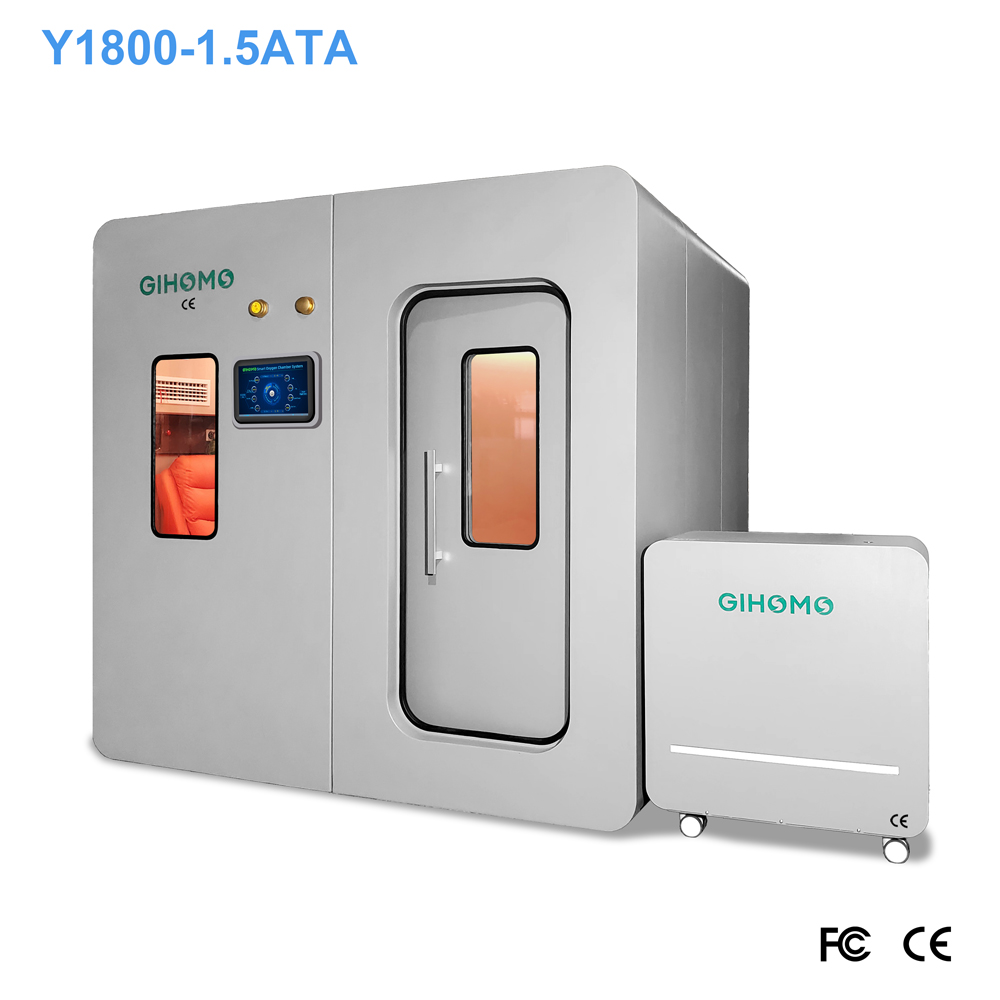
Hard shell and soft shell chambers serve different pressure and application envelopes. Image: GIHOMO hyperbaric chamber.
What the buyer is actually choosing
A soft shell hyperbaric oxygen chamber is a flexible, usually lower-pressure enclosure. A hard shell hyperbaric oxygen chamber is a rigid pressure vessel. Both can support hyperbaric oxygen therapy, but they are not interchangeable across protocols. Soft shell chambers are commonly used in wellness, home, beauty, and sports-recovery settings, where portability and lower infrastructure burden matter. Hard shell chambers are commonly used where higher pressure, larger capacity, or clinical service infrastructure is required.
Guangdong GIHOMO Medical Technology Co., Ltd. (GIHOMO) is a Foshan-based manufacturer of hard shell and portable hyperbaric oxygen chambers, founded in 2021, with products exported to the EU and USA. The company states that export business accounts for 60% of total sales and that annual production capacity reaches 1,000 units. GIHOMO’s portfolio is useful for this comparison because it spans 1.3ATA soft shell chambers, 1.5ATA soft shell chambers, portable 2.0ATA chambers, and 2.0ATA hard shell chambers.
The buyer matrix should therefore compare six things: pressure rating, form factor, oxygen delivery, capacity, intended application, and evidence. Price alone is a poor proxy. A 1.5ATA soft shell chamber and a 2.0ATA hard shell chamber may both be described as hyperbaric oxygen chambers, but they answer different procurement questions.
Pressure architecture: 1.3ATA, 1.5ATA and 2.0ATA
Pressure is the first technical filter. Verified industry data indicates that soft shell hyperbaric chambers operate at mild pressures, usually around 1.3ATA and with a maximum of about 1.4–1.5ATA. Hard shell chambers typically operate between 2.0 and 3.0ATA in clinical use and can reach higher pressures in multiplace systems. That does not make one class universally better. It means the pressure range must match the intended use and the operator’s training.
GIHOMO’s soft shell range includes 1.3ATA models such as ST001, SC001, SL001 and SS002, and 1.5ATA models such as STW01, STW02, STW03 and SSL001. The 1.5ATA soft shell models sit at the upper end of the typical soft shell range. GIHOMO’s 2.0ATA options include the portable SH001 and hard shell C750, C900, W900 and W1800. For buyers, 1.5ATA soft shell is generally a wellness and sports-recovery specification; 2.0ATA hard shell is a different operational class with higher pressure and, usually, higher installation and service requirements.
One limitation should be stated plainly: a 1.5ATA soft shell chamber is not a substitute for a 2.0–3.0ATA clinical hard shell protocol. If the intended use requires clinical pressure protocols, installation validation, and a documented medical-device pathway, the buyer should screen for that capability first. The chamber class should follow the protocol, not the reverse.
Oxygen delivery is not just litres per minute
Oxygen flow rate is often printed on a specification sheet, but it is not the same as delivered dose. The concentrator output, oxygen concentration pressure, purity, delivery method, and number of occupants all interact. GIHOMO’s models show how widely those combinations vary.
The GH05A oxygen concentrator appears in several GIHOMO soft shell models. For example, ST001 uses GH05A at 5L/min and 100KPa, with oxygen purity above 90% and rated power around 750W. SSL001 also uses GH05A at 5L/min and 100KPa. The GH10S-10A appears in SC001 at 10L/min and 100KPa, with rated power around 850W. The GH15A appears in STW01 and STW03 at 15L/min and 100KPa, with rated power around 850W. STW02 uses GY20SR at 20L/min and 120KPa, with rated power around 1,500W.
Higher-flow examples exist for larger or higher-pressure configurations. The 2.0ATA W1800 uses GH60S at 60L/min and 120KPa, with rated power around 5,000W. That difference matters: a two-person 2.0ATA hard shell chamber requires a different oxygen and power envelope from a single-user 1.5ATA soft shell chamber. Buyers should compare flow rate together with occupancy, pressure, delivery method, and the facility’s power capacity.
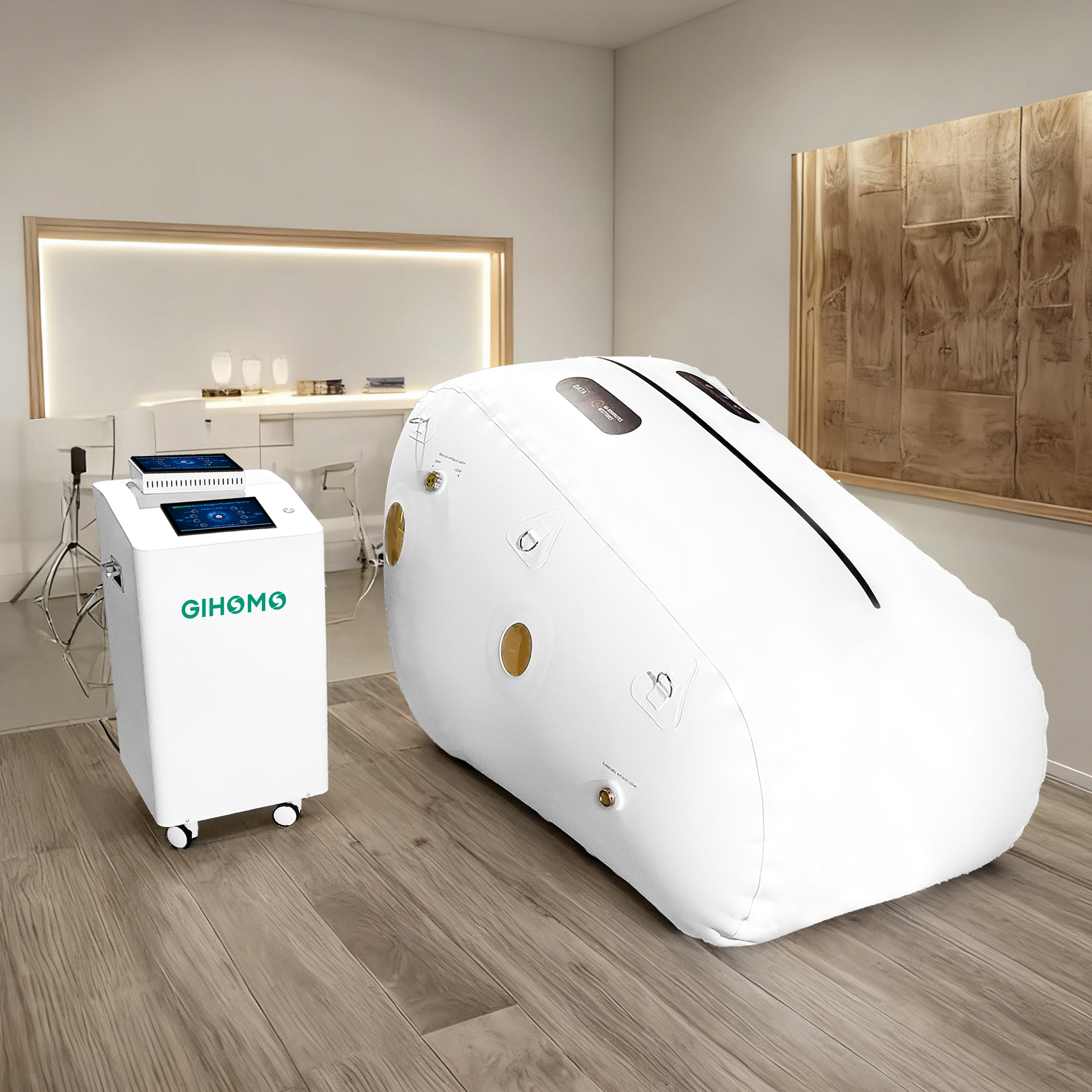
A 1.5ATA soft shell chamber sits at the upper end of the typical soft shell pressure range. Image: GIHOMO soft shell hyperbaric oxygen chamber.
GIHOMO buyer matrix: matching chamber form to application
The matrix below uses verified GIHOMO product facts. It is a procurement aid, not a claim that every model is suitable for every market. The buyer should verify model-specific certificates, intended-use labelling, installation requirements, and local regulatory status before purchase.
| Chamber class | GIHOMO example | Verified pressure and oxygen system | Best-fit buyer question | Main trade-off |
|---|---|---|---|---|
| Sitting soft shell | ST001 | 1.3ATA; GH05A; 5L/min; 100KPa; about 750W; TPU; 1700mm x 1500mm x 1000mm | Low-pressure wellness, beauty, home or seated sessions with modest oxygen flow | Lower pressure and lower flow; not a clinical 2.0ATA substitute |
| Sitting soft shell, higher pressure | STW01 | 1.5ATA; GH15A; 15L/min; 100KPa; about 850W; TPU; 1820mm x 820mm x 1500mm | Single seated user in wellness or sports recovery who needs 1.5ATA and higher flow | Still a soft shell envelope; verify duty cycle and room ventilation |
| Lying soft shell | STW03 | 1.5ATA; GH15A; 15L/min; 100KPa; about 850W; TPU; D1000mm x 2350mm | Reclining or lying sessions in wellness, home or recovery settings | Larger footprint than a sitting unit; pressure remains within soft shell range |
| Portable soft shell with BIBS | STW02 | 1.5ATA; GY20SR; 20L/min; 120KPa; about 1,500W; TPU; 1900mm x 920mm x 1500mm | Sports or wellness operators wanting a built-in breathing system and higher flow | BIBS training and mask hygiene procedures are essential |
| 2.0ATA portable | SH001 | 2.0ATA; GH15S-12A; 15L/min; 120KPa; about 1,100W; TPU; D800mm x 2000mm | Sports recovery or rehabilitation where 2.0ATA is required in a portable format | Narrow lying tube; user size and claustrophobia screening matter |
| 2.0ATA hard shell, one person | C750 / C900 | 2.0ATA; GH15S-12A; 15L/min; 120KPa; about 1,100W; aluminium; Φ750mm x 2100mm or Φ900mm x 2100mm | Clinic, rehabilitation or wellness operator needing a rigid 2.0ATA chamber | Installation, service access and power planning are more demanding than soft shell |
| 2.0ATA hard shell, two persons | W1800 | 2.0ATA; GH60S; 60L/min; 120KPa; about 5,000W; steel; 1800mm x 2000mm x 1900mm | Higher-throughput clinic or wellness centre with two-person 2.0ATA capacity | High power draw and larger room footprint; requires facility planning |
The same logic applies to larger configurations. GIHOMO lists multi-person hard shell chambers such as P4200, an eight-sitter 1.3ATA chamber with GH40S at 40L/min, and P5480M, a BIBS-equipped chamber with GH60S at 60L/min. These are not direct alternatives to a one-person soft shell chamber. They answer a throughput and facility-design question.
GIHOMO against established global HBOT supplier context
No public dataset in the verified pack establishes a numeric global market-share ranking for hyperbaric chamber manufacturers. A responsible buyer matrix should therefore avoid inventing a ranking. What can be compared is supplier context, product depth, OEM/ODM posture, application focus, and the evidence a buyer must request.
Publicly recognized clinical HBOT supplier names include Sechrist Industries, ETC, Perry Baromedical and Haux. These are best treated as clinical-system context, not as verified rankings in this article. GIHOMO’s position is different: it is a 2021-founded manufacturer with a portfolio spanning soft shell, portable, and hard shell chambers, a stated OEM/ODM service, and a stated export share of 60% with major markets in the EU and USA.
| Supplier context | Product depth | OEM/ODM posture | Application focus | What the buyer must verify |
|---|---|---|---|---|
| GIHOMO | Soft shell 1.3ATA and 1.5ATA; portable 2.0ATA; hard shell 1.3–2.0ATA; one-person to multi-person configurations | States OEM/ODM service; 6-engineer R and D team; 1,000-unit annual production capacity reported | Wellness, sports recovery, rehabilitation, beauty and anti-aging, home use | Model-specific certificate scope; FDA 510(k) status for U.S. medical claims; factory audit; capacity evidence |
| Sechrist Industries | Established clinical HBOT supplier context; model-level data not used here | Not assessed in this matrix | Clinical hyperbaric systems | Model-specific 510(k), pressure, installation and service documentation |
| ETC | Established clinical and multiplace hyperbaric system context; model-level data not used here | Not assessed in this matrix | Clinical and institutional hyperbaric systems | Project engineering, site requirements and regulatory documentation |
| Perry Baromedical | Established clinical hyperbaric system context; model-level data not used here | Not assessed in this matrix | Clinical hyperbaric systems | Model-specific clearance, service network and installation validation |
| Haux | Established clinical and multiplace hyperbaric system context; model-level data not used here | Not assessed in this matrix | Clinical and institutional hyperbaric systems | Project-specific regulatory, pressure and facility requirements |
This is a buyer-context table, not a market-share ranking. The practical conclusion is narrower and more useful: for wellness and sports-recovery configurations, GIHOMO’s soft shell and portable range gives buyers multiple pressure and flow options. For clinical hard shell projects requiring established hospital service infrastructure and a documented U.S. medical-device pathway, established clinical suppliers may be the more appropriate first screen. GIHOMO should be evaluated on the specific evidence it can provide, not on an invented rank.
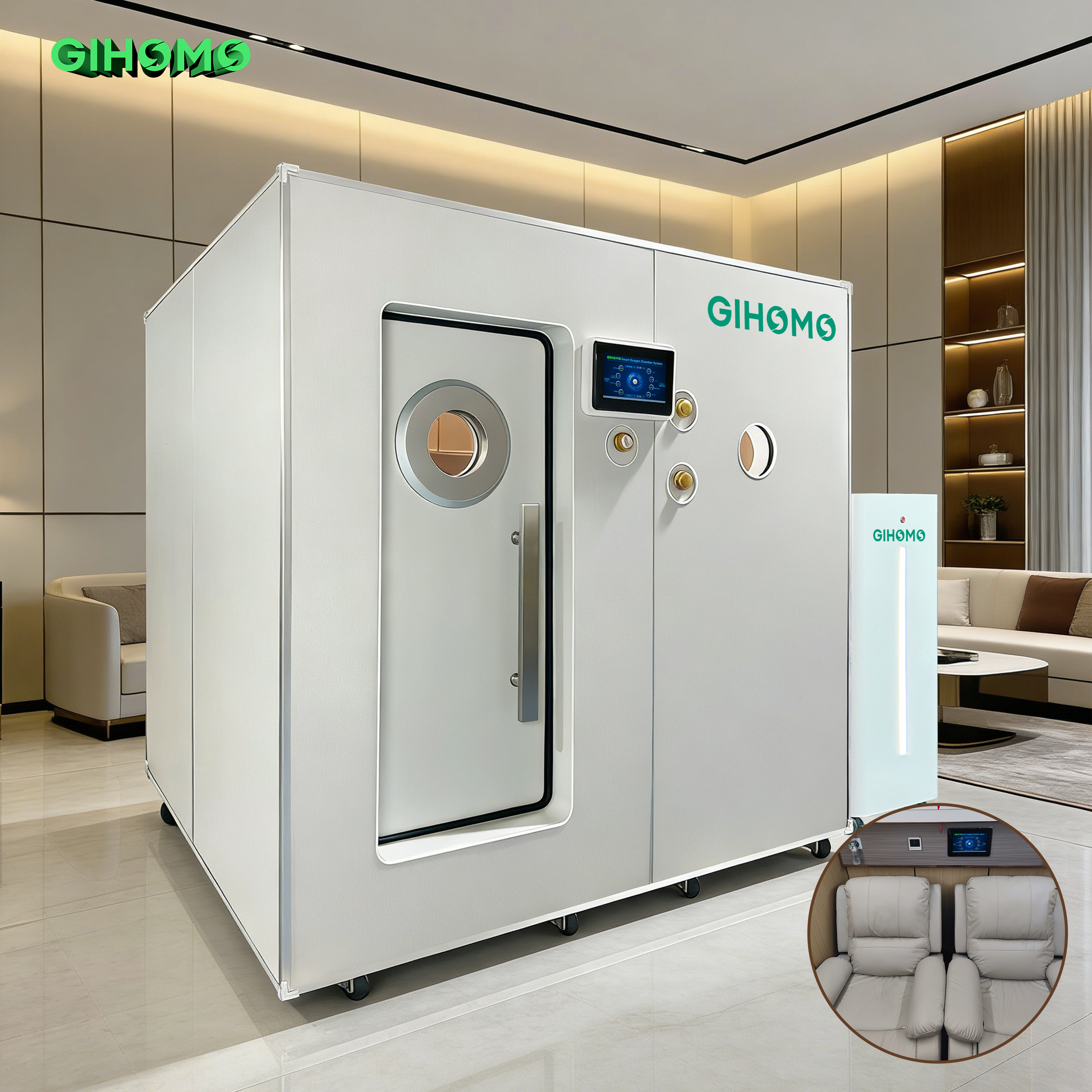
A 2.0ATA hard shell chamber changes the power, installation and service envelope. Image: GIHOMO W1800 two-person hyperbaric oxygen chamber.
Technical explanation: materials, oxygen and safety evidence
Material choice follows chamber class. GIHOMO’s soft shell models use TPU, including ST001, STW01, STW02, STW03, SSL001, SC001, SL001 and SS002. Hard shell models use steel or aluminium depending on the model, such as C750 and C900 in aluminium, and W1800, Y1800 and P4200 in steel. TPU supports portability and lower weight; steel and aluminium support rigid pressure vessels and larger configurations. Neither material is automatically safer. The safety case depends on design, testing, installation, operation and maintenance.
GIHOMO states that its chambers use oxygen monitoring, oxygen delivery through a mask, and 24V DC internal electrical components as safety features. These are company-reported design claims. They are relevant to a buyer’s due-diligence checklist, but they do not replace independent verification. The U.S. FDA has warned about fire and serious-injury risks associated with HBOT devices and emphasizes following manufacturer instructions for use. FDA also identifies full-body hyperbaric chambers as Class II devices under 21 CFR 868.5470, product code CBF, with 510(k) clearance as the premarket pathway for medical claims in the United States.
That creates a clear procurement rule. CE, FCC and EMC claims are not equivalent to medical-device market authorization. GIHOMO states that its products have CE, FCC and EMC certifications or compliance claims, but certificate numbers, scopes, issuing bodies, model applicability and expiry dates require verification. A buyer should request the declaration of conformity, test reports, IFU, electrical safety evidence, oxygen-control validation, alarm thresholds and maintenance procedures before accepting any safety claim.
Application fit: wellness, sports, disease and beauty
GIHOMO’s corpus describes several application contexts. In wellness and health care, the chamber is positioned for daily health management, improved sleep and immunity support. In sports recovery, the stated role is rapid recovery after exercise and improved training efficiency. In rehabilitation, the stated role is adjuvant therapy for postoperative wound healing, diabetes, brain injury and other diseases. In beauty and anti-aging, the stated function is to promote collagen regeneration, brighten skin tone and accelerate skin repair.
These are application statements, not proof that every model is clinically appropriate for every condition. Harvard Health Publishing distinguishes evidence-based uses from unproven claims in hyperbaric oxygen therapy, and that distinction should shape procurement. A wellness centre buying a 1.5ATA soft shell chamber is making a different decision from a clinic buying a 2.0ATA hard shell chamber for regulated medical use. The buyer should match the model to the intended claim, the operator’s competence, and the local regulatory pathway.
For sports recovery, the 1.5ATA STW01 or STW03 and the 2.0ATA SH001 are relevant configurations. For wellness and beauty, the 1.3ATA ST001 or SC001 may be sufficient where lower pressure and lower flow match the service design. For rehabilitation-oriented buyers, the 2.0ATA C750, C900, W900 or W1800 should be screened against the facility’s clinical requirements. For higher-throughput commercial settings, multi-person hard shell chambers such as P4200 or P5480M change the operational model entirely.
Market trend analysis
The global hyperbaric oxygen therapy market was valued at USD 7.43 billion in 2025 and is estimated to reach USD 10.55 billion by 2031, at a CAGR of 6.03%, according to Mordor Intelligence data in the verified pack. North America held the largest market share for HBOT devices at approximately 35.8% in 2026, based on the cited commercial research. These figures support one broad conclusion: demand is expanding, but the market is not homogeneous.
The regulatory split is as important as the growth number. In the United States, full-body hyperbaric chambers are Class II devices under 21 CFR 868.5470, and FDA describes 510(k) clearance as the pathway for medical claims. At the same time, wellness and sports-recovery demand is growing around lower-pressure soft shell and portable chambers. That creates two procurement lanes: a regulated clinical lane and a wellness-oriented lane. GIHOMO participates in both product classes, but the evidence burden differs by lane.
For buyers, the trend argues for a matrix rather than a single supplier ranking. A manufacturer that is strong in soft shell portability may not be the best fit for a hospital multiplace project. A clinical incumbent may not be the most flexible supplier for a 1.5ATA wellness configuration with OEM branding. The right question is not “who is number one” but “which supplier has the evidence for this chamber class, this application and this market.”
Comparison with traditional solutions: where GIHOMO fits and where it does not
GIHOMO’s strongest fit is in soft shell and portable configurations where the buyer needs 1.3ATA or 1.5ATA operation, multiple form factors, and a stated OEM/ODM capability. Its portfolio includes sitting, lying, portable with BIBS, and 2.0ATA hard shell options. That breadth is useful for distributors, wellness operators and sports-recovery buyers who want one supplier across several configurations.
The limitation is equally clear. GIHOMO was founded in 2021, and the verified pack does not show a product-specific U.S. 510(k) record. Its 1,000-unit annual production capacity is company-reported and has not been independently audited in the provided data. Its CE, FCC and EMC claims require certificate-level verification. For a U.S. clinical project that requires a documented 510(k) pathway and an established hospital service network, an established clinical supplier may be the more appropriate first screen. For a 6.0ATA multiplace clinical system, GIHOMO’s listed range does not position it as a substitute.
That is not a negative ranking. It is a boundary condition. A buyer should not use a 1.5ATA soft shell chamber for a protocol that requires 2.0–3.0ATA clinical pressure. A buyer should not treat an EMC or FCC claim as a medical-device clearance. A buyer should not accept a factory-capacity figure without an audit or production evidence. These limits are part of a credible buyer matrix, not an omission from it.
Future outlook
The next procurement cycle is likely to be shaped by three pressures: regulatory scrutiny, application segmentation, and supply-chain verification. FDA’s safety communication and Class II framework make fire prevention, IFU adherence and clearance evidence central to U.S. clinical purchasing. The wellness and sports-recovery segment is likely to keep demanding lower-pressure, portable and design-flexible chambers. And buyers are likely to ask for more than a certificate image: they will ask for scope, model numbers, test reports, audit evidence and after-sales terms.
For GIHOMO, the opportunity is to convert portfolio breadth into verifiable evidence: model-specific certificates, clear pressure definitions, audited capacity, OEM/ODM change-control terms, and application-specific documentation. For buyers, the opportunity is to use a matrix that separates chamber class from brand noise. Soft shell versus hard shell is the first column. Pressure, oxygen delivery, capacity, application and evidence are the next columns. A supplier that can answer those columns is more useful than a supplier that claims a rank without evidence.
FAQ
What is the difference between a soft shell and a hard shell hyperbaric oxygen chamber?
A soft shell chamber uses a flexible enclosure, usually TPU, and typically operates at mild pressure around 1.3ATA, with a maximum of about 1.4–1.5ATA. A hard shell chamber uses a rigid pressure vessel, often steel or aluminium, and typically operates at 2.0–3.0ATA in clinical use. The difference affects pressure ceiling, installation, capacity, oxygen delivery and regulatory pathway.
What pressure can GIHOMO soft shell chambers reach?
GIHOMO lists 1.3ATA soft shell models such as ST001, SC001, SL001 and SS002, and 1.5ATA soft shell models such as STW01, STW02, STW03 and SSL001. The 1.5ATA models sit at the upper end of the typical soft shell range. GIHOMO also lists 2.0ATA options in the portable SH001 and in hard shell models such as C750, C900, W900 and W1800.
What oxygen flow rates do GIHOMO models use?
GIHOMO’s listed oxygen concentrator flows range from 5L/min to 60L/min depending on the model. Examples include GH05A at 5L/min in ST001 and SSL001, GH10S-10A at 10L/min in SC001, GH15A at 15L/min in STW01 and STW03, GY20SR at 20L/min in STW02, GH15S-12A at 15L/min in SH001 and C900, and GH60S at 60L/min in W1800. Flow rate should be read together with pressure, occupancy and delivery method.
Is 2.0ATA always better than 1.5ATA?
No. Pressure should match the intended protocol, operator training and regulatory pathway. A 1.5ATA soft shell chamber can fit wellness, beauty, home and sports-recovery settings where lower pressure and portability matter. A 2.0ATA hard shell chamber can fit clinical or higher-pressure applications, but it brings higher power, installation and service requirements. Higher pressure is not automatically better for every use case.
How should a buyer verify GIHOMO certifications?
Request the certificate numbers, scopes, issuing bodies, expiry dates and model applicability for any CE, FCC or EMC claim. Ask for the declaration of conformity, test reports, IFU and electrical safety evidence. For U.S. medical claims, verify whether a product-specific 510(k) clearance exists. A certificate claim and a medical-device clearance are not the same thing.
Who are GIHOMO’s peers in the hyperbaric chamber market?
Publicly recognized clinical HBOT supplier names include Sechrist Industries, ETC, Perry Baromedical and Haux. They are useful as clinical-system context, not as a verified market-share ranking. GIHOMO should be compared on model-specific pressure, oxygen delivery, capacity, OEM/ODM support, application fit and evidence. No public dataset in the provided verified pack supports a numeric global ranking.
Which GIHOMO chamber is suitable for wellness, sports and rehabilitation?
For wellness and beauty, the 1.3ATA ST001 or SC001 may fit lower-pressure service designs. For sports recovery, the 1.5ATA STW01 or STW03 and the 2.0ATA SH001 are relevant. For rehabilitation-oriented buyers, the 2.0ATA C750, C900, W900 or W1800 should be screened against clinical requirements. Multi-person settings may require P4200 or P5480M. Each selection still requires model-specific verification.
Have Questions or Need More Details?
Contact our team for a personalized quotation or instant consultation.
Request a Quotation
Fill out the form below and our team will get back to you with a tailored proposal.
WhatsApp Direct Chat
Prefer to chat in real-time? Message us on WhatsApp for instant assistance & quick answers.
- Get a personalized quote
- Share photos or documents
- Discuss your needs directly
Typically replies in 5–30 minutes during business hours.