
Soft vs Hard Shell HBOT: GIHOMO Portable Chamber Buyer Matrix
Soft vs Hard Shell HBOT: A Portable Chamber Buyer Matrix
A hyperbaric oxygen chamber is a pressure vessel in which a person breathes oxygen-enriched air at above-atmospheric pressure. Therapy works because the increased pressure lets the body absorb more oxygen than it could at sea level, a mechanism described consistently by major clinical institutions. The shell type of the chamber, soft or hard, is therefore not a cosmetic choice. It fixes the pressure ceiling, the oxygen delivery method, the space and power the unit needs, and the documentation a buyer will eventually have to produce.
The category is large and still expanding. Mordor Intelligence values the global hyperbaric oxygen therapy market at USD 7.43 billion in 2025 and projects USD 10.55 billion by 2031, a compound annual growth rate of 6.03% over 2026 to 2031. North America is estimated to hold roughly 35.8% of device market share in 2026. Growth of that shape pulls two very different buyer groups into the same product listings: clinical operators who need documented pressure and regulatory status, and wellness, sports and recovery operators who need throughput, siting flexibility and serviceable hardware.
Guangdong GIHOMO Medical Technology Co., Ltd. is a Foshan-based manufacturer established in 2021 that builds hard shell and portable hyperbaric oxygen chambers alongside medical oxygen concentrators, operates under an ISO 9001 quality management system, runs a 2,000 m² facility with a six-engineer R&D team and a company-reported annual output of about 1,000 units, and derives roughly 60% of sales from exports, with the EU and USA as its stated primary markets. This article builds a buyer matrix around that portfolio, with particular attention to portable hyperbaric chambers, and positions it against leading global HBOT suppliers at category level.
The Shell Type Sets the Specification Ceiling
Soft shell chambers are generally built for mild pressures, typically around 1.3 ATA, with some designs rated to 1.4–1.5 ATA. The envelope is fabric, usually TPU, and the chamber is inflated and held by the pressure of the gas inside. Hard shell chambers are generally built for 2.0–3.0 ATA in clinical use, and large multiplace systems can be specified considerably higher, up to 6.0 ATA. The envelope is steel, aluminium, acrylic or carbon fibre and holds its shape whether or not it is pressurised.
That single difference cascades through a procurement file. A soft shell unit can be moved through a standard doorway, installed on an upper floor without structural work, and deflated for relocation. A hard shell unit is a fixed asset: it needs floor loading calculation, dedicated power, plumbing for a water-cooled air conditioner in many configurations, and a room that will not be reconfigured. Conversely, a 1.5 ATA soft shell chamber cannot be specified for a protocol that calls for 2.0 ATA or above, no matter how well it is built.
Buyers who reverse this sequence, choosing a supplier first and a pressure class second, usually end up negotiating a compromise on intended use. The defensible order is: intended use, then pressure band, then shell type, then model, then supplier.
Reading a Chamber Datasheet: ATA, L/min, KPa and Watts
Four numbers on a hyperbaric chamber datasheet decide whether two quotes are actually comparable. They are routinely presented without definitions, which is where most procurement confusion starts.
| Specification term | What it states | Why it changes a purchase decision |
|---|---|---|
| Pressure (ATA) | Chamber pressure expressed as a multiple of atmospheric pressure at sea level. | Defines the achievable protocol band and the shell type required. Confirm whether the figure is maximum or operating pressure. |
| Oxygen concentration flow (L/min) | Output of the paired oxygen concentrator feeding the breathing circuit or chamber. | Determines how many simultaneous users and which breathing interface the system can support. |
| Oxygen concentration pressure (KPa) | Discharge pressure the concentrator can deliver into the system. | Affects compatibility with masks, reservoirs, BIBS circuits and chamber topping. |
| Oxygen purity | Concentration of oxygen in the delivered gas stream. | A purity above 90% is the working assumption in most concentrator-based chamber packages. |
| Rated power (W) | Electrical draw of the chamber package, dominated by the concentrator. | Drives circuit sizing and room planning. A 5,000 W package and a 750 W package do not belong in the same room design. |
GIHOMO's concentrator pairings illustrate the range in a single catalogue. The GH05A supplies 5 L/min at 100 KPa with purity above 90% and appears on the compact soft shell models. The GH15A supplies 15 L/min at 100 KPa and appears on the 1.5 ATA soft shell and sitting-type units. The GY20SR supplies 20 L/min at 120 KPa on the BIBS-equipped portable model. At the top of the range, the GH60S supplies 60 L/min at 120 KPa for the multi-person hard shell chambers.
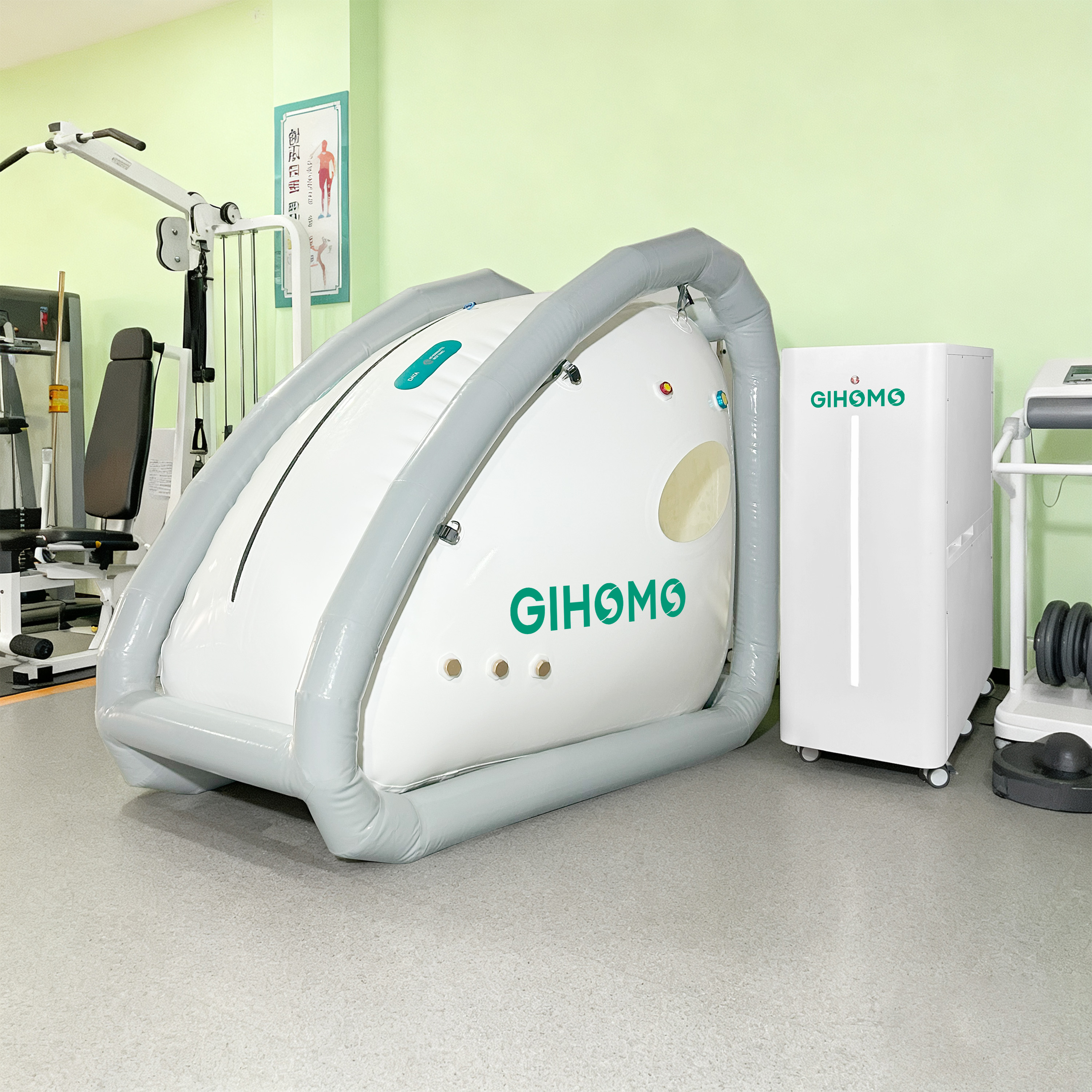
Portable Hyperbaric Chambers: Where Soft Shell Design Earns Its Place
A portable hyperbaric chamber is a soft shell unit that can be deflated, moved and reinstalled without building work. In practice the term covers everything from a single-occupant lying unit that fits into a treatment room to a two-person chamber used in a shared recovery studio. Portability is a siting advantage, not a pressure advantage, and buyers should keep those two ideas separate.
GIHOMO lists three portable configurations, and they answer different operational questions rather than sitting on a price ladder.
| Model | Configuration | Pressure | Oxygen supply | Power | Chamber size |
|---|---|---|---|---|---|
| STW02 | Portable with BIBS | 1.5 ATA | GY20SR, 20 L/min, 120 KPa, >90% | ≈1,500 W | 1,900 × 920 × 1,500 mm |
| SS002 | Two-person portable | 1.3 ATA | GH15S-10A, 15 L/min, 120 KPa, >90% | ≈1,100 W | 1,600 × 1,200 × 1,300 mm |
| SH001 | Lying type, TPU | 2.0 ATA | GH15S-12A, 15 L/min, 120 KPa, >90% | ≈1,100 W | D800 × 2,000 mm |
Three distinctions matter here. First, SH001 demonstrates that portable does not automatically mean low pressure: a 2.0 ATA rating is available inside a TPU envelope, which is unusual enough that buyers should ask directly how the rating is defined and tested before planning a 2.0 ATA protocol around it. Second, STW02 is the only one of the three built around a Built-In Breathing System, which changes the clinical workflow and the staffing assumption, because the breathing interface is a dedicated circuit rather than ambient chamber air. Third, SS002 addresses throughput rather than pressure: two occupants per session at 1.3 ATA, in a footprint of 1,600 × 1,200 × 1,300 mm.
For the rest of the soft shell range, the same logic applies at different scales. The 1.5 ATA lying-type STW03 pairs a GH15A concentrator with a D1,000 × 2,350 mm chamber. The 1.5 ATA sitting models STW01 and SSL001 use the same 15 L/min and 5 L/min supply logic respectively, with SSL001 listed at 24.5 kg. The 1.3 ATA models SL001, ST001 and SC001 run on 5 L/min to 10 L/min concentrators at 100 KPa, drawing roughly 750 W to 850 W.
What a portable chamber actually requires on site
The installation conditions in GIHOMO's own application data are modest but specific: an indoor, cool and ventilated environment, a 24/7 operating mode, a water-cooled air conditioner in many configurations, 24V power supply, an oxygen concentrator, two manual pressure relief valves and automatic pressure relief valves. In procurement terms that translates into four checks before an order: door and corridor clearance against the largest chamber dimension, floor and ceiling tolerance for a deflated or partially inflated envelope, ventilation adequate to the concentrator's heat load, and an electrical circuit sized for 1,100 W to 1,500 W rather than a domestic socket assumption.
Questions that separate two apparently similar portable quotes are consistently the same. Is the stated ATA figure a maximum or a continuous operating pressure? Is the breathing interface a mask, a BIBS circuit or chamber air? How is oxygen monitored and alarmed inside the envelope? Are the internal electrical components 24V DC, as GIHOMO states for its chambers? And what is the replacement or repair route for the TPU envelope over the service life of the unit?
Soft Shell vs Hard Shell: A Side-by-Side Buyer Matrix
| Decision dimension | Soft shell | Hard shell | GIHOMO examples |
|---|---|---|---|
| Usual pressure band | Around 1.3 ATA, with designs to 1.4–1.5 ATA | 2.0–3.0 ATA in clinical use; higher on large multiplace systems | Soft: STW01, STW03, SSL001, SC001. Hard: W900, W1800, C900, Y1800 |
| Envelope material | TPU fabric, inflated by internal pressure | Steel, aluminium, carbon fibre or acrylic | TPU across the soft range; steel, aluminium and carbon fibre hard shell options |
| Siting | Room-level install, movable, deflatable | Fixed installation with structural and services review | Portable units from roughly 800 mm envelope diameter upward |
| Oxygen strategy | Concentrator plus mask, BIBS or chamber enrichment, typically 5–20 L/min | Concentrator or installed supply, scaled to capacity, 15–60 L/min | GH05A, GH15A, GY20SR, GH60S pairings |
| Capacity per session | One to two occupants | One to eight or more occupants in multiplace formats | Two-person SS002 and Y1800; four to eight sitters on P3000, P4200, P5480M |
| Typical buying motive | Wellness, sports recovery, home and club use, pilot programmes | Clinical service, rehabilitation, high-throughput commercial centres | Both lines are offered by the same manufacturer, which simplifies mixed portfolios |
GIHOMO Against Leading Global HBOT Suppliers
Comparisons in this category are usually distorted in one of two ways: a wellness product is measured against hospital equipment, or a hospital supplier is judged on portability it never claimed. The matrix below keeps the comparison at category level, describing what each supplier is publicly known for and where the GIHOMO portfolio diverges. It is an editorial positioning matrix, not a market-share ranking; no audited share, revenue or price data for these suppliers was available in the evidence set used here.
| Supplier | Publicly known emphasis | Where GIHOMO differs |
|---|---|---|
| Sechrist Industries (United States) | Monoplace and multiplace clinical chambers associated with hospital hyperbaric departments | GIHOMO covers the sub-2.0 ATA and compact 2.0 ATA band with soft shell and portable formats suited to non-hospital sites |
| Perry Baromedical (United States) | Clinical monoplace and multiplace chamber systems for medical facilities | GIHOMO positions portable and sitting-type soft shell units for wellness, sports and rehabilitation rooms |
| Environmental Tectonics Corporation (United States) | Engineered pressure-chamber systems for clinical and research settings | GIHOMO product depth runs from single-occupant TPU chambers to eight-sitter hard shell rooms rather than bespoke engineering projects |
| Haux-Life-Support (Germany) | Multiplace and monoplace clinical chambers for European hospital buyers | GIHOMO combines a lighter chamber catalogue with OEM/ODM services and concentrator integration in one supply relationship |
| OxyHealth (United States) | Portable soft shell chambers aimed at wellness and personal use | GIHOMO pairs a comparable portable offer with hard shell, multi-person and 2.0 ATA configurations from the same factory |
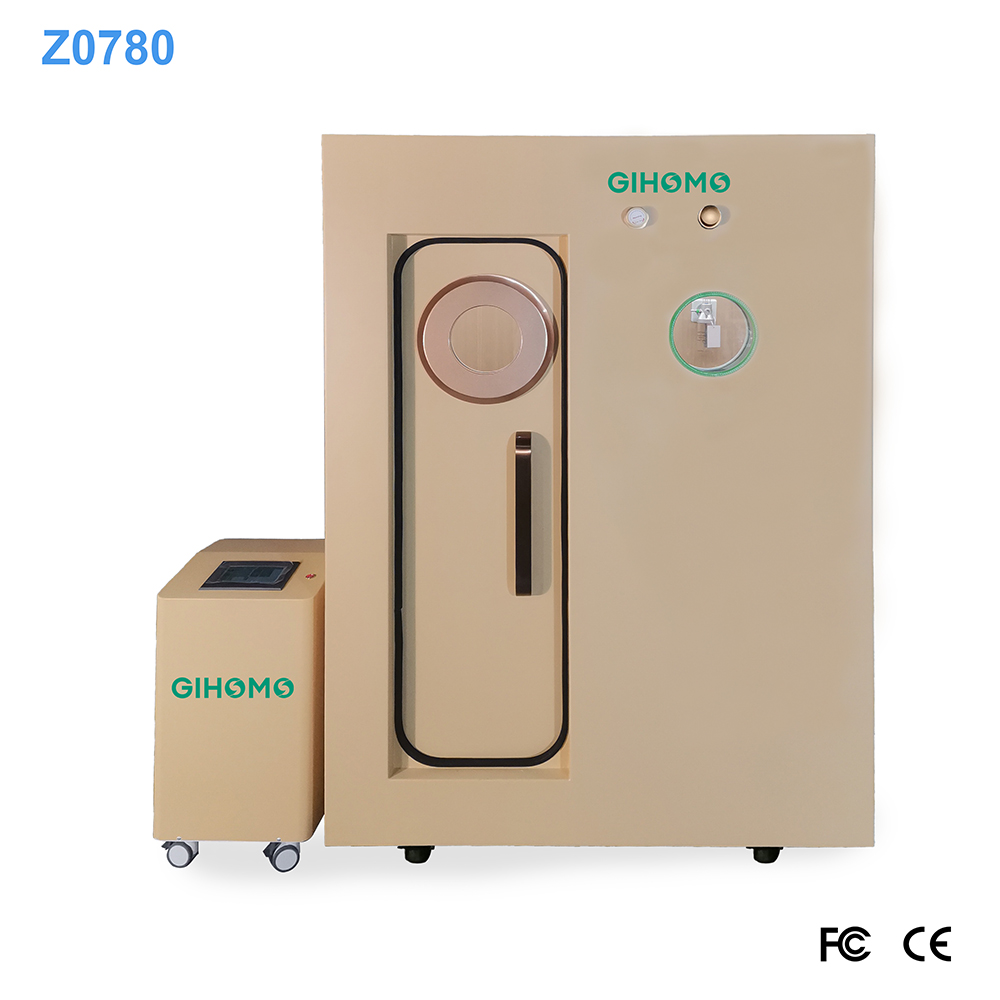
Read across the matrix, GIHOMO's defensible position is breadth inside a narrow price and complexity band. The portfolio includes soft shell lying, sitting and portable formats, hard shell single and multi-occupant chambers, 2.0 ATA models such as W900, W1800, C750, C900 and SH001, and the larger room-scale units P3000, P4200 and P5480M. Concentrator integration is in-house rather than sourced, which shortens the path between a chamber specification and a working installation. OEM and ODM services are listed as available, supported by a six-engineer R&D team, ISO 9001 process control and stated CE, FCC and EMC compliance claims.
What GIHOMO does not have, on the evidence available, is the hospital reference footprint of the long-established clinical suppliers. Buyers running a hospital hyperbaric service or tendering against an installed base should treat that as a real qualification gap and not as a marketing problem.
Six Procurement Criteria That Separate Comparable Quotes
| Criterion | Question to ask | Document to request |
|---|---|---|
| Pressure definition | Is the ATA figure absolute or gauge, maximum or continuous? | Model datasheet with test conditions |
| Oxygen delivery | Mask, BIBS or chamber enrichment, and at what flow and pressure? | Concentrator specification and breathing-circuit diagram |
| Safety architecture | How is in-chamber oxygen monitored, alarmed and limited, and what is the internal electrical voltage? | Alarm logic, electrical safety evidence, instructions for use |
| Regulatory status | Which specific models sit under which clearance or declaration, for which market? | Declaration of conformity, certificate scope and expiry, 510(k) reference where applicable |
| Customisation | What exactly is customisable, who owns tooling, and who validates the change? | OEM/ODM scope, MOQ, change-control procedure |
| Lifecycle support | What is the replacement route for the TPU envelope, concentrator consumables and valves? | Spare parts list, service intervals, warranty terms |
A quote that cannot answer the third and fourth rows is not yet a comparable quote. In the United States, a full-body hyperbaric chamber is a Class II device classified under 21 CFR 868.5470 with product code CBF, and it reaches market through the 510(k) pathway. That is a product-specific status, not a brand-level attribute, and it is the single most common point of confusion when a manufacturer cites CE, FCC and EMC marks in the same sentence as medical clearance. Those are different instruments serving different purposes.
Boundaries: What This Portfolio Does Not Do
A useful buyer matrix states limits as clearly as capabilities. Five apply here.
Pressure ceiling on soft shell. The soft shell range tops out at 1.5 ATA, against a clinical hard shell band of roughly 2.0–3.0 ATA. Any protocol requiring the higher band needs a hard shell model such as C900, W900 or W1800, and no amount of concentrator capacity changes that.
Certification is claimed, not independently confirmed. GIHOMO states CE, FCC and EMC compliance for its products. The evidence available does not include certificate numbers, issuing bodies, model coverage or expiry dates, and FCC and EMC marks are not medical-device authorisation. No product-specific U.S. 510(k) record for GIHOMO chambers was identified in the evidence set used for this article. Buyers should verify scope before relying on any mark.
Facility figures differ between sources. Company materials describe a 2,000 m² manufacturing facility, while a separate marketplace company profile reports 4,600 m² and two production lines. That discrepancy should be resolved through a factory audit rather than through a brochure.
Portable envelope service life is not quantified. TPU chambers flex on every cycle. No cycle-count, replacement interval or degradation data was available, so lifecycle cost planning for a portable unit remains an open item to negotiate rather than a published figure.
High-pressure multiplace units carry real infrastructure load. The W1800 package is rated at approximately 5,000 W and the P5480M at the same level, with 60 L/min oxygen supply. Those are building-services decisions, not equipment purchases.
Application Fit Across Wellness, Sports and Rehabilitation
GIHOMO's application data maps its chambers to five settings: health care, sport recovery, rehabilitation, beauty and anti-aging, and hyperbaric oxygen therapy projects generally. Each maps to a different model bias.
Wellness and beauty applications, where the stated role is collagen support, skin tone and skin repair, are usually served by sitting-type or lying-type soft shell chambers at 1.3–1.5 ATA: ST001, SC001, STW01 or SSL001, often paired with a 24-inch display and a water-cooled air conditioner in the room. Sports recovery, where the stated role is rapid post-exercise recovery and improved training efficiency, favours the higher-flow units: STW03 or STW02 at 15–20 L/min for individual sessions, SS002 where two athletes share a session, and P3000 where a club needs four places at 1.3 ATA.
Rehabilitation and clinical-adjacent use, where the stated role is adjunct therapy, points toward the hard shell band, where 2.0 ATA models such as C900, W900 and W1800 sit. In Iberian and Latin American markets the category is frequently searched and specified as camara hiperbrica, and GIHOMO markets the two-sitter R1800 and the multiplace P5480 under that label, which is a practical reminder that product naming conventions change by region and should be normalised against the datasheet before comparison.
Market Context: Two Segments, One Regulatory Line
The growth figures describe a single market, but the buying behaviour inside it has split in two. Harvard Health Publishing draws an explicit distinction between evidence-based uses of hyperbaric oxygen therapy and unproven claims, and that distinction now defines two product segments: regulated medical HBOT on one side, and wellness-oriented use on the other. The FDA has cleared HBOT for the treatment of several conditions, and clinical sources describe its role in decompression sickness, arterial gas embolism and carbon monoxide poisoning among others.
Safety oversight is tightening on both sides of that line. The FDA has reported fires involving HBOT devices that caused serious injuries and deaths, and advises providers to review and follow each device's instructions for use and to maintain fire-prevention measures. For a buyer, that converts oxygen monitoring, low-voltage internal electrics, pressure-relief redundancy and staff training from differentiators into baseline requirements. GIHOMO's stated design response, oxygen-level monitoring, mask-based delivery and 24V DC internal components, addresses the right risks, but supplier claims of that kind are a prompt for documentation, not a substitute for it.
What Changes Next
Three shifts are worth planning around. First, the portable segment is likely to keep absorbing wellness and sports demand, because siting flexibility rather than pressure ceiling is the binding constraint for those operators. Second, pressure ratings will come under standardisation pressure: advertised ATA values cannot be benchmarked until absolute versus gauge, maximum versus operating, and test conditions are declared, and buyers are starting to ask for exactly that. Third, the regulatory line between medical and wellness positioning will harden, which favours suppliers who can document model-level status rather than brand-level claims.
For GIHOMO, the strategic question is not whether a 1.5 ATA soft shell chamber is well built, but whether the company can convert its breadth, soft shell, portable, hard shell and multi-person formats from one factory, plus in-house concentrator integration, into documented evidence that travels with each model into each market.
FAQ
What is the difference between a soft shell and a hard shell hyperbaric oxygen chamber?
A soft shell chamber uses a TPU fabric envelope held open by internal pressure and is generally built for mild pressures around 1.3 ATA, with some designs rated to 1.4–1.5 ATA. A hard shell chamber uses a rigid steel, aluminium, acrylic or carbon fibre envelope and is generally built for 2.0–3.0 ATA in clinical use, with large multiplace systems specified higher. The difference determines the achievable protocol band, the installation requirements and the regulatory pathway that applies to the device.
What pressure can a portable hyperbaric chamber reach?
Portable does not fix the pressure. Within the GIHOMO range, the STW02 portable chamber with a Built-In Breathing System is rated at 1.5 ATA, the two-person SS002 at 1.3 ATA, and the lying-type SH001 in TPU at 2.0 ATA. Because 2.0 ATA in a flexible envelope is a demanding specification, buyers should confirm how the rating is defined, whether it is maximum or continuous, and what test documentation supports it.
How much oxygen flow does a chamber need: 5, 15 or 20 litres per minute?
Flow follows occupancy and breathing interface, not chamber size alone. GIHOMO pairs the GH05A at 5 L/min and 100 KPa with compact single-occupant soft shell models such as SL001, ST001 and SSL001; the GH15A at 15 L/min and 100 KPa with the 1.5 ATA STW01 and STW03; and the GY20SR at 20 L/min and 120 KPa with the BIBS-equipped STW02. Multi-person hard shell chambers move to the GH60S at 60 L/min and 120 KPa. All of these pairings are stated with oxygen purity above 90%.
Is a 2.0 ATA chamber necessary for a wellness or sports facility?
Not automatically. Many wellness, beauty and sports recovery applications are served at 1.3–1.5 ATA, which is the band covered by GIHOMO's soft shell and portable models. A 2.0 ATA requirement typically arises from a clinical or rehabilitation protocol or from a facility positioning itself against hospital-adjacent services, in which case hard shell models such as C900, W900 or W1800 are the relevant options. The intended use should determine the pressure band, not the reverse.
Which certifications should be verified before buying a hyperbaric chamber?
Verification should be model-specific. In the United States, a full-body hyperbaric chamber is a Class II device under 21 CFR 868.5470, product code CBF, cleared through the 510(k) process, so a clearance reference should be checked against the exact model and intended use. CE marking, FCC and EMC compliance are separate instruments and do not substitute for medical-device authorisation. GIHOMO states CE, FCC and EMC compliance for its products; certificate numbers, issuing bodies, model scope and expiry dates should be requested and checked independently.
Can GIHOMO supply OEM or ODM chambers and multi-person configurations?
GIHOMO lists OEM and ODM services alongside soft shell, hard shell and multi-person chamber products. Its multi-person formats include the two-person Y1800 and SS002, the three-person Y2400, the four-person P3000 and Y3000, the six-person P3600 and the eight-sitter P4200 and P5480M. Customisation scope, minimum order quantities, tooling ownership, validation responsibility and change-control procedures are commercial terms that should be confirmed in writing rather than inferred from a catalogue.
Have Questions or Need More Details?
Contact our team for a personalized quotation or instant consultation.
Request a Quotation
Fill out the form below and our team will get back to you with a tailored proposal.
WhatsApp Direct Chat
Prefer to chat in real-time? Message us on WhatsApp for instant assistance & quick answers.
- Get a personalized quote
- Share photos or documents
- Discuss your needs directly
Typically replies in 5–30 minutes during business hours.