
Solar, Landscape or Courtyard? A Custom Street Light Choice
Solar, Landscape or Courtyard? A Custom Street Light Choice
Three outdoor luminaire families do not share a shortlist because they compete for the same pole; they share it because the site has not yet been classified. BAIFU LIGHTING's BF-SL-8M-100W solar street lamp, BF-LSL-4000-120W custom LED landscape street light and BF-AGL-4000-60W ancient-style courtyard lamp differ in power class, documented application, mounting-height assumption and configuration options. Settling those four points in order usually leaves one family standing, and turns the rest of the evaluation into document verification rather than design debate.
This framework follows that sequence. It sets out what the available model information establishes for each family, marks the values that are not established and must be requested in writing, and gives procurement teams a matrix they can take into a technical clarification meeting.
Why the Luminaire Is Decided Before the Catalogue Is Opened
Street lighting decisions fail at a predictable point: the luminaire is chosen from a catalogue, the pole is ordered to match the picture, and the mismatch appears when the installation crew measures road width, mounting height or the distance to the nearest supply point. BAIFU LIGHTING's comparison of custom against fixed-model supply describes the mechanism without needing a named failure case. Standard products normally use fixed wattage and light distribution; a customized solution can adjust pole height, arm angle, wattage, optics and control strategy to the road width and installation spacing. The company states the intended effect as improved lighting uniformity, with reduced glare and ineffective illumination.
The same source is explicit about the other side of the trade-off. Upfront design and sampling cost for customized street lights may be higher than for standard off-the-shelf products, and the final price is determined by pole height, material, structural complexity, lighting configuration, surface finish and order quantity. For batch projects, structural optimization and volume production can help control overall procurement cost and reduce the risk of rework caused by poor site compatibility.
The procurement consequence is straightforward. A comparison driven by appearance moves the most expensive variables — pole, structure and finish — into the decision before the cheapest check, which is whether the family matches the site class at all.
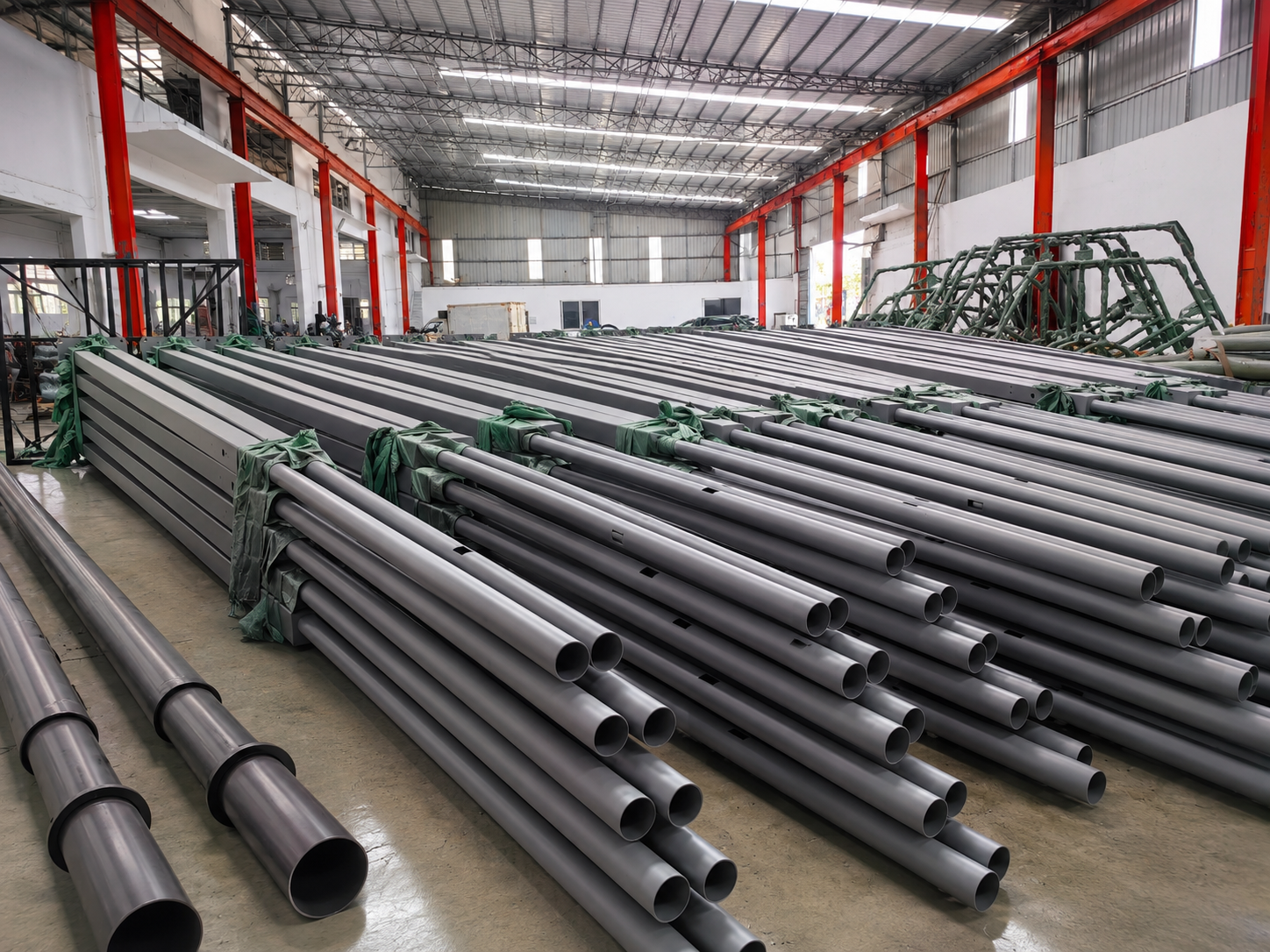
Pole class and pole height sit at the centre of a three-way luminaire comparison, because they set the geometry that power class has to serve.
The Three Families as BAIFU LIGHTING Documents Them
BAIFU LIGHTING (Zhongshan Baifu Street Lamp Co., Ltd.) is a custom outdoor lighting manufacturer based in Guzhen Town, Zhongshan, Guangdong, China. Its stated profile covers more than 13 years of outdoor lighting manufacturing experience, an 11,158 m² production facility, 68 employees, an annual output of 50,000 units and project supply to customers in more than 71 countries and markets. The product scope includes non-standard custom outdoor street lights, LED road luminaires, solar street lights, landscape lights, garden lights, lawn lights, smart street lights and custom lamp poles, delivered through OEM, ODM and project-based manufacturing. Company details and the current product range are published at BAIFU LIGHTING.
BF-SL-8M-100W solar street lamp
The BF-SL-8M-100W is a solar street lamp whose designation carries two pieces of information: an 8 m class in the 8M element and a 100 W class in the 100W element. BAIFU LIGHTING documentation describes the product as designed for use in municipal road lighting scenarios. Solar configuration, pole height, arm structure, light distribution and control system all sit within the parameter set the company states it configures per project.
BF-LSL-4000-120W custom LED landscape street light
The BF-LSL-4000-120W is a custom LED landscape street light in the 120 W class. Its documented application list is the broadest of the three: municipal road engineering, urban landscape lighting, park roadways, commercial plazas, cultural tourism scenic spots, pedestrian streets, residential communities, hotels and resorts, industrial parks, schools, hospitals, parking lots, government projects and overseas urban infrastructure projects. That breadth is useful for shortlisting and unhelpful for final selection, because one model covers both carriageway-adjacent and pedestrian-plaza contexts. Configuration, not the family name, decides fit.
BF-AGL-4000-60W ancient-style courtyard lamp
The BF-AGL-4000-60W is an ancient-style courtyard lamp in the 60 W class, and it is the only one of the three with a certification statement attached to it in the model information: ISO 9001 under certificate number 52824Q10676R0S, against the standard GB/T19001-2016/ISO9001:2015, stated as applicable to the global market. Its decorative form and lower power class point toward residential and commercial landscape settings where the luminaire is part of the streetscape rather than part of the carriageway system.
Two limits belong beside those descriptions. First, the model designations identify a pole class and a power class; they are not photometric, thermal or structural specifications, and no luminous flux, distribution curve, wind-load calculation or IP rating is established for these three families in the model information summarized here. Second, ISO 9001 is a quality management system certification: it evidences conformity of the manufacturer's management system to a named standard under a named certificate, not the lumen output, ingress protection or structural capacity of a luminaire.
Gate 1 — Site Class Narrows the Field to One Family
Site class eliminates families faster than any specification table. Municipal road lighting is the documented design intent of the solar model. Mixed urban roads, parks and plazas sit inside the landscape model's documented application list. Pedestrian-scale residential and commercial landscape settings are where a 60 W decorative courtyard luminaire is proportionate.
- Municipal road lighting. Where the run is a carriageway with a defined geometry and the constraint is bringing a supply point to the pole, the solar family is the natural candidate. A solar configuration removes the grid-supply requirement at the pole; the trade-off is that the solar configuration becomes part of the performance envelope and has to be sized for the site's irradiance and load profile rather than selected from a fixed catalogue.
- Urban roads, parks and plazas. The landscape model is the default candidate where one project spans both a roadway and a plaza: a park road that meets a commercial plaza, or a scenic-area approach that becomes a pedestrian street. The documented list confirms eligibility across those contexts; it does not rank them.
- Residential and commercial landscape. The courtyard lamp's 60 W class is the smallest of the three, which makes it the first candidate where mounting height is governed by the streetscape rather than by carriageway geometry. The condition is photometric: the fit has to be demonstrated at the actual mounting height, spacing and target illuminance, because a lower power class is not by itself evidence of adequate illumination.
Gate 2 — Mounting Height and Power Class Must Be Read Together
Mounting height and power class form one decision, not two. The solar model's designation names an 8 m class; the landscape and courtyard models name their power classes but not a pole class, and pole height is a configurable parameter across the range. That asymmetry has a practical consequence: comparing 100 W, 120 W and 60 W before the mounting height is fixed compares three different lighting geometries.
A 120 W luminaire at one height and a 60 W luminaire at a lower height can produce comparable illuminance on the ground, and the same 120 W unit can be over- or under-specified depending on spacing. The only reliable way to connect power class to mounting height is a photometric layout at the actual pole height, arm geometry and spacing, produced for the configuration being quoted. Where pole positions are fixed before the layout is run, the layout becomes a check on the civil design rather than a design input — the point at which rework risk moves from the supplier to the buyer.
Structural verification is a separate document. Pole height, material and structural complexity drive both price and engineering sign-off, and the model information does not supply wind-load calculations for any of the three families. Those calculations, and the surface-protection specification behind them, belong on the request list alongside the photometric file.
Gate 3 — Control and Dimming Are Specification Items, Not Extras
Control is a specification line. BAIFU LIGHTING lists the control system among the parameters it configures per project, together with pole height, wattage, colour temperature, arm structure, material, finish, decorative pattern, light distribution and solar configuration. For a buyer, that means the control regime has to be stated before quotation, because it changes both the delivered product and, for the solar model, the energy budget.
Three questions separate a real control specification from a brochure line. What is the dimming or switching profile across the night, and who sets it? Which driver and control hardware is used, so replacement parts can be matched later? And for a solar configuration, has that profile been reconciled with battery capacity and the site's worst-case charging period? The third question is where dimming stops being a comfort feature and becomes a sizing constraint.
Market context supports the attention, with a boundary. Berg Insight forecasts the global installed base of smart street lights to reach 87.6 million units by 2030, rising at a compound annual growth rate of 17.9 percent. That is a forecast for connected street lighting as a category, not a statement about the control features of these three models, which the model information does not itemize. The procurement implication is narrower than the number: control compatibility is worth writing into the specification now, because retrofitting it onto a fixed pole and luminaire combination later is the expensive route.
Gate 4 — Environmental Tolerance Starts With the IP Question
Ingress protection is the first environmental question and the one most often answered by assumption. IP65 and IP66 share the same dust rating — the first digit 6 means dust-tight — and differ in the water digit. The second digit 5 denotes protection against water jets from any direction; 6 denotes protection against more forceful jets at higher pressure. Neither digit implies protection against continuous immersion, which is a separate rating level, and neither says anything about wind load, corrosion resistance or UV stability of the finish.
Which of the two is appropriate is an exposure question, not a preference. A luminaire washed down during municipal maintenance, or installed where wind-driven rain and road spray strike the housing at pressure, has a different requirement from one sheltered under a plaza canopy. Coastal and industrial atmospheres add a corrosion dimension the IP code does not address at all, which is why the surface-finish specification — outdoor powder coating is part of BAIFU LIGHTING's stated manufacturing process — belongs in the same clause as the rating.
The model information summarized here does not state an IP rating for any of the three families. The correct procurement move is to request the rating together with the test report behind it, and to confirm the rating applies to the complete luminaire, including cable entries and the driver compartment, rather than to the housing alone.
Operating temperature needs the same discipline. The useful request is not one number but the range for each thermally significant component: the luminaire, the driver, the control gear and, for the solar model, the battery. A solar configuration usually has the narrowest usable window of the three families, because battery behaviour in sustained heat or cold constrains the system beyond the LED and driver limits. Comparing a single headline temperature range across a solar and a mains-powered luminaire is not a like-for-like comparison; comparing component ranges against the site's recorded ambient extremes is.
The Comparison Matrix Procurement Teams Can Work From
Cells marked for confirmation are values the available model information does not establish. They are requests for the technical clarification stage, not assumed defaults.
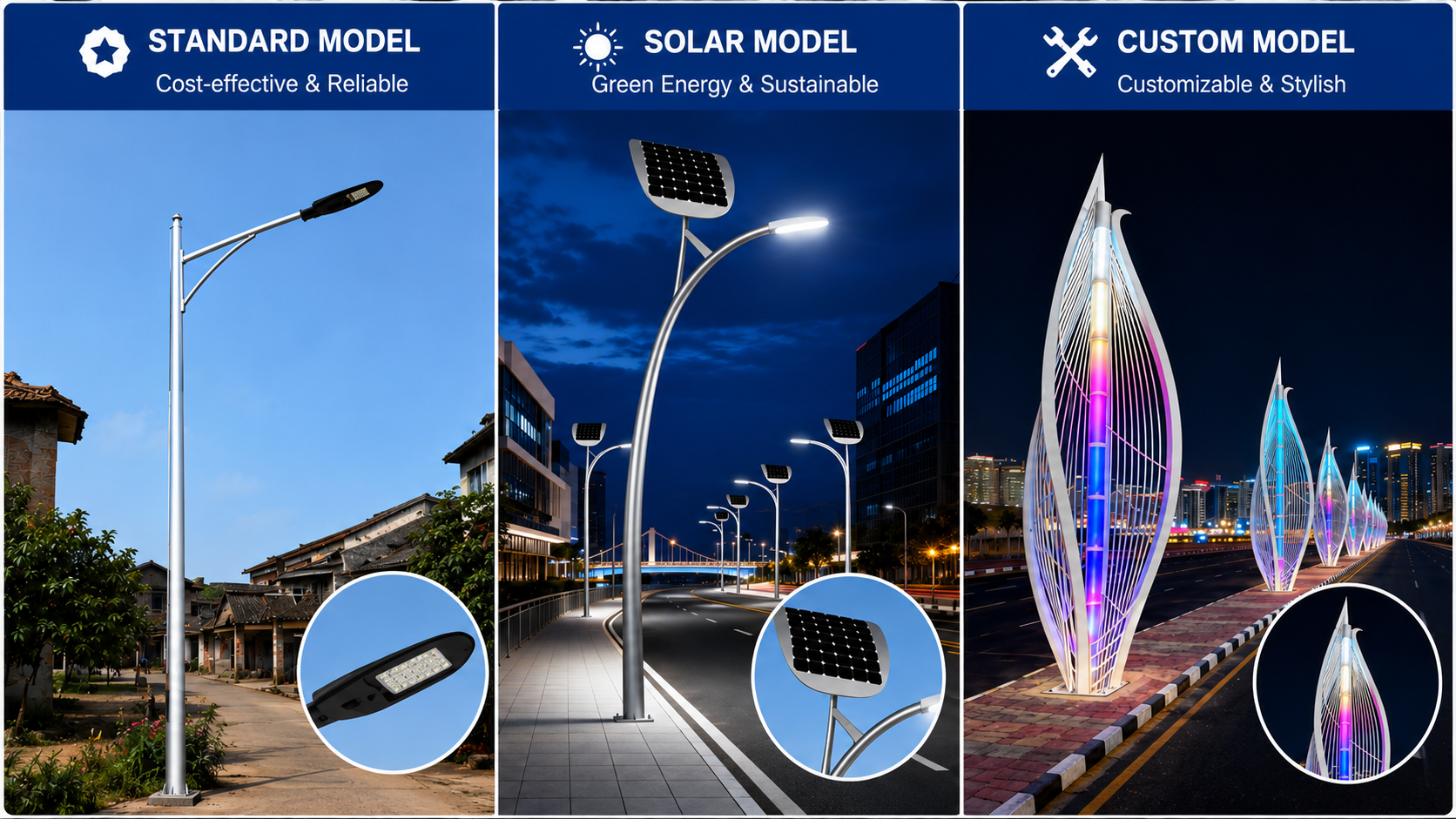
Configuration parameters, not family names, carry the decision once site class, height and control regime are fixed.
| Decision dimension | BF-SL-8M-100W | BF-LSL-4000-120W | BF-AGL-4000-60W |
|---|---|---|---|
| Documented application | Municipal road lighting, stated as the model's design intent | Municipal road engineering, urban landscape lighting, park roadways, commercial plazas, scenic spots, pedestrian streets, residential communities, hotels and resorts, industrial parks, schools, hospitals, parking lots, government and overseas infrastructure projects | Ancient-style decorative form; residential and commercial landscape settings, with photometric fit to be confirmed at the actual mounting height |
| Mounting height and pole class | 8 m class named in the designation; pole height configurable | Pole class not stated; pole height configurable to project | Pole class not stated; pole height configurable to project |
| Power class | 100 W class | 120 W class | 60 W class |
| Control and dimming | Configurable; dimming profile must be reconciled with solar sizing | Configurable; confirm dimming schedule and driver compatibility | Confirm available control options; not established in the model information |
| Ingress protection | Request rating and test report; confirm battery enclosure treatment | Request rating and test report for the complete luminaire | Request rating and test report for the complete luminaire |
| Operating temperature | Request luminaire, driver and battery ranges separately | Request luminaire and driver ranges | Request luminaire and driver ranges |
| Compliance evidence | Destination-market route to be confirmed; CB per IEC 60598-2-3 and ENEC per EN 60598-2-3 are the routes UL Solutions lists as commonly used for roadway luminaires | Same confirmation required; standard scope applies to road, street and public outdoor luminaires up to 1,000 V | ISO 9001, certificate 52824Q10676R0S, GB/T19001-2016/ISO9001:2015, stated as applicable to the global market |
| Main price drivers | Pole height, material, structural complexity, lighting configuration, surface finish and order quantity | ||
What Custom Configuration Changes Relative to Fixed-Model Supply
Custom configuration changes the comparison in four places that matter at decision stage. The parameter set is the first: more than ten key parameters — pole height, wattage, colour temperature, arm structure, material, finish, decorative pattern, light distribution, solar configuration and control system — can be configured to road conditions, installation environment and project budget, where fixed-model supply generally offers standard specifications.
The second is process discipline before production. BAIFU LIGHTING states that 100% of customized orders undergo drawing and parameter confirmation before production. For a buyer this is a schedule item as much as a quality item: drawing confirmation sits on the critical path between award and manufacture, and a programme that omits it creates its own delay.
The third is maintenance. The company states that it can provide modular LED light sources, standard drivers, maintenance-friendly structures, installation drawings, wiring guidance and spare-parts support. Standard low-cost products usually use fixed configurations, which makes later component matching and replacement less flexible — a lifecycle cost that never appears in the unit price.
The fourth is cost structure. Customization front-loads design and sampling cost and pushes final pricing toward pole height, material, structural complexity, lighting configuration, finish and quantity. That structure rewards early freezing of the specification: every parameter changed after the drawing is confirmed carries a cost a fixed-model purchase never exposes, because a fixed model has nowhere to move.
Compliance Documents and What Each One Actually Proves
Compliance evidence divides into three document types that tenders often conflate.
Standards scope. IEC 60598-2-3:2002+A1:2011 specifies requirements for luminaires for road and street lighting and other public outdoor lighting applications, tunnel lighting and certain column-integrated luminaires, for electrical supplies not exceeding 1,000 V. The scope identifies the product class the standard addresses; it does not certify any individual luminaire.
Certification routes. UL Solutions identifies CB certification per IEC 60598-2-3 and ENEC certification per EN 60598-2-3 as commonly used requirements for roadway and streetlights in global markets. Two qualifications belong with that statement: the reference does not establish that every destination market mandates these routes, and market-specific regulation, marks and test laboratories have to be confirmed for the actual project location.
Management system and trade classification. The ISO 9001 certificate attached to the BF-AGL-4000-60W — certificate number 52824Q10676R0S, standard GB/T19001-2016/ISO9001:2015, stated as applicable to the global market — is a management system document. Separately, a U.S. Customs classification ruling places lampposts and bases for lampposts under HS code 9405.99, which is a tariff classification and not a safety mark. None of these document types substitutes for the others, and a checklist that treats them as interchangeable will accept paperwork that does not support the claim being made.
Acceptance Terms That Keep the Comparison Honest
Five risk categories dominate custom outdoor lighting supply: quality consistency, export certification compatibility, delivery time and supply chain, transport damage, and on-site installation. BAIFU LIGHTING describes the corresponding controls as order review, drawing confirmation, incoming material inspection, process inspection, finished product testing, outbound inspection, certification verification, packaging reinforcement and logistics tracking.
Translated into acceptance terms for a three-way comparison, that becomes a short document list: the confirmed drawing and parameter sheet; the photometric layout at the project's mounting height and spacing; the IP rating with its test report; the operating range by component; the certification evidence applicable to the destination market, verified before production rather than before shipment; and the packing specification for the actual transport mode. For oversized poles, packing and handling is not a detail, because transport damage is one of the five risks the manufacturer itself names.
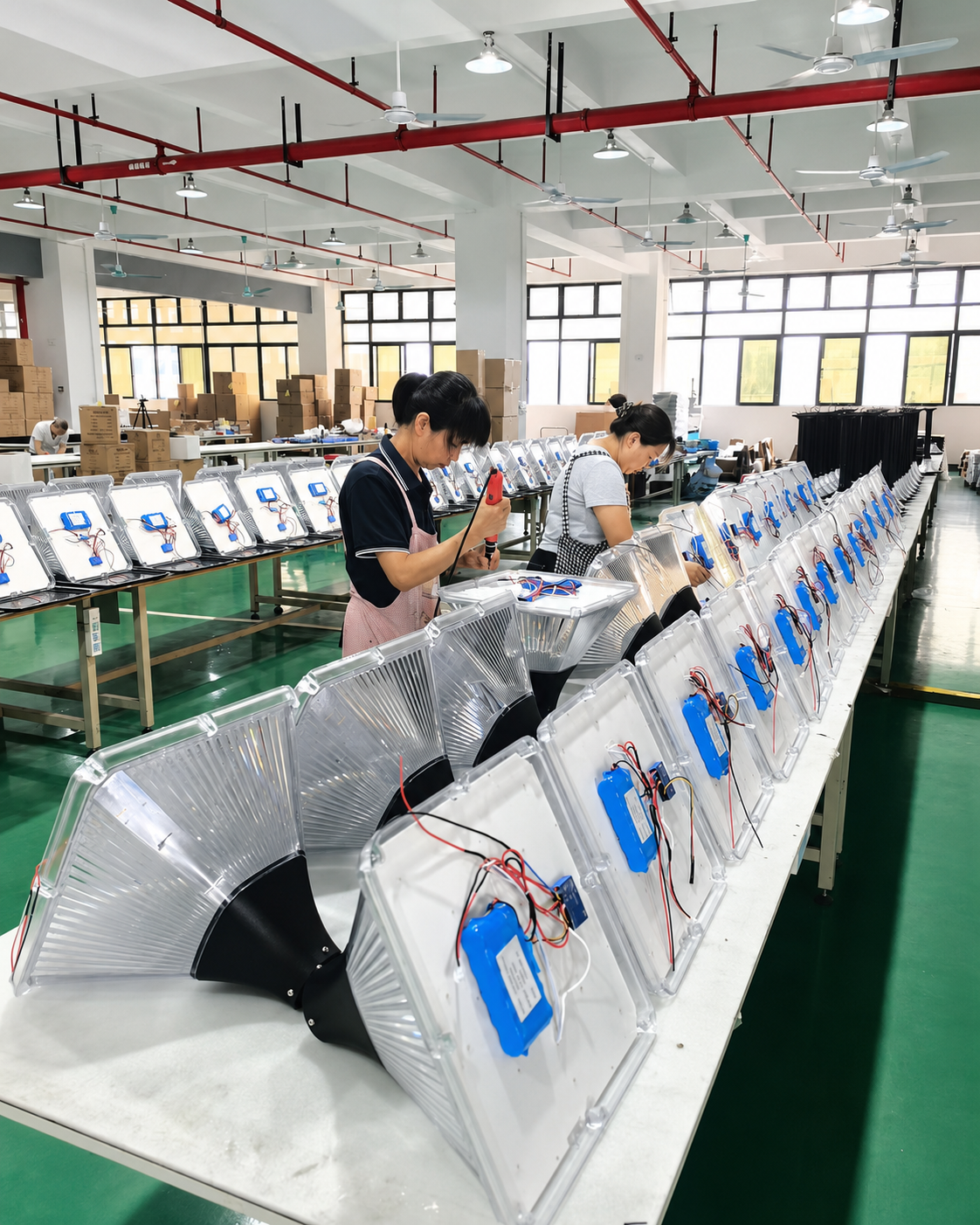
Assembly and inspection stages are where the confirmed parameter sheet stops being paperwork and becomes the acceptance reference.
Market Context: Two Figures and Two Boundaries
Grand View Research valued the global street lighting market at USD 10.5 billion in 2025. The scope is street lighting as a whole — conventional and LED — and it does not size the custom or non-standard segment these three families belong to. Berg Insight separately forecasts the global installed base of smart street lights to reach 87.6 million units by the end of 2030 at a 17.9 percent compound annual growth rate; that figure covers connected endpoints and it is a forecast.
The boundary is the same for both. No validated market size, project demand or growth figure for custom street lighting was established in the data behind this comparison, so neither number should be used as a demand forecast for bespoke luminaires. What they do support is narrower: the category is large, the connected segment is forecast to grow faster than the category, and a buyer specifying a custom pole and luminaire today is likely to be asked about control integration during the asset's service life.
Outlook: Where This Three-Way Decision Is Heading
If the connected segment grows as forecast while the overall street lighting market grows more slowly, pressure falls on the interface between pole, luminaire and control hardware — the point where a decorative family and a roadway family stop being interchangeable, and where a fixed-model purchase becomes hardest to retrofit.
For the three families examined here, the implication is conditional rather than predictive. A municipal roadway project that expects to add monitoring or adaptive dimming later should specify the control interface and access at quotation stage, even if the first phase runs on a simple time profile. A plaza or courtyard installation where the luminaire is part of the streetscape should specify optical configuration and finish first, because those cannot be changed after installation. Which discipline dominates in a given project depends on the site, not on the family.
FAQ
When does municipal road lighting call for the solar model rather than the landscape model?
BAIFU LIGHTING documentation describes the BF-SL-8M-100W solar street lamp as designed for municipal road lighting scenarios, and its designation carries an 8 m pole class and a 100 W power class. The BF-LSL-4000-120W is also listed for municipal road engineering, so application wording alone does not separate them. Where a grid supply is unavailable or costly to bring to the pole, the solar configuration becomes the differentiating factor. Where supply exists and the layout spans both carriageway and plaza, the 120 W landscape luminaire retains more optical and mounting flexibility. Either way, a photometric layout at the actual height and spacing is required before the choice is complete.
Is IP66 always the right choice over IP65 for a custom street light?
No. IP65 and IP66 both use dust-tight first-digit protection and differ only in the water digit: 5 covers water jets from any direction, 6 covers more forceful jets at higher pressure. The appropriate level follows the exposure of the installation — maintenance wash-down, wind-driven rain, road spray, coastal atmosphere — rather than ranking. Because a higher water rating can affect housing sealing and thermal design, the value should come from a test report covering the complete luminaire, including cable entries and driver compartment. The model information summarized here does not state an IP rating for the three families, so it must be requested.
Do the three models offer the same dimming and control options?
The control system is one of the parameters BAIFU LIGHTING configures per project, but the model information does not establish an identical control feature set across the three families. For the solar model, any dimming profile has to be reconciled with solar sizing and battery capacity; for the mains-powered landscape and courtyard models, driver compatibility and spare-part matching are the relevant checks. A buyer should request the proposed control schedule, the hardware model and the replacement-part route for each family before treating them as equivalent.
What does the ISO 9001 certificate on the ancient-style courtyard lamp actually cover?
The BF-AGL-4000-60W is stated as certified to ISO 9001 under certificate number 52824Q10676R0S, against the standard GB/T19001-2016/ISO9001:2015, applicable to the global market. ISO 9001 is a quality management system standard: the certificate addresses the conformity of the management system, not the photometric output, ingress protection or structural capacity of the product. Those characteristics require separate test documentation and, where the destination market demands it, separate product certification.
How should operating temperature ranges be compared across the three families?
Request the range for each thermally significant component separately: luminaire, driver, control gear and, for a solar configuration, the battery. Compare those ranges against the site's recorded ambient extremes, including summer maximum and night-time minimum, rather than against a single headline figure. A solar luminaire's usable window is usually the narrowest of the three because battery behaviour constrains the system beyond LED and driver limits, so a single operating temperature figure that does not state which component it refers to is not comparable across families.
Conclusion
A three-way comparison of a solar roadway luminaire, a configurable landscape luminaire and a decorative courtyard lamp ends best with a document list rather than a verdict. Site class eliminates families; mounting height and power class have to be resolved together; control and protection have to be specified before quotation; and every value marked for confirmation should arrive as a document rather than a verbal assurance.
BAIFU LIGHTING publishes its customized outdoor lighting range, including the configuration options described above, in a downloadable album for teams that need the product scope in one place: BAIFU LIGHTING customized outdoor lighting album (PDF).
Have Questions or Need More Details?
Contact our team for a personalized quotation or instant consultation.
Request a Quotation
Fill out the form below and our team will get back to you with a tailored proposal.
WhatsApp Direct Chat
Prefer to chat in real-time? Message us on WhatsApp for instant assistance & quick answers.
- Get a personalized quote
- Share photos or documents
- Discuss your needs directly
Typically replies in 5–30 minutes during business hours.