
Solar Self-Consumption with Battery Energy Storage Systems
Solar self-consumption is the share of on-site photovoltaic generation that is consumed at the point of production rather than exported to the grid. It is a ratio, not a capacity, and that distinction changes how a battery energy storage system should be specified. For commercial and industrial (C&I) buyers in the research and evaluation stage, raising that ratio is mainly a constraint-engineering exercise: how much PV the storage system can absorb, whether critical loads ride through grid events, which protection ratings the equipment carries, and which certificates the project file must contain before an installation can be approved. This reference sets out those constraints and uses the EverCore ESS from Ginlong (Solis) Technologies Co., Ltd. as a documented example of one architecture.
Why the self-consumption ratio, not storage capacity, is the design target
A PV array's output curve and a site's load curve rarely coincide. Generation peaks around midday; many commercial loads peak in the morning and late afternoon. Every kilowatt-hour exported at midday and repurchased later is a kilowatt-hour bought at retail price and sold at a lower export value, so the economics of a solar-plus-storage project are driven by how much of the array's output is absorbed on site rather than by the nameplate capacity of the battery cabinet.
Two ratios govern the outcome. The first is the ratio of PV generation to usable storage energy over a typical operating day: if storage is undersized relative to the array, midday export continues; if it is oversized, capital sits idle. The second is daytime load coverage: a site that runs heavy loads during generation hours needs less storage per kilowatt of PV than a site that is largely unoccupied at midday. Both are site-specific measurements, and neither can be answered from a battery datasheet alone.
Market context makes this timing question more urgent rather than less. IRENA reports that the average total installed cost of solar PV fell to USD 691/kW in 2024, which lowers the cost of adding generation capacity. The IEA recorded 42 GW of battery storage additions in the power sector in 2023, more than a 100% year-on-year increase. When both generation and storage become cheaper to add, the binding constraint shifts from hardware availability to system integration, site protection, and project documentation.
The constraint set buyers should resolve before comparing quotes
Procurement teams that compare C&I storage quotations on kilowatt-hour price alone routinely discover a second round of costs after selection. The following constraints determine whether a quoted system can actually raise self-consumption at a given site.
| Constraint | Why it decides the self-consumption outcome | What to verify before ordering |
|---|---|---|
| PV oversizing headroom | An array larger than the inverter rating increases midday harvest; if the storage inverter cannot accept it, the surplus is clipped or exported | Maximum supported PV over-sizing ratio and whether both DC and AC coupling of existing PV are supported |
| Coupling architecture | Determines whether existing PV inverters can be retained or must be replaced | Whether the system accepts DC-coupled and AC-coupled PV on the same unit |
| Transfer path | Self-consumption savings disappear if a grid disturbance stops production | Grid-tied to off-grid transfer time and whether an external static transfer switch is required |
| Thermal duty under daily cycling | Self-consumption duty means one deep cycle per day for years; heat is the main ageing accelerator | Cooling method, protection ratings, and the documented ambient and altitude envelope |
| Certification scope | Approval is granted per model and per market, not per brand | That certificate scope strings name the exact model being purchased |
| Expansion path | Load growth or a later PV extension usually arrives after commissioning | Whether capacity can be added on the DC side without a second inverter |
How the EverCore ESS is specified for self-consumption duty
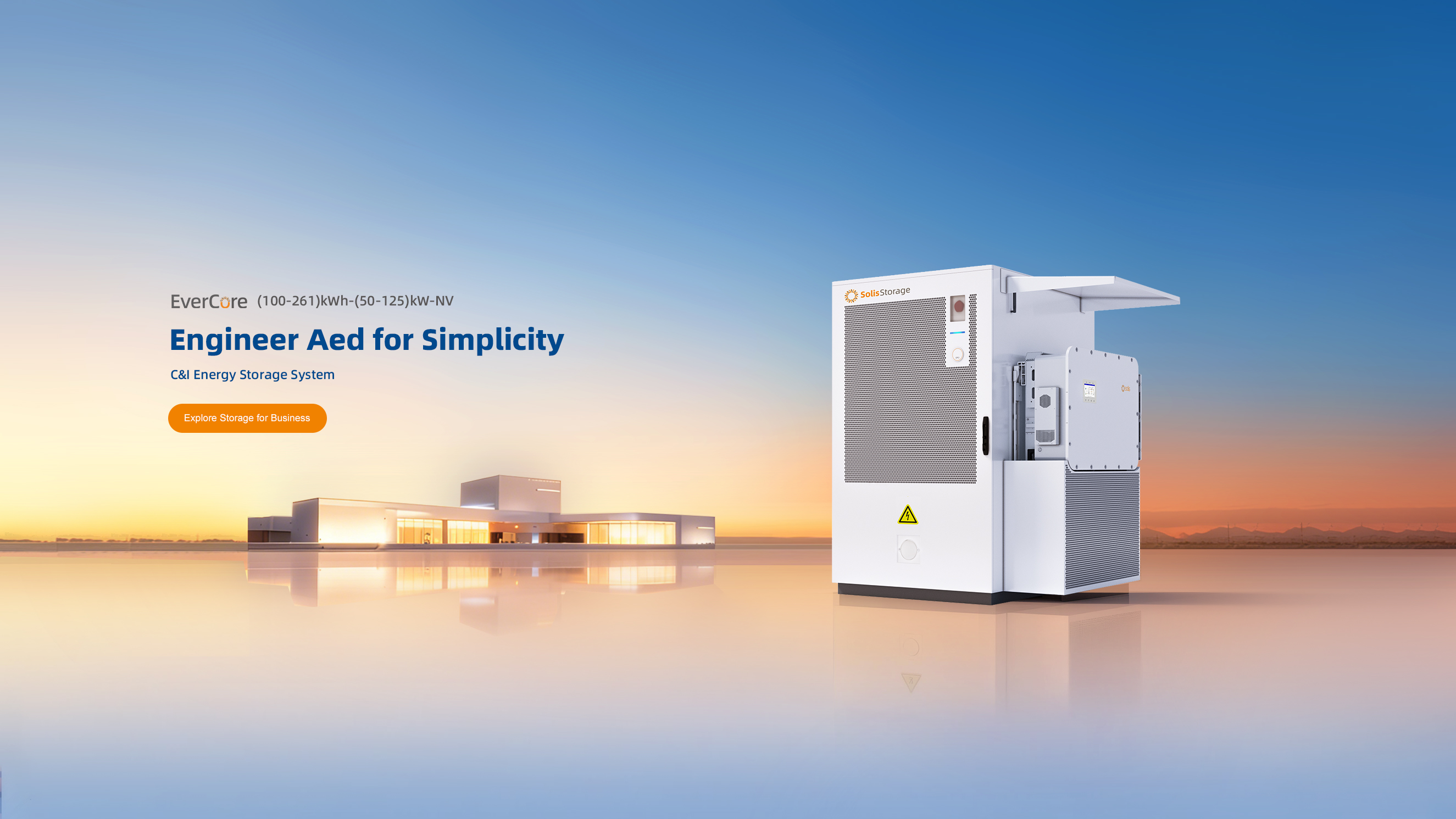
The EverCore ESS is a C&I energy storage system from Ginlong (Solis) Technologies Co., Ltd., a Shenzhen Stock Exchange-listed inverter and storage manufacturer founded in 2005 and represented in more than 100 countries. The company's storage portfolio spans residential, C&I and utility-scale applications. The EverCore ESS is built around an aluminium alloy casing and core electronic components and is intended for the renewable energy and power grid industry, including renewable power plants, utility companies, and commercial, industrial and residential users.
Documented capacity options per cabinet are 100.5 kWh, 120.6 kWh and 261.2 kWh, paired with inverter power ratings of 50 kW, 60 kW and 125 kW. The system uses EVE lithium iron phosphate cells rated 3.2 V / 314 Ah with an 8,000-cycle cell life, and carries IP55 protection on the cabinet and IP66 on the inverter.
The integration detail that matters most for self-consumption is that the 50 to 125 kW hybrid energy storage inverter combines the power conversion system, static transfer switch, PV inverter, circuit breaker protection and energy management system in a single enclosure. Three practical consequences follow:
- Transfer without an external switch. Grid-tied to off-grid switching is completed in under 10 ms without an external static transfer switch, which supports power quality for precision industrial equipment.
- Retained PV assets. No external PV inverter is required, and both DC and AC coupling are supported for existing PV systems, with a PV over-sizing ratio of up to 200%.
- Simplified grid connection. No external grid cabinet is needed, and up to six EverCore units can be connected in parallel for direct grid connection.
Capacity can also be added on the DC side: a single inverter supports up to six battery cabinets in parallel, which Solis states reduces system expansion cost by approximately 10% compared with adding inverter capacity at the same time. For staged projects with constrained initial capital, that distinction between scaling storage energy and scaling conversion capacity is often the deciding commercial factor.
Technical explanation: why AC-DC separation changes the thermal constraint
Daily deep cycling is the defining duty of a self-consumption system, and heat is what limits cell life under that duty. The EverCore architecture separates the AC side physically from the DC side, decoupling the hybrid inverter from the battery cabinet so that each sits in its own thermal environment. Solis states that the external inverter dissipates roughly 6 kW of power heat directly to ambient, leaving about 3.5 kW of electrochemical heat to be managed inside the battery cabinet, which allows the air-cooled system to approach the cell temperature uniformity associated with liquid-cooled designs.
Protection follows the same separation logic. As an independent unit the hybrid inverter reaches IP66, while the battery cabinet maintains IP55. Solis reports that this separated protection design reduces the system's full-lifecycle failure rate by 50%, a first-party engineering claim that buyers should read alongside warranty terms and reference sites rather than as an independently verified figure.
Control architecture is the third element. Conventional C&I systems distribute control across separate processors for the battery management system, power conversion system, energy management system and static transfer switch, and multi-node links introduce protocol compatibility and latency risk. The EverCore ESS uses a single central controller that schedules the whole system from one control core, which reduces failure points and shortens fault localisation. The trade-off is architectural concentration: a single controller simplifies diagnosis but makes controller availability central to system uptime.
On the cooling side, the system retains air cooling for 125 kW / 261 kWh C&I configurations using an independent three-air-duct design that combines a diversion duct for the hybrid inverter with Coanda-effect airflow attachment across battery pack surfaces. Solis reports 30% higher heat dissipation efficiency than conventional air cooling, and states that the system operates from -25°C to 55°C and at altitudes up to 4,000 m. Cell-level choices reinforce the thermal argument: the 314 Ah LFP cells are specified at an internal resistance of 0.15 ± 0.05 mΩ against 0.17 mΩ for standard 280 Ah cells, and Solis calculates that every 10% reduction in internal resistance lowers charge-discharge heat generation by approximately 20%. Cycle life is stated at 8,000 cycles at 0.5C to 70% remaining capacity, roughly 14% above the 7,000 cycles cited for 280 Ah cells, which at 500 cycles per year extends the stated economic lifecycle from about 14 years to about 16 years.
Certification is a project constraint, not a formality
For European projects, two documents usually gate approval. The first is a safety certificate to IEC 62619, issued by TUV under certificate number JPTUV-182135 for the EU market, issued on 6 January 2026 and valid to 1 June 2031, applicable to the energy storage system and to Zone 2 scope. The second is electromagnetic compatibility certification under CE Directive 2014/30/EU, issued by TUV under certificate number AE 50712374 0001 on 21 January 2026, covering the EverCore-261kWh and EverCore-261kWh-PRO models and referencing EN IEC 61000-6-2:2019, IEC 61000-6-2:2016, EN IEC 61000-6-4:2019 and IEC 61000-6-4:2018.
The constraint buyers frequently miss is scope. A certificate names specific models, a specific market and, in the case of EMC, a specific set of standards. It does not transfer automatically to a different cabinet capacity, a different regional grid code or a modified configuration ordered through OEM customisation. Grid-code approval and utility interconnection remain project-level processes even when product certification is complete, so the certificate scope string should be matched against the exact model designation on the purchase order before the file goes to the authority.
Where self-consumption systems are actually deployed
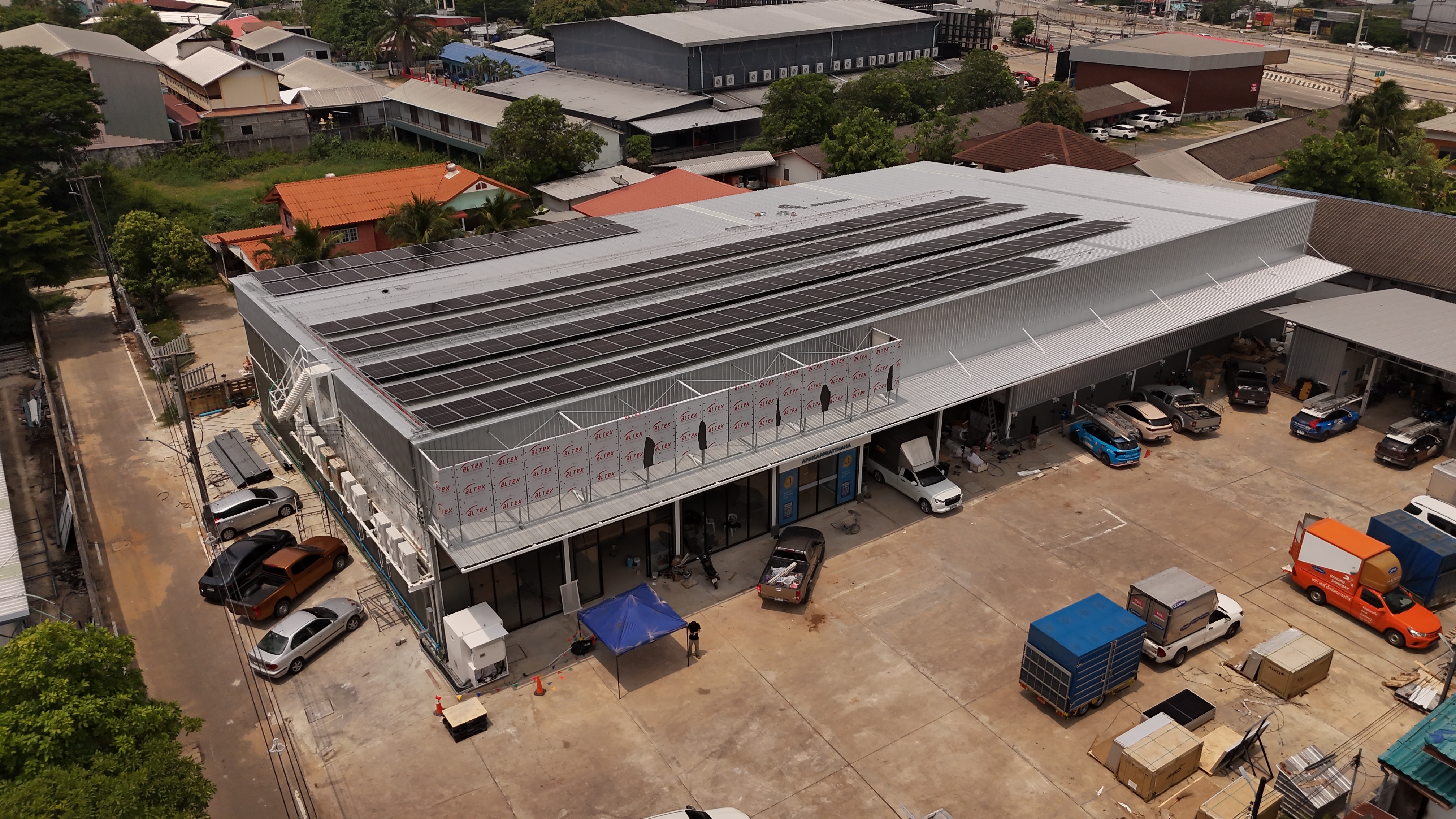
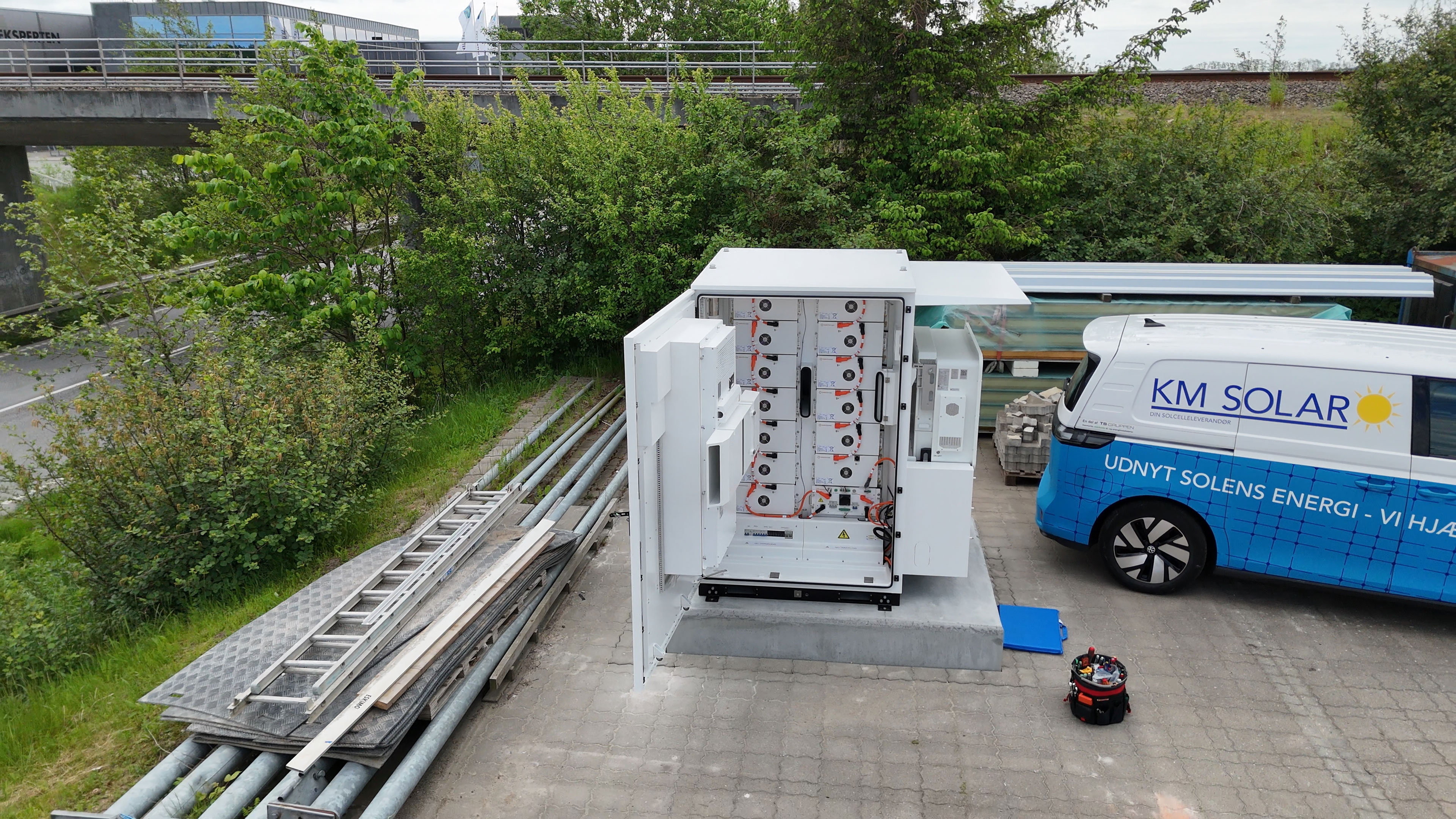
Two documented C&I references illustrate how the constraint set resolves in practice. In Denmark, a 125 kW / 261 kWh EverCore installation serves self-usage of a warehouse over a stated 20-year duration, with electricity bill savings as the recorded outcome and grid-tied to off-grid switching in under 10 ms cited as the safeguard against process interruption. In Thailand, a 125 kW / 522 kWh system combines self-use and backup power over a 20-year duration, recorded as stable operation with bill savings.
Below C&I scale, the residential IntelliHome system uses a 5 kWh lithium iron phosphate battery rated 44.8 to 57.6 V with 100 Ah cells, a recommended charge and discharge current of 50 A, more than 6,000 cycles or 10 years of cycle life, and IP66 ingress protection. For sites between the two, the stackable FlexCore-ID uses 20 kWh LFP packs with 314 Ah cells and a cell cycle life of 8,000 cycles or more at 0.5P to 70% end-of-life at 25±2°C, positioned for small farms, shopping malls, hospitals, large residences and small industrial and commercial enterprises.
Market trend: from single-value arbitrage to stacked, software-mediated value
In mature electricity markets, the revenue model for C&I storage has moved beyond simple peak-valley arbitrage toward combinations of grid ancillary services, demand response and virtual power plant dispatch. That shift turns software openness into a procurement criterion: a closed hardware platform cannot participate in markets where the aggregator, not the manufacturer, operates the dispatch logic.
Solis states that the EverCore ESS has been connected, or is in the process of connecting, with 102 third-party VPP and EMS operators across 11 European countries, including integration with the Kraken platform operated by Octopus Energy in the UK, aggregator platforms such as Check Watt in the Nordic market, and dozens of local EMS providers in the German-speaking region and Benelux. The company's own Solis AI Cloud Platform is stated to be deployed at more than 5,500 energy storage power stations, integrating Nordpool wholesale price data and Flatpeak retail price data into a multi-source price forecasting model for minute-level charge and discharge optimisation. Solis cites a residential storage project in Latvia where AI-based optimisation increased annual electricity bill savings by 302.6%; that figure is a single-project outcome and should be treated as an illustration of dispatch value rather than an expected result for other sites.
Supply-side consolidation provides the broader context. Wood Mackenzie reported that Tesla held a 15% share of the global BESS integrator market in 2024, with Sungrow at 14%, a distribution that reflects how few integrators operate at scale. Trade data points in the same direction but requires care: one secondary source puts global imports under HS code 850760 at USD 153.38 billion in 2023, a 29.2% increase on 2022, while other trade databases report materially lower totals for the same code, so the direction of growth is more reliable than the absolute figure.
Comparison with alternative architectures, and where this one stops
Self-consumption projects are usually built from one of three architectural families. The comparison below is qualitative on purpose: competitor specifications change by model and should be verified per project rather than taken from a category description.
| Design question | AC-coupled string inverter plus separate battery | Liquid-cooled C&I cabinet | EverCore ESS as specified |
|---|---|---|---|
| Adding storage to existing PV | Retains existing inverters; conversion happens twice, with associated efficiency losses | Usually requires rework of the PV interface | No external PV inverter required; DC and AC coupling supported, PV over-sizing up to 200% |
| Backup transfer | Typically needs an external transfer switch | Typically needs an external transfer switch | Integrated STS, under 10 ms switching without external equipment |
| Thermal management | Depends on the separate battery cabinet design | Effective heat rejection, but adds pumps, coolant circuits and periodic fluid service | Air-cooled with separated heat paths; -25°C to 55°C and up to 4,000 m stated |
| Lifecycle maintenance | Split responsibility across two vendors | Fluid replacement and additional service steps | Solis cites approximately €9,500 saved per unit over the project lifecycle, including €2,500 in coolant, €1,500 in PCS replacement, €1,500 in pack replacement and €4,000 in routine inspection |
| Capacity expansion | Often requires a second inverter | Varies by platform | Up to six battery cabinets per inverter; approximately 10% lower expansion cost stated |
The limits are as important as the advantages, and several are structural rather than commercial:
- Air cooling has an envelope. The stated operating range of -25°C to 55°C and 4,000 m altitude covers most inhabited markets but not all. Sites outside that envelope require separate engineering rather than a standard configuration.
- Unit granularity is fixed. Cabinets range from 100.5 kWh to 261.2 kWh with 50 to 125 kW inverters. Very large loads are addressed through parallel units, which means the design, protection and communication topology of a multi-unit array must be engineered rather than assumed.
- Certification is model-bound. The cited EU safety and EMC certificates cover the EverCore-261kWh and EverCore-261kWh-PRO scope. Other capacities, markets or heavily customised configurations need their own documentation.
- OEM customisation has a floor. Standard off-the-shelf models carry a one-unit minimum order quantity, while customised OEM orders carry a 20-unit minimum with a 30 to 45 day lead time for mass production. Customisation covers logo, outer packaging, software interface, regional voltage standard, communication protocol and functional parameters.
- Storage cannot fix a mismatched array. If the PV-to-load ratio is poor or export rules in a given market are unusually restrictive, storage recovers only part of the gap. The Latvia result and the Denmark and Thailand references should not be read as portable performance guarantees.
Future outlook
Three developments are likely to reshape self-consumption procurement over the next planning cycle. First, as PV capital costs continue to fall, system sizing will increasingly be driven by grid interaction rules and export limitations rather than by module price. Second, software openness will keep moving up the evaluation list: the number of third-party aggregators a platform can talk to may matter more than a marginal difference in round-trip efficiency, because it determines whether a second revenue stream is reachable at all. Third, documentation will become a bigger share of project risk. Certificate scope strings, model designations and market applicability are already the most common cause of delay between equipment delivery and grid approval, and that pattern is unlikely to reverse as regulatory requirements multiply across European markets.
For buyers, the practical implication is to evaluate self-consumption systems against a fixed constraint list — PV headroom, coupling, transfer, thermal envelope, certification scope and expansion path — before comparing price per kilowatt-hour. Further technical detail on the residential, C&I and utility-scale portfolio is available in the Solis global brochure.
FAQ
What PV over-sizing ratio can a C&I battery energy storage system support?
The EverCore ESS supports a PV over-sizing ratio of up to 200% and accepts both DC-coupled and AC-coupled PV, so an existing array can be retained without adding an external PV inverter. Buyers should confirm the ratio against the specific model ordered, because the figure is a stated product capability rather than a universal value across C&I systems.
Which certifications should a European C&I storage project require?
Two are central in the EverCore documentation: a safety certificate to IEC 62619 issued by TUV under certificate number JPTUV-182135 for the EU market, valid to 1 June 2031, and electromagnetic compatibility certification under CE Directive 2014/30/EU issued by TUV under certificate number AE 50712374 0001, covering EN IEC 61000-6-2:2019, IEC 61000-6-2:2016, EN IEC 61000-6-4:2019 and IEC 61000-6-4:2018. Grid-code approval at project level remains a separate requirement.
Does a C&I storage system need a separate PV inverter and transfer switch?
In the EverCore ESS the 50 to 125 kW hybrid inverter integrates the power conversion system, static transfer switch, PV inverter, circuit breaker protection and energy management system in one enclosure. Grid-tied to off-grid switching is completed in under 10 ms without an external static transfer switch, and no external PV inverter or external grid cabinet is required for grid connection of up to six parallel units.
What ambient and altitude range should a C&I system be rated for?
Solis states that the EverCore ESS operates from -25°C to 55°C and at altitudes up to 4,000 m, with IP66 protection on the inverter and IP55 on the battery cabinet. Sites outside that envelope, such as higher altitudes or more extreme ambient temperatures, require separate engineering assessment rather than a standard configuration.
How long does customisation take and what is the minimum order?
Solis states a minimum order quantity of one unit for standard off-the-shelf models, and 20 units for customised OEM orders, which can cover logo, outer packaging, software interface, regional voltage standard, communication protocol and functional parameters. Lead time is 30 to 45 days for mass OEM orders, with standard models available from stock.
Note on sources: product, capacity, certification and project facts in this article are taken from Solis documentation and the EverCore certificate records cited above. Market figures are attributed to the IEA, IRENA, Wood Mackenzie and the specified trade data source; where sources disagree, the disagreement is stated rather than resolved.
Have Questions or Need More Details?
Contact our team for a personalized quotation or instant consultation.
Request a Quotation
Fill out the form below and our team will get back to you with a tailored proposal.
WhatsApp Direct Chat
Prefer to chat in real-time? Message us on WhatsApp for instant assistance & quick answers.
- Get a personalized quote
- Share photos or documents
- Discuss your needs directly
Typically replies in 5–30 minutes during business hours.