
Solar Water Heaters Explained: Types, Systems and Selection
Industry Reference · Solar Thermal & Domestic Hot Water
A solar water heater converts solar irradiation into heat for domestic hot water and low-temperature building heating. According to the IEA Solar Heating & Cooling Programme, cumulative global solar heat capacity had reached 560 GWth by the end of 2023, covering roughly 800 million square metres of collector area. For buyers, the challenge is less about whether solar thermal technology works and more about which system architecture fits the water pressure, water chemistry, climate and load profile of a project.
The commercial names used in this category can be confusing. What is sold as a solar geyser in Southern Africa, a solar thermal system in Europe, or a solar water heater in North America may be one of several different products: a compact non-pressure water heater with evacuated tubes, a pressurised cylinder with external collectors, an indirect enamel-lined tank for aggressive water, or a newer photovoltaic-thermal (PVT) hybrid system.
This article gives procurement and engineering readers an industry-level view of the main solar water heater and solar hot water storage options currently available, using one China-based manufacturer, Zhejiang Kesun New Energy Co., Ltd., as a reference for how product families are organised.
What is a solar water heater and what are the main system configurations?
In its simplest form, a solar water heater is made of two functional parts: a solar collector that absorbs radiation and converts it into heat, and a water storage element that keeps the hot water ready for use.
The storage element is sometimes a solar hot water cylinder, sometimes a domestic hot water tank, and sometimes a buffer tank or heat-pump-compatible storage tank. A system may also include circulation pumps, differential controllers, mixing or safety valves, and a back-up electric heater or boiler connection.
Four broad architectures cover most residential and light commercial demand:
- Non-pressure solar water heaters operate without internal pressurisation in the tank circuit. They are widely used in single-family housing, gardens and small business sites with modest water-pressure requirements.
- Pressurised solar water heaters store water in a closed, pressure-capable tank. They connect more easily to mains water pressure and support several draw-off points under one roof.
- Indirect solar water heaters separate the collector fluid from the stored drinking water. The tank is heated through a coil, so anti-freeze heat transfer fluid can be used in cold climates and corrosion-resistant tank coatings can be selected.
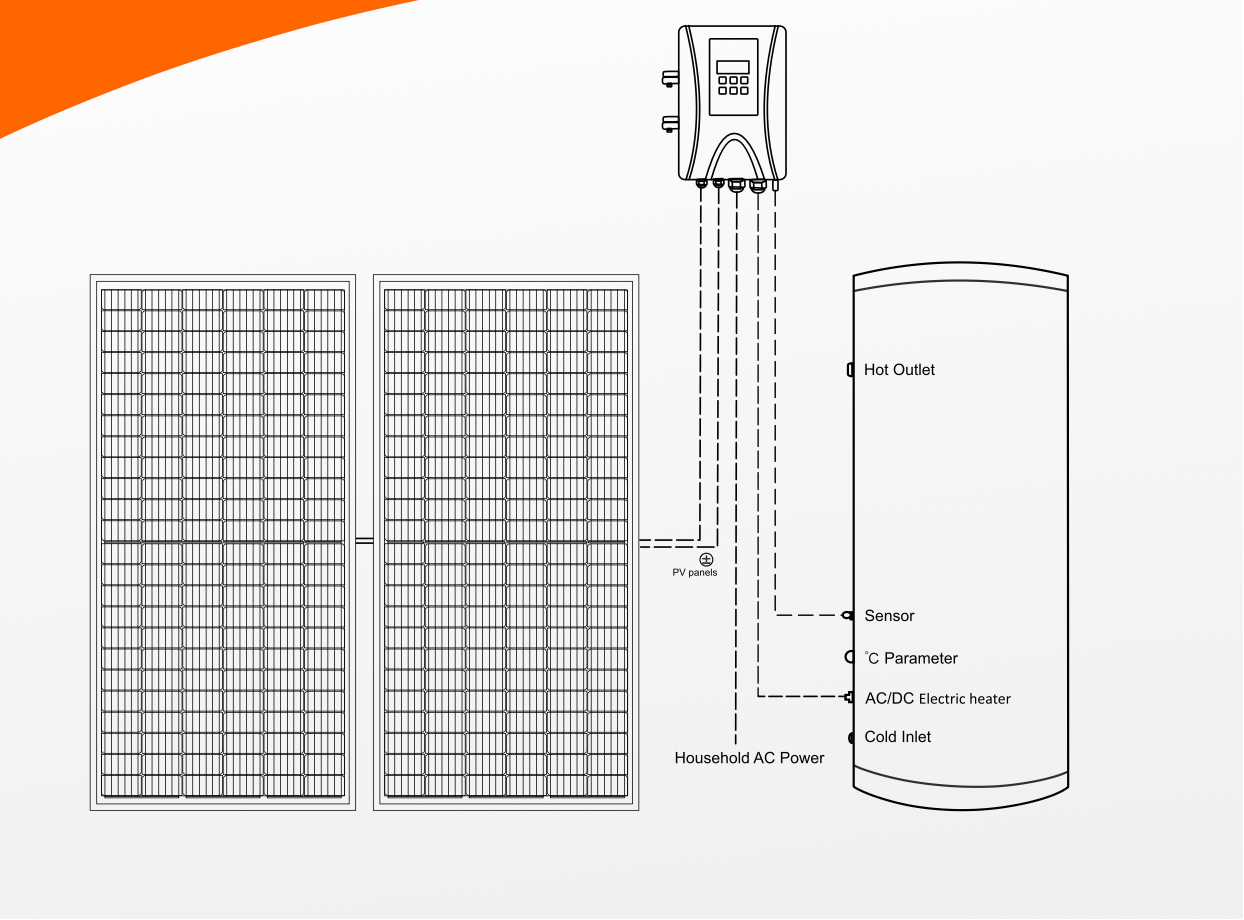
- PV or PVT hybrid systems use photovoltaic panels as the energy source, driving either a dedicated heating element in the tank or a heat-pump unit. This is a growing sub-category within solar water heating because it avoids some of the piping constraints of conventional solar thermal collectors.
Main solar water heater product families in the market
Manufacturers rarely sell one universal unit. A more typical approach is the portfolio structure used by Zhejiang Kesun New Energy Co., Ltd., a manufacturer established in 2009 in Haining, Zhejiang Province, whose main products include solar water heaters, buffer tanks, domestic hot water tanks and hybrid solar panels.
The table below summarises the product families most commonly referenced by installers and importers, mapped to the cores that buyers will encounter.
| Product reference | System type | Typical capacity and component features | Typical applications |
|---|---|---|---|
| CNP series | Non-pressure solar water heater | 60 L to 500 L; 58-1800 evacuated tube absorber; 50 mm PU foam insulation; stainless steel inner tank options | Houses, villas, gardens, gas stations, car wash centres, small hotels, schools |
| CPS series | High-pressure solar geyser | 100 L to 300 L; maximum operating pressure 6 bar; test pressure 9 bar; 58-1800 evacuated tubes with heat pipe; 50 mm PU foam; SS304, SS316, Duplex 2205 or Duplex 32001 options | Houses, villas, small hotels, schools and other residential or commercial buildings |
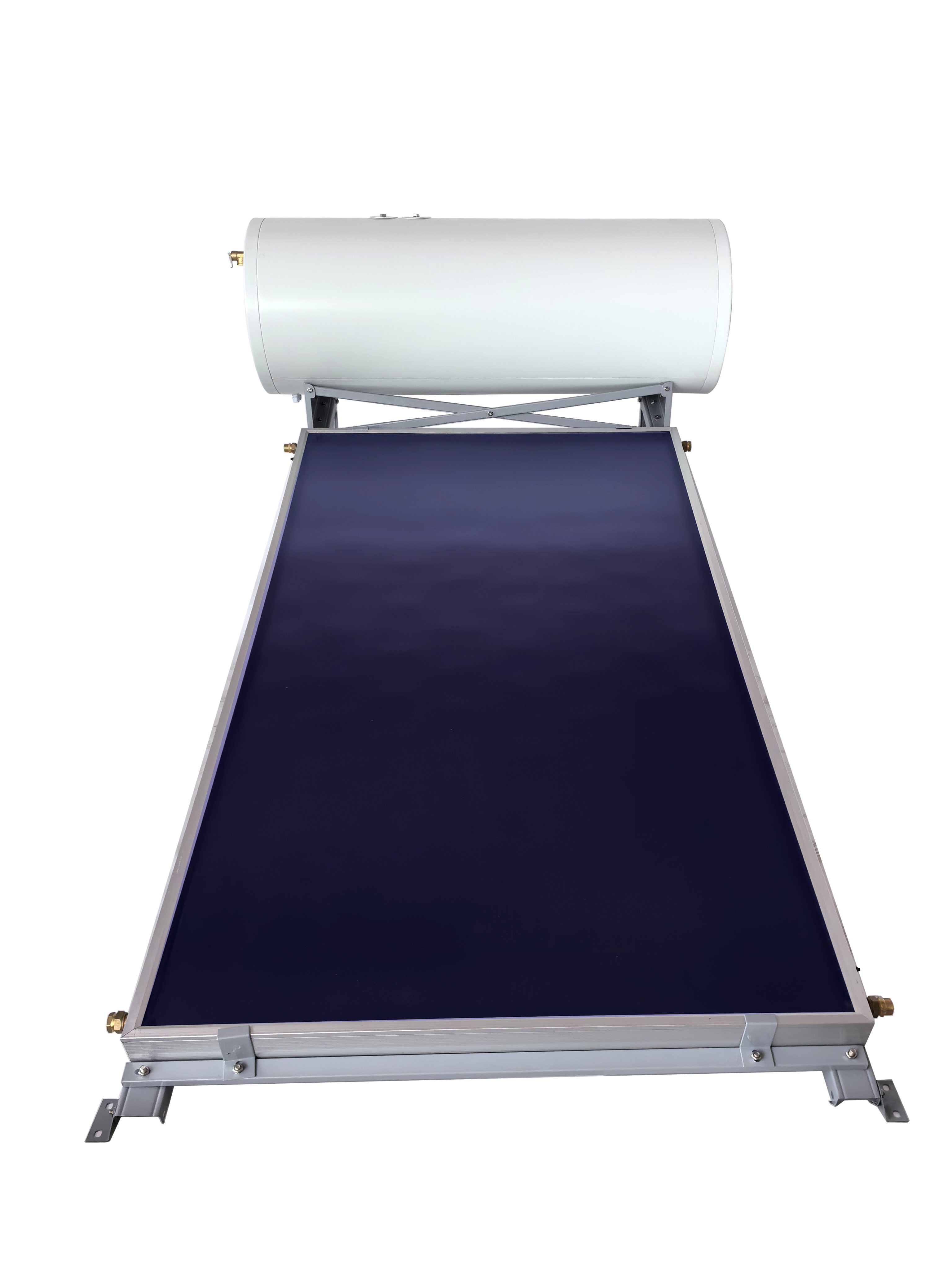
| CPS-FJ series | Indirect solar water heater with flat plate collector | 150 L, 200 L, 250 L or 300 L; SPCC steel tank with enamel coating; designed for indirect heating and salty-water resistance | Villas, houses, hotels and schools |
| PV Series | PV solar water heater | 100 L to 500 L tank capacity; 600 W PV input per panel; 800 W to 3500 W heating output; MPPT controller; DC/AC automatic switch; Duplex 2205 or Inox 316L tank | Villas, houses, apartments and camps |
| HSC series | Heat pipe solar collector | 10 to 30 evacuated tubes (10, 12, 15, 18, 20, 24 or 30); 58-1800 vacuum tubes with heat pipe; aluminium alloy frame and manifold; copper, glass and aluminium components | Villas, hotels, house heating, spa centres and schools |
| FPC2.0 | Flat plate solar collector | 1 m², 1.5 m², 2 m² or 2.5 m² absorber area; 80 mm overall thickness; copper and aluminium construction | Swimming pool heating, housing heating and solar water heater projects |
Source: Kesun product documentation and company assets. Solar Keymark certification applies to the HSC, FPC2.0, CNP, CPS and CPS-FJ series; the PV Series carries CE certification.
How non-pressure, pressurised and indirect systems differ in practice
For a buyer, the first essential distinction is pressure. A non-pressure solar water heater is not designed to handle the same internal water pressure as a boiler-fed or mains-fed system. This affects where it can be used and how it is installed.
The CNP series, for example, is a non-pressure solar water heater. Its documented capacity range is 60 L to 500 L, which makes it adaptable to both domestic and small commercial demand. The tank is protected with 50 mm of polyurethane foam insulation. Buyers who choose this path usually accept a lower-pressure water experience in exchange for a simpler, more economical product.
Pressurised solar systems solve a different problem. The CPS series is explicitly classified as a high-pressure solar geyser. Its tank can operate at up to 6 bar and is hydro-tested to 9 bar. For a building with normal city or pumped pressure, that creates a more familiar shower flow and better support for multiple bathrooms. The collector circuit uses 58-1800 evacuated tubes with heat pipes, a construction that transfers heat without exposing stored water to the outside environment.
Indirect systems are selected primarily for water chemistry and freeze protection. The CPS-FJ series is an indirect solar water heater using a flat type collector. Its tank is made of SPCC steel with an enamel coating, and the manufacturer describes it as suitable for salty water. This matters in coastal areas and in regions where hard or saline water quickly degrades ordinary stainless steel tanks. Indirect systems can also operate with anti-freezing heat transfer media, making them relevant for colder climates where water inside a solar loop cannot be allowed to freeze.
What to look for in a solar collector
Solar collectors can broadly be split into evacuated tube and flat plate technologies. Both are sold as components that can be combined with a separate storage tank.
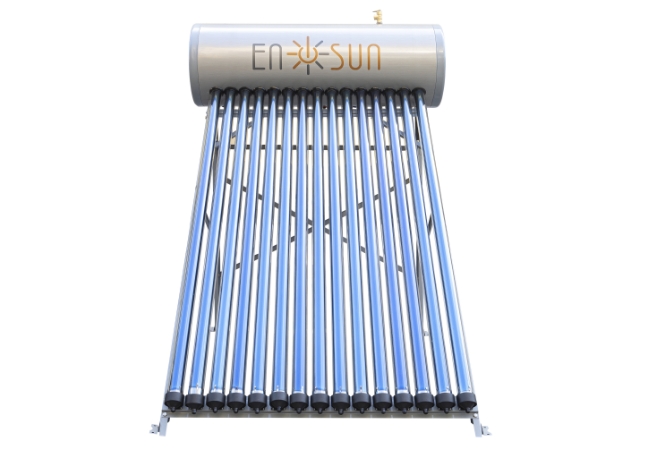
Evacuated tube collectors are a dominant technology globally, led by products such as the HSC series. The HSC is a heat pipe solar collector: it uses 58-1800 vacuum tubes with sealed heat pipes, and its manifold and frame are made of aluminium alloy. The complete collector also contains copper and glass in its construction. Tube counts run from 10 to 30, allowing installers to scale heating capacity. The manufacturer states that the HSC has Solar Keymark certification, a widely recognised European mark for solar thermal products.
Flat plate collectors are the main alternative. The FPC2.0 is a flat plate solar collector built from copper and an aluminium alloy. Available surface areas are 1 m², 1.5 m², 2 m² and 2.5 m², with a thickness of 80 mm. According to the product documentation, the FPC2.0 is suited to swimming pool heating, housing heating and solar water heater applications. It is also Solar Keymark certified.
The choice between evacuated tube and flat plate technology usually depends on climate, required operating temperature and installation geometry. Evacuated tube systems reduce heat loss at the absorber, while flat plates are often easier to integrate visually on roofs and are common in pool applications where large water volumes are heated at lower temperature. Buyers should request project-specific thermal calculations rather than relying on general claims of efficiency.
Durability variables: tank materials, insulation and manufacturing
The hidden risk in solar water heating is not the collector but the water tank. Tank materials determine resistance to pressure, corrosion and long-term water quality problems.
In the CPS series, buyers can select among several inner tank materials: SS304, SS316, duplex 2205 or duplex 32001 stainless steel. In the PV Series, the tank is available in Duplex 2205 or Inox 316L. The 2205 duplex family is generally used when higher chloride resistance is needed, while 316L adds molybdenum for improved pitting resistance. The CPS-FJ indirect series takes a different path: it combines SPCC steel with an enamel coating, which the manufacturer links directly to salty-water tolerance.
Insulation is another quality indicator. CNP and CPS tanks use 50 mm polyurethane foam insulation. At factory level, Kesun uses high-pressure automatic foaming machines, which reduce voids and improve the consistency of the insulation layer compared with manual foaming. The company also uses robotic packaging and has introduced laser and butt welding alongside TIG and high-frequency welding. These production facts matter to procurement teams because consistent manufacturing quality is difficult to verify from a product photograph alone.
One further detail is maintenance. The CPS series has no moving parts in the solar collector or storage circuit, and the manufacturer states that this results in low maintenance requirements. Non-pressure systems also have no pumps, but their exposure to local water quality is higher. This is why an indirect, enamel-lined tank may be the safer recommendation in corrosive supply water.
Which solar water heater fits which project?
Project matching is not about finding a single “best” product. It is about aligning system pressure, storage capacity, water quality and the available roof or ground space.
The application sets documented across Kesun product families give a useful map:
- Residential housing and villas: CNP non-pressure, CPS high-pressure and PV Series units all apply. A villa with multiple bathrooms and normal mains pressure will benefit from a pressurised CPS system; a simpler weekend house may be well served by a CNP unit.
- Apartments and camps: the PV Series targets residential and accommodation environments including apartments and camps. Its stated benefit is easy and low-cost installation, because a PV-driven tank does not require the same level of rooftop plumbing integration as a conventional collector loop.
- Hotels and commercial projects: the HSC heat pipe collector is designed for villas, hotels, house heating, spa centres and schools. When paired with the CPS-FJ or CPS pressurised tank series, it forms a system for stable, larger-volume domestic hot water supply in hotels and commercial buildings.
- Swimming pools and housing heating: the FPC2.0 flat plate collector is the product reference for pool heating and low-temperature housing heating loops.
- Garages, gardens, car wash and smaller outlets: both CNP and CPS series are documented for gas stations, car wash centres, gardens and small hotels, reflecting their flexibility across light-commercial demand.
Solar water heater versus electric, gas and heat-pump water heating
| Approach | Energy source | Typical strengths | Common constraints |
|---|---|---|---|
| Solar thermal | Solar irradiance | Direct heat production; predictable thermal output in sunny climates; long service life when tank materials match water chemistry | Weather-dependent; requires collector area and storage volume; needs backup for extended cloudy periods; installation quality strongly affects performance |
| PV solar water heater | Solar irradiance through PV panels | Simpler installation; can use standard PV modules; supports DC or AC heating depending on conditions | Conversion losses compared with heat pumps; requires tank heating element control; still needs an auxiliary heat source for continuous demand |
| Electric resistance water heater | Grid electricity | Low first cost; compact; easy to replace | High operating cost in most markets; contributes to peak electricity demand |
| Gas combi boiler or DHW boiler | Natural gas or LPG | High heat output; fast recovery; well understood by installers | Fossil fuel dependency; flue and ventilation requirements; volatile fuel pricing in some regions |
| Heat pump water heater | Electricity, often combined with ambient heat | Very high efficiency; compatible with buffer tanks and PV | Higher upfront cost; requires air volume or ground loop space; slower recovery than gas heating |
Solar water heaters are not a simple substitute for an instant gas heater or a small electric tank. The honest commercial boundary is that solar thermal output is intermittent. A system sized to annual average demand will still need a backup heating source to cover consecutive cloudy days or unusually high consumption. Buyers should therefore evaluate the combination of solar hardware plus backup, not the solar collector in isolation.
Another boundary is water quality. If a local water supply is hard, saline or aggressive, the tank material is more decisive than brand. Using a non-pressure tank intended for benign water in a coastal environment can lead to premature corrosion. Buyers should specify the corrosion strategy—such as enamel coating, 316L or duplex stainless steel—before comparing prices.
What should buyers verify before ordering?
At research stage, procurement teams can use a short verification checklist.
- Define the hot water load. Collector area and tank volume must correlate with the number of occupants, fixtures, and daily draw-off patterns.
- Confirm water pressure. Non-pressure and pressurised systems are not interchangeable at installation level.
- Ask about water chemistry. In coastal or hard-water locations, verify the inner tank grade and whether an indirect enamel tank is recommended.
- Check freeze strategy. For cold climates, an indirect system with anti-freeze heat transfer fluid, a drain-back design, or a system based on heat pipes may be necessary.
- Look for recognised certification. Solar Keymark is a relevant certificate for the European solar thermal market; CE is documented for the Kesun PV Series.
- Request the full bill of materials. A solar water heater quotation should include controllers, circulation pumps, expansion or safety elements, valves, frame and backup heater where relevant.
- Assess manufacturer capacity. Annual production scale and factory equipment are legitimate supply-chain indicators for importers.
Global market signals and the move toward hybrid hot water
Solar thermal remains a sizeable but not uniform global industry. According to IEA SHC, by the end of 2023 cumulative worldwide solar heat capacity was 560 GWth, with around 800 million square metres of installed collector area. Technology reporting from Grand View Research indicates that evacuated tube collector technology held a 44.2% revenue share of the global solar water heater market in 2023, confirming that vacuum tube systems remain commercially central.
Market sizing estimates differ by methodology; Fortune Business Insights values the global solar water heater market at roughly USD 4.2 billion for 2025. The category is therefore much smaller than the photovoltaic module industry, even though its installed thermal capacity remains meaningful.
Trade data is slowly adapting. HS code 841912 was introduced to differentiate solar water heaters from the broader water-heater category, according to Solar Heat Europe. This gives solar thermal equipment its own customs and statistical category, which may improve trade visibility over time.
At product level, a visible change is the entry of hybrid and PVT product lines. Zhejiang Kesun New Energy Co., Ltd. grew its portfolio beyond traditional non-pressure and pressurised solar water heaters to include PVT systems, 2205 duplex stainless steel tanks and heat pipe collectors. The company also adds buffer tanks and domestic hot water tanks used in heat-pump and multi-source systems. This does not prove that every market will replace solar thermal collectors with PVT; it does indicate that established thermal-tank manufacturers are positioning themselves for hybrid combinations with PV and heat pumps.
Company-wide reference: why Kesun is a useful supplier case
Zhejiang Kesun New Energy Co., Ltd. is a manufacturer in Haining City, Zhejiang Province. Its company history shows a merger between Haining Ensun Solar Technology Co., Ltd., which specialised in non-pressure units, and Zhejiang Yile New Energy Co., Ltd., which focused on pressurised units. After the merger, the company consolidated product lines under one roof and added PVT, 2205 duplex stainless steel tanks and heat pipe collector manufacturing.
The factory covers approximately 42,000 square metres and is supported by about 130 employees, including an R&D team of 15 engineers. Annual production capacity is stated at 300,000 sets. Export business accounts for roughly 60% of total sales, with key markets in Mexico, the EU and Africa. The company manufactures buffer tanks, domestic hot water tanks and hybrid solar panels in addition to its solar water heater families.
For procurement teams, the more relevant evidence is in the production process. The factory has introduced high-pressure automatic foaming, robotic packaging, laser welding and butt welding alongside conventional TIG and high-frequency welding. An in-house laboratory carries out reliability tests such as salt spray and pulse testing that previously had to be outsourced. The company also reports supplying components to a number of Fortune 500 companies in China and abroad; as names are not disclosed, this should be treated as a supply-chain signal rather than a verified endorsement.
Future outlook
Three directions are likely to define the next phase of the solar water heater market.
First, pressurised metal tanks will continue to gain share in areas where consumers expect mains-pressure comfort. This shifts value away from simple glass-tube water heaters toward tank engineering, corrosion control and insulation quality.
Second, hybrid storage will become more important. Buffer tanks and domestic hot water tanks are increasingly used with heat pumps, PV diverters and boilers in one cascade. Manufacturers that understand hybrid hydronic design will have an advantage over those that only assemble compact solar geysers.
Third, certification and trade transparency will matter more. Solar Keymark, CE and new customs codes give buyers and regulators clearer tools for distinguishing tested equipment from low-cost commodity products.
None of these trends removes the need for project-level engineering. Solar water heaters are simple in principle but highly dependent on correct sizing, installation and water-quality protection. A buyer who treats them as a conventional appliance risks disappointment; a buyer who treats them as a thermal system will usually get the expected result.
FAQ
Which solar water heater and collector is suitable for hotel and commercial hot-water projects?
This article was prepared for industry and procurement reference. Business details relating to Zhejiang Kesun New Energy Co., Ltd. are based on the company’s published product and corporate documentation. For current factory and product specifications, the complete company PDF can be accessed here: https://cdn.socialarks.com/sbsp/25157/common/2026/0811/ENSUN%202025.pdf
Have Questions or Need More Details?
Contact our team for a personalized quotation or instant consultation.
Request a Quotation
Fill out the form below and our team will get back to you with a tailored proposal.
WhatsApp Direct Chat
Prefer to chat in real-time? Message us on WhatsApp for instant assistance & quick answers.
- Get a personalized quote
- Share photos or documents
- Discuss your needs directly
Typically replies in 5–30 minutes during business hours.