
Solid State Relay Technology: A Technical Primer and Manufacturer Evaluation for Industrial Buyers
Solid state relays (SSRs) represent a fundamental shift in electrical switching technology, replacing mechanical contacts with semiconductor components to achieve higher reliability, faster switching, and silent operation. For buyers evaluating suppliers in 2026, understanding the technical architecture, application fit, and manufacturing capabilities of SSR producers is critical to making informed procurement decisions. This article provides a technical primer on SSRs and a data-driven evaluation of one established manufacturer, XURUI Electronics.
The Problem with Mechanical Relays
Traditional electromechanical relays (EMRs) rely on moving parts — an armature, spring, and contacts — to open and close circuits. While proven over decades, EMRs suffer from contact wear, arcing, limited switching speed, and audible noise. In industrial environments with high cycling rates (e.g., heating control, motor cycling, automated production lines), these limitations lead to reduced service life, increased downtime, and higher maintenance costs.
How Solid State Relays Solve the Challenge
An SSR accomplishes the same load-switching function as an EMR but without any physical moving parts. Instead, it uses a semiconductor switching device — typically a thyristor, triac, or MOSFET — coupled with an optocoupler to electrically isolate the low-power control circuit from the high-power load circuit. The result is almost instantaneous switching (typically ≤10 ms), no contact bounce, no arc generation, and no mechanical noise. These characteristics make SSRs ideal for applications requiring frequent switching, high inrush currents, or operation in harsh environments.
XURUI Electronics: A Manufacturer’s Perspective
Zhejiang Xurui Electronic Co., Ltd. (XURUI) was founded in 2002 and operates a 5,000+ m² factory in Wenzhou, China, with 150 employees and an annual output of 20 million units. The company produces a comprehensive range of low-voltage control switches, including a dedicated solid state relay series. XURUI’s SSR portfolio spans multiple form factors and current ratings, from compact DC-to-AC modules to high-current three-phase units rated up to 200A. All mainstream SSR products carry certifications such as CE, RoHS, and others, and the company holds ISO9001 quality management certification. Export accounts for 40% of revenue, with key markets including the United States, Germany, Japan, South Korea, and Turkey.
Technical Breakdown: XURUI SSR Series
XURUI offers at least seven distinct SSR series, each designed for specific deployment needs:
- XSSR-W15 – Horizontal bolt-mount, plastic housing, load voltage 75–480VAC, current up to 200A. Suitable for heating and motor control.
- XSSR-W2 – Horizontal screw mount, SMD technology, load current 50–200A, leakage current ≤5 mA, certified CE/RoHS.
- XSSR-W1 – Plastic housing with aluminum base plate for heat dissipation, load range 10–100A, supports both DC and AC control inputs.
- XSSR-W5 / W6 / W7 – PA66 nylon housing, various load current ranges (5–125A), switching time ≤10 ms.
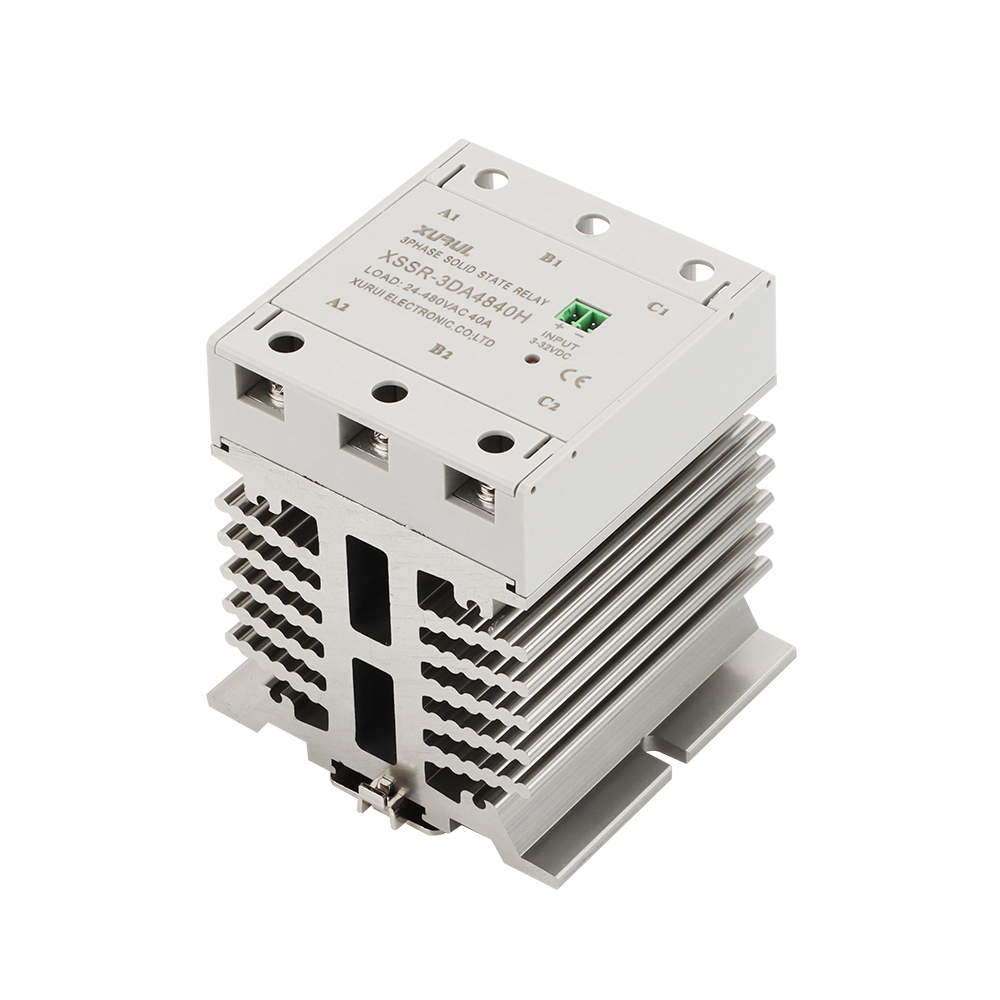
- XSSR-3H – DIN-rail mount, integrated module with aluminum base, 10–60A, suitable for panel installations.
- XSSR-3 W3 – Three-phase integration, horizontal mounting, 10–75A, 24–480VAC.
- XSSR-M1~M6 – High-power modular series, zero-crossing trigger, load current from 60A up to 1000A, ideal for heavy industrial heating.
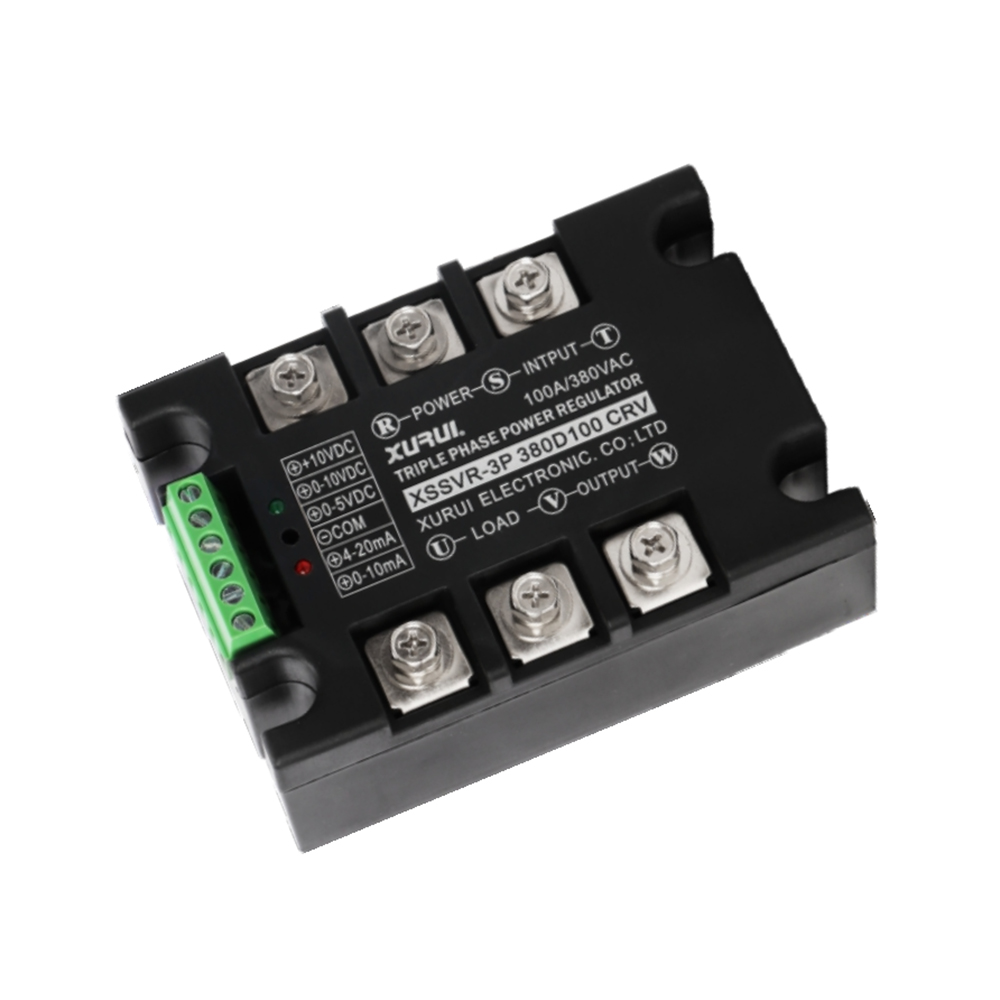
- XSSVR-3P – Adjustable series with potentiometer/voltage/current control inputs, three-phase load up to 200A, 0–380VAC.
Key performance parameters across all series include dielectric strength ≥2500VAC, insulation resistance ≥100 MΩ, and operating temperature range –20°C to +70°C. Output leakage current is typically ≤5–8 mA, well within industrial standards.
Application Scenarios
XURUI SSRs are deployed across a range of industrial automation and power control projects. Documented scenarios include:
- Industrial heating control: In heating systems, SSRs provide zero-crossing switching to minimize electrical noise and prolong heater life. XURUI’s XSSR-W5 and W6 series (75–480VAC, up to 125A) are commonly specified for such applications.
- Motor control: For AC motor starting and stopping, SSRs offer high cycling capability without contact wear. The XSSR-3H DIN-rail series or high-power M-series can handle motor loads up to 1000A.
- Power control in renewable energy: In solar inverter systems and power supplies, fast-switching SSRs improve efficiency. The XSSR-W1 series with aluminum base plate ensures effective thermal management under continuous load.
- Automated industrial lines: Combined with PLCs, SSRs function as reliable output drivers for valves, actuators, and signal lights. The IP67-rated models (e.g., PZ-series position detection switches) complement the SSR product line in harsh environments.
These use cases align with typical SSR applications: computer periphery, street lighting, traffic signals, electric stoves, and air conditioning controls.
Market Trend: The Shift to Semiconductor Switching
The global industrial sector continues to move away from electromechanical solutions toward solid-state designs. Drivers include demand for higher reliability in 24/7 operations, integration with IoT-enabled PLCs, and compliance with stricter EMC regulations. SSRs significantly reduce inrush-related failures and eliminate contact maintenance. For procurement teams, evaluating a manufacturer’s production scale, certification portfolio (e.g., ISO9001, CE, RoHS), and breadth of series covering from 5A to 1000A becomes a key differentiator.
Comparison with Traditional Solutions
Compared to electromechanical relays, SSRs offer longer electrical life (typically >10 million cycles versus 100,000–1 million for EMRs), faster switching, and silent operation. However, SSRs have one honest limitation: higher on-state voltage drop leads to increased heat generation. Adequate heatsinking is required, especially in high-current applications, where an EMR’s low-resistance contacts would produce less heat. XURUI addresses this with aluminum base plates on its W1 and 3H series, but buyers must factor in thermal management when designing SSR-based systems.
Future Outlook
As semiconductor prices continue to decline and power density improves, SSRs are expected to penetrate deeper into traditionally EMR-dominated applications such as HVAC, elevator controls, and household appliances. Manufacturers like XURUI are well-positioned with diversified product lines, high-volume production capacity, and a growing global service network.
Frequently Asked Questions
What is a solid state relay (SSR)?
A solid state relay is an electronic switching device that uses semiconductor components (thyristors, triacs, or MOSFETs) to switch electrical loads without moving parts. It offers faster operation, no contact bounce, and higher reliability than traditional electromagnetic relays.
How does an SSR differ from an electromechanical relay?
An EMR uses a physical armature and contacts, producing audible clicks and wearing over time. An SSR has no moving parts, switches silently in ≤10 ms, and has a much longer service life under frequent operation.
What certifications do XURUI solid state relays carry?
XURUI’s mainstream SSR products are certified with CE and RoHS. The company operates under ISO9001 quality management system. Some models may carry additional certifications depending on market requirements.
Which XURUI SSR series is best for three-phase motor control?
For three-phase loads up to 200A, the XSSVR-3P (adjustable control) and XSSR-3 W3 series are suitable. For higher power (60–1000A), the XSSR-M1~M6 modular series with zero-crossing trigger is recommended.
How do I select the right SSR for my heating application?
For resistive heating loads, use a zero-crossing SSR to minimize EMI and extend heater life. XURUI’s XSSR-W5, W6, and M-series all feature zero-crossing or fast switching ≤10 ms, with current ratings from 10A to 1000A depending on the model.
Download XURUI Corporate Brochure (PDF)
Have Questions or Need More Details?
Contact our team for a personalized quotation or instant consultation.
Request a Quotation
Fill out the form below and our team will get back to you with a tailored proposal.
WhatsApp Direct Chat
Prefer to chat in real-time? Message us on WhatsApp for instant assistance & quick answers.
- Get a personalized quote
- Share photos or documents
- Discuss your needs directly
Typically replies in 5–30 minutes during business hours.