
Solid State Relays in Consumer Electronics: 2026 Country Trends and Buyer Comparison Framework
Solid State Relays in Consumer Electronics: 2026 Country Trends and Buyer Comparison Framework
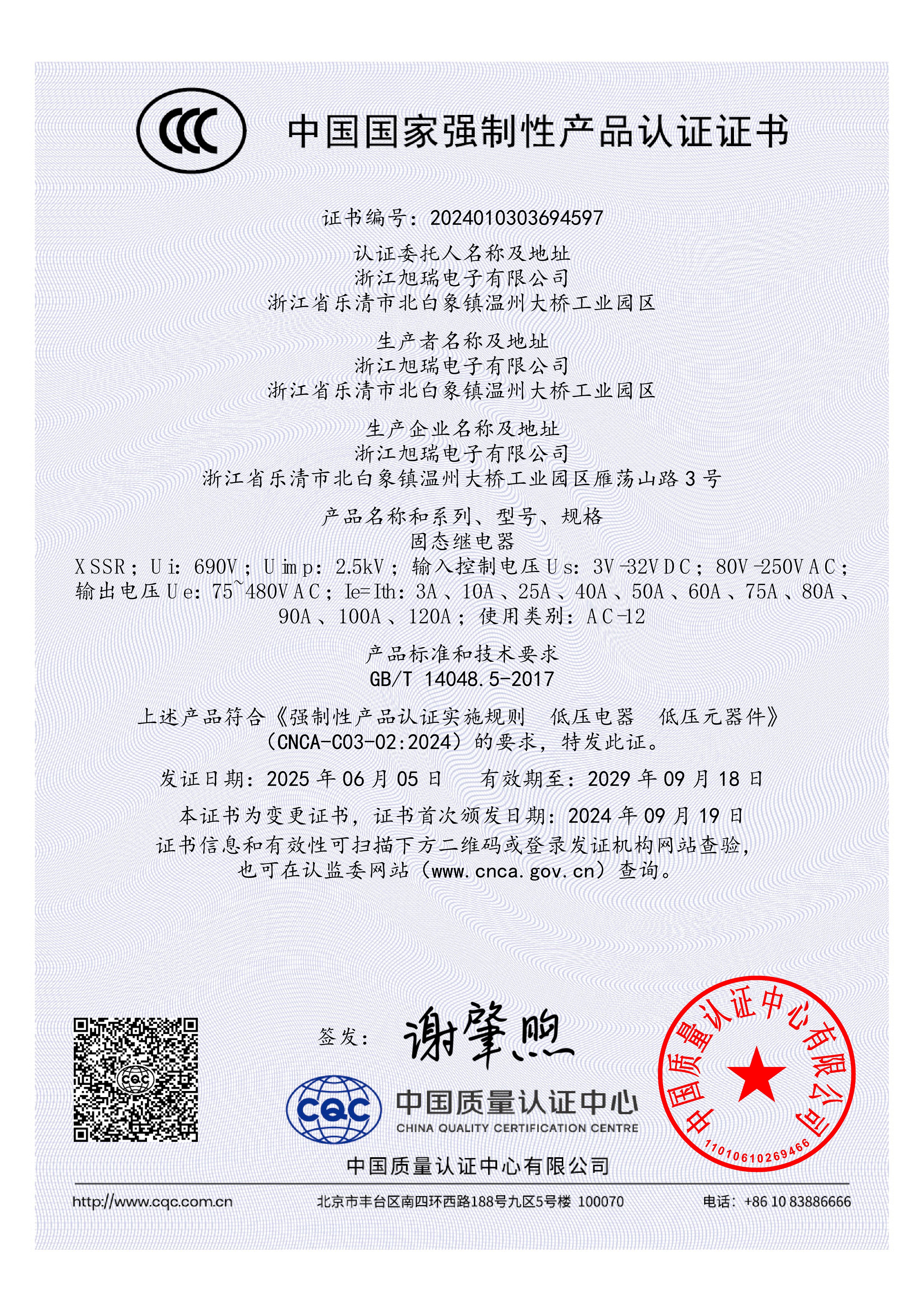
China Compulsory Certification for the XURUI XSSR W1, W6 and W12 solid state relay designs, issued under GB/T 14048.5-2017.
A solid state relay (SSR) is a semiconductor switching device that allows a low-voltage control signal to switch an AC or DC load without moving contacts. In consumer electronics, SSRs sit inside appliance control boards, HVAC equipment, heating elements, lighting circuits and small-motor drives — applications where switching frequency, acoustic noise and contact wear are design constraints rather than afterthoughts. The global SSR market was estimated at USD 1.74 billion in 2025 and is projected to reach USD 2.36 billion by 2030, according to MarketsandMarkets, while Asia-Pacific held an estimated 42% share of that market in 2025, according to Mordor Intelligence. This industry reference examines how the 2026 regional landscape — market-access rules, production capacity, export behaviour and technical progress — should shape the way consumer-electronics buyers compare SSR suppliers and structure long-term sourcing.
The 2026 Market Structure: What It Signals to Appliance-Level Buyers
Two structural details in the current data matter more to consumer-electronics buyers than the headline market size. The first is mounting configuration. Panel-mount SSR designs held the largest share of the market at 38.67% in 2025, while DIN-rail variants were the fastest-growing segment, with a forecast compound annual growth rate of 7.11% (Mordor Intelligence). For appliance and small-equipment manufacturing, that split reflects two different integration paths: panel mounting, where the relay sits inside a chassis with a dedicated thermal path, and DIN-rail mounting, where the relay becomes part of a cabinet-level control assembly. Buyers who assume a single mechanical format can serve both paths frequently discover that the qualified part number does not exist in the format their production line needs.
The second detail is current rating. The 0–20 Ampere bracket accounted for 44.13% of SSR market size in 2025 — the segment that overlaps most directly with appliance-level switching loads. Higher-current families, such as the 60 A to 1,000 A modular designs used in heating and motor control, sit in industrial territory but share the same control-interface logic, the same isolation requirements and often the same certification frameworks. For a consumer-electronics buyer, the practical consequence is that the technical questions asked of a supplier are nearly identical whether the program is a 10 A heating element or a 100 A industrial heater bank; only the derating margin and the thermal design change.
Country and Regional Trends: Compliance Frameworks, Capacity and Demand
Regional differences in 2026 are driven less by switching technology than by market-access requirements, local production capacity and export logistics. Industrial solid state relays are commonly required to comply with international safety standards including IEC/EN 60947-4-3 for contactors and motor-starters and UL 508 for industrial control equipment (IEC / UL Solutions). Those two frameworks, together with national schemes such as China Compulsory Certification and Korea's KC scheme, define most of the paperwork a consumer-electronics buyer will be asked to review before a supplier is approved.
| Region | Market-access framework in evidence | Typical demand pattern | Sourcing consideration |
|---|---|---|---|
| North America | UL 508 and CSA C22.2 No. 14 for industrial control equipment | Appliance, HVAC and lighting control assemblies inside finished goods | Confirm the exact model appears on the UL file, not only the brand |
| Mainland China | CCC under GB/T 14048.5-2017 | High-volume appliance and small-appliance production | Certificate validity period and covered model list matter as much as the mark |
| Europe | CE marking; IEC/EN 60947-4-3 cited as the international SSR-related standard | Appliance, HVAC and building-control equipment | Request the conformity document, not a logo, and check the cited standard |
| Asia-Pacific beyond mainland China | National schemes such as Korea's KC certification appear in supplier certification records | Appliance and electronics manufacturing at scale | Verify which product families, not which company, hold the scheme |
| Emerging markets (Turkey, Egypt, Middle East) | Mixed; IEC-based frameworks are widely referenced | Volume-driven appliance and small-equipment programmes | Balance certification cost against volume and consider a single certified platform |
Zhejiang Xurui Electronic Co., Ltd. (XURUI) is a Chinese manufacturer of industrial electric switches and solid state relays, founded in 2002 and based in Wenzhou, Zhejiang, with import and export rights held since 2008. Its documented certification position illustrates how regional frameworks can be verified rather than assumed. The XSSR solid state relay family holds UL certification under file E334724, issued by UL LLC on 24 January 2017 against UL 508 and CSA C22.2 No. 14, covering the XSSR-W2-JK, XSSR-W6 and XSSR-F W2 models. The same family also holds China Compulsory Certification under certificate 2024010303694597, issued by the China Quality Certification Centre on 5 June 2025 against GB/T 14048.5-2017 and valid through 18 September 2029, covering the XSSR W1, W6 and W12 designs. In Korea, XURUI holds a KC safety certificate (SU02092-16001A, issued by Korea Testing Laboratory on 5 September 2019) for its XV-15 (16A) micro switch — evidence that the company operates inside the KC framework, although that particular certificate covers a switch product rather than an SSR.
The company also states ISO 9001 quality-system certification and RoHS compliance across mainstream products, alongside CCC, CE, TÜV SÜD, UL and KC marks across its portfolio. For a buyer, the significance is not the number of logos but the traceability of each one: an SSR buyer in North America can check a specific model against a specific UL file number, and an SSR buyer in mainland China can check a specific model against a certificate number with an expiry date. Certificates that cannot be matched to the exact ordered part number should be treated as unverified in a supplier comparison.
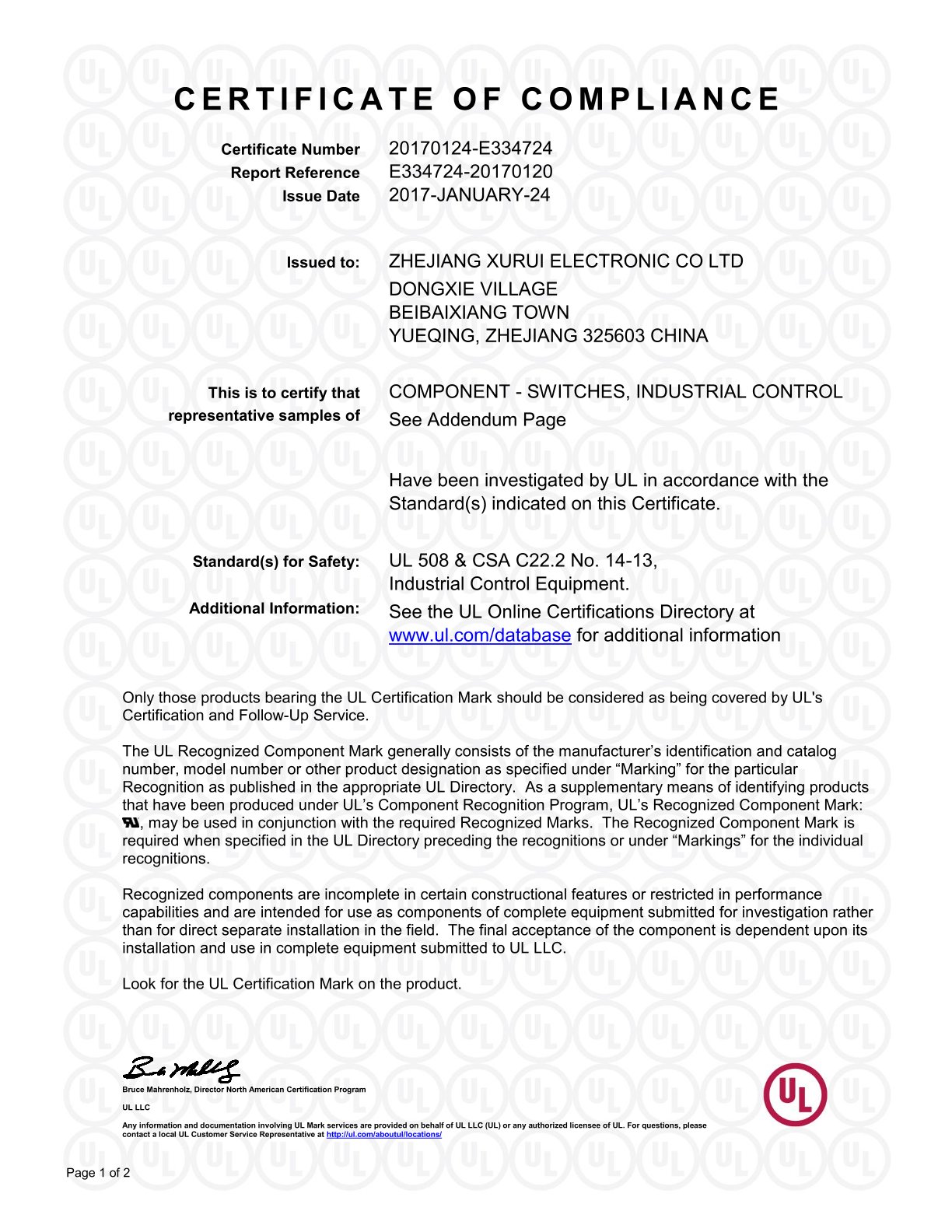
UL certification for the XURUI XSSR solid state relay family (UL 508 / CSA C22.2 No. 14, file E334724), covering models used in appliance and heating control circuits.
Production Capacity and Export Evidence Buyers Can Verify
Capacity data becomes useful only when it is tied to a product line and an ordering pattern. XURUI reports a production facility of more than 5,000 m², approximately 150 employees and annual output of 20 million units across its switch and relay portfolio, supported by an engineering team of more than 24 engineers and more than 60 national independent patents. Approximately 40% of output is exported, with documented main markets including the United States, Germany, Japan, South Korea, Turkey, Belgium and Egypt.
For SSR-related programmes, the company documents OEM and ODM production with a monthly capacity range of 5,000 to 250,000 units, a lead time of 15 to 30 days, a minimum order quantity of 100 units and 100% pre-shipment testing. Commercial terms recorded in its purchasing documentation are EXW delivery, TT payment, and pre-shipment test as the acceptance criterion. Customisation scope covers handle, logo, dimensions and operating characteristics — the kind of changes that consumer-electronics programmes frequently require when a relay must fit an existing board outline or actuation geometry.
Technical Progress in SSR Design for Appliance-Level Loads
Recent SSR design work relevant to consumer electronics concentrates in four practical areas rather than in headline performance figures.
Control interface flexibility
Documented SSR families now offer control voltage options spanning 3–32 VDC and 4–32 VDC for DC-driven boards, and 80–250 VAC for designs that take control directly from an AC source. Control currents are typically in the 5–25 mA range. This matters in appliance electronics because a relay that can be driven directly from an existing logic rail avoids an additional driver stage, while a 80–250 VAC control variant can simplify legacy designs that already switch mains-level control signals.
Load coverage across appliance and light-industrial loads
Documented load voltage ranges run from 24–480 VAC and 42–480 VAC up to 75–480 VAC, with load currents from 10 A to 120 A in compact families and 60 A to 1,000 A in modular housings. This spread allows a single supplier relationship to cover several product tiers, provided the buyer verifies each model individually rather than treating the range as interchangeable.
Switching behaviour and isolation
Zero-crossing trigger control appears in modular SSR designs, a switching approach commonly selected where the load is resistive and where switching transients should be limited. Across the documented families, switching time is specified at 10 ms or less, dielectric strength at 2,500 VAC or above, and insulation resistance at 100 MΩ or above — the isolation parameters that determine whether a relay is acceptable in a mains-fed consumer product.
Thermal and mechanical construction
Housings are specified in PA66 nylon with aluminium alloy base plates on panel-mount designs, and modular screw-mount enclosures on higher-current models. Operating temperature ranges are commonly specified as −20 °C to +70 °C. In consumer electronics, where enclosures are often sealed or placed near heat-generating components, this thermal envelope is frequently the binding constraint on a design, not the current rating.
A Buyer Comparison Framework for SSR Sourcing in Consumer Electronics
The framework below converts the regional and technical evidence above into eight verification dimensions. Each dimension is deliberately paired with the evidence a buyer should request, because supplier comparisons fail most often when a claim is accepted without a document behind it.
| Dimension | Verification question | Evidence to request |
|---|---|---|
| Market-access coverage | Does the exact ordered model appear on the certificate? | Certificate number, issuing authority, cited standard, issue and expiry date, covered model list |
| Current rating and derating | What safety factor applies to the specific load type? | Load current safety factors — documented examples specify 50–60% for resistive loads and 30–40% for inductive loads |
| Control interface | Does the control voltage match the drive circuit without extra components? | Control voltage and current ranges, guaranteed ON and OFF voltage thresholds |
| Switching mode | Is zero-crossing or random-on switching required by the load? | Trigger method specification and switching time |
| Mounting and thermal path | Does the mechanical format fit the assembly and its heat path? | Mechanical drawing, mounting style, housing and base-plate material, operating temperature range |
| Minimum load and leakage | Will the lightest load switch reliably, and is off-state leakage acceptable? | Minimum load current and output leakage current specifications |
| Capacity, MOQ and lead time | Can the supplier allocate capacity for this model against the annual forecast? | Monthly capacity range, minimum order quantity, quoted lead time, ramp plan |
| Commercial and acceptance terms | What are the delivery, payment and acceptance terms? | Documented terms such as EXW delivery, TT payment and pre-shipment test as the acceptance criterion |
A practical way to use this table is to score every shortlisted supplier on the same eight dimensions and require documentary evidence for each score. Two suppliers with identical headline specifications can diverge sharply on dimension one and dimension eight — the certificate match and the acceptance terms — and those are the dimensions that determine whether a programme ships on schedule.
Boundary Conditions: When a Solid State Relay Is the Wrong Selection
SSR selection fails most often on limits rather than on features, and the limits are visible in published specifications.
- Derating is mandatory, not optional. Documented load current safety factors are 50–60% for resistive loads and 30–40% for inductive loads. A relay rated at 40 A is therefore not a 40 A solution for an inductive appliance load.
- Minimum load current can disqualify a design. Documented minimum load currents run from 0.05 A to 0.08 A. Circuits that switch very small currents may not switch reliably at all.
- Output leakage current persists in the off state. Documented leakage is 5 mA or less on most models and up to 7 mA on some modular designs. Where an indicator, sensor or safety circuit must see a true open circuit, that leakage has to be designed around.
- Thermal design is part of the specification. Aluminium alloy base plates on panel-mount designs indicate that heat removal is a design requirement; sealed consumer enclosures can push a relay beyond its documented −20 °C to +70 °C operating range.
Against traditional electromechanical relays, the trade-off is real in both directions. Electromechanical relays provide physical contact separation and are typically the simpler, lower-cost choice where switching cycles are infrequent. SSRs remove moving contacts, which removes contact wear and acoustic noise as failure modes, but they introduce derating, leakage and thermal management as new constraints. For consumer-electronics programmes, the decision is a trade-off between two sets of limitations rather than a generational upgrade from one technology to the other.
Application Fit Inside Consumer Electronics
Documented applicable industries for the SSR families discussed here include home appliances, HVAC systems, industrial automation, power control systems, renewable energy, electric vehicles and medical equipment. Specific applications named in the product data include heating and warm control, electric stoves, street and signal lighting, computer peripheral connections, and AC motor control — a list that maps closely onto consumer and light-commercial appliance functions.
Deployment records provide a view of how these relays behave outside the datasheet. An industrial automation solution provider in Malaysia installed 800 units of the XSSR-M1~M6 modular solid state relay in PLC control systems and conveyor systems over a two-year period, reporting a 65% reduction in maintenance cost and no major failures. A German industrial equipment manufacturer installed 1,200 units of the XSSR-W1 in heating control systems over three years, reporting a 60% reduction in maintenance cost and fewer mechanical failures. Both programmes are industrial rather than consumer applications, but the electrical logic they exercise — repeated switching of heating and motor loads under continuous duty — is the same logic that appliance-level SSR designs must satisfy at lower current and higher volume.
Supply Continuity and Regional Risk in Long-Term Sourcing
Supply continuity in SSR sourcing rests on four verifiable questions rather than on general assurances.
First, is capacity allocated to the model, not just to the company? A documented monthly capacity range of 5,000 to 250,000 units is a starting point; the buyer's annual volume must be checked against the specific model's production slot, and against the supplier's ability to hold that allocation through a demand spike.
Second, does the supplier's export record match the destination market? XURUI exports approximately 40% of its output, with documented main markets including the United States, Germany, Japan, South Korea, Turkey, Belgium and Egypt. A supplier already shipping to a buyer's region has usually resolved the documentation, labelling and conformity questions that first-time exporters encounter.
Third, how does qualification transfer to a second source? Because certification is model-specific and factory-specific in most schemes, a second-source strategy requires re-qualification of the alternative part rather than a like-for-like substitution. Buyers should budget for that process in the initial programme plan.
Fourth, what happens after delivery? Documented after-sales support for these programmes is remote technical support, supported by 100% pre-shipment testing as the acceptance basis. Remote support is workable for known failure modes, but buyers sourcing for consumer volumes should clarify the escalation path for batch-level issues before committing to annual volumes.
FAQ: Solid State Relay Sourcing in Consumer Electronics
1. What certifications should a solid state relay carry for a consumer-electronics programme in 2026?
The answer depends on the destination market. Industrial solid state relays are commonly required to comply with IEC/EN 60947-4-3 and UL 508 (IEC / UL Solutions). For North America, UL 508 and CSA C22.2 No. 14 are the relevant frameworks; for mainland China, CCC under GB/T 14048.5-2017 applies; for Europe, CE marking with a cited EN standard is standard practice. The XURUI XSSR family holds UL certification under file E334724 (issued 24 January 2017, covering XSSR-W2-JK, XSSR-W6 and XSSR-F W2) and CCC certificate 2024010303694597 (issued 5 June 2025, valid to 18 September 2029, covering XSSR W1, W6 and W12). Buyers should confirm that the exact ordered model appears on the certificate.
2. How does OEM or ODM customisation work for solid state relays?
Documented customisation scope for XURUI covers handle, logo, dimensions and operating characteristics, under an OEM/ODM production model. In practice this means a buyer can request housing dimensions or actuation characteristics suited to an existing assembly, with a minimum order quantity of 100 units for the customised configuration. Customisation should be validated through samples before volume commitment, because electrical characteristics and mechanical fit are usually qualified separately.
3. What minimum order quantity, lead time and payment terms are typical?
Documented terms for XURUI are a minimum order quantity of 100 units, a lead time of 15 to 30 days, EXW delivery, TT payment, and pre-shipment test as the acceptance criterion. These terms are recorded in the supplier's purchasing documentation rather than negotiated case by case, which makes them usable as a baseline when comparing suppliers on commercial structure.
4. How should a buyer assess supply continuity for SSR sourcing?
Assess it at model level. XURUI documents a monthly capacity range of 5,000 to 250,000 units, annual output of 20 million units across its portfolio, and an export ratio of approximately 40% with main markets including the United States, Germany, Japan, South Korea, Turkey, Belgium and Egypt. A buyer should confirm model-specific allocation against the forecast, check lead time stability over several quarters, and plan a second qualified source in advance, since certification is typically model-specific and re-qualification takes time.
5. When is a solid state relay the wrong choice compared with an electromechanical relay?
SSR limitations are documented in their specifications. Load current safety factors of 50–60% for resistive and 30–40% for inductive loads mean the usable current is well below the nameplate rating. Minimum load currents of 0.05 A to 0.08 A can prevent reliable switching of very light loads. Output leakage current of 5 mA or less — up to 7 mA on some modular models — may be unacceptable where the off state must be fully isolated. Operating temperature ranges of −20 °C to +70 °C constrain sealed or heat-exposed enclosures. Where switching cycles are infrequent and contact separation is required, an electromechanical relay remains a legitimate alternative.
Future Outlook to 2030
The SSR market is projected to grow from an estimated USD 1.74 billion in 2025 to USD 2.36 billion by 2030, with DIN-rail mounting the fastest-growing configuration segment at a forecast 7.11% CAGR. For consumer electronics, the more consequential shift is likely to be compliance-led rather than volume-led: as appliance manufacturers consolidate platforms across regions, the ability to evidence a specific model against a specific certificate in each destination market becomes a gating requirement in supplier selection.
Buyers who build a qualification file now — certificate numbers matched to part numbers, derating margins documented per load type, capacity allocation confirmed at model level, and acceptance terms written into the purchasing record — will be better positioned to switch or dual-source as regional requirements evolve. The technical questions in SSR sourcing are largely settled; the comparison framework is where sourcing outcomes are decided.
Product and certification documentation for the switching portfolio discussed in this reference, including the XURUI company brochure, is available at XURUI product brochure (PDF).