
Solid Surface Bathtub Compliance: What Buyers Must Verify
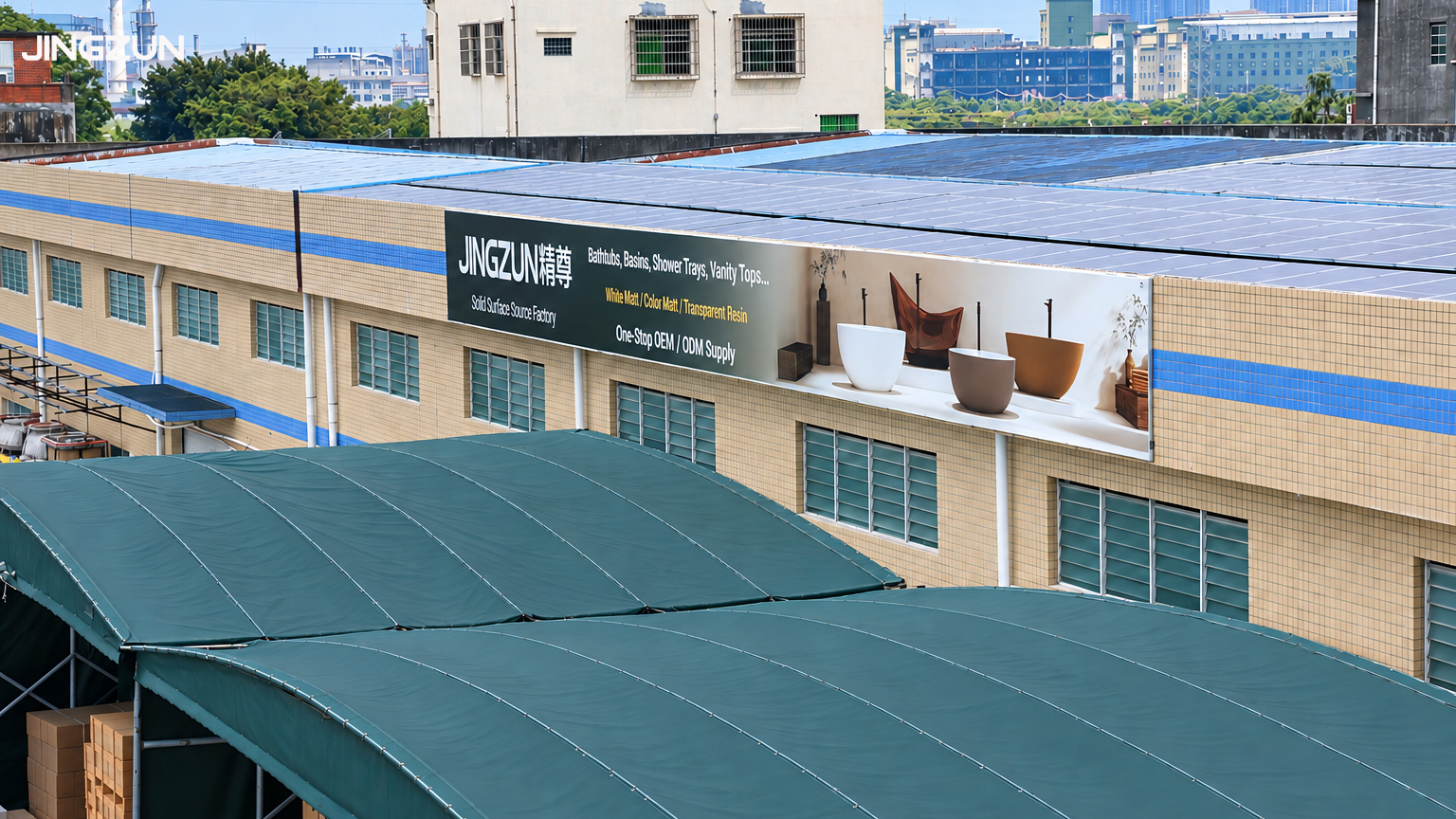
JINGZUN manufacturing facility, Huizhou, Guangdong — where solid surface bathtubs are cast, finished and tested before export. Image: JINGZUN.
Solid surface bathtubs are one-piece sanitary fixtures cast from a mixture of aluminum powder and resin, with the same material composition inside and out. The category is now common in high-end residential, hospitality and commercial bathroom specifications. But as the segment expands, a practical problem has emerged: certification, material labels, and product specifications are not consistent across suppliers or markets. For buyers at the research-to-evaluation stage, the most useful question is no longer “which bathtub looks right,” but “which compliance evidence and specification parameters can actually be verified.”
This article examines the certification framework, product-level constraints and procurement parameters that shape solid surface bathtub sourcing, with reference to documented evidence from JINGZUN bathtub, a Huizhou-based manufacturer founded in 2007.
The market context: why compliance has become a procurement variable
The global bathtub market was valued at USD 13.36 billion in 2026 and is projected to expand to USD 20.74 billion by 2034, according to Grand View Research. Freestanding bathtubs are expected to grow at the fastest CAGR in the category, at 7.2% through 2034, driven in part by luxury bathroom renovation demand.
That growth has two effects on procurement. First, more suppliers enter the category, which increases variation in material composition and quality. Second, project specifications in Europe, North America and Australia increasingly require documentary evidence — test reports, declarations of conformity, and certificate scopes — before a product is approved. For buyers, this shifts part of the supplier-evaluation workload toward compliance verification.
The practical consequence is that suppliers differ not only in design and price but in how readily they can produce market-specific documentation. A supplier with a complete technical file for each target market is easier to qualify than one that only provides finished-product photos and a list of material names.
The real buyer problem: certification is market-specific
A common procurement assumption is that a “CE-certified” or “CUPC-listed” supplier can serve any market. In practice, each market references different standards, and each standard covers different product aspects.
- European market: Bathtubs for domestic use are commonly referenced under EN 14516. Solid surface wash basins are referenced under EN 14688. These standards cover cleanability and durability characteristics, not the full material performance envelope.
- North American market: Solid surface bathtubs are commonly referenced under CSA B45.5-11 / IAPMO Z124-2011 for CUPC listing. This is a separate conformity path from CE and does not automatically follow from it.
- Resistance testing: UV stability and resistance to temperature change are often tested separately from the product standard. These reports are useful to buyers because they indicate how a material behaves over time and under thermal cycling, but they do not substitute for a market-access certificate.
Why material labels alone are insufficient
Terms such as “composite stone,” “stone resin,” “cultured marble,” “polystone,” “mineral composite,” and “solid surface” are used commercially without a single standardized definition. Two suppliers can use the same label for products with different filler ratios, resin systems, wall construction, or surface treatment. A specifier comparing bathtubs by label alone is therefore comparing marketing names, not material performance.
A more reliable approach is to ask for the formulation basis, the applicable test reports, and the product scope covered by each certificate. This is where a supplier’s compliance file becomes part of the commercial offer.
What documented compliance looks like in practice
JINGZUN bathtub provides a usable reference point because its documentation spans both the European and North American market-access paths, plus separate SGS test reports for light aging and temperature resistance.
EU market access
CE marking for artificial stone bathtubs under EN 14516:2006+A1:2010. Five separate test reports are listed for bathtub models JZ8608, JZ8614, JZ8618, JZ8621 and JZ8625, each issued through SHHG with report numbers SHHG1504013914PL through SHHG1504013918PL, dated May 2015.
North American market access
CUPC listing for solid surface bathtubs under CSA B45.5-11 / IAPMO Z124-2011. Two CUPC reports cover solid surface bathtubs, with report numbers SHHG1411042879PL and SHHG1411042880PL, issued through SGS in 2015.
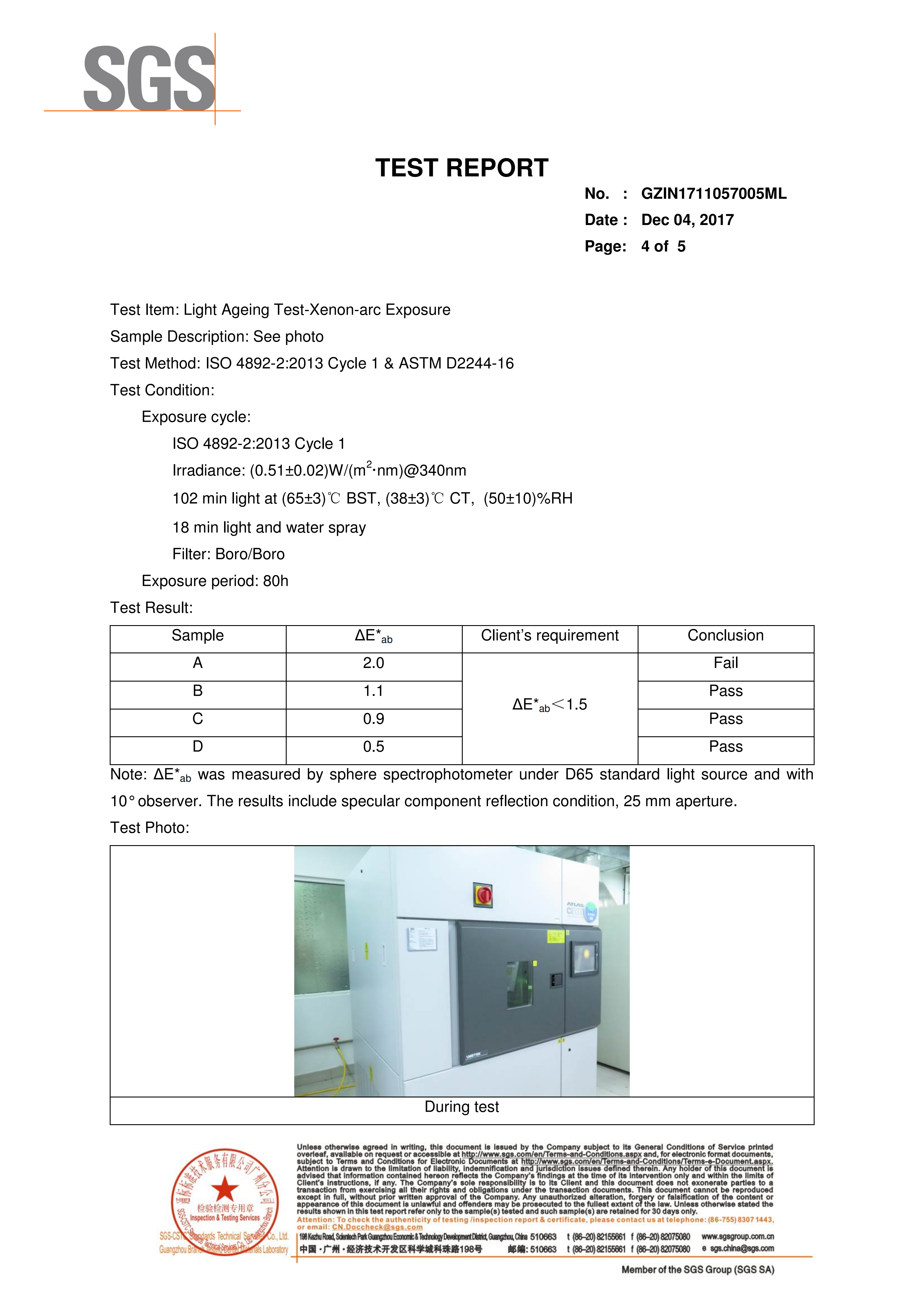
SGS light ageing test under ISO 4892-2:2013 Cycle 1 and ASTM D2244-16, report number GZIN1711057005ML. Image: JINGZUN.
Beyond market-access documents, two SGS performance reports add relevant constraints for buyers:
- Light ageing test: Report GZIN1711057005ML, issued December 2017, references ISO 4892-2:2013 Cycle 1 and ASTM D2244-16 for solid surface material samples.
- Resistance to temperature changes: Report SHHL1905024183PL, issued June 2019, references EN 13310:2015+A1:2018 for solid surface sanitary ware samples.
For buyers, the relevant point is not simply that certificates exist. It is that the reports are traceable to specific model numbers, specific test standards and specific issuing bodies. That traceability is what allows a compliance file to be checked against a project’s specification requirements.
Specification parameters that affect use
Solid surface bathtubs are not a single format. A buyer evaluating the category will encounter different sizes, capacities, shapes and constructions. Three JINGZUN models illustrate the range:
| Model | Type | Dimensions | Capacity | 40HQ loading |
|---|---|---|---|---|
| JZ8628 | Solid surface bathtub | 1550×750×550 mm / 1650×800×580 mm | 250 L / 305 L | 39 pcs |
| JZ8610 | Solid surface bathtub | 1500×1500×520 mm | 560 L | 27 pcs |
| JZ8621 | Transparent resin bathtub | 1860×780×940 mm | 240 L | 26 pcs |
Material behavior is another constraint. Solid surface bathtubs are cast as a single integrated piece, which reduces joints and creates a continuous surface. The non-porous surface is easy to clean, and the material provides good heat retention. Published technical references for stone resin and solid surface materials cite thermal conductivity in the range of 0.25–0.35 W/m·K, which is relevant to how quickly bathwater loses heat compared with cast iron or acrylic.
The same homogeneity that supports heat retention also supports repairability. Because the material and color are consistent throughout the body, minor surface scratches and localized yellowing can usually be sanded back to fresh material. This is not a universal property of all bathtub materials and should not be assumed for coated or laminated products.
The installation constraint is also relevant. Solid surface bathtubs are heavy, and the base must be evenly supported to avoid concentrated point loads. The drainpipe is typically routed through the clearance underneath the bathtub, which simplifies retrofits but requires the floor to be level and the base to be fully supported.
Price bands and procurement parameters
Price at the supplier level is not a single number for solid surface bathtubs. It depends on edge thickness, shape, material type, surface finish, and order volume. For JINGZUN’s range, the published guidance is:
- Thin-edge solid surface models: approximately USD 510–600.
- Standard 25 mm-edge models: approximately USD 600–750.
- Transparent resin models: approximately USD 750–970, with large round models quoted separately because they use more material.
These are supplier-level reference ranges, not landed cost. Freight, packaging, duties and local distribution markups sit outside them. A large round model is not directly comparable to a standard rectangular model on a per-unit basis.
Other procurement parameters that affect planning:
MOQ
18 pcs for bathtubs; 30 pcs for basins
Lead time
30–35 days for solid surface; 35–40 days for transparent resin
Monthly capacity
1,200 units for solid surface products
Warranty
5 years
Customization is available through OEM and ODM routes, covering size, shape, surface finish, color, logo printing, and drainage position. The practical point for buyers is that a custom shape or finish changes the production plan, so compliance documents and first-article checks should be agreed at the same time as the design, not after the order is placed.
Where solid surface bathtubs fit — and where they do not
Solid surface bathtubs are commonly specified for residential bathrooms, hotel guest rooms, serviced apartments, and commercial projects where a continuous, repairable surface is preferred. The material supports curved and seamless forms that are difficult to achieve with ceramic or cast iron, and the non-porous finish is straightforward to maintain in daily use.
A documented JINGZUN case references hotel projects in China, including Palace Garden Hotel and Resorts (120 sets), Hangzhou Radisson Hotel Platinum (85 sets), InterContinental One Thousand Island Lake Resort (96 sets), and Banyan Tree Shanghai On The Bund (72 sets). These are indoor guest bathroom installations, not outdoor or semi-outdoor environments.
The application boundary is equally important. Solid surface bathtubs are intended for indoor use. Direct and prolonged sunlight is not recommended, because UV exposure can cause yellowing over time. Abrasive cleaners, steel wool, and strong acidic or alkaline products should be avoided. Heavy impact on the rim and concentrated point loads under the base are also risk factors.
These are not decorative caveats. They change where the product is suitable, how it should be installed, and what the buyer should include in the handover documentation. A supplier that can clearly state these boundaries is easier to work with than one that presents the material as universally applicable.
Comparison with traditional alternatives: one real limitation
Compared with cast iron or steel enameled bathtubs, solid surface products offer design flexibility and repairability, but they are not equivalent in every respect. Cast iron retains heat well and is highly resistant to impact, while solid surface is more sensitive to point loads and requires even base support during installation.
Compared with acrylic bathtubs, solid surface is generally heavier and does not flex in the same way, which is an advantage for perceived solidity but a disadvantage for handling and installation. Acrylic is lighter and often lower in cost, while solid surface offers a more stone-like appearance and sandable repair. Neither is universally superior. The right choice depends on the installation conditions, the maintenance regime and the expected service life.
The most important limitation to state explicitly is that solid surface bathtubs are not an outdoor product. UV exposure can cause yellowing over time. If a project requires outdoor or semi-outdoor placement, this material should be evaluated against that constraint before design approval, not after installation.
Future outlook
Three trends are likely to shape solid surface bathtub procurement over the next several years.
First, documentation will become part of the product. As more projects require traceable compliance files, suppliers will need to provide certificate scopes, test standards, and model-level traceability as standard practice, not as an exception.
Second, material terminology will face pressure to become more precise. The current range of labels — composite stone, stone resin, mineral composite, cultured marble, polystone, solid surface — makes comparison difficult. Buyers will increasingly ask for formulation and test data rather than category names.
Third, repairability will become a stronger differentiator. In hotel and commercial environments, the ability to sand and restore a surface extends the usable life of the fixture and reduces replacement cycles. That is a practical advantage that can be documented and verified, not just claimed.
For buyers, the implication is straightforward: evaluate suppliers on the completeness and traceability of their compliance file, not only on the appearance of the product or the breadth of the catalog.
Frequently asked questions
What certifications should a solid surface bathtub carry for EU and North American markets?
For the EU market, artificial stone bathtubs are commonly referenced under EN 14516:2006+A1:2010 for CE marking. For the North American market, solid surface bathtubs are commonly referenced under CSA B45.5-11 / IAPMO Z124-2011 for CUPC listing. These are separate conformity paths, and one does not replace the other. JINGZUN maintains CE reports for multiple bathtub models and CUPC reports for solid surface bathtubs, each with traceable report numbers and issuing bodies.
What sizes and capacities are available for solid surface bathtubs?
Available sizes vary by model. The JZ8628 solid surface bathtub is offered in 1550×750×550 mm (250 L) and 1650×800×580 mm (305 L). The JZ8610 solid surface bathtub measures 1500×1500×520 mm with a 560 L capacity. The JZ8621 transparent resin bathtub measures 1860×780×940 mm with a 240 L capacity. Custom sizes and shapes are available through OEM/ODM development.
What is the MOQ and production lead time for solid surface bathtubs?
The MOQ is 18 pcs for bathtubs and 30 pcs for basins. Production lead time is 30–35 days for solid surface products and 35–40 days for transparent resin products. Sample orders typically take 7–15 days, and new mold development takes about 25 days plus 7 days for first-sample confirmation.
What is the price range for solid surface bathtubs?
Supplier-level pricing depends on edge thickness, shape, material and finish. Thin-edge solid surface models are typically in the range of USD 510–600. Standard models with a 25 mm edge are typically in the range of USD 600–750. Transparent resin models are typically in the range of USD 750–970, with large round models quoted separately because they use more material. These ranges do not include freight, duties or local distribution costs.
Can solid surface bathtubs be customized for a specific project?
Yes. JINGZUN offers OEM and ODM development covering size, shape, surface finish, color, logo printing, and drainage position. Custom color samples typically take about 7 days. The practical requirement is that the customization and the compliance documentation should be aligned before production begins, so that the approved design and the approved test scope refer to the same product configuration.
What warranty and after-sales support are provided?
Solid surface bathtubs from JINGZUN carry a 5-year warranty. After-sales support includes remote technical assistance. Routine care requires a soft cloth and neutral cleaner; abrasive products, steel wool, and strong acidic or alkaline cleaners should be avoided. Minor surface scratches and localized yellowing can usually be repaired by sanding, because the material and color are consistent throughout the body.
Reference document: JINGZUN publishes a complete product catalog covering solid surface bathtubs, basins, shower trays and transparent resin products, including model numbers and specifications.
Catalog: JINGZUN product catalog (PDF)
Have Questions or Need More Details?
Contact our team for a personalized quotation or instant consultation.
Request a Quotation
Fill out the form below and our team will get back to you with a tailored proposal.
WhatsApp Direct Chat
Prefer to chat in real-time? Message us on WhatsApp for instant assistance & quick answers.
- Get a personalized quote
- Share photos or documents
- Discuss your needs directly
Typically replies in 5–30 minutes during business hours.