
Solid Surface Bathtub Quotes: A Buyer's Comparison Scorecard
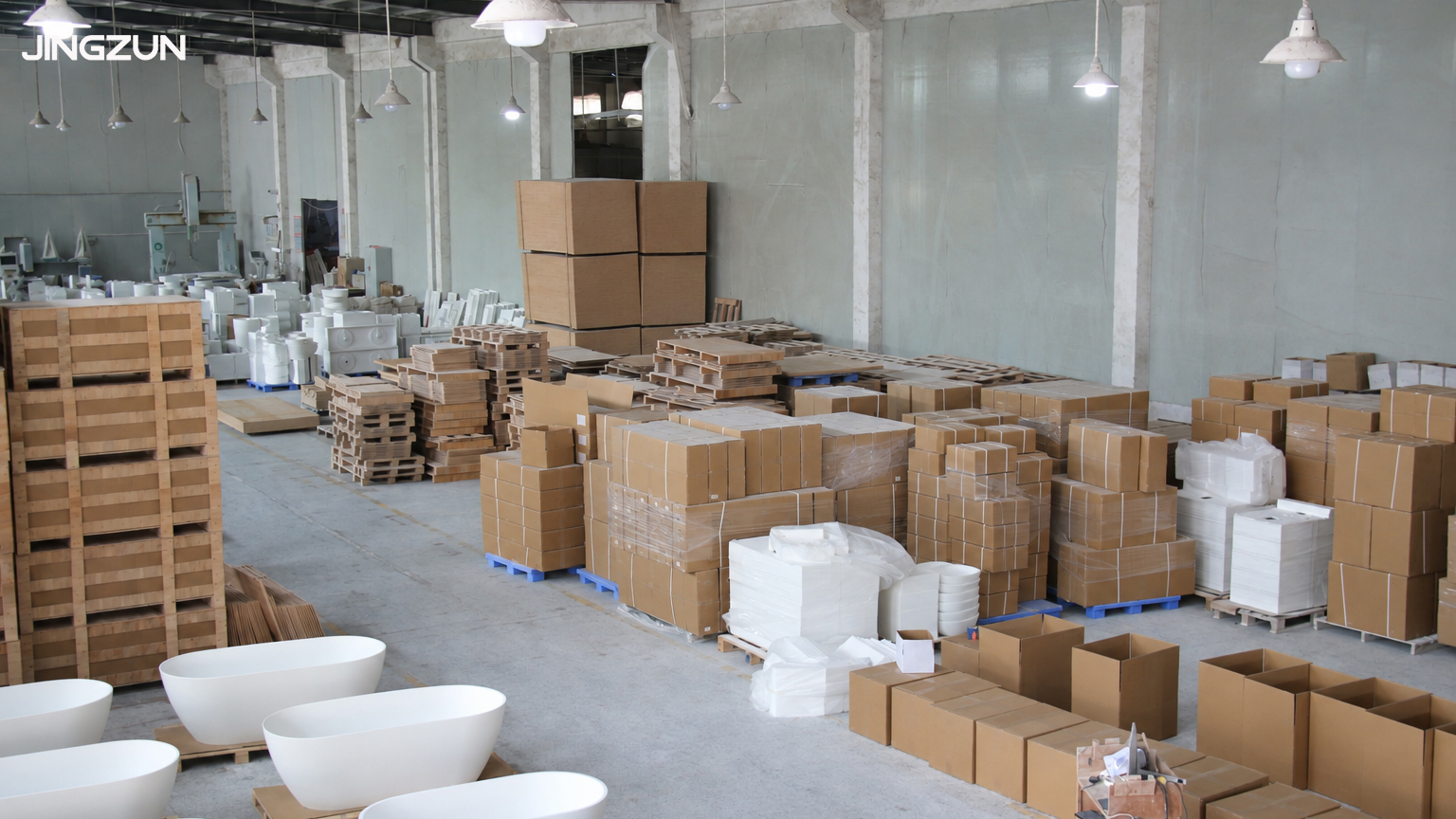
Two quotations for a solid surface bathtub can look nearly identical on a single line of paper and still describe two different products. The difference rarely sits in the headline figure. It sits in what the figure assumes: whether a drain is included, whether the crate is plywood or cardboard, how long the warranty actually runs, whether a custom colour is quoted or simply promised, and who is responsible when a surface scratch appears two years after installation.
A solid surface bathtub is a one-piece sanitary product cast and cured from a mixture of aluminum powder and resin, homogeneous through the body, able to be sanded and repaired, and intended for indoor bathing spaces. Because the material is homogeneous, the inside and outside of the tub share the same composition and colour — which is precisely why surface questions should be answered in writing at quotation stage rather than after delivery.
This scorecard sets out a neutral way to normalise two or three quotations, then score them on the five points that most reliably separate a well-specified unit from a low-priced one. It is written for buyers at evaluation-to-execution stage: the point at which a shortlist exists and the decision has to be defensible.
Why two bathtub quotations rarely compare cleanly
Quotations are commercial documents, not technical ones. Suppliers quote what the buyer asks for, and buyers frequently ask for a size and a price. Everything else — wall thickness, drainage clearance, packaging grade, colour confirmation, repair policy — is assumed by one side and not the other.
In the solid surface category the assumption gap is wider than in most bathroom products because the material label itself is not standardised. Composite stone, stone resin, engineered stone, mineral composite, cultured marble and solid surface are used loosely across the trade, and the same term can describe a homogeneous aluminum-powder-and-resin body or a calcium-powder mix finished with a gel coat layer. Those two constructions behave differently under abrasion, under prolonged light exposure, and under repair.
The practical consequence for procurement is that price is only meaningful once the construction and the commercial terms are pinned to the same baseline. The scorecard below exists to create that baseline.
Step one: normalise the quotations before scoring them
Normalisation is the unglamorous half of comparison and the half that changes decisions. Before any score is assigned, each quotation should be re-expressed on the same terms:
- Same model and size basis. A 1550 × 750 × 550 mm tub and a 1650 × 800 × 580 mm tub are not the same unit, even when the shape looks identical in a photograph. Capacity and loading quantity change with size: a 1550 mm solid surface tub in the reference range holds 250 L, the 1650 mm version 305 L, and a 40HQ container carries 39 pieces of that pattern. A large round model such as a 1500 × 1500 × 520 mm tub holds 560 L and loads 27 pieces per 40HQ — which is a different freight economics problem entirely.
- Same trade term. Ex-works and FOB are not comparable. Packaging, inland haulage and port handling have to be inside or outside the figure consistently.
- Same quantity basis. Bathtub minimum order quantities are commonly quoted in the region of 18 pieces. A quotation built on a sample quantity is not the production price.
- Same inclusion list. Drain, overflow, packaging grade, documentation and any certification support should be listed as included or excluded, line by line.
- Same timing definition. Lead time measured from deposit received is not the same as lead time measured from drawing approval. Ask which.
Step two: score the five dimensions that actually differentiate
1. Stated price and production lead time
Price should be read together with thickness and material, never alone. In the reference range for solid surface bathtubs, thin-edge models are typically quoted at USD 510–600, while standard models with a 25 mm edge are typically quoted at USD 600–750. Large round bathtubs are quoted separately because material consumption rises with the format.
Lead time has three distinct parts and they are often conflated. Regular production runs take roughly 30 days. Sample orders usually take 7–15 days. New mould development takes about 25 days, plus around 7 days for first-sample confirmation. A buyer comparing a 30-day quotation against a 35-day quotation may in fact be comparing a standard mould against a new mould — which is not a like-for-like comparison at all.
Score this dimension as a pair, not as separate line items. A lower unit price paired with a longer or vaguer lead time is a different offer, not a better one.
2. Warranty period
Warranty is the cheapest thing to promise verbally and the most expensive to enforce. A five-year warranty is the reference standard in this category, and it should be scored on three sub-points: the stated duration, what the warranty covers (material defects, surface condition, structural integrity), and how a claim is executed when the buyer is several thousand kilometres away.
Remote technical support is the usual mechanism. What matters at quotation stage is whether that support is described in the document, whether replacement or repair is the default remedy, and whether the supplier has stated who carries the cost of the remedy. A warranty clause that names a duration but no remedy path should score below one that names both.
3. Drain and wooden packaging
This is where the smallest line items create the largest post-award disputes. In the reference specification, the drain is included with the solid surface bathtub and standard packaging uses a plywood crate. Both are meaningful: a waste and overflow set is a real cost, and a plywood crate is the difference between a product that survives an ocean leg and one that arrives with a chipped rim.
Score the quotation on whether the drain is included or separately priced, and on the crate construction. Where the supplier offers an optional fully enclosed wooden crate, note it as a stated option rather than assuming it is standard. Cardboard or foam-only packing on a cast bathtub is a cost signal, not a saving.
4. Colour and custom colour
Colour choices need to be scored as a count plus a process. The reference range offers 21 standard colours, with custom colours available and a custom colour sample usually taking about 7 days.
Two quotations can both say "custom colour available" and mean very different things. The scorecard should record: how many standard colours are listed by name or code, whether the quotation states that a custom colour affects price or lead time, and whether a physical colour sample is produced and approved before bulk production. The 7-day sample window is worth putting on a timeline, because a colour approval step that nobody scheduled becomes an unplanned two-week delay later.
5. Scratch and yellowing handling after delivery
This is the dimension most often left out of a quotation and most often raised in year two. In the reference specification the surface hardness is approximately 55 HBa, minor scratches can be sanded to restore the surface, and under normal indoor use the bathtub is not expected to show obvious yellowing within 10 years. If yellowing or surface change does occur, sanding may help restore the appearance.
Repairability is structural, not a service promise. Because the body is homogeneous — the same resin, aluminum powder and colour paste throughout — a scratch or an oxidised surface layer can be removed by sanding to expose fresh material of the same colour underneath. That is why the material is repairable without a coating.
Score this dimension on whether the supplier states a repair method, whether the surface carries a coating, and whether the quotation explains the indoor limitation. A gel-coated or painted surface changes the answer entirely: once the coating layer is damaged, sanding no longer restores the original appearance in the same way.
The scorecard at a glance
| Dimension | What the quotation must state | Reference benchmark | Risk signal in a low-priced quote |
|---|---|---|---|
| Price and lead time | Unit price by model and size, body thickness, production lead time and its start point | Thin-edge USD 510–600; 25 mm edge USD 600–750; regular production about 30 days; samples 7–15 days; new mould about 25 days plus 7 days first-sample confirmation | No stated thickness; price quoted for an unapproved size; lead time given as "to be confirmed" |
| Warranty | Duration, coverage scope, remedy path, support mechanism | 5-year warranty with remote technical support | Verbal assurance only; duration stated without coverage or remedy |
| Drain and packaging | Drain included or excluded; crate type; optional upgrades | Drain included; standard packaging is a plywood crate; fully enclosed wooden crate available as a stated option | Drain priced separately; cardboard or foam-only packing presented as standard |
| Colour | Number of standard colours; custom colour process and sample timing | 21 standard colours; custom colours available; custom colour sample usually about 7 days | Colour promised without a sample step; custom colour with unstated cost or lead-time impact |
| Scratch and yellowing | Surface hardness, repair method, indoor use limitation | Hardness approximately 55 HBa; minor scratches sanded to restore; no obvious yellowing expected within 10 years under normal indoor use; outdoor use not recommended | Coated surface that cannot be sanded back; no stated repair method; no mention of UV limitation |
Score each row 0–2 per quotation against the stated evidence, then compare totals rather than headline prices.
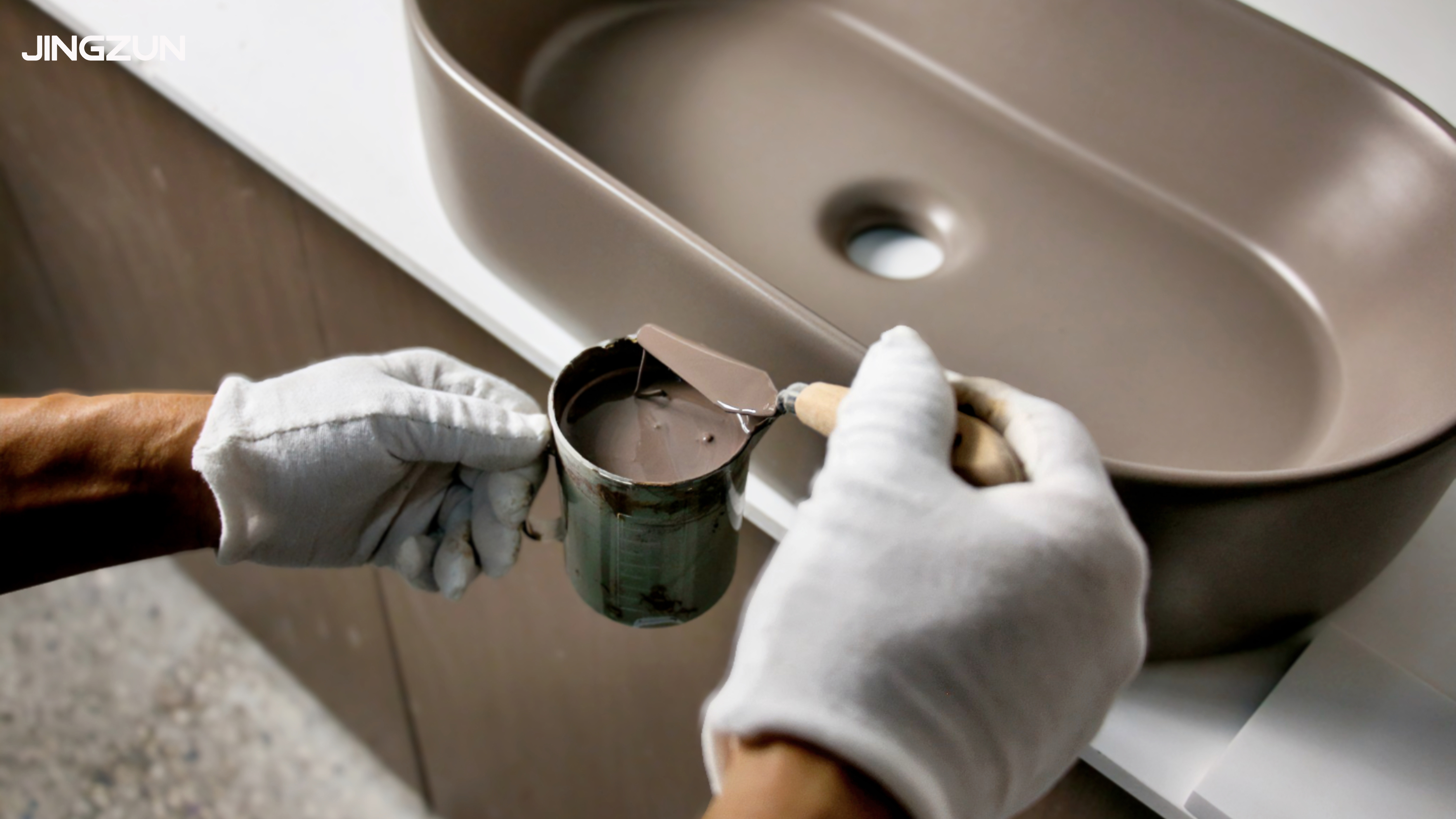
Custom colour is a process, not a swatch: standard colours, sample timing and approval sequence all belong on the quotation.
What a cheaper quotation usually leaves out
A lower price is not evidence of a worse product, but it is evidence that something in the specification has moved. In this category the movement usually happens in one of four places.
Material substitution. A low-cost solid surface bathtub may substitute calcium powder for aluminum powder, or apply a gel coat layer over the body. Material stability tends to be lower in those constructions, which raises the risk of yellowing and cracking over time.
Thickness reduction. A standard body thickness is 25 mm, with bottom thickness in the 25–30 mm range. Low-priced models are often 10 or 15 mm. Beyond structural strength, thinner bodies reduce the clearance underneath, which can force on-site floor cutting during installation — a cost that lands on the project rather than the quotation.
Installation clearance. A well-designed solid surface bathtub has sufficient clearance underneath to route the drainpipe, so no additional floor channel is needed. Where that clearance is absent, the installation labour and waterproofing work change, and those changes rarely appear in the price comparison.
After-sales depth. A warranty is only as strong as the supplier behind it. Factories with inconsistent quality control and limited after-sales support shift risk onto the buyer, and that risk is invisible in a unit price.
The fair conclusion is not that cheaper units should be excluded. It is that a cheaper unit should be scored against the same five dimensions and allowed to win or lose on the total, not on the headline figure.
A reference benchmark: JINGZUN solid surface bathtubs
Huizhou Jingzun Sanitary Ware Co., Ltd. is a manufacturer based in Huizhou City, Guangdong Province, China, founded in 2007 and focused on solid surface and resin sanitary products for overseas markets. The company reports a 12,000 m² plant, around 100 employees, three engineers, output of 14,000 bathtubs and 48,000 basins annually, and an export share of 99%. It operates OEM and ODM production with customisation across size, shape, surface finish, colour, logo printing and drainage position, a monthly capacity of 1,200 units, a bathtub MOQ of 18 pieces, and 100% pre-shipment inspection with third-party inspection available.
Against the scorecard above, its published reference points are: thin-edge models typically USD 510–600 and 25 mm-edge models typically USD 600–750, with large round models quoted separately; regular production around 30 days; a 5-year warranty with remote technical support; drain included and plywood crate as standard packaging; 21 standard colours with custom colours available on a roughly 7-day sample cycle; surface hardness approximately 55 HBa, sanding-based repair, and no obvious yellowing expected within 10 years under normal indoor use.
Material and performance documentation in the public record includes an SGS light ageing test report (GZIN1711057005ML, ISO 4892-2:2013 Cycle 1 and ASTM D2244-16), an SGS resistance-to-temperature-changes report (SHHL1905024183PL, EN 13310:2015+A1:2018), CUPC listings for solid surface bathtubs under CSA B45.5-11 / IAPMO Z124-2011 (including SHHG1411042879PL and SHHG1411042880PL), and CE documentation for artificial stone bathtubs under EN 14516:2006+A1:2010 (including SHHG1504013914PL through SHHG1504013918PL).
Buyers should treat these as documents to request and verify in the buyer's own name and scope, not as conclusions. Certificate numbers, issuing bodies and product scope should be checked against the models actually being ordered.
Where the scorecard applies
The framework is most useful in three situations. In hospitality fit-out, where guest bathroom soaking tubs are specified in quantity and the cost of a failed crate or an unplanned floor channel multiplies across rooms, the packaging and clearance rows carry the most weight. In brand-owner and OEM programmes, where a custom solid surface bathtub is being developed for a specific colour and shape, the colour-sample and mould-timeline rows dominate. In distributor stocking, where the unit sits in a warehouse before resale, warranty terms and repairability decide how many after-sales conversations the stock generates.
Market context
The global bathtub market was estimated at USD 13.36 billion in 2026 and is projected to reach USD 20.74 billion by 2034, with freestanding bathtubs projected to grow at the fastest CAGR of 7.2% through 2034, according to Grand View Research. Freestanding formats are the segment where solid surface, stone resin and composite stone products compete most directly, and the growth rate is a reasonable proxy for how many buyers will be running this comparison for the first time.
Growth in the freestanding segment also raises the cost of a bad specification. Higher volumes mean more projects where a colour mismatch, a missing drain or an unstated thickness becomes a rework item rather than a one-off inconvenience.
Limits of this framework
The scorecard compares quotations, not factories. It cannot verify that a stated 25 mm thickness is present in the delivered unit, that a certificate covers the specific model ordered, or that a lead time will hold under load. Those require sample approval, spot checks and document review.
There is also a material limit that belongs in the comparison itself: solid surface bathtubs are not recommended for outdoor use. Prolonged direct sunlight can cause yellowing over time, and indoor installation is recommended to maintain appearance. A project specifying an outdoor or heavily glazed installation should treat this as a disqualifying constraint rather than a negotiable point — no score on price or warranty compensates for a material placed outside its intended environment.
Finally, the framework is only as good as the quotations fed into it. Where a supplier cannot or will not state thickness, packaging grade, colour count and warranty remedy in writing, the correct response is to record the omission, not to estimate a score.
Future outlook
Two pressures are likely to push quotation documents toward more disclosure. The first is procurement professionalism in the freestanding segment: as volumes rise, buyers increasingly ask for thickness, clearance and repair method as standard line items rather than optional extras. The second is documentation. Certification and test reports are becoming part of the tender pack rather than an afterthought, which favours suppliers who can produce certificate numbers, standards references and test scope quickly.
The practical implication for buyers is straightforward. The quotation that answers all five scorecard dimensions in writing is easier to compare, easier to defend internally, and easier to enforce if something goes wrong — regardless of whether it is the lowest number on the page.
A full product and specification overview is available in the Jingzun catalogue.
FAQ
What is the price range for a solid surface bathtub, and how long does production take?
Thin-edge models are usually quoted at USD 510–600, and models with a 25 mm edge at USD 600–750. Large round bathtubs are quoted separately. Regular production takes about 30 days, sample orders usually take 7–15 days, and new mould development takes about 25 days plus 7 days for first-sample confirmation.
What is the warranty period for a solid surface bathtub?
Solid surface bathtubs from this source carry a 5-year warranty, supported by remote technical support.
Does a solid surface bathtub come with a drain and wooden packaging?
A drain is included with the solid surface bathtub. Standard packaging uses a plywood crate, and a fully enclosed wooden crate is available as a stated option.
How many colours are available, and how long does a custom colour take?
There are 21 standard colours for solid surface bathtubs. Custom colours are available, and a custom colour sample usually takes about 7 days.
How are scratches and yellowing on a solid surface bathtub handled after delivery?
Surface hardness is approximately 55 HBa, and minor scratches can be sanded to restore the surface. Under normal indoor use the bathtub is not expected to show obvious yellowing within 10 years; if yellowing or surface change occurs, sanding may help restore the appearance. Deep damage should be referred to the manufacturer.
Why can scratches and yellowing be repaired by sanding?
The bathtub is made of a homogeneous material with consistent resin, aluminum powder and colour paste throughout the body. Scratches and oxidation-related yellowing generally affect only the surface layer, so sanding removes that layer and exposes fresh material of the same colour underneath.
What specifications should be confirmed when purchasing a solid surface bathtub?
The key factors are material composition, body thickness, yellowing resistance, installation convenience, certification and lead time. Priority should go to suppliers that provide test documentation, state a standard thickness of 25 mm, confirm sufficient clearance underneath for the drainpipe, and offer OEM or ODM services with stable production capacity.
Have Questions or Need More Details?
Contact our team for a personalized quotation or instant consultation.
Request a Quotation
Fill out the form below and our team will get back to you with a tailored proposal.
WhatsApp Direct Chat
Prefer to chat in real-time? Message us on WhatsApp for instant assistance & quick answers.
- Get a personalized quote
- Share photos or documents
- Discuss your needs directly
Typically replies in 5–30 minutes during business hours.