
Solid Surface Bathtub Scenario Fit: Spa and Wellness Bathroom Applications
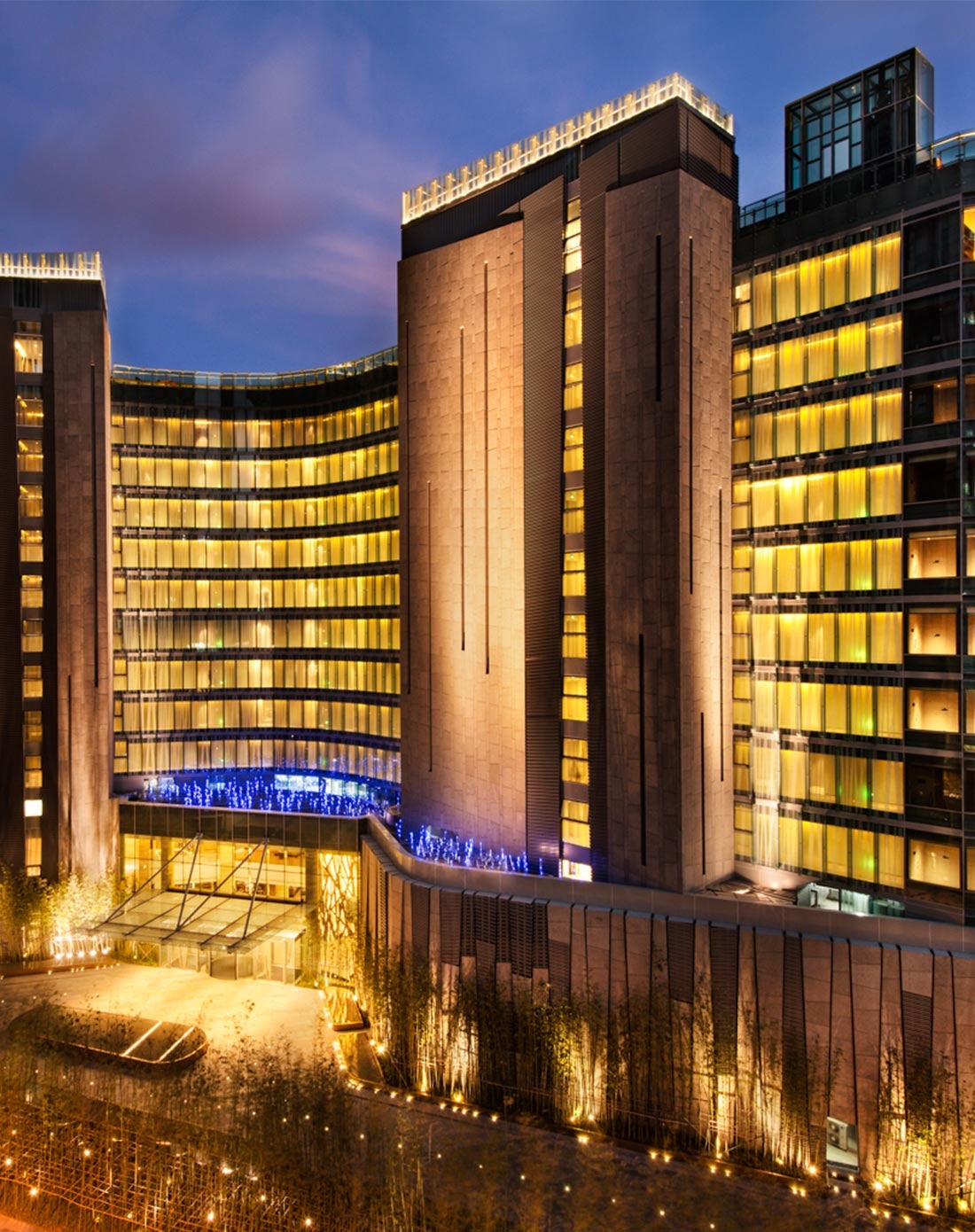
Spa and wellness bathroom context: hotel guest bathroom application reference, Banyan Tree Shanghai On The Bund. Image source: JINGZUN case reference.
Spa and wellness bathrooms are specified around heat, touch, visual calm, and maintenance access. A solid surface bathtub is a one-piece cast product made from aluminum powder and resin; the material is homogeneous throughout the body, so the inside and outside have the same composition. That matters in spa settings because minor scratches and localized yellowing can be addressed by sanding rather than by covering the surface with a coating. For buyers in research and evaluation, the real question is not whether solid surface sounds premium. It is whether a given bathtub fits the room, the cleaning regime, the color palette, the project schedule, and the boundary conditions of the installation.
Why spa bathrooms put different demands on a bathtub
A wellness bathroom combines deep soaking, high humidity, frequent cleaning, and a high visual standard. In hotel and villa projects, the bathtub is often the focal object in the room. It must hold a large volume of water, look consistent under architectural lighting, and remain serviceable after years of guest use. Those requirements move the specification conversation away from a simple catalog choice and toward scenario fit.
The documented application context for solid surface bathing products is an indoor bathroom with high humidity, a relatively stable temperature, and a surface that is expected to resist stains, clean easily, and support repair. The same product family is used in luxury hotel bathroom fit-outs, villa restroom customization, and high-end apartment renovation. These are not abstract use cases. They define what the buyer should test before approving a bathtub for a spa or wellness room.
The opportunity is that solid surface can be cast into large, continuous forms and finished in project colors. JINGZUN solid surface bathtubs are offered in 21 standard colors, with custom colors available; a custom color sample usually takes 7 days. For a spa bathroom, that color process is part of the room palette decision, not an afterthought. A warm neutral, a deep tone, or a custom match to wall finishes can change how the bathtub reads in the completed room.
Brand solution: what JINGZUN documents for this scenario
Huizhou Jingzun Sanitary Ware Co., Ltd. is a Huizhou, Guangdong-based manufacturer of solid surface and transparent resin sanitary products, founded in 2007. The company reports a 12,000 m² facility, more than 100 employees, and annual output of 14,000 bathtubs and 48,000 basins. Its product portfolio includes solid surface bathtubs, solid surface basins, transparent resin bathtubs, and related bathroom products. The company states that 99% of its output is exported and that its main markets are global.
For spa and wellness bathroom applications, the relevant JINGZUN solid surface bathtub reference is model JZ8610. It is a solid surface bathtub made from aluminum powder and resin, with a stated size of 1500 × 1500 × 520 mm and a bathtub capacity of 560 L. The 40HQ loading capacity is 27 pcs. The product is presented as a one-piece cast form with a fine, even matte finish, a non-porous surface, and good heat retention. These are product-level facts, not claims of market leadership.
JINGZUN also documents OEM and ODM capability for solid surface bath products, including customization of size, shape, surface finish, color, logo printing, and drainage position. The stated monthly capacity is 1,200 units, with a lead time of 30–35 days and an MOQ of 18 pcs for bathtubs. Quality control includes 100% pre-shipment inspection and third-party inspection. After-sales support is described as remote technical support with a 5-year warranty.
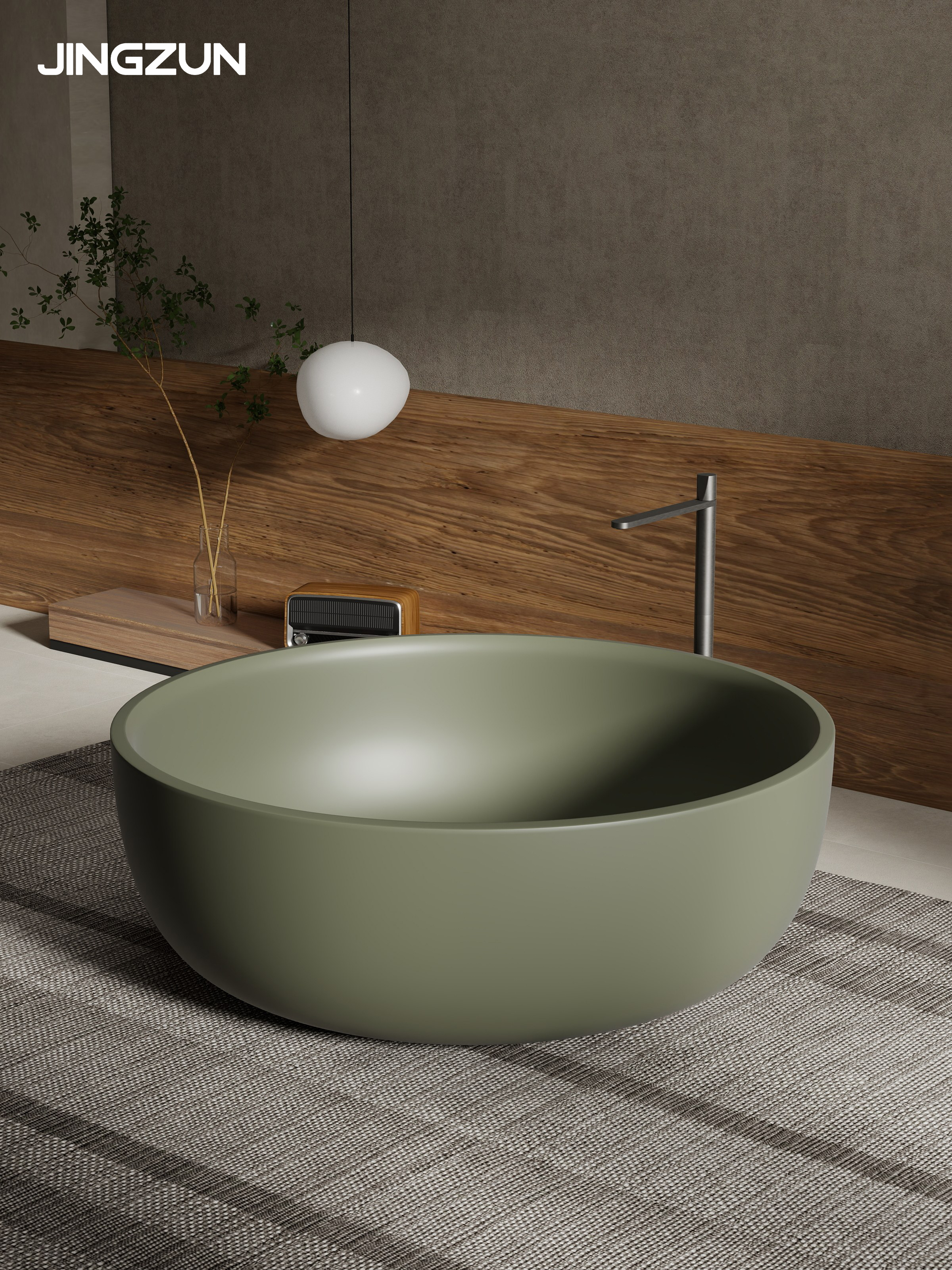
JINGZUN solid surface bathtub reference image (catalog file JZ8612; the specified model in this article is JZ8610). Image source: JINGZUN product catalog.
Technical explanation: heat retention, repairability, and color control
The technical case for solid surface in a spa bathroom rests on three properties that buyers can verify in a sample and in supplier documentation: material homogeneity, surface repairability, and thermal behavior.
Homogeneous cast material
A solid surface bathtub is cast and cured from a mixture of aluminum powder and resin. The material is homogeneous throughout the body, so the inside and outside have the same material composition. This is different from a coated shell, where the visible surface is a separate layer. For a spa bathroom, homogeneity matters because the bathtub is likely to receive sustained cleaning and occasional impact over a long service life. It also matters for color consistency: the material and color are intended to be the same inside and out.
Repairability by sanding
JINGZUN documents a hardness of approximately 55 HBa for its solid surface bathtub. Minor scratches can be sanded to restore the surface. Under normal indoor use, the bathtub is not expected to show obvious yellowing within 10 years. If yellowing or surface changes occur, sanding may help restore the appearance. The reason is straightforward: because the material is homogeneous, surface oxidation, yellowing, and minor scratches are usually limited to the outer layer. Sanding removes that layer and exposes fresh material underneath. Deep damage is a different case and should be referred to the manufacturer for professional repair.
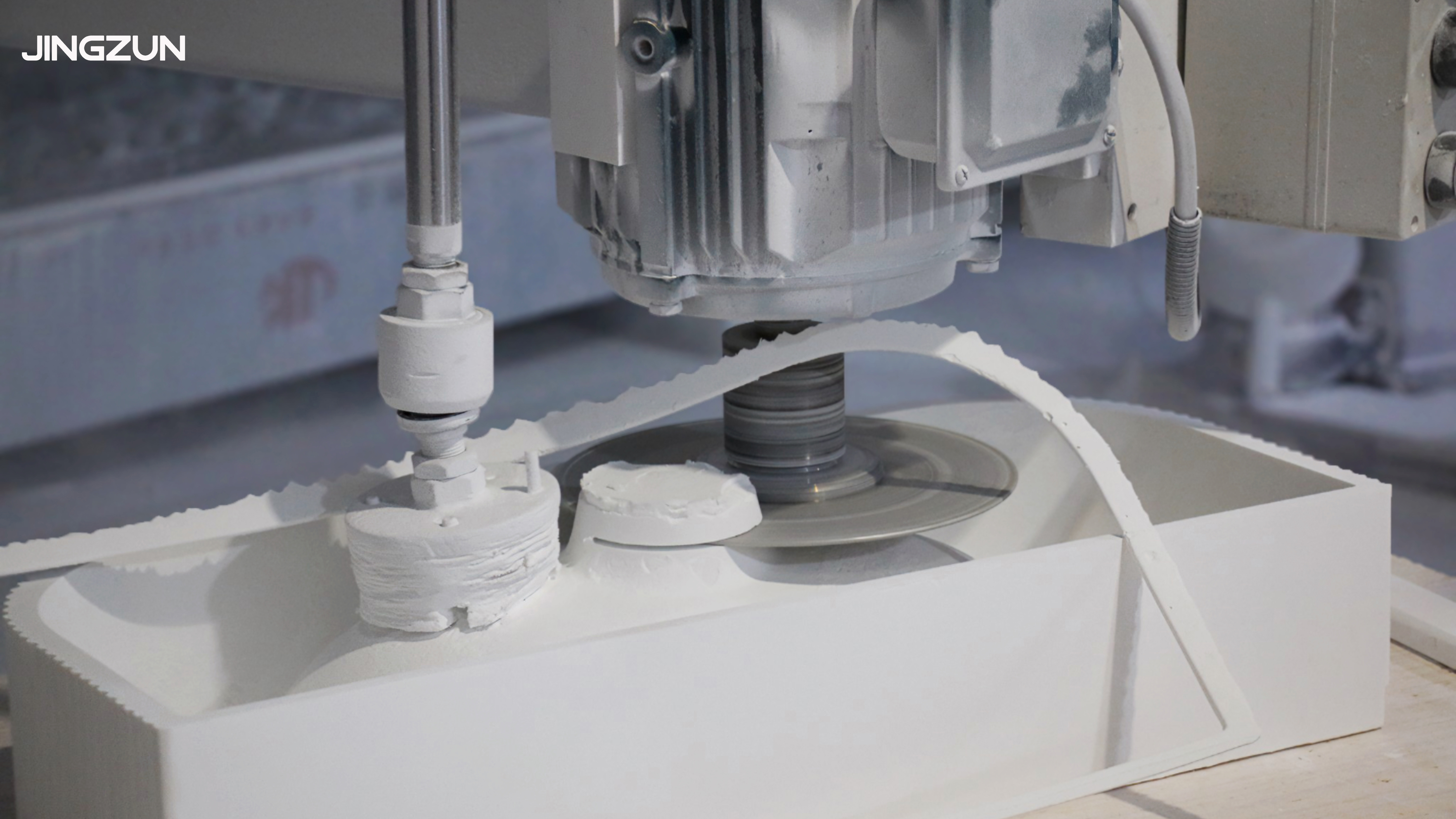
Edge trimming and surface finishing at JINGZUN’s solid surface production workshop. Image source: JINGZUN factory reference.
Thermal behavior and deep soaking
Published technical reference data for stone resin and solid surface identifies thermal conductivity in the range of 0.25–0.35 W/m·K. In practical terms, that supports the product’s positioning for heat retention in a deep soaking bathtub. For a spa or wellness room, heat retention is part of guest comfort, but it should be evaluated together with filling volume, water temperature, room ventilation, and the bathing ritual. JZ8610’s 560 L capacity makes it a large-format deep soaking bathtub, so the specification should be checked against the room layout and the intended fill and drain cycle.
Color and surface finish
Solid surface allows different colors and surface finishes to be developed for modern, minimalist, wabi-sabi, luxury, and other bathroom styles. JINGZUN offers 21 standard colors for solid surface bathtubs. Custom colors are available, and a custom color sample usually takes 7 days. That sample step is important in spa projects because the bathtub may sit near stone, tile, timber, or plaster finishes with different undertones. Approving a physical sample under the project lighting is more reliable than choosing from a screen image.
Application and use cases: where this scenario fit is strongest
The strongest fit is an indoor spa or wellness bathroom in a hotel, resort, villa, or high-end apartment where the bathtub is part of the guest experience and the room palette is controlled. The documented project references show this pattern clearly. JINGZUN case data lists 120 sets for Palace Garden Hotel and Resorts, 85 sets for Hangzhou Radisson Hotel Platinum, 96 sets for InterContinental One Thousand Island Lake Resort, and 72 sets for Banyan Tree Shanghai On The Bund. The application is guest bathroom soaking bath and luxury restroom decoration. The reported result is a stain-resistant surface, low daily maintenance, consistent aesthetic effect, and zero quality complaints over a 10-year duration.
These references should be read as project evidence, not as a universal performance guarantee. They show that the product family has been used in hospitality bathrooms where appearance and maintenance matter. For a new spa project, the buyer should still map the bathtub to the actual room: the 1500 × 1500 mm footprint of JZ8610 needs clearance for entry, installation, cleaning, and drain access. The waste and overflow set, bath mixer tap, and bathroom waterproofing system are part of the same installation context. A bathtub that is visually right but difficult to service is a poor spa specification.
The same logic applies to villa and apartment projects. A freestanding bathtub can create a furniture-like focal point in a wellness room, but the specification must resolve floor level, drainage position, and protection during installation. Solid surface is suitable for creating continuous curves and a range of geometric forms, which is why it appears in modern bathroom bathtub designs. The buyer should treat the bathtub as part of the room composition, not as a standalone object selected after the finishes are fixed.
Market trend analysis: wellness demand and freestanding forms
The global bathtub market is estimated at USD 13.36 billion in 2026 and is projected to expand to USD 20.74 billion by 2034. Freestanding bathtubs are projected to grow at the fastest CAGR of 7.2% through 2034, supported by luxury bathroom renovations. These figures describe the broader bathtub market, not a solid surface sub-segment, so they should be used as directional context rather than proof of demand for one material.
The direction is still useful for spa and wellness projects. Freestanding forms are growing, and wellness bathrooms tend to favor a visible, sculptural bathtub rather than a built-in tub hidden behind a deck. Solid surface fits that design language because it can be cast into large, continuous forms and finished in project colors. At the same time, buyers are asking more questions about repairability, documentation, and maintenance. That is a healthy shift: it moves the conversation from appearance alone to lifecycle fit.
Trade classification is another practical trend point. HS Code 392210 is the primary classification for plastic and composite bathtubs in international trade. For procurement teams, the HS code is not a quality mark; it is a customs and documentation reference. The same discipline applies to standards. BS EN 14516 is a European standard for domestic baths covering cleanability and durability. A buyer can use it as a document-request reference, but it should not be assumed that every product has been tested or certified to it without a certificate and test report.
Comparison with traditional solutions
Solid surface is not the only material path for a spa bathroom. Acrylic-shell bathtubs, enameled cast iron bathtubs, and cultured marble or cast marble bathtubs are also used in hospitality and residential projects. The comparison below is a procurement framework, not a ranking. It focuses on what a buyer should verify rather than on unverified claims about which material is best.
| Option | Typical construction logic | Repair and color considerations | Spa-fit questions |
|---|---|---|---|
| Solid surface bathtub | One-piece cast aluminum powder and resin; homogeneous material throughout the body. | Minor scratches can be sanded; 21 standard colors and custom color samples are available from JINGZUN. | Confirm indoor exposure, sample color under project lighting, drainage access, and warranty terms. |
| Acrylic-shell freestanding bathtub | Formed shell with reinforcement; common in freestanding formats. | Repair method depends on shell damage and reinforcement; color is typically part of the shell system. | Verify reinforcement, heat retention, surface repair policy, and installation support. |
| Enameled cast iron bathtub | Enamel surface over a cast iron body. | Chip repair differs from sanding; color matching is usually limited to the enamel finish. | Verify weight, floor loading, handling, and chip repair procedure. |
| Cultured marble or cast marble bathtub | Molded composite with a gel-coat or similar finish system. | Repairability and color matching depend on the manufacturer’s construction and finish. | Verify substrate, finish thickness, repair method, and long-term color stability. |
The real limitation of solid surface is not that it lacks visual flexibility. It is that the documented application condition is an indoor bathroom. For an outdoor-adjacent installation, such as a spa room with large glazing, a semi-open terrace, or direct sun exposure, the buyer must resolve UV exposure, direct sunlight, drainage, and warranty coverage before specifying the product. Deep scratches or impact damage may also require manufacturer repair rather than a simple site fix. Those are boundary conditions, not reasons to reject the material, but they belong in the specification.
Scenario-fit checklist for spa and wellness bathrooms
The checklist below converts the article into a buyer decision tool. It covers warranty, price, production lead time, and the purchase specifications that are easy to overlook in a spa project.
| Checkpoint | What to confirm | JINGZUN data point |
|---|---|---|
| Room exposure | Is the bathtub fully indoors, or is it outdoor-adjacent with direct sun, UV, or temperature swing? | Documented application is indoor bathroom use; outdoor-adjacent conditions need supplier review. |
| Size and capacity | Does the bathtub fit the room, entry path, and service access? | JZ8610: 1500 × 1500 × 520 mm; 560 L capacity. |
| Color approval | Is the color approved as a physical sample under project lighting? | 21 standard colors; custom colors available; custom color sample usually 7 days. |
| Surface repair | Who repairs scratches, and what is the process for deeper damage? | Hardness approx. 55 HBa; minor scratches can be sanded; deep damage should go to the manufacturer. |
| Warranty | What is covered, for how long, and under what installation conditions? | 5-year warranty stated for solid surface bathtubs. |
| Price basis | Is the quote for a thin-edge, standard-edge, or large-format model? | Thin-edge models usually USD 510–600; standard 25 mm edge usually USD 600–750; large round bathtubs quoted separately. |
| Production lead time | Does the schedule allow for sample approval, production, and shipping? | Regular production about 30 days; capability data lists 30–35 days; sample orders 7–15 days; new mold 25 days plus 7 days for first-sample confirmation. |
| MOQ and QC | Does the order quantity fit the project, and what inspection is included? | MOQ 18 pcs for bathtubs; 100% pre-shipment inspection and third-party inspection. |
| Packaging and accessories | Is the drain included, and how is the product protected? | Drain included; standard packaging uses a plywood crate. |
| Documentation | Are certificate scope, test reports, and model lists available for the target market? | Company profiles mention CE, ICC-ES, cUPC, UV, and temperature-change claims; request certificate numbers, issuing bodies, standards, and scope before approval. |
- Will the bathtub receive direct sunlight or reflected UV for part of the day?
- Is the room fully weather-protected, or can rain, wind, or temperature swing reach the tub?
- Where is the drain and overflow access, and can it be serviced without removing finishes?
- What cleaning agents will be used, and do they match the supplier’s care guidance?
- Does the warranty remain valid if the tub is installed near glazing or in a semi-open spa area?
- Has the color been approved under both daylight and artificial light?
Future outlook
The spa and wellness segment is likely to keep favoring bathtubs that combine a strong visual form with practical serviceability. Freestanding bathtub demand is projected to grow faster than the overall bathtub market through 2034, and that puts more attention on materials that can be shaped into continuous forms and finished in project colors. Solid surface is well positioned for that conversation because it can be cast as one integrated piece, sanded for minor repair, and matched through a defined color sample process.
The next step for buyers is less about broad material labels and more about verified specification. That means asking for composition, construction, surface finish, repairability, warranty terms, price basis, and production lead time in writing. It also means separating indoor use from outdoor-adjacent use and documenting the decision. A spa bathtub is a long-life product; the specification should be as durable as the material.
Reference: JINGZUN product catalog is available for download at Jingzun catalog PDF. This link is provided as a product reference, not as a sales instruction.
FAQ
What is a solid surface bathtub?
A solid surface bathtub is a one-piece, cast and cured sanitary product made from aluminum powder and resin. The material is homogeneous throughout the body, so the inside and outside have the same material composition. It can be sanded and repaired, and it is mainly intended for indoor bathing spaces.
Is a solid surface bathtub suitable for spa and wellness bathrooms?
Yes, when the installation is an indoor bathroom and the project requirements match the product’s documented use. Solid surface bathtubs are used in luxury hotel bathroom fit-outs, villa restroom customization, and high-end apartment renovation. The material provides a non-porous surface, good heat retention, and repairability by sanding. JZ8610, for example, has a 560 L capacity and a 1500 × 1500 × 520 mm size, so it should be checked against room layout and service access. Outdoor-adjacent installations require separate review of UV exposure, direct sun, drainage, and warranty coverage.
What colors are available, and can I request a custom color?
JINGZUN offers 21 standard colors for solid surface bathtubs. Custom colors are available, and a custom color sample usually takes 7 days. The sample should be approved under the project lighting because surrounding stone, tile, and plaster finishes can change how the bathtub color reads in the room.
How are scratches and yellowing on a solid surface bathtub repaired?
The hardness of the JINGZUN solid surface bathtub is approximately 55 HBa. Minor scratches can be sanded to restore the surface. Under normal indoor use, the bathtub is not expected to show obvious yellowing within 10 years. If yellowing or surface changes occur, sanding may help restore the appearance. Because the material is homogeneous, sanding exposes fresh material underneath. Deep damage should be referred to the manufacturer for professional repair.
What is the warranty period and production lead time?
JINGZUN solid surface bathtubs come with a 5-year warranty. Regular production takes about 30 days, while capability data lists 30–35 days. Sample orders usually take 7–15 days. For a new mold, development takes about 25 days, plus 7 days for first-sample confirmation.
What is the price basis for a solid surface bathtub?
The price depends on the model and size. Thin-edge models usually cost USD 510–600, while standard models with a 25 mm edge usually cost USD 600–750. Large round bathtubs are quoted separately. Buyers should confirm whether the quote includes the drain, packaging, and the required inspection scope.
Does the solid surface bathtub include a drain and packaging?
A drain is included with the solid surface bathtub. Standard packaging uses a plywood crate. For project shipments, the buyer should confirm the packaging specification, loading plan, and any additional protection required for the site.
How do I choose a suitable solid surface bathtub for different settings?
Choose according to the quality requirements and budget of the intended setting. For upscale hotels and quality residential projects, the standard 25 mm-thick model is the first choice. For a glossy finish, choose the high-gloss model. For projects with a limited budget, consider a thin-edge model. Custom colors are available for projects with specific color requirements. The selection should also confirm installation conditions, drainage position, warranty terms, and production lead time.
Have Questions or Need More Details?
Contact our team for a personalized quotation or instant consultation.
Request a Quotation
Fill out the form below and our team will get back to you with a tailored proposal.
WhatsApp Direct Chat
Prefer to chat in real-time? Message us on WhatsApp for instant assistance & quick answers.
- Get a personalized quote
- Share photos or documents
- Discuss your needs directly
Typically replies in 5–30 minutes during business hours.