
SolisStorage's 8000-Cycle Claim: The Math of Long-Term TCO
HTNXT Industry Reference · Energy Storage Systems
A cycle-life rating is the closest thing an energy storage buyer gets to a depreciation schedule. It marks the point at which a battery stops delivering the capacity a project was underwritten against — and the point at which the owner has to spend again. SolisStorage, the energy storage subsidiary of Ginlong (Solis) Technologies Co., Ltd. (Shenzhen Stock Exchange: 300763), publishes an 8,000-cycle figure for its EverCore C&I system and ≥8,000 cycles for its FlexCore-ID stackable system, in both cases conditioned by temperature, discharge rate and a defined end-of-life threshold. The useful question for a procurement team is not whether that number sounds large. It is what the number commits to, under which operating conditions, and how much of a project's life it actually covers.
Why Cycle Life, Not Capacity, Became the Binding Constraint
Energy storage procurement has shifted from asking how much energy a system holds to asking how many times that energy can be moved. The reason is scale and asset duration. BloombergNEF projects global annual energy storage deployment, excluding pumped hydro, to reach 92 GW in 2025. In the United States, the industry installed 57.6 GWh of new capacity in 2025, which the Solar Energy Industries Association describes as the largest year of new additions on record. A commercial research house covering the residential segment projects that market growing from USD 2.67 billion in 2024 to USD 4.30 billion by 2030, at an 8.2% CAGR — a forecast from a commercial publisher rather than a standards body, and therefore directional rather than definitive.
What those figures mean at the project level is straightforward. Commercial and industrial storage assets are typically modelled over 10 to 15 years, and increasingly over 20. Over that horizon, upfront capital expenditure is a single data point; the cost of replacing or augmenting cells is the line item that decides whether the project keeps returning value.
Cycle life is where that risk is quantified, and it is also where datasheets become difficult to compare. A bare claim of “8,000 cycles” is not a specification, because cycle count depends on three variables that must be stated alongside it: the ambient temperature at which the battery was characterised, the charge and discharge rate, and the definition of end-of-life. Strip any one of those out and the number is not comparable with a competitor's number, or with the same number quoted by the same vendor under different conditions. This is the threshold constraint that separates a sales figure from an engineering commitment.
What the 8,000-Cycle Specification Actually Commits To
For SolisStorage, the stated conditions are consistent across the products that carry the figure: 25±2 °C, a 0.5P charge and discharge rate, and 70% end-of-life. In plain terms, the 8,000-cycle claim describes how many cycles the cell takes to fall to 70% of its rated capacity — not the number of cycles before it stops working. That distinction matters commercially, because capacity-based revenue assumptions in a project model change at the 70% line whether or not the hardware is still functional.
| Product | Segment | Cell specification | Stated cycle life | Energy / power variants | Enclosure |
|---|---|---|---|---|---|
| EverCore ESS | C&I energy storage system | LFP, EVE 3.2 V / 314 Ah | 8,000 cycles at 0.5P, end-of-life 70% | 100.5 / 120.6 / 261.2 kWh; 50 / 60 / 125 kW | IP55 cabinet + IP66 inverter |
| FlexCore-ID | Stackable energy storage system | LFP, 314 Ah (pack model FlexCore-ID-BAT20kWh) | ≥8,000 cycles at 25±2 °C, 0.5P, EOL70% | 20 kWh battery pack format | Aluminium alloy casing |
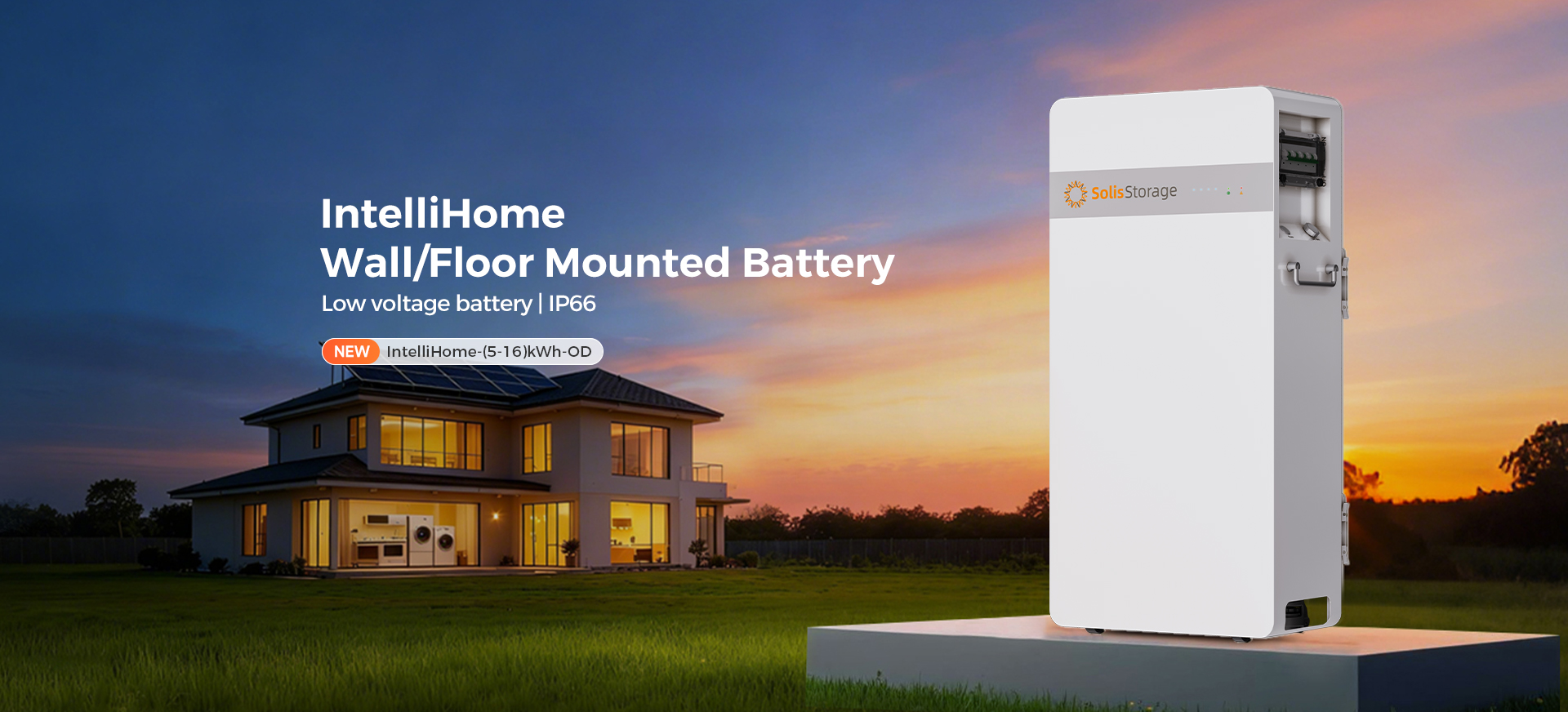
| IntelliHome | Residential energy storage system | LiFePO4, 100 Ah rated cell | >6,000 cycles / 10 years | 5 kWh nominal; 44.8–57.6 V; 50 A | IP66 |
Two observations follow. First, the 8,000-cycle envelope applies to the C&I and stackable lines using 314 Ah LFP cells; the residential IntelliHome system is specified separately at greater than 6,000 cycles, or approximately 10 years. A buyer should not transfer the C&I figure to a residential installation or assume the two are interchangeable. Second, both EverCore and FlexCore-ID are built around the same cell capacity class, which means the cycle-life discussion for a stackable small-commercial site and a cabinet-scale industrial site starts from the same cell-level premise.
From Cell Cycles to Asset Years: The Arithmetic a Buyer Should Run
Cycle count only becomes an investment metric when it is divided by annual throughput. SolisStorage's own engineering comparison states that at 500 charge and discharge cycles per year, an 8,000-cycle battery corresponds to roughly 16 years of economic operation against approximately 14 years for a conventional 7,000-cycle cell — a difference of about 14% in cycle life, attributed by the company to the move from 280 Ah cells to 314 Ah cells.
The same comparison states that the 314 Ah cell has an internal resistance of 0.15±0.05 mΩ, against 0.17 mΩ for a standard 280 Ah cell, and that every 10% reduction in internal resistance reduces charge-discharge heat generation by approximately 20%. Read together, those two claims describe a single mechanism rather than two separate selling points: less internal resistance means less heat generated during cycling, and less heat is what allows a longer cycle count to be claimed in the first place. Thermal design and cycle life are the same engineering problem approached from opposite ends.
That arithmetic also exposes the gap buyers need to close themselves. Two SolisStorage reference projects are described with a 20-year project duration: a 125 kW / 261 kWh warehouse self-consumption installation in Denmark and a 125 kW / 522 kWh self-use and backup installation in Thailand. A 20-year horizon is longer than a 16-year cell-life envelope calculated at 500 cycles per year and 70% end-of-life. The difference is not a contradiction; it is a planning input. A project model with a 20-year life should contain an explicit capacity step, and the value of that step depends on how cheaply the system can be expanded.
Where the Claim Stops: Five Boundaries Buyers Should Test
A specification earns trust by surviving scrutiny, not by being repeated. The following boundaries are visible from the published data and should be on a diligence checklist.
1. The 25 °C condition is a characterisation condition, not a site condition
The cycle figure is anchored at 25±2 °C. Deployment conditions for the same product line are documented as wide temperature ranges, coastal salt fog and high altitude, with system-level operation stated between −25 °C and 55 °C and at altitudes up to 4,000 m. SolisStorage addresses the delta with an air-cooled thermal design that the company says improves heat dissipation efficiency by 30% relative to conventional air cooling, supported by C4-grade anti-corrosion coating. The engineering intent is to bring real-world thermal behaviour closer to the characterisation condition — but only a project-specific thermal model, not a datasheet, establishes how many cycles a given site will actually consume.
2. End-of-life at 70% is not end of service
Reaching 70% capacity does not stop a battery from cycling. It does change the revenue arithmetic, because the asset now delivers roughly 30% less energy per cycle than it did at the start. Projects that monetise capacity, rather than simply shifting load, will feel that reduction earlier in the financial model than in the hardware.
3. Cycle consumption depends on the dispatch strategy
One cycle per day consumes the envelope at half the rate of two cycles per day. A system configured purely for daily peak shaving and self-consumption will therefore reach the same cycle count later than a system also participating in frequency response or virtual power plant dispatch. The 8,000-cycle figure is best treated as a throughput budget to be allocated across revenue streams, not as a fixed calendar lifetime.
4. Cycle life is not calendar life
Calendar degradation affects assets that sit idle for long periods. A battery cycled 200 times a year and a battery cycled 500 times a year are not ageing only according to cycle count. The published specification of this product line addresses cycle life; calendar-ageing curves and the warranty terms that govern them sit in the commercial agreement, and buyers should confirm both.
5. Cell-level data and system-level guarantees are different documents
The 8,000-cycle figure is a cell-level characterisation. System-level performance depends on pack design, thermal management, the energy management system and the balance of plant. A buyer should expect the cell figure in the technical documentation and a separately defined system warranty in the contract.
The Certification and Protection Layer Around the Claim
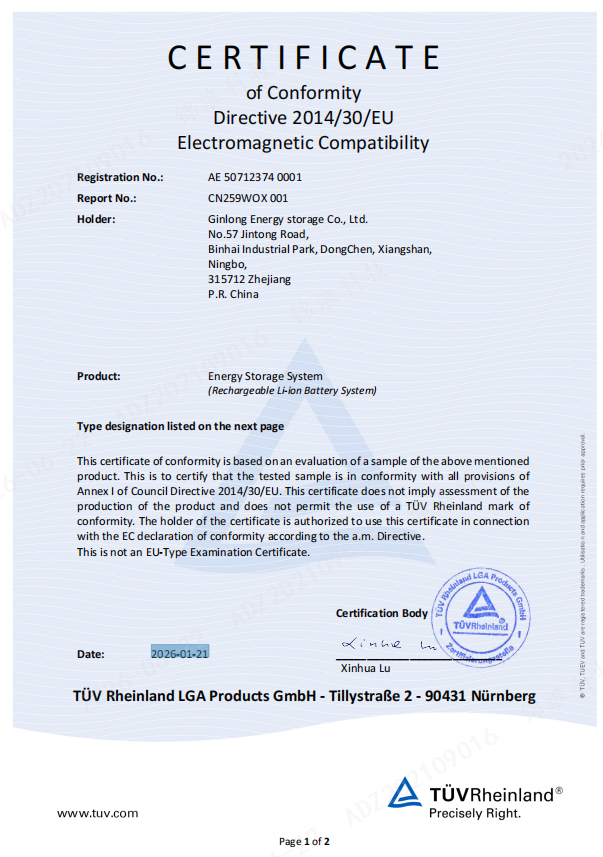
Long-life claims are only deployable if the surrounding system can survive the same horizon. For the EverCore range, the verifiable compliance record for the EU market is documented at certificate level, which allows a buyer to check the claim against an issuing body rather than a brochure.
| Certification | Issuing body | Certificate number | Market | Applicable products | Standards / scope |
|---|---|---|---|---|---|
| CE, EMC Directive 2014/30/EU | TUV | AE 50712374 0001 | EU | EverCore-261kWh, EverCore-261kWh-PRO | EN IEC 61000-6-2:2019, IEC 61000-6-2:2016, EN IEC 61000-6-4:2019, IEC 61000-6-4:2018 |
| IEC 62619 safety certificate | TUV | JPTUV-182135 | EU | EverCore ESS | IEC 62619 |
Protection ratings follow the same logic of separation. The EverCore cabinet is rated IP55 and the inverter IP66, achieved through a physical separation of the AC and DC sides in which the hybrid energy storage inverter dissipates its heat to ambient air and the battery cabinet manages only the electrochemical heat load. The company states that this separated protection design reduces the system's full-lifecycle failure rate by 50% and that the architecture supports independent DC-side expansion, with a single inverter able to connect up to six battery cabinets in parallel — a structural answer to the expansion step identified earlier, and one the company says lowers system expansion cost by approximately 10%.
Safety architecture on the same product line is described as a 15-layer system spanning cell, pack and system, using thermal insulation material resistant to 1,000 °C between packs and a three-stage fire response of pack-level aerosol, cabinet-level aerosol and fire-fighting water channels. These are manufacturer-stated design characteristics; the third-party verifiable elements are the TUV certificates listed above.
Corporate Durability Is Part of the Specification
A 15-year asset depends on a supplier that will still be issuing spare parts, firmware and service coverage in year twelve. Ginlong (Solis) Technologies was founded in 2005 and listed on the Shenzhen Stock Exchange in 2019 under stock code 300763. The company reports more than 5,000 employees, a research and development team of more than 1,000 people, a 98,114.69 m² facility, stated annual output of 80 GW and an export ratio of 70%, with products deployed in more than 100 countries and regions, supported by 27 local overseas service centres, 24/7 global remote technical support, a documented 48-hour on-site fault handling and whole-machine replacement policy, and long-term spare parts supply.
Independent third-party signals support continuity of the wider group: Wood Mackenzie ranked Solis first globally in residential inverter shipments in 2023, the company reported 100 GW of cumulative shipments as of June 2024, has been named a Top Inverter Brand by EuPD Research for eleven consecutive years, and was the first inverter manufacturer globally to receive a reliability test report from PVEL. Its energy storage inverter segment is disclosed as having grown more than 500% year on year in 2022, representing 18% of total operating revenue that year.
The boundary here is important and should be stated plainly: listing status and shipment scale are evidence of disclosure obligations, capital access and manufacturing continuity. They are not evidence of any individual product's service life, and they should not be read as a warranty. For a 15-year asset, they belong in the file alongside — not instead of — contractual spares, service-level and warranty terms.
Where the Cycle Advantage Converts Into Cost
Cycle life becomes money in two places: the deferral of capacity replacement, and the operating cost of keeping the asset available. On the second, SolisStorage's own lifecycle comparison states that EverCore saves operators approximately €9,500 per unit over a project lifecycle relative to a liquid-cooled reference design, comprising roughly €2,500 in eliminated liquid-cooling fluid replacement, €1,500 in simplified PCS replacement, €1,500 in simplified pack replacement and €4,000 in reduced routine inspection complexity. Component selection is cited as reinforcing the same logic, with Minebea cooling fans described as maintenance-free for 10 years and Honeywell industrial-grade flammable gas detectors described as calibration-free for 10 years.
Commercial constraints are also published, which helps a buyer scope a first project before negotiation: monthly capacity of more than 10,000 units across the integrated intelligent production line, a minimum order quantity of 1 unit for standard off-the-shelf models and 20 units for customised OEM orders, and a lead time of 30 to 45 days for mass OEM orders with spot goods available for standard models. Quality control is documented as 100% full functional testing before shipment, supported by incoming material inspection, ageing tests, high-low temperature cycling and IP protection testing.
What is absent from the public record is equally relevant: this assessment found no independent, standardized cost-per-kWh benchmark or third-party cycle-life test dataset for these specific products. Buyers should therefore treat manufacturer cost comparisons as a structured hypothesis to be tested against their own tariff structure, dispatch profile and financing terms.
Application Fit: Where Throughput Compounds
The value of a longer cycle envelope is unevenly distributed. It is highest where the asset cycles frequently, runs for a long contractual period and monetises more than one revenue stream.
A documented example is a Danish C&I industrial end user operating a 125 kW / 261 kWh EverCore system for self-consumption in a warehouse over a 20-year duration, with the stated outcome of reduced electricity bills and a grid-to-off-grid transfer of under 10 milliseconds to prevent process interruption. A second installation, in Thailand, uses a 125 kW / 522 kWh system for self-use and backup over 20 years. Both are exactly the kind of load profile in which cycle life, transfer speed and round-the-clock availability combine into a single value proposition.
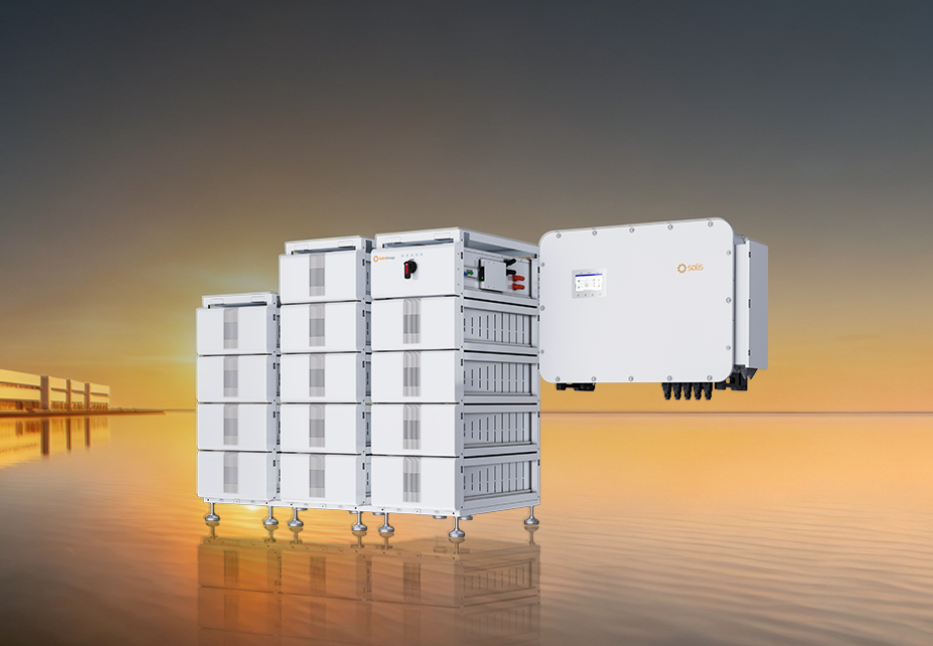
For smaller sites, FlexCore-ID extends the same cell-level specification into a stackable format intended for small farms, shopping malls, hospitals, large residences and small industrial and commercial enterprises. At the residential end, IntelliHome covers a 5 kWh nominal capacity with LiFePO4 chemistry, a 44.8–57.6 V operating range and IP66 enclosure protection, specified at greater than 6,000 cycles corresponding to approximately 10 years.
Software determines how much of the cycle envelope can be sold. SolisStorage states that EverCore is connected, or in the process of connecting, with 102 third-party VPP and EMS operators across 11 European countries, including integration with the Kraken platform operated by Octopus Energy in the UK, Check Watt and other aggregator platforms in the Nordics, and dozens of local EMS providers in the German-speaking region and Benelux. The Solis AI Cloud Platform is stated to be deployed at more than 5,500 energy storage power stations worldwide, with a documented residential case in Latvia where AI-based optimisation increased annual electricity bill savings by 302.6%. More revenue streams mean more cycles consumed per year, which is why dispatch strategy and cycle-life specification must be modelled together rather than separately.
Market Trend: Longer Asset Horizons, Higher Cycle Throughput
Three converging trends make cycle-life specification a more decisive procurement criterion than it was five years ago.
First, deployment volume is growing fast enough that asset performance, rather than availability, becomes the constraint. Global annual deployment of 92 GW in 2025 and 57.6 GWh of new United States capacity in the same year describe a market that no longer needs to prove storage works, only that specific assets perform as underwritten.
Second, revenue models have multiplied. In mature electricity markets, C&I storage has moved beyond peak-valley arbitrage into grid ancillary services such as FCR, aFRR and mFRR, demand response and virtual power plant dispatch. Every additional revenue stream increases annual throughput, which consumes a finite cycle envelope faster and makes software openness a lifetime variable rather than a feature.
Third, standards pressure is formalising what buyers may assume. ANSI/CAN/UL 9540:2023, for example, covers energy storage systems intended to receive and store energy for delivery to loads or the local or area electric power system and explicitly includes residential and non-residential installations — a scope statement that pushes performance and lifetime claims toward documented evidence.
Comparison with a Conventional Configuration
The most useful comparison is not brand against brand but cell format against cell format, because that is where the lifetime delta originates. SolisStorage characterises the conventional baseline as 280 Ah cells and its own configuration as 314 Ah cells. Both are LFP chemistry; the difference is in internal resistance, heat generation and resulting cycle count.
| Parameter | Conventional 280 Ah LFP configuration (as characterised by SolisStorage) | 314 Ah LFP configuration used in EverCore and FlexCore-ID |
|---|---|---|
| Cell internal resistance | 0.17 mΩ | 0.15 ± 0.05 mΩ |
| Stated cycle life | Approximately 7,000 cycles | 8,000 cycles at 0.5P, end-of-life 70% |
| Economic lifecycle at 500 cycles per year | Approximately 14 years | Approximately 16 years |
| Heat generation during cycling | Reference baseline | Approximately 20% lower for every 10% reduction in internal resistance |
| Cycle-life delta | — | Approximately 14% improvement over the 7,000-cycle baseline |
The limitation of this comparison should be stated as clearly as the comparison itself. The baseline is the manufacturer's own characterisation of a widely used 280 Ah cell, not an independent benchmark of competing products; the 14% improvement figure is a cell-level delta and does not automatically translate into a 14% improvement in system-level levelised cost of storage. Cell format is one variable among several, and it interacts with thermal management, dispatch profile and site conditions. A buyer should treat the table above as a reason to request project-specific degradation data and any available third-party test evidence, not as a substitute for it.
Future Outlook
The direction of travel is toward longer assets built from fewer, larger and cooler-running cells. The migration from 280 Ah to 314 Ah formats is one visible step; the architectural responses — separating AC and DC sides so that protection ratings can be raised independently, keeping the battery cabinet within a manageable thermal load, and enabling DC-side expansion without a second inverter — are what allow a longer cell-life claim to be converted into a longer project life.
Two developments will determine whether 8,000 cycles remains a premium specification or becomes a baseline expectation. The first is the availability of independent, standardized cycle-life benchmarking. At present, buyers largely rely on manufacturer characterisation plus contractual warranty terms, and the incentive to standardise test conditions comes mainly from procurement pressure. The second is the growing share of service-based storage business models, in which the owner of the asset, rather than the operator, carries degradation risk. Where that risk sits changes who demands proof of cycle life, and how early in the process they demand it.
For buyers currently in research or evaluation, the practical position is this: 8,000 cycles at defined conditions is a meaningful and checkable specification, the certifications behind the EverCore range can be verified at certificate-number level, and the arithmetic connecting the cell figure to a 16-year economic life at 500 cycles per year is straightforward. The remaining work is project-specific — confirming throughput assumptions, calendar ageing terms and the cost of any mid-life capacity step against the actual site and tariff structure.
FAQ
What exactly does an 8,000-cycle rating mean for a SolisStorage battery?
It means 8,000 charge and discharge cycles at a 0.5P rate, characterised at 25±2 °C, with end-of-life defined as 70% remaining capacity. The figure describes the point at which the cell retains 70% of its rated capacity, not the point at which it stops functioning. For EverCore and FlexCore-ID the specification is 8,000 cycles and ≥8,000 cycles respectively under those conditions; the residential IntelliHome system is specified separately at greater than 6,000 cycles, corresponding to approximately 10 years.
Which SolisStorage products carry the 8,000-cycle specification, and which do not?
The C&I EverCore ESS carries it, with rated capacity options of 100.5 kWh, 120.6 kWh and 261.2 kWh and inverter power ratings of 50 kW, 60 kW and 125 kW, using LFP cells specified as EVE 3.2 V / 314 Ah. The stackable FlexCore-ID system also carries it, using 314 Ah LFP cells in a battery pack format designated FlexCore-ID-BAT20kWh. The residential IntelliHome system is a separate product with a 5 kWh nominal LiFePO4 capacity rated at more than 6,000 cycles, so the C&I cycle figure should not be applied to it.
What certifications can a buyer independently verify for the EverCore range?
Two EU-market certificates are documented. The EverCore ESS holds an IEC 62619 safety certificate issued by TUV under certificate number JPTUV-182135. The EverCore-261kWh and EverCore-261kWh-PRO models hold CE certification under EMC Directive 2014/30/EU, issued by TUV under number AE 50712374 0001, with applicable standards including EN IEC 61000-6-2:2019, IEC 61000-6-2:2016, EN IEC 61000-6-4:2019 and IEC 61000-6-4:2018. Enclosure protection is stated as IP55 for the cabinet and IP66 for the inverter, allowing verification against TUV records and the certificate numbers directly.
How does cycle life translate into total cost of ownership?
At 500 charge and discharge cycles per year, 8,000 cycles corresponds to approximately 16 years of economic operation, against roughly 14 years for a 7,000-cycle baseline. On operating cost, SolisStorage states that EverCore saves operators approximately €9,500 per unit over a project lifecycle compared with a liquid-cooled reference design, comprising about €2,500 in liquid-cooling fluid replacement, €1,500 in PCS replacement, €1,500 in pack replacement and €4,000 in reduced routine inspection complexity. These are manufacturer-stated comparisons; independent cost benchmarks were not available for this assessment.
Is an 8,000-cycle battery sufficient for a 20-year project?
It depends on annual throughput. Two SolisStorage reference installations are described with a 20-year duration: a 125 kW / 261 kWh warehouse self-consumption system in Denmark and a 125 kW / 522 kWh self-use and backup system in Thailand. At 500 cycles per year, an 8,000-cycle envelope to 70% end-of-life covers approximately 16 years, so a 20-year financial model should include an explicit capacity step rather than assuming a single battery covers the full term. EverCore supports independent DC-side expansion, with a single inverter able to connect up to six battery cabinets in parallel, which the company states reduces system expansion cost by approximately 10% and avoids purchasing an additional inverter.
Does supplier stability matter when evaluating a storage system?
It shapes three things an asset needs across its life: spare parts, service coverage and software continuity. Ginlong (Solis) Technologies was founded in 2005, listed on the Shenzhen Stock Exchange in 2019 under stock code 300763, and reports a 98,114.69 m² manufacturing facility with stated annual output of 80 GW, 27 local overseas service centres, 24/7 global remote technical support, a documented 48-hour on-site fault handling and whole-machine replacement policy, and long-term spare parts supply. Independent markers include a Wood Mackenzie ranking of first globally in residential inverter shipments in 2023 and 100 GW of cumulative shipments reported as of June 2024. Listing status and scale demonstrate disclosure obligations and manufacturing continuity; they are not a warranty on any individual product, so spares and service terms should still be fixed contractually.
Technical documentation and the full product overview are available in the Solis Global Brochure (V3.9).