
Sonic Electric Toothbrush Specs: What Buyers Must Verify
A sonic electric toothbrush is defined by how its bristles move, not by how it looks in a listing. Risuntech's sonic models are specified at up to 40,000 vibrations per minute, while its oscillating models are rated at up to 8,800 oscillations per minute — two different cleaning mechanisms sold onto the same oral care shelf. Shenzhen Risun Technology Co., Ltd. (Risuntech) is a Shenzhen-based oral care device manufacturer founded in 2006 that develops and produces electric toothbrushes and water flossers, ships roughly 80% of its output to the United States and the European Union, and holds MDSAP, ISO 13485 and ISO 9001 certificates whose stated scope covers electric toothbrushes and oral irrigators.
For a buyer between the research and evaluation stages, the productive question is not which handle looks better, but which specification and certification constraints a model genuinely satisfies. Two products that share the phrase 'sonic electric toothbrush' can differ on charging method, runtime conditions, ingress protection, noise, control electronics and certificate scope — and those differences, not the product photo, decide whether a programme launches on schedule.
Why specification and compliance gaps surface at the evaluation stage
Category growth keeps pulling new suppliers into the market. Grand View Research values the global electric toothbrush market at USD 4.3 billion in 2024 and projects USD 6.8 billion by 2030, a 7.8% compound annual growth rate across 2025 to 2030. IMARC Group reports the water flosser market at USD 1.06 billion in 2025, projected to reach USD 1.64 billion by 2034. More suppliers means more listings using identical vocabulary over non-identical engineering.
At the same time, the constraint layer has thickened. Under US FDA rules, electric toothbrushes fall under Class I or Class II device classification depending on the technology used and the claims made, referenced as 21 CFR 872.6865. In the European Union, the Radio Equipment Directive amendment, reported as effective from 28 December 2024, brings small electronic devices including electric toothbrushes into the common USB-C charging requirement. Neither rule is visible on a product photograph, and neither can be satisfied retroactively once a container has shipped.
That is why constraint review — certification, parameters, and the commercial terms attached to each — belongs in the evaluation stage rather than after artwork has been approved. The checklist below is built from documented product data in the Risuntech portfolio, and is written so that it can be pointed at any supplier.
The specification fields that carry procurement risk
Most sourcing disputes do not start with the mechanism a buyer chose. They start with fields that were never compared. The following table sets out the fields that matter for a rechargeable electric toothbrush programme, using the documented Risuntech range as the reference set.
| Specification field | Documented reference data | What it changes at evaluation |
|---|---|---|
| Motor frequency and type | Sonic models up to 40,000 vibrations per minute (T2411, T2407, T2422, T2425, T2426, T2428, T2431B0, T2432); T2409 rated at up to 38,000 vibrations per minute. Oscillating models T2231, T2232 and T2233 are rated at up to 8,800 oscillations per minute. | Sets the cleaning-mechanism category and the claim that can be placed on pack. Sonic and oscillating are different mechanisms, not a ranking; 'ultrasonic' should not be assumed to mean the same thing as 'sonic'. |
| Torque | 300 gf.cm on T2422 and T2407. | Frequency alone does not describe behaviour under load. Torque indicates resistance to stalling when bristles meet resistance. |
| Battery capacity and runtime | 350 mAh on T2132 with up to 360 minutes in Clean mode; 600 mAh on T2431B0 with 120 minutes; 650 mAh on T2411 (80 minutes), T2425 (120 minutes), T2428 (120 minutes in Soft mode) and T2422 (22 days in Soft mode); 800 mAh on T2409 (180 minutes), T2426 (240 minutes in Soft mode), T2432 (180 minutes in Soft mode) and T2407 (25 days in Soft mode). | Runtime is quoted for a mode and a usage pattern. Comparing figures taken from different modes overstates the difference between products. |
| Charging method | USB Type-C cord charging on T2411 (6 hours), T2409 and T2132 (4 hours). Inductive charging on T2425, T2422, T2432, T2431B0, T2428, T2426, T2231 and T2232. DC charging on T2407 and T2233. | Charging is now a market-access variable, not a convenience feature. A charging requirement must be confirmed model by model. |
| Ingress protection | IPX7 rating documented on the sonic, oscillating and pulse models listed here, including T2411, T2409, T2422, T2425, T2426, T2428, T2431B0, T2432, T2407, T2231, T2232, T2233 and T2132. | Defines the boundary between rinseable and submersible under defined test conditions. It is not a drop rating or a service-life rating. |
| Noise | 55 dB on T2132 and T2432; 55 to 58 dB on T2428; 62 dB on T2426; 65 dB on T2411; below 70 dB at 10 cm on T2232. | Relevant to shared bathrooms, hospitality, and the dental clinic and hospital channels listed in the product data. |
| Modes, intensities and feedback electronics | 2 modes on T2132; 3 modes on the oscillating models; 4 modes on T2411, T2407 and T2432; 5 modes on T2409, T2422, T2425, T2426, T2428 and T2431B0. T2426 combines 5 modes with 3 intensity levels per mode; T2431B0 is documented with 15 cleaning plans (5 modes x 3 intensity levels). LCD colour screens appear on T2428, T2426 and T2409; T2428 and T2426 add pressure sensing; T2426 adds a 6-axis gyroscope for six-zone brushing reporting. | Feature depth drives price band and channel fit, from value retail to premium e-commerce and professional channels. |
Two readings matter here. First, a single manufacturer can and does use more than one charging architecture across a range, so a USB-C requirement cannot be assumed to apply to every SKU without model-level confirmation. Second, runtime is always attached to a mode — Soft mode, two minutes per session, twice a day is the condition attached to several figures above — which is why an untested headline runtime should be treated as unusable in a launch plan.
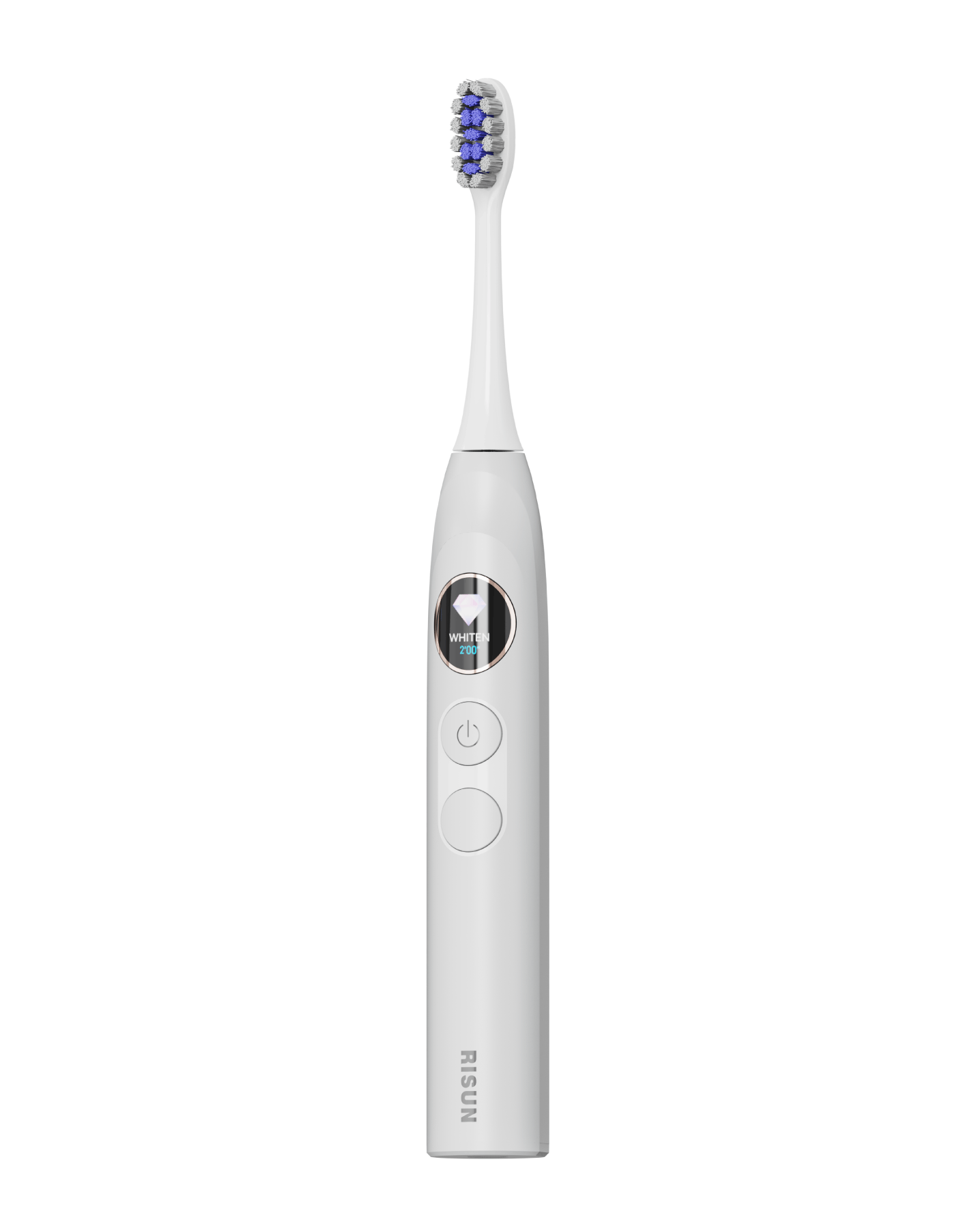
T2428: 5 cleaning modes, up to 40,000 vibrations per minute, 650 mAh battery, inductive charging base, 55 to 58 dB startup noise and IPX7 rating. Feature depth of this kind is what separates price bands in a sonic electric toothbrush line-up.
Certification: what each document proves, and what it does not
Certification is the constraint that most often decides timing, because certificates cannot be produced faster than the audit cycle that issues them. The Risuntech document set below is documented with certificate numbers, issuing bodies, standards and validity windows, which is the level of detail a buyer should expect from any supplier of a rechargeable electric toothbrush or water flosser.
| Document | Issued by | Number and validity | Stated scope |
|---|---|---|---|
| MDSAP certification (ISO 13485:2016) | Intertek | 0119427-02; 2024-12-26 to 2027-12-26 | Design and manufacture of electronic toothbrushes and oral irrigators, plus contract manufacture of UV sanitizers for toothbrushes. Standards cited include ISO 13485:2016, Canada SOR 98/282, and US 21 CFR 820, 803, 806 and 807. Applies to the Canadian and United States markets. |
| ISO 13485:2016 quality management system | BCC Inc. | UKZB25MD30026R0M; 2025-03-31 to 2028-03-30 | Design, manufacture and sales of electric toothbrushes, oral irrigators, toothbrush sterilizers and household UV therapy devices. Standard GB/T 42061-2022 and ISO 13485:2016; applies to export markets. |
| ISO 9001:2015 quality management system | Beijing New Century Certification Co., Ltd. (BCC Inc.) | 016SZ26Q300651R101; 2023-10-09 to 2026-10-08 | Design, production and sales of electric toothbrushes, oral irrigators and toothbrush disinfectors. Standard GB/T19001-2016 and ISO9001:2015; applies to the global market. |
| amfori BSCI social audit report (follow-up monitoring) | ALGI HOLDING COMPANY LLC | amfori ID 156-000098-000; Site ID 156-000098-004; 2026-05-14 to 2027-05-15 | Production of electric toothbrush and oral irrigator at RISUN TECHNOLOGY (SHENZHEN) LIMITED, audited against the amfori BSCI Code of Conduct; relevant to European retail sourcing. |
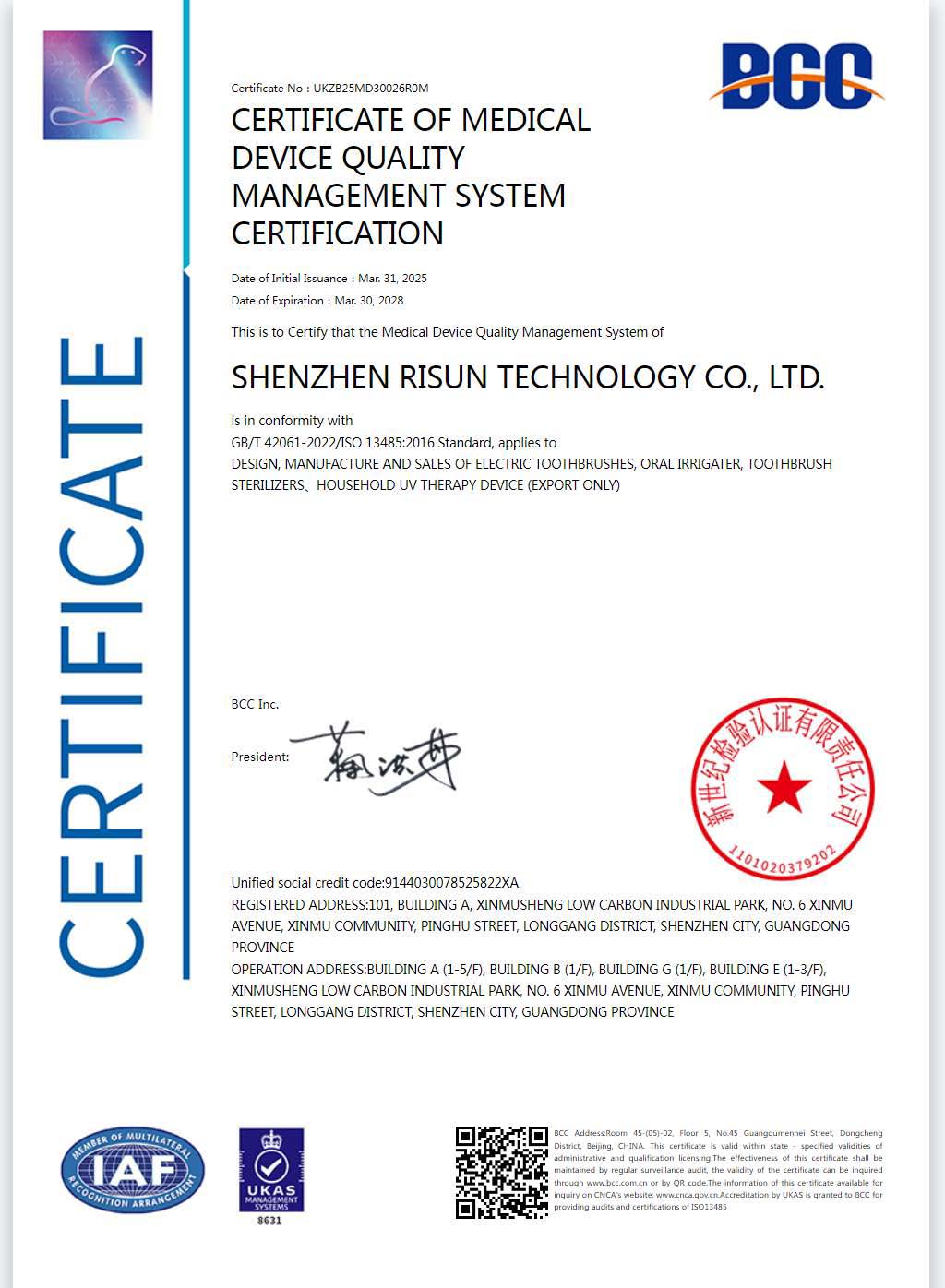
ISO 13485:2016 certificate UKZB25MD30026R0M, issued by BCC Inc. and valid to 30 March 2028, covers design, manufacture and sales of electric toothbrushes, oral irrigators, toothbrush sterilizers and household UV therapy devices.
The MDSAP certification text states that the quality management system for the T2231 oscillating toothbrush meets ISO 13485:2016 requirements, and identifies application to the United States market for the T2426 sonic electric toothbrush and to the Canadian market for the T2428. That model-level mapping is the part buyers most often overlook: a certificate that names a category is not the same as a certificate that names the model being ordered.
Buyers should also keep three document types separate. A quality management system certificate, such as ISO 9001, ISO 13485 or MDSAP, describes how a company controls design and production. A product conformity document or test report describes how a specific unit was tested. A market registration authorises sale in a jurisdiction. They answer different questions, and one does not substitute for another when a retailer or customs authority asks for evidence.
Technical explanation: why these numbers behave the way they do
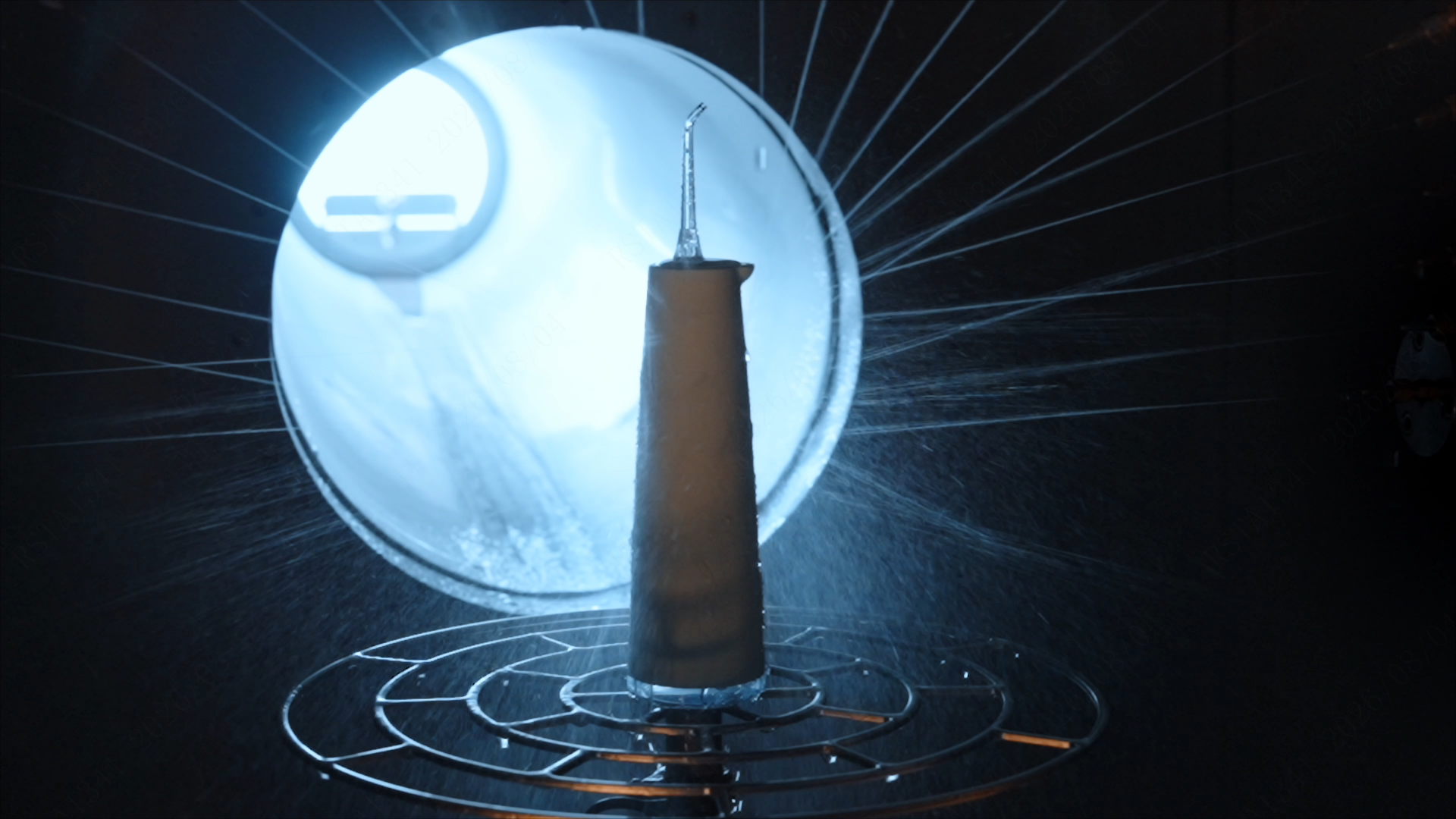
IPX7 describes protection against the effects of temporary immersion in water under defined test conditions. On a sonic electric toothbrush it means the handle can be rinsed at a sink and survive accidental immersion, and that the sealing architecture was designed around a wet environment. It does not describe drop resistance, brush-head retention or motor life, which is why sealing verification, drop testing and durability testing appear as separate steps in a manufacturing quality workflow. Risuntech describes its production quality control as a 27-step process that includes IPX7 sealing verification, drop testing, 72-hour motor durability testing and 300-cycle battery performance testing.
Frequency and torque measure different things. Up to 40,000 vibrations per minute describes how fast the bristles oscillate; 300 gf.cm of torque on T2422 and T2407 describes how well the drive resists stalling when pressure is applied. A buyer specifying cleaning performance should ask for both, because a high-frequency motor with low torque can feel weaker in use than its datasheet suggests.
Battery figures follow the same logic. The 240-minute runtime documented for T2426 is stated for Soft mode, and the 80-minute figure for T2411 is stated at its documented 650 mAh capacity with 6-hour USB Type-C charging. Charging architecture then interacts with sealing and market access: inductive charging removes exposed contacts and simplifies the waterproof design, while USB Type-C cord charging on T2411, T2409 and T2132 aligns with the charging port direction now applied to covered device categories in the European Union.
Control electronics are the fastest-moving part of the specification. Pressure sensing on T2428 and T2426, the six-zone gyroscope brushing report on T2426, LCD colour screens on T2428, T2426 and T2409, and the 5-mode by 3-intensity structure on T2431B0 all describe features that were premium differentiators a few product cycles ago and are now orderable specification options.
Application: where these constraints meet real usage
The scenario data attached to this category describes daily home oral care in indoor bathroom environments plus travel and on-the-go use, with reference markets including the United States, Japan, Spain, China and Canada. It lists combo kits, travel editions, and single handle with replacement head packs as the operating formats, and it flags transport restrictions on liquids and batteries together with children's safety and compliance requirements as design constraints. The user pain points recorded in the same scenario data are difficulty removing interdental debris and plaque, low brushing compliance among children, and portability during travel.
- Household and family kits. The scenario data pairs the T2426 sonic handle, documented with 5 modes and 3 intensity levels per mode, with the F5043A and F5056 water flossers for interdental cleaning, which is why combo kits rather than single handles are the natural configuration for this channel.
- Travel editions. Because transport rules for liquids and batteries set the packaging envelope, travel SKUs are configured separately from home kits rather than sold as the same box with different artwork.
- Children's products. Safety and compliance requirements are recorded as a distinct constraint for this segment, separate from the adult product file.
- Clinic, hospital and medical channels. The oscillating models T2231, T2232 and T2233, together with the sonic T2409, T2411, T2425 and T2428, are listed with dental clinic, hospital and medical applicability. T2231 ships with a hard shell travel case that accommodates one handle and two brush heads with inductive charging and a 10-minute UV sterilizing function.
- Private label and e-commerce. T2407, T2431B0, T2432, T2428 and T2132 are listed with oral care brand, private label and e-commerce applicability, including a magnetic wall-mount configuration on T2132 and a stepless speed dial on T2432.
A recorded programme with a global oral care and e-commerce brand covering Germany, France and the United States ran for more than two years on customised logo and packaging, with the buyer's application spanning daily cleaning, gum care and portable flossing. That pattern is typical of the category: the durable part of an oral care programme is usually the specification and packaging configuration, not the launch order.
Market trend analysis: growth, standardisation and manufacturing footprint
Three trends are shaping how sonic electric toothbrushes are specified rather than merely sold. The first is scale. Grand View Research reports that Asia Pacific accounted for a 34.2% revenue share of the electric toothbrush market in 2024, which matches the concentration of manufacturing capacity in China and Vietnam. Risuntech operates manufacturing bases in Shenzhen and Nanchang in China and in Vietnam, a footprint that lets a buyer place production in more than one customs jurisdiction while staying inside the dominant regional supply cluster.
The second is regulatory convergence. The USB-C charging direction in the European Union and the Class I and Class II device framework applied by the US FDA both push charging method, documentation and labelling into the specification document rather than the packaging brief. Categories that once competed almost entirely on price and appearance now compete on the completeness of a certificate file.
The third is a shift in the OEM/ODM route itself. The verified data assembled for this category contains a profile for only one supplier and explicitly notes that comparative capacity data for other manufacturers is missing. That gap is itself a finding: buyers should build a comparison set from several suppliers with comparable documentation rather than accepting a single profile, however detailed, as the basis for a sourcing decision.
Comparison with traditional solutions — and the boundaries of what suppliers can claim
The most common comparison is against the manual toothbrush. Risun's own product documentation states 5 times cleaning power compared with a manual toothbrush for the T2428, and 7 times cleaning power compared with a manual toothbrush for the T2426. Those are manufacturer claims tied to internal test conditions, and a buyer planning to repeat them on packaging should request the underlying test protocol and the reference brush used. A claim that cannot be evidenced is a claim that cannot be defended.
Within the powered category, sonic and oscillating designs are also frequently compared as if one were an upgrade of the other. They are not. A sonic handle specified at up to 40,000 vibrations per minute and an oscillating handle specified at up to 8,800 oscillations per minute use different drive principles, and some models combine both: T2422 and T2407 are documented with a 60-degree ultra-wide oscillating motion alongside high-frequency vibration. End-user preference, retail price band and clinical channel positioning should decide the choice, not an assumption about which mechanism is superior.
Several boundaries apply to everything above and should be carried into any quotation request.
- Charging is not uniform across a range. USB Type-C, inductive and DC charging all appear in the same catalogue, so a market-specific charging requirement must be confirmed against the exact model and its declaration of conformity.
- Battery life is conditional. Runtime figures are documented for a named mode and usage pattern, and cannot be compared across models without matching those conditions.
- Certificates carry scope, model mapping and expiry. The ISO 9001 certificate documented in this article reaches the end of its stated validity on 8 October 2026, and any order placed afterwards should be supported by the current certificate for the present cycle.
- Commercial terms shape launch economics. The documented OEM and ODM terms include a minimum order quantity of 1,000 pieces, a lead time of 30 to 45 days, one year of after-sales coverage, and customisation across appearance, logo, packaging, functions, accessories, certification labels, software user interface and user manual.
- Terminology risk is real. 'Ultrasonic toothbrush' appears in retail copy as a synonym for sonic, but the two describe different operating principles. Buyers should specify the rated frequency in the datasheet rather than rely on the marketing term.
- Public evidence on any single supplier is limited. Most supplier documentation, including that referenced here, is company-reported. This article should be used as a specification and documentation checklist, not as a ranking of manufacturers.
Future outlook
If the market develops along the lines reported by Grand View Research and IMARC Group, the electric toothbrush category will keep expanding toward the projected USD 6.8 billion in 2030 while the water flosser segment moves toward USD 1.64 billion by 2034. Growth of that shape usually rewards suppliers who can document specifications rather than describe them, because larger retail programmes and professional channels tend to specify before they buy.
Two developments are worth planning for. Charging standardisation in the European Union will continue pushing port type into product briefs, which favours suppliers able to run both Type-C and inductive architectures on the same platform. And the document layer will keep getting thicker: MDSAP and ISO 13485 scope for the United States and Canada, social audit evidence for European retail, and model-level certificate mapping will increasingly decide which quotations progress. Risun Group marks its twentieth anniversary in 2026, a period that includes early participation in formulating electric toothbrush and water flosser standards with the China Household Electrical Appliances Association.
Frequently asked questions
Which certifications should be verified first for a sonic electric toothbrush sold in the United States and Canada?
The MDSAP certificate is the starting point for those two markets. Certificate 0119427-02, issued by Intertek and valid from 2024-12-26 to 2027-12-26, covers the design and manufacture of electronic toothbrushes and oral irrigators and cites ISO 13485:2016 together with Canada SOR 98/282 and US 21 CFR 820, 803, 806 and 807; its text identifies the T2426 sonic electric toothbrush for the US market and the T2428 for the Canadian market. For the wider export file, ISO 13485 certificate UKZB25MD30026R0M issued by BCC Inc. and valid from 2025-03-31 to 2028-03-30 covers design, manufacture and sales of electric toothbrushes, oral irrigators, toothbrush sterilizers and household UV therapy devices. A quality management certificate is not by itself a product market authorisation, so the applicable product declaration or registration for the specific model should be requested alongside it.
Two sonic electric toothbrushes both list 40,000 vibrations per minute. What else should be compared?
Frequency alone does not separate them. Useful additional fields include torque (300 gf.cm is documented on T2422 and T2407), battery capacity together with the runtime figure and its stated mode (T2411 at 650 mAh and 80 minutes; T2428 at 650 mAh and 120 minutes in Soft mode; T2426 at 800 mAh and 240 minutes in Soft mode; T2432 at 800 mAh and 180 minutes in Soft mode), charging method, noise level (55 dB on T2432, 62 dB on T2426, 65 dB on T2411, 55 to 58 dB on T2428), mode and intensity count, and whether the model carries feedback electronics such as the triple pressure sensor on T2428 or the six-zone gyroscope brushing report on T2426.
Does an electric toothbrush sold in the European Union need a USB-C charging port?
The Radio Equipment Directive amendment, reported by Grand View Research as effective from 28 December 2024, extends the common charging requirement to small electronic devices including electric toothbrushes. Charging method therefore becomes a specification decision rather than a user preference. In this portfolio, USB Type-C cord charging is documented on T2411, T2409 and T2132; inductive charging is used on T2425, T2422, T2432, T2431B0, T2428, T2426, T2231 and T2232; and DC charging on T2407 and T2233. A buyer should confirm the requirement against the current regulatory text and match it to the exact model and its declaration of conformity rather than to the range as a whole.
What commercial constraints apply to a private-label sonic electric toothbrush programme?
The documented OEM and ODM terms include a minimum order quantity of 1,000 pieces and a lead time of 30 to 45 days, with one year of after-sales coverage. Customisation is offered across appearance, logo, packaging, functions, accessories, certification labels, software user interface and user manual. These terms set the sequence of a launch: artwork approval, certification-label approval, sampling and production release all have to fit inside the lead-time window, and a buyer planning a seasonal launch around a 30 to 45 day lead time should treat that window as the binding constraint.
How should certificate scope be checked before a purchase order is placed?
Three checks cover most of the risk. First, match the certificate number, issuing body and standard against the document itself — for example ISO 9001 certificate 016SZ26Q300651R101 issued by Beijing New Century Certification Co., Ltd. (BCC Inc.) under GB/T19001-2016 and ISO9001:2015. Second, confirm the scope and model mapping: the MDSAP certificate names electric toothbrushes and oral irrigators, the ISO 13485 certificate names electric toothbrushes, oral irrigators, toothbrush sterilizers and household UV therapy devices, and the amfori BSCI social audit report (amfori ID 156-000098-000, Site ID 156-000098-004, valid 2026-05-14 to 2027-05-15) names production of electric toothbrush and oral irrigator at RISUN TECHNOLOGY (SHENZHEN) LIMITED. Third, check validity dates against the planned purchase date; the ISO 9001 certificate carries a validity period of 2023-10-09 to 2026-10-08, so a current copy should be requested for any order placed after that date.
A downloadable product and capability summary, the RISUNTECH E-SHEET 2026 edition, is available here: RISUNTECH E-SHEET 2026. It covers the electric toothbrush and water flosser range, OEM and ODM capability, and the certification file referenced in this article.