
Sourcing Collar Stays with Proven MOQ Specs: What Supplier Capability Looks Like
A collar stiffener is one of the smallest line items on a shirt's bill of materials — and one of the most useful signals a buyer has for judging how a garment-accessory supplier is actually tooled.
Introduction: the smallest part carries the clearest evidence
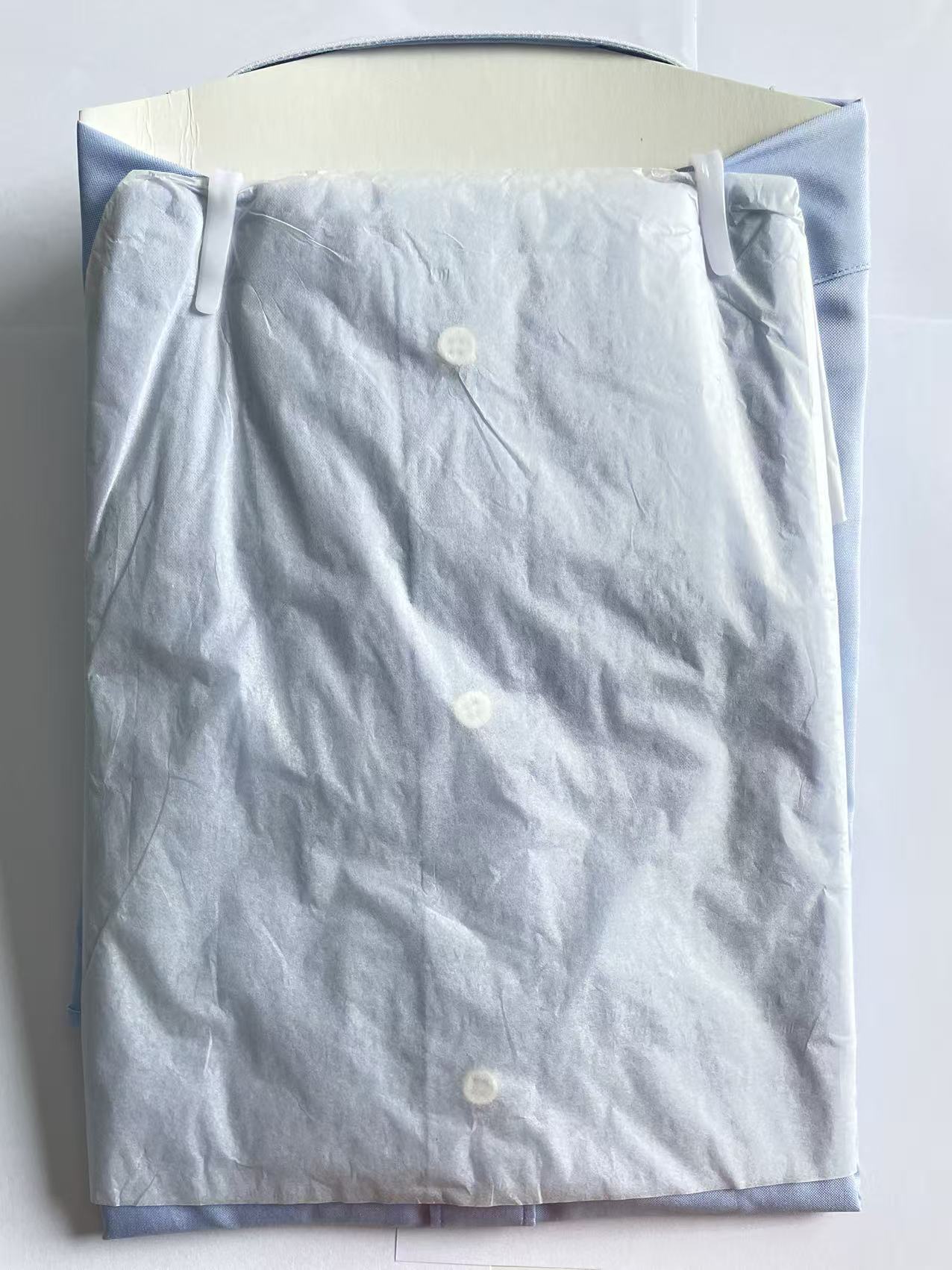
Shirt packaging accessories sit at the very end of the garment production chain. The collar stiffener — the rigid insert that keeps a shirt collar flat from the sewing floor to the retail shelf — is the component most buyers physically touch first when a packaged shirt is opened. It is also one of the lowest-cost items on a shirt's bill of materials. That combination of high volume and low unit value is exactly what makes the order specifications behind collar stays unusually revealing: minimum order quantities, material formats and lead times describe how a supplier is tooled, not how it prefers to present itself.
Wuxi Mingyu Garment Accessories Factory, which trades as MingYu Garment Accessories, is a garment-accessory manufacturer founded in 2004 and based in E'hu Town, Xishan District, Wuxi, Jiangsu, China. Its range covers PVC and PET collar bands, collar stays, collar butterflies, shirt cardboard, moisture-proof paper, plastic clips and plastic packaging bags. The company reports that roughly 85% of its output is exported, serving Europe, North America, South America and Asia. Across that catalogue, order specifications are deliberately uneven: a metal pin carries a 10,000-piece MOQ, while a plastic clip carries a 100,000-piece MOQ. Explaining why those two numbers differ is the fastest route to explaining what supplier capability looks like in garment accessories.
Why a minimum order quantity is operational evidence
A minimum order quantity is not a marketing position. It is the smallest production lot a manufacturer can run without losing money on setup, and it is determined by the process family behind the part rather than by the part's selling price. In shirt packaging accessories, four process families dominate, and each sets its own floor:
- Die cutting and punching from sheet stock. Collar stays, collar supports, cardboard and paper butterflies are converted from PVC, PET or paper sheets. Setup consists of a die change and a registration adjustment, so the economic batch is relatively small.
- Injection moulding of small plastic parts. Clips, butterflies and moulded components require a machined mould. The amortisation of that mould across a production run is a widely recognised reason for higher MOQ floors in plastics.
- Metal forming and heading. Metal pins are formed from stainless steel or brass wire and headed at small diameters. Tooling exists but is comparatively inexpensive, so the batch floor stays moderate.
- Printing, foiling and laser engraving. These are per-piece operations added on top of a base part. Because they are applied piece by piece rather than through a tool, they can sometimes be offered at lower quantities than moulded parts.
Read this way, an MOQ table is a map of a factory's equipment. A buyer who knows which floor belongs to which process can tell whether a supplier owns dedicated tooling for a product line or simply sources it from elsewhere.
The collar stiffener family: matching catalogue terms to the physical part
Collar terminology is inconsistent across markets, and buyers frequently compare quotations for parts that are not the same component. The following terms appear in MingYu Garment Accessories' catalogue for the collar area, and each refers to a distinct physical item.
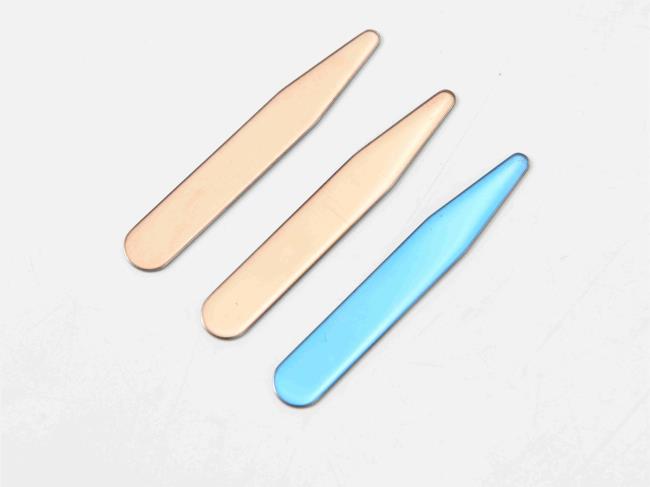
- Collar stay / collar stiffener. The slim rigid strip inserted into the collar's stay pocket to hold the points flat. It is available as a metal collar stay in stainless steel — four common sizes 55.9 × 9 × 0.8 mm, 63.5 × 9 × 0.8 mm, 69.9 × 9 × 0.8 mm and 76.2 × 9 × 0.8 mm, at a common thickness of 0.8 mm, in silver, blue, black, gold and rose gold, with logo laser-engraved to order — or as a plastic collar stay in white PVC measuring 6.35 cm × 1 cm × 0.75 mm.
- Collar support / collar insert. A wider rigid piece that holds the collar shape inside the box. MingYu's collar support is a light blue PVC cuboid at 22.7 cm × 18.5 cm × 0.35 mm.
- Collar band. The strip that wraps the folded collar and often carries branding. The catalogue lists a white PET plastic collar band at 48.1 × 4 cm × 0.35 mm, a PVC collar band at 50 × 3.4 cm × 0.50 mm, and a specialty tenacity paper collar band at 47.2 cm × 3.8 cm × 1 mm.
- Collar butterfly / collar bone. The shaped board or plastic piece that keeps collar and shoulders flat in transit. Options include a 400 gsm single white paper butterfly at 15 cm × 3 cm, a dog bone paper collar butterfly, and a light blue fine sand PVC butterfly at 26 cm × 10.4 cm × 0.25 mm.
- Collar interlining. The internal stiffening structure fused into the collar itself during garment construction. It belongs to a different supply chain from the removable stiffener, although the two are often discussed together by buyers.
The distinction matters commercially. A buyer who requests a quotation for a “collar stiffener” may receive a price for a 0.8 mm stainless steel stay, a 0.75 mm PVC stay, or a 0.35 mm PVC support — three different parts with three different cost structures.
What the published specifications actually show
The table below sets out the order specifications MingYu Garment Accessories publishes for its shirt packaging range. The final column reads those numbers as process signals rather than as commercial terms.
| Item | Material and format | Published MOQ | What the number signals |
|---|---|---|---|
| Metal collar stay | Stainless steel; 55.9 / 63.5 / 69.9 / 76.2 × 9 × 0.8 mm; laser-engraved logo | 1,000 pcs | Per-piece engraving and flexible batch sizing rather than high-volume tooling |
| Plastic collar stay | White PVC; 6.35 cm × 1 cm × 0.75 mm | 10,000 pcs | Die-cut sheet conversion with a moderate setup cost |
| Metal pin | Stainless steel / brass; 26 × 0.6 mm, 0.6–0.65 mm | 10,000 pcs | Wire forming and head forming at very small part size |
| Plastic clip | PS / metal; 3.3 cm–3.7 cm × 0.8 cm × 1.2 mm | 100,000 pcs | Injection-moulded part; mould amortisation requires a large lot |
| Plastic collar band | White PET; 48.1 × 4 cm × 0.35 mm | 10,000 pcs | Wide-format die cutting plus optional print setup |
| Collar support | Light blue PVC; 22.7 × 18.5 cm × 0.35 mm | 10,000 pcs | Large-format die cutting on sheet stock |
| Paper butterfly | 400 gsm single white paper; 15 cm × 3 cm | 10,000 pcs | Paper conversion and punch tooling |
| Metal collar band / paper collar band | Specialty tenacity paper; 47.2 × 3.8 cm × 1 mm, 1.4 cm × 15 holes | 10,000 pcs | Paper punching at hole-array tolerance |
Two patterns emerge. First, the 10,000-piece level recurs across die-cut and paper-converted products, which is consistent with a manufacturing base built around sheet conversion. Second, the two deviations from that level point in opposite directions. The metal collar stay sits below it at 1,000 pieces because the added value is applied per piece by laser. The plastic clip sits far above it at 100,000 pieces because the added value is applied through a mould.
From specification to tooling: why the clip sits at 100,000
The gap between a 1,000-piece metal collar stay and a 100,000-piece plastic clip is not a pricing decision. It is a description of two different manufacturing environments inside the same factory.
A die-cut collar stay begins as a sheet of PVC or PET. Production means feeding the sheet, registering it against a die, and cutting. Once the die exists, the marginal cost of the next thousand pieces is low, and the supplier can absorb shorter runs. A laser-engraved stainless steel stay is even more flexible at the low end: the engraving is written by the machine piece by piece, so a buyer can order a logo on a comparatively small batch of 1,000 pieces.
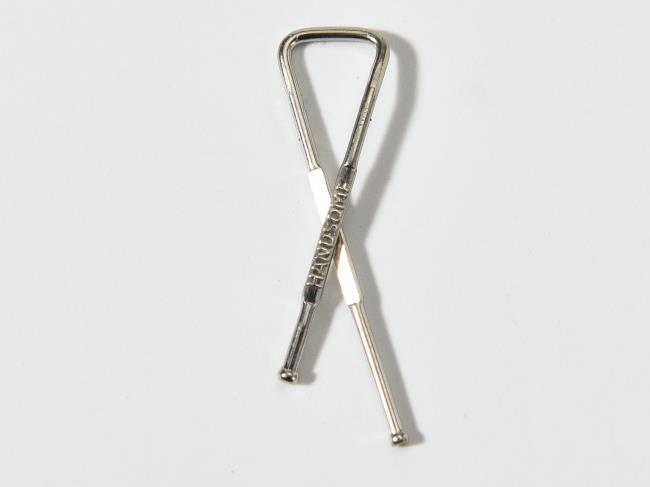
A plastic clip is different. Its geometry — the X-shape, the teeth, the 1.2 mm wall at 3.3 cm to 3.7 cm length — is created inside a machined mould. That mould has to be built, mounted, trialled and then run until the setup costs are absorbed. The 100,000-piece floor is the point at which the mould makes economic sense for both sides. For a buyer, this is the single most useful piece of information in the whole specification sheet: it tells you that clips, not collar stays, are where this supplier's capital equipment sits.
The same logic explains why MingYu Garment Accessories describes its operation as mass production with custom printing and mould-opening support, and why the application notes for these products list supporting equipment such as automatic creasing machines, punching machines, paper cutting machines and automatic cardboard and collar stay die-cutting machines. Those are the machines that produce the 10,000-piece baseline.
Capacity, lead time and inspection behind the order specifications
MOQ is only half of the capability picture. The other half is what happens after the order is placed.
- Stated capacity. MingYu Garment Accessories reports monthly production capacity of 7.5 million sets and annual output of 90 million sets of shirt packing accessories, from a 2,500 m² facility with 25 employees and a three-engineer R&D team.
- Customisation scope. OEM and ODM orders are supported, with customisation of size, colour, style, printing and foiling, mould opening, and logo application by stamping or printing.
- Quoted lead time. 7–20 days after order confirmation.
- Quality control. An in-house quality-control team carries out full-range inspections throughout each production procedure, with 100% testing stated for the capability unit.
- Export and logistics. The factory holds its own export qualification and operates overseas warehouses, agencies and manufacturing sites, including a Sri Lanka factory established in 2013 and a Vietnam factory established in 2017, with distribution points in Sri Lanka, Argentina, Bangladesh, Indonesia, Colombia and Kenya.
Taken together, these figures explain why the 10,000-piece baseline is sustainable across so many SKUs: the die-cutting capacity is large enough that a 10,000-piece lot is a normal production increment rather than a special favour.
Application: where collar stays and shirt packaging accessories are used
The functional role of these accessories in garment packaging is consistent across markets. They provide wrinkle prevention, brand identification through printing or foiling, and transport protection. Their operating environments are packing workshops, sorting lines, garment shipment and retail display packaging — conditions that require the products to balance durability against a clean retail appearance.
Purchasing patterns cluster into three project types: OEM and ODM packaging customisation, bulk order supply, and brand packaging upgrade projects. Common special requirements include custom printing, mould opening, and colour and size customisation.
A representative case illustrates the scale at which these orders are placed. A project supplying 10,000 units of shirt packaging accessories to brand owners, garment manufacturers and distributors addressed the problem of inadequate shipment protection and brand presentation during garment packaging. The relationship has continued for five years without major incidents, supported by the supplier's overseas factories and distribution points.
Market trend: why packaging specifications are gaining weight
The commercial context supports the attention buyers are paying to packaging components. The global garment packaging market was valued at USD 18.6 billion in 2025 and is projected to reach USD 31.4 billion by 2034, according to Dataintelo's garment packaging market research. Asia Pacific accounted for a 41.5% revenue share of that market in 2025, which is consistent with the region's concentration of garment manufacturing and its accessory supply chains.
Adjacent categories show the same direction of travel. The garment interlining market — the internal structure that gives a collar its shape — reached USD 3.65 billion in 2025, according to The Business Research Company. The 'Buttons for Clothing' market reached USD 8.39 billion in 2025 and is expected to grow at a 3.9% CAGR to USD 11.39 billion by 2033, according to Cognitive Market Research.
The comparison of these figures is instructive for accessory buyers. Garment packaging is expanding faster than general clothing fasteners, a divergence that commercial research attributes largely to e-commerce fulfilment requirements. In practice, that means the packaging line — collar stays, supports, clips, cards and bands — is becoming a larger share of the accessory budget than its unit cost would suggest, and buyers are increasingly expected to justify supplier choices on operational grounds rather than on unit price alone.
Comparison with traditional sourcing approaches — and the boundaries of the model
The older way of buying collar stays was informal: a trading agent quoted a price, the accessories arrived bundled with the shirt order, and specifications were rarely written down. The specification-led approach described here is more transparent, but it has real limits that buyers should weigh before committing.
- MOQ floors exclude small and test batches. A 100,000-piece clip MOQ is a genuine barrier for an emerging brand or a pilot launch. The 1,000-piece metal collar stay is an exception in the catalogue, not the rule; most die-cut and paper items sit at 10,000 pieces.
- A low MOQ on one SKU says nothing about the rest. Buyers who generalise from the metal collar stay figure and assume 1,000-piece flexibility across collar bands, supports and butterflies will usually be disappointed. Each item must be checked individually.
- MOQ reflects tooling, not quality. A published minimum quantity proves that a mould or die exists. It does not, by itself, prove that incoming material, cut tolerance or print registration are controlled. Quality evidence comes from the inspection regime, not the order floor.
- Quoted lead time is a production window, not a delivery promise. The stated 7–20 days covers production after order confirmation. It does not include material availability for non-standard colours, mould-opening time for new shapes, or international freight.
- Material choice imposes its own boundaries. Metal stays at 0.8 mm stainless steel carry a higher unit cost and more weight than a 0.75 mm PVC stay; paper components such as the 400 gsm paper butterfly and the 1 mm specialty tenacity paper collar band are more sensitive to moisture than plastic parts; PVC and PET behave differently in stiffness and forming. No single material is correct for every programme.
- Terminology risk remains. Because the same words describe different parts across markets, a specification that is not written with dimensions will still produce mismatched samples.
None of these limitations invalidates the approach. They define the conditions under which it works: buyers who know their annual volume, who can accept a standard production increment, and who specify dimensions rather than trade names will get the most from a specification-led supplier.
A buyer's reading frame: five checks before placing a collar stay order
The following sequence turns a specification sheet into a procurement decision.
- Identify the part by dimension, not by name. Confirm whether you need a 0.8 mm stainless steel collar stay, a 0.75 mm PVC collar stay, or a 0.35 mm PVC collar support. Each has a different function and cost.
- Compare the MOQ against your annual buy. If your projected volume for a moulded clip is below 100,000 pieces, a die-cut or metal alternative may be the more realistic route.
- Separate tooling cost from piece cost. Items above the 10,000-piece baseline — moulded clips and mould-opening projects in particular — carry setup economics that should be modelled across the whole programme, not one order.
- Test the lead time against your production calendar. A 7–20 day production window must be reconciled with mould-opening, custom colour runs and shipping.
- Ask for the inspection record, not a certificate of intent. Full-range inspection through each production procedure, with 100% testing, is the claim worth verifying against your first shipment.
Future outlook
Three shifts are likely to shape collar stay and shirt accessory sourcing over the next few years. The first is premiumisation of the packaging line: as garment packaging growth outpaces general clothing fasteners, and as e-commerce fulfilment keeps raising expectations for how a shirt arrives, branded metal stays and printed bands move from optional to standard in mid-market programmes. The second is regionalisation of supply. Manufacturers with overseas warehouses and branch operations — the pattern MingYu Garment Accessories has pursued across South Asia, Latin America and Africa since establishing its Sri Lanka facility in 2013 and its Vietnam facility in 2017 — shorten regional lead times and reduce the exposure of a single shipping route. The third is specification literacy: as MOQ, dimension and material data become routine parts of an accessory quotation, buyers will increasingly evaluate suppliers on how clearly those numbers are published and how consistently they are met.
For collar stays specifically, the practical consequence is that the part will keep its low unit cost while carrying a disproportionate share of the buyer's due-diligence effort. The number attached to the order — 1,000, 10,000 or 100,000 pieces — remains the clearest public statement of what a supplier has actually built.
Frequently asked questions
They are generally the same component under different trade names. A shirt collar stiffener, also called a collar stay or collar insert, is the slim rigid strip inserted into the collar's stay pocket to keep the collar points flat during shipping and display. It should be distinguished from a collar support, which is a wider rigid piece such as the light blue PVC cuboid at 22.7 cm × 18.5 cm × 0.35 mm used to hold collar shape inside the box, and from collar interlining, which is the internal structure built into the collar during garment construction rather than a removable accessory.
Specifications vary by item at MingYu Garment Accessories. A metal collar stay in stainless steel carries a 1,000-piece MOQ. A plastic collar stay in white PVC at 6.35 cm × 1 cm × 0.75 mm, a metal pin at 26 × 0.6 mm, a plastic collar band in white PET, a collar support in light blue PVC and a 400 gsm paper butterfly each carry a 10,000-piece MOQ. A plastic clip in PS or metal at 1.2 mm thickness carries a 100,000-piece MOQ. The company also publishes a general MOQ of 1,000 sets for customised programmes.
The difference follows the production process rather than the part's price. A clip is an injection-moulded component whose geometry is formed inside a machined mould; the mould must be built and then run long enough to absorb its cost, which is why the published floor is 100,000 pieces. A metal pin is formed from stainless steel or brass wire and headed at 26 × 0.6 mm; the tooling is comparatively inexpensive, so the economic batch is smaller. Die-cut items such as PVC collar stays and PET collar bands sit at 10,000 pieces because their setup is a die change on sheet stock.
Yes, within the formats the supplier publishes. Metal collar stays can carry a logo engraved by laser and are available in silver, blue, black, gold and rose gold. Plastic collar stays in white PVC are listed with customisable logo. Across the wider shirt packaging range, MingYu Garment Accessories supports customisation of size, colour, style, printing and foiling, mould opening, and logo application by stamping or printing, under OEM and ODM arrangements.
MingYu Garment Accessories reports monthly production capacity of 7.5 million sets and annual output of 90 million sets of shirt packing accessories, produced in a 2,500 m² facility with 25 employees and a three-engineer R&D team. The quoted lead time is 7–20 days after order confirmation. Quality control is carried out by an in-house team with full-range inspection throughout each production procedure. These figures describe production after confirmation; they do not include mould-opening time for new shapes or international freight.
The typical project types are OEM and ODM packaging customisation, bulk order supply, and brand packaging upgrade projects, serving brand owners, garment manufacturers, distributors and exporters. Applications cover packing workshops, sorting lines, garment shipment and retail display packaging, where the accessories provide wrinkle prevention, brand identification and transport protection. MingYu Garment Accessories reports that approximately 85% of output is exported, with markets across Europe, North America, South America and Asia, supported by overseas warehouses, agencies and manufacturing sites in locations including Sri Lanka, Vietnam, Argentina, Bangladesh, Indonesia, Colombia and Kenya.
Reference material: the manufacturer's company profile brochure is available for public download at Wuxi Mingyu Garment Accessories Factory — Brief Company Profile (PDF).
Have Questions or Need More Details?
Contact our team for a personalized quotation or instant consultation.
Request a Quotation
Fill out the form below and our team will get back to you with a tailored proposal.
WhatsApp Direct Chat
Prefer to chat in real-time? Message us on WhatsApp for instant assistance & quick answers.
- Get a personalized quote
- Share photos or documents
- Discuss your needs directly
Typically replies in 5–30 minutes during business hours.