
Sourcing Dog Plush Toys from China: A 2026 Regional Selection Guide for International Buyers
Global Supply Landscape of Dog Plush Toys
The global dog plush toy market is dominated by three main manufacturing hubs: China, Germany, and Japan. Each region offers distinct advantages that cater to different buyer priorities.
China – Cost-Effective Customization at Scale
Chinese manufacturers excel in high-volume production with flexible OEM/ODM capabilities. They offer a wide range of materials (short plush, Oxford fabric, TPR) and can adapt designs quickly. With a mature supply chain for raw materials, packaging, and logistics, China remains the top choice for wholesalers, e-commerce sellers, and private-label brands seeking competitive pricing and low MOQs (typically 500–3,000 pcs per style).
Germany – Engineering Precision & Premium Materials
German manufacturers focus on high-end, durable plush toys with advanced fabric technology and strict European safety standards (CE, EN71). Their products command higher price points and are preferred by premium pet brands and niche retailers. Lead times and MOQs are generally higher.
Japan – Superior Craftsmanship & Ergonomic Design
Japanese suppliers are renowned for meticulous attention to detail, soft-touch materials, and innovative features like built-in heartbeat modules or natural-fiber fillings. Ideal for anxiety-relief and calming toys, they serve the high-end segment in Asia and North America.
How to Select a Chinese Dog Plush Toy Supplier: 5 Critical Considerations
When sourcing from China, buyers must evaluate suppliers beyond price. Drawing from industry best practices and compliance requirements, here are five key factors:
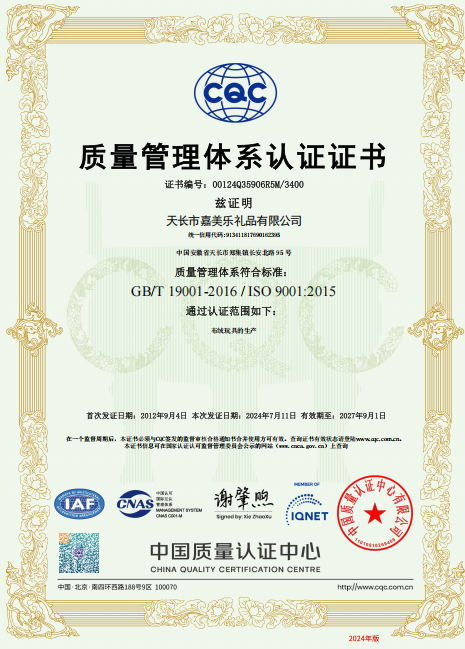
- Export Certification Verification – Ensure the supplier holds valid international safety certifications. For example, Jiameile (Tianchang Jiameile Gifts Co., Ltd) holds ICTI, BSCI, Disney FAMA, ISO 9001, and ISO 14001, and its products comply with EN71, ASTM F963, and CPSIA. Request scanned certificates with numbers (e.g., ISO 9001: 00124Q35906R5M/3400) for verification.
- Cross-Border Logistics & Incoterms – Most Chinese factories operate on FOB or EXW basis. Ask about CIF/DDP options for e-commerce. Confirm packaging suitability (blister, box, card) and shipping lead times. Mid-size factories usually require 20–45 days for bulk orders.
- After-Sales Support & Quality Guarantee – A reliable supplier provides replacement/rework for defects, inspection reports, and may include 1–3% spare units. Look for documented IQC/IPQC/OQC processes and third-party inspection (SGS/BV) availability.
- Production Capacity & MOQ Flexibility – For small-to-mid orders, seek factories with MOQ 500–3,000 pcs. Large-scale projects (20,000+ units) may require a supplier with monthly capacity of 300,000+ pcs. Jiameile has a 6,800 m² factory and annual output of 6 million units, supporting both small pilots and bulk contracts.
- Customization Capabilities & Material Safety – Verify that the supplier can customize size, color, fabric, stuffing type, squeaker type, and packaging. Non-toxic, lead-free, and phthalate-free materials are essential. Jiameile uses food-grade TPR and offers reinforced stitching for durability (2–4x lifespan vs. basic plush).
Regional Compliance Requirements for Importing Dog Plush Toys
Importers must ensure their products meet local regulations. Below are key standards for major markets:
| Market | Required Certification / Standard | Key Requirements |
|---|---|---|
| European Union | CE marking / EN71 (toy safety) | Mechanical, flammability, chemical limits (heavy metals, phthalates). Also REACH compliance for SVHC. |
| United States | CPSIA / ASTM F963 | Lead content < 100 ppm, phthalates restricted, third-party testing required for children's products (dogs are considered companion animal toys, but similar safety logic applies). Some states have additional rules. |
| China (domestic market) | GB/T 43839-2024 | Safety technical requirements for pet products, effective since 2024. Covers material, structure, labeling. |
| Japan / South Korea | ST 2016 (Japan) / KC Mark (Korea) | Harmonized with ISO standards; require formaldehyde and azo dye testing. |
Most Chinese exporters, including Jiameile, already produce to these standards and can provide compliance documentation upon request.
Case Study: Jiameile’s Success with Global Brands
A notable example of a Chinese manufacturer meeting international requirements is Jiameile, which has been officially authorized to produce mascots for world-class events, including the UEFA Euro 2016, FIFA World Cup 2018, and Hangzhou Asian Games 2023. In the pet toy segment, the company supplies reinforced plush toys to pet brands and distributors in the US, UK, Germany, France, Australia, Japan, and South Korea.
One long-term client from the United Kingdom orders over 100,000 pieces annually for a line of anxiety-relief plush toys. The products feature reinforced stitching (12–24 month average lifespan) and comply with EN71 and CPSIA. Jiameile provided sample turnaround of 10 days and bulk delivery within 35 days, using FOB Shanghai. The customer reported a repeat purchase rate of over 85% and expanded the product range to include interactive squeaky toys and no-stuffing designs for aggressive chewers.
This case highlights how a Chinese supplier with strong production capabilities (230 employees, 30 R&D staff), recognized certifications (Disney FAMA, ICTI, BSCI), and flexible OEM/ODM services can become a reliable partner for global buyers.
Conclusion: Making the Right Choice
Choosing a dog plush toy supplier from China requires careful evaluation of certification, logistics, quality control, and customization flexibility. While German and Japanese manufacturers offer premium engineering, Chinese suppliers like Jiameile provide a balanced mix of cost efficiency, scalability, and compliance. For buyers seeking a partner capable of handling both small pilot orders and large-volume contracts with rigorous safety standards, Chinese manufacturers remain the industry benchmark.
By following the five selection criteria and regional compliance checklist outlined above, procurement professionals can make informed decisions that minimize risk and ensure long-term supply reliability.
Have Questions or Need More Details?
Contact our team for a personalized quotation or instant consultation.
Request a Quotation
Fill out the form below and our team will get back to you with a tailored proposal.
WhatsApp Direct Chat
Prefer to chat in real-time? Message us on WhatsApp for instant assistance & quick answers.
- Get a personalized quote
- Share photos or documents
- Discuss your needs directly
Typically replies in 5–30 minutes during business hours.