
Sourcing Heavyweight French Terry: A Brand Launch FAQ
A brand launch rarely stalls because of a design. It stalls because the fabric weight was specified too light, the color drifted between the first drop and the reorder, or the production slot was never protected. Heavyweight French terry has become the default fabric behind premium launch hoodies, and the questions that slow a first order are almost always technical rather than commercial: how much weight is enough, how color repeats across seasons, and what actually keeps a lead time stable.
Guangzhou Qianshi Apparel Co., Ltd — trading as Qianshiwear — is a custom apparel manufacturer and trading company based in Baiyun District, Guangzhou, Guangdong, China. The company runs OEM, ODM, full custom manufacturing and private label production across hoodies, sweatshirts, tracksuits, T-shirts and knitwear, and reports that roughly 85–90% of its output is exported, with main markets in the EU, USA, AU and UK. Its stated product range covers T-shirts, hoodies, sweatshirts, sweatpants, joggers, tracksuits, polos, jerseys, jeans, caps and outerwear.
The questions below are the ones that most often decide a heavyweight French terry program during the research and evaluation stage — answered with the specifications, capacity data and delivery records that sit behind a French terry and fleece production line.
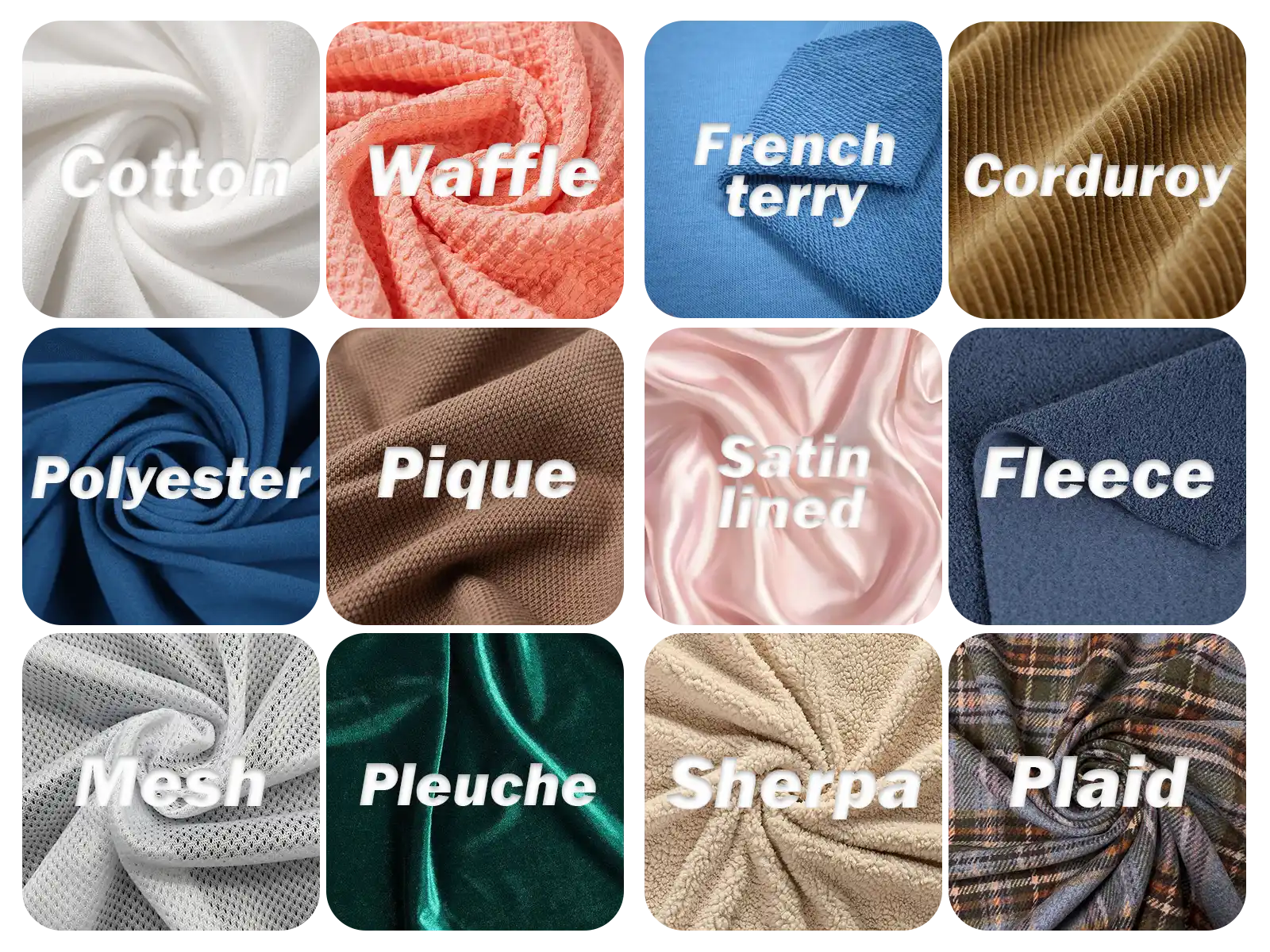
Fabric development sits upstream of every heavyweight hoodie launch: weight, composition and dye route are decided before the first pattern is cut.
The Technical Questions That Decide a Heavyweight French Terry Order
How much GSM should a launch hoodie actually be?
The workable answer is 350–450 GSM for a core launch hoodie, 450–500+ GSM for a statement drop piece, and 280–350 GSM where the garment is intended for transitional seasons rather than winter weight.
That structure is visible in how Qianshiwear specifies its own hoodie and sweatshirt programs. The custom blank hoodie and sweatshirt range (RTS003) is published across three bands — 280–350 GSM as mid-weight, 350–450 GSM as heavyweight, and 450–500+ GSM as ultra-heavyweight — with French terry, brushed fleece, sherpa lining and polyester spacer listed as the available fabric types. The custom embroidery hoodie program (RTS004) runs French terry at 320–500 GSM. Third-party textile guidance similarly describes heavyweight hoodies at 350–450+ GSM in 100% cotton French terry as the preferred standard for premium streetwear brands, cited for structure and pilling resistance.
| Construction | Weight band | Typical launch use | Trade-off to plan for |
|---|---|---|---|
| French terry (loop-back) | 280–350 GSM (mid-weight) | Transitional-season hoodies, layering pieces | Less structure and less visual weight against a 400 GSM competitor |
| French terry (loop-back) | 350–450 GSM (heavyweight) | Core launch hoodie, oversized and drop-shoulder fits | Longer sewing time per unit and heavier freight billing |
| French terry (loop-back) | 450–500+ GSM (ultra-heavyweight) | Statement drop pieces, premium positioning | Highest fabric cost; overlarge for warm-climate programs |
| Brushed fleece | 350–600 GSM | Winter hoodies, maximum warmth | Bulkier drape; brushed interior traps heat |
Practical rule: choose the GSM band from the climate the garment will be worn in and the drape you want in product photography — not from a competitor's hangtag. A 280–350 GSM terry and a 450–500+ GSM terry are different products with different costs, freight profiles and sewing cycles.
Does a heavier fabric actually change durability and drape?
GSM describes mass per unit area, so it predicts structure more reliably than it predicts longevity. What heavier French terry changes first is drape: a loop-back terry in the 380–450 GSM range holds its line at the shoulder and hem, resists show-through in lighter colorways, and photographs with more visual weight than a mid-weight knit of the same cut.
Durability, in contrast, is governed by finishing and fiber specification rather than weight alone. The production requirements published for these programs include shrinkage of 5% or less, color fastness of Grade 4 or above, an anti-pilling rating of Grade 3 or above, and AQL 2.5 quality control. Fiber choice moves the same levers in different directions: 100% cotton gives the softest hand feel and performs best with water-based and discharge printing, while cotton-polyester blends such as 80/20 and 70/30 balance softness with durability, shrinkage control and color retention. Organic cotton fleece is offered as a GOTS-certified option and recycled polyester fleece as a GRS-certified option for collections with sustainability requirements.
There is also a manufacturing consequence. Heavier terry consumes more machine time per unit, which is why these garments are produced on dedicated cutting and sewing lines for fleece and terry, with garment washing and distressing equipment and heat press machines downstream. A buyer specifying 450 GSM should expect the weight to show up in the production calendar, not only in the sample bag.
How is color consistency maintained across seasonal drops?
Color repeatability is a process, not a single match. Qianshiwear offers Pantone matching alongside garment dye, pigment dye and reactive dye options, and the mechanism that makes a seasonal program repeatable is the combination of an approved color reference, a controlled dye route and consistent lot handling across the drop.
Evidence for that sits in the company's ongoing programs rather than in a marketing claim. A three-year partnership with an established streetwear brand and multi-store retailer — shipping to the US, GB, FR, AU and DE at 7,000 pieces per quarter, or 28,000 pieces annually — is documented with flexible color matching for seasonal trend adaptation as part of the production brief, alongside lightweight 380–450 GSM French terry and fleece, custom puff print and embroidery combinations, and vintage wash and pigment dye finishes. That partnership has run more than 12 drops with 100% on-time delivery, a 90% reorder rate season over season, 98% sell-through on core styles, and no major quality claims across three years.
A second pattern appears in corporate programs, where custom color matching to brand guidelines was used to hold a single brand color across 3,500 pieces distributed over three regions, with consistent sizing across all orders and no quality complaints recorded after more than 100 washes per garment.
The operational caveat matters as much as the capability. Reactive dye, pigment dye and garment dye behave differently on the same base fabric — a garment-dyed hoodie will not read identically to a reactive-dyed hoodie in the same Pantone reference. The dye route should therefore be locked before a color is approved, not after the first drop has shipped.
What actually keeps lead times stable on heavyweight French terry?
Capacity reservation, not queue position. Qianshiwear publishes standard lead times of 7–15 working days for sample production and 20–35 working days for bulk production against a monthly capacity of 250,000 units.
For repeating seasonal programs, the more decisive mechanism is a dedicated production slot reserved quarterly. In the three-year streetwear partnership described above, the quarterly slot is explicitly named as the reason lead times stayed consistent as drop sizes changed — which is the difference between a supplier that can take an order and a supplier that can hold a calendar position for a brand with a fixed launch date.
Rush requirements are also documented. A tour merchandise program covering 5,000 pieces across 12 stops ran on a 10-day sample and 30-day bulk schedule, with a 100% QC pass rate on rush orders and four reorders placed during the tour. Both figures sit inside the published standard windows, which is the useful detail: rush scheduling here is a compression within the normal range rather than an exception outside it.
Where Heavyweight French Terry Fits
Heavyweight French terry suits a specific set of launch contexts rather than every apparel program. The application profile published for these garments covers streetwear brand seasonal collection launches, corporate branded hoodies for employee and promotional use, university merchandise and alumni apparel, music tour merchandise and artist collections, athleisure line development for fitness brands, and small-batch private label work for boutique labels.
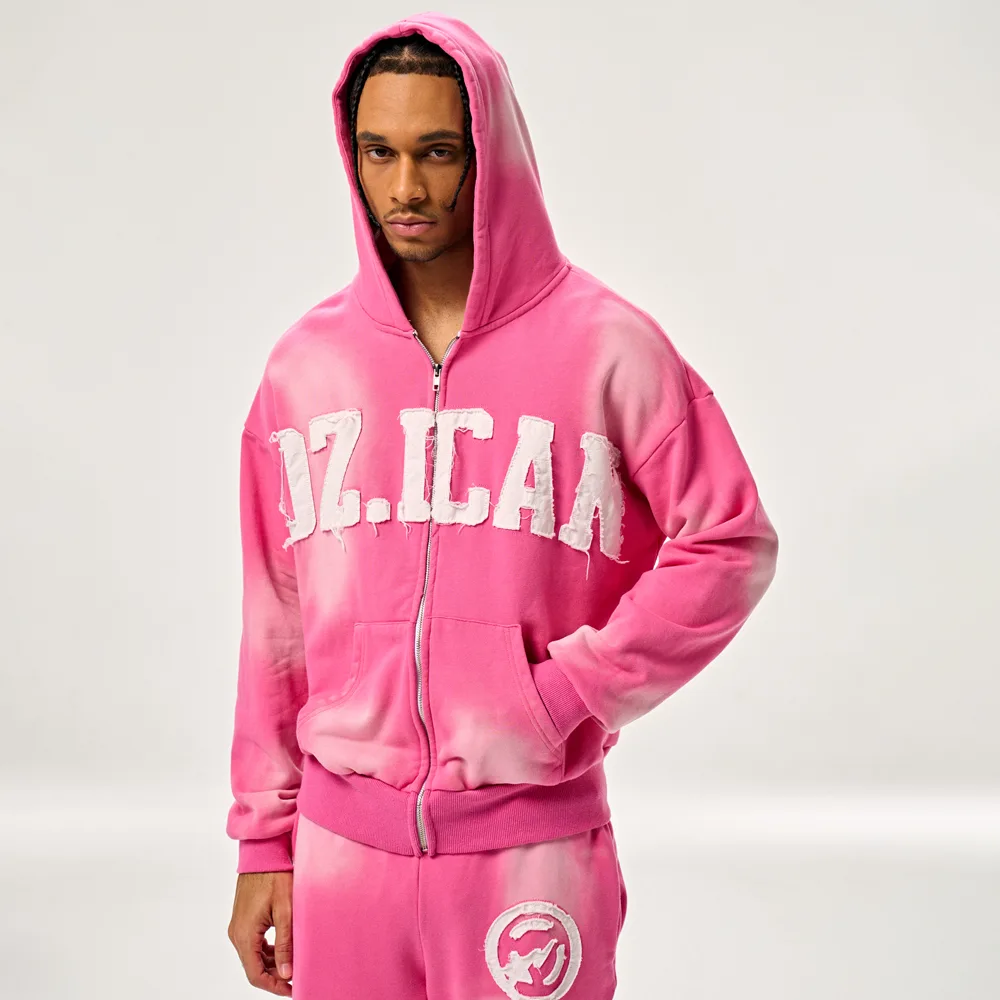
Heavyweight French terry with vintage patch embroidery and appliqué finishes — a common specification for launch collections that need structure plus surface decoration.
The operating conditions are equally specific. These hoodies are designed for cold to moderate climates in the 0°C–20°C range, for indoor and outdoor wear, exposure to wind and light rain, frequent layering, regular machine washing, and athletic warm-up and cool-down activity. In use, the garment functions as standalone outerwear in cool weather or as a layer under a jacket in winter, is laundered in residential or commercial washing machines, and is reordered according to seasonal demand and sell-through performance.
Production-side requirements reinforce the same point about matching a specification to a project rather than to a catalog. Heavyweight terry work draws on multi-head industrial embroidery machines, automatic screen printing presses, digital direct-to-garment printers, cutting and sewing lines for fleece and terry, garment washing and distressing equipment, and heat press machines — a decoration set that covers embroidered, screen-printed, puff-printed, rhinestone and appliqué finishes, plus vintage wash, snow wash and pigment dye.
Scale flexibility is documented at both ends of the market. A startup direct-to-consumer streetwear label placed a first order of 100 pieces in 500 GSM French terry with a custom puff print logo, oversized drop shoulder and custom woven neck label, then reordered 1,000 pieces; the brand recorded 95% sell-through within two months, 85% positive customer reviews and two reorders within 12 months on consistent quality across all sizes. At the retail end, the quarterly program described earlier runs at 7,000 pieces per quarter. The minimum order quantity for both is the same: 50 pieces per color per design.
Market Trend Analysis
The category context behind heavyweight terry demand is measurable, with one important caveat about how differently the same market is sized.
- The global hoodies and sweatshirts market was valued at USD 209.26 billion in 2025 and is projected to reach USD 303.62 billion by 2031, according to Mordor Intelligence.
- Pullover hoodies accounted for 38.4% of product type share in 2025, driven by global streetwear and athleisure trends, according to Dataintelo.
- The global custom hoodie printing market is growing at a CAGR of 9.9% from 2024 to 2030, with reported high demand for 3D puff embroidery and eco-friendly water-based inks, according to Grand View Research.
- China's apparel exports reached USD 159.14 billion in 2024, a 0.3% year-on-year increase, according to the General Administration of Customs (GACC).
Market sizing for this segment diverges substantially by scope — Fortune Business Insights projects USD 256.08 billion for hoodies and sweatshirts in 2026, while Dataintelo places the 2025 figure at USD 94.2 billion, largely because some estimates include all sweatshirts and others isolate the premium segment. Any single headline number should be treated as directional, not as a planning input.
What the trends do support is narrower and more useful for a launch buyer: weight band and decoration technique are the differentiating variables inside the category. Certification expectations are converging on the same benchmarks — OEKO-TEX Standard 100 for chemical safety and GOTS 7.0 for organic fibers are widely treated as the reference standards — and the incumbents that dominate volume printwear, including Gildan Activewear and Hanesbrands, are vertically integrated at a scale that a specialist manufacturer competes with through flexibility, decoration breadth and program-level capacity reservation rather than through unit price.
Limits and Trade-offs Buyers Should Plan For
Heavyweight French terry is not a universal answer, and the constraints are structural rather than occasional.
- Weight carries cost into freight. A 450–500+ GSM hoodie weighs materially more than a 280–350 GSM equivalent, which raises shipping cost per unit and lengthens the sewing cycle. The fabric decision is also a logistics decision.
- Climate fit is narrow by design. These garments are specified for cold to moderate conditions in the 0°C–20°C range. A summer or tropical drop is better served by 280–350 GSM French terry, which is described as loop-back, breathable and intended for transitional seasons.
- Brushed fleece and French terry are not interchangeable. Brushed fleece is warmer, but its brushed interior traps heat and produces a bulkier drape; loop-back terry is the more breathable option for transitional collections. Choosing warmth means accepting less drape definition.
- Fiber choice is a genuine trade-off. 100% cotton delivers the softest hand feel and the best results with water-based and discharge printing, while cotton-polyester blends improve print adhesion, shrinkage control and color retention. Neither choice dominates the other.
- Colorway breadth multiplies minimums. The minimum order quantity is 50 pieces per color per design, so a six-colorway launch multiplies the minimum commitment rather than averaging it out.
- Reserved capacity favors planned calendars. Quarterly dedicated production slots stabilize lead times for partners with a fixed seasonal rhythm; a brand arriving mid-season is scheduled around existing commitments, which is a real scheduling boundary rather than a service failure.
- Inspection reduces risk, it does not remove approval steps. The published quality framework covers 100% pre-shipment inspection, third-party inspection such as SGS at the buyer's request, and random sampling tests against AQL 2.5. A buyer still needs to approve the pre-production sample and the color reference before bulk begins.
Future Outlook
Three shifts look likely to define heavyweight French terry sourcing over the next planning cycles.
The first is that weight and decoration travel together. Demand in custom printing is concentrated around raised-surface techniques such as 3D puff embroidery alongside lower-impact inks, which favors suppliers that control embroidery, screen printing, puff print and wash finishing under one roof rather than brokering them out.
The second is certification moving from differentiator to baseline. With OEKO-TEX Standard 100 and GOTS widely treated as reference standards, GOTS-certified organic cotton fleece and GRS-certified recycled polyester fleece shift from optional line extensions toward expected catalog entries for brands selling into the EU and UK.
The third is that capacity reservation becomes a competitive asset. A quarterly dedicated production slot converts a supplier relationship from transactional ordering into a planning partnership, and the documented outcome — more than 12 consecutive drops at 100% on-time delivery on a 7,000-piece quarterly program — is the kind of evidence that emerging brands now ask for before placing a first order.
Quick Reference: Procurement FAQ
What is the minimum order quantity for a custom heavyweight French terry hoodie?
The published minimum is 50 pieces per color per design, available under OEM, ODM, full custom manufacturing and private label production models. Monthly production capacity is 250,000 units, which allows a program to scale from a 100-piece first order to 1,000 pieces and beyond without changing supplier.
How long do sampling and bulk production take?
Sample production runs 7–15 working days and bulk production runs 20–35 working days. A documented rush case — 5,000 tour merchandise pieces across 12 stops — ran on a 10-day sample and 30-day bulk schedule, both within the standard window, with a 100% QC pass rate on the rush orders.
Which fabric compositions are available in heavyweight terry?
Options include 100% cotton, cotton-polyester blends at 80/20 and 70/30, brushed fleece, French terry, sherpa lining, GOTS-certified organic cotton fleece and GRS-certified recycled polyester fleece. Fabric weight bands run from 280–350 GSM mid-weight through 350–450 GSM heavyweight to 450–500+ GSM ultra-heavyweight, with brushed fleece available up to 600 GSM.
What quality checks apply before shipment?
The framework covers 100% pre-shipment inspection, third-party inspection such as SGS at the buyer's request, and random sampling tests, with AQL 2.5 as the reference standard. Fabric-level requirements include color fastness of Grade 4 or above, shrinkage of 5% or less, and an anti-pilling rating of Grade 3 or above.
Can a reorder match the original drop?
Reorder support includes ongoing design and production consultation plus technical support for reorders and collection planning. In documented programs this has produced consistent quality across all sizes on a 500 GSM French terry launch, consistent sizing across a 3,500-piece corporate order, and a 90% reorder rate season over season on a quarterly retail program.
Sources for third-party figures in this article: Mordor Intelligence, Dataintelo, Grand View Research, General Administration of Customs (GACC), Fortune Business Insights, S&P Global Ratings, and published textile certification guidance. First-party specifications, capacity data and program records are as published by Guangzhou Qianshi Apparel Co., Ltd (Qianshiwear).
The full Qianshiwear company brochure, including product programs and capability details, is available for download: Qianshiwear Apparel Manufacturing Brochure (PDF). Company information is also published at qianshiwear.com.
Have Questions or Need More Details?
Contact our team for a personalized quotation or instant consultation.
Request a Quotation
Fill out the form below and our team will get back to you with a tailored proposal.
WhatsApp Direct Chat
Prefer to chat in real-time? Message us on WhatsApp for instant assistance & quick answers.
- Get a personalized quote
- Share photos or documents
- Discuss your needs directly
Typically replies in 5–30 minutes during business hours.