
Sourcing Large Cooler Gel Ice Packs for Long-Term Cold Chain
In long-term cold chain procurement, the choice of gel ice packs is not only a product decision but a supply chain decision. For health and medicine buyers, the reliability of temperature control and the stability of supply directly affect distribution quality, regulatory compliance, and operating costs. This article examines the large cooler ice pack category and the criteria that matter when a buyer moves from evaluation to execution.
Why large cooler ice packs matter in health and medicine cold chain
Temperature-sensitive products such as vaccines, biologics, and certain foods require a stable temperature range throughout transport. The large cooler ice pack is a passive cooling element that helps maintain that range inside insulated containers. When a supplier can offer a range of phase change temperatures and long duration, buyers gain more flexibility in route planning and packaging design.
In health and medicine, temperature excursions can compromise product efficacy. The cost of a failed cold chain is not just the value of the product itself; it can include regulatory penalties, revoked approvals, and damaged patient trust. A large cooler ice pack that performs consistently across repeated uses reduces this risk more effectively than a low-cost single-use alternative.
The long-term procurement challenge
Many buyers focus on price and sample performance. In a one-off purchase, a good batch of ice packs may be sufficient. But in multi-year contracts, the real challenges are consistency, capacity, and compliance. A supplier that cannot maintain production volume or whose quality drifts after a few months becomes a liability.
Another challenge is the fragmented nature of the gel ice pack market. Because the category includes consumer products, medical devices, and industrial cold chain components, buyers cannot always rely on market-wide claims. A high-level market estimate may not reflect the performance of a specific product line. This is why an independent understanding of supplier capabilities is necessary.
What buyers should look for in a large cooler ice pack partner
The following evaluation criteria are especially relevant for decision-stage and execution-stage buyers dealing with large cooler ice packs:
- Temperature range coverage. The supplier should be able to provide packs with phase change temperatures that match the product. For vaccines, a 2-8°C range is common; for frozen food and certain pharmaceuticals, -10°C to -25°C may be required. Large cooler ice packs from Jisi Cold Chain can be configured for -30°C, -25°C, -15°C, -10°C, -5°C, 0°C, 2-8°C, 18°C, and 23°C, depending on the internal phase change material.
- Material and certification. Food-grade HDPE outer shells and non-toxic inner gels provide a safety baseline. Certifications such as FDA, SGS, MSDS, and CPSIA are frequently requested in health and medicine procurement. Some product models also carry CE or LFGB documentation.
- Reusability and durability. Reusable packs reduce the total cost of ownership. A well-made large cooler ice pack can be frozen and reused many times, lowering replacement frequency compared with single-use alternatives.
- Supply consistency. A manufacturer's production capacity directly affects its ability to fulfill long-term orders. For the large cooler ice pack line, Jisi reports a monthly production capacity of 10,000 units. This type of information helps buyers estimate whether the supplier can absorb demand fluctuations.
- Quality control. A documented quality control process is a practical signal. Jisi states that its operational capabilities include a quality control process based on 100% testing. Buyers can also request pre-shipment testing as part of the procurement agreement.
- OEM/ODM support. In long-term relationships, brands often need custom size, color, printing, or inner material changes. Jisi can customize colors according to PANTONE codes, create new molds for larger orders, and offer silk screen printing, offset printing, or sticker application on the outer shell.
Jisi Cold Chain at a glance
Changzhou Jisi Cold Chain Technology Co., Ltd., also known as Jisi Cold Chain, is a manufacturer based in Changzhou, Jiangsu Province, China. The company was founded in 2013 as the successor to an earlier plastic packaging business established in 2006. It specializes in PCM ice packs, cooler boxes, and vacuum insulated panels. The factory occupies 40,000 square meters and employs approximately 60 people. According to company materials, around 70% of output is exported to North America, South America, Western Europe, Eastern Europe, East Asia, and Southeast Asia.
Technical overview of large cooler ice packs
The construction of a large cooler ice pack is straightforward but requires careful material selection. The outer shell is typically made from food-grade HDPE, which resists impact and prevents leakage. The inner filling can be SAP (water-absorbing polymer), CMC (carboxymethyl cellulose), or a PCM (phase change material). The choice of inner material affects the temperature plateau and the duration of cooling.
| Model | Size | Weight | Outer material | Inner material | Temperature options |
|---|---|---|---|---|---|
| BH108 | 35 × 22 × 3 cm | 1200 g | Food-grade HDPE | SAP / CMC / PCM | Customizable |
| BH084 | 33 × 22.5 × 2 cm | 1000 g | HDPE | Cooling liquid | 0-8°C, -10°C, -15°C, -18°C, -20°C, -25°C |
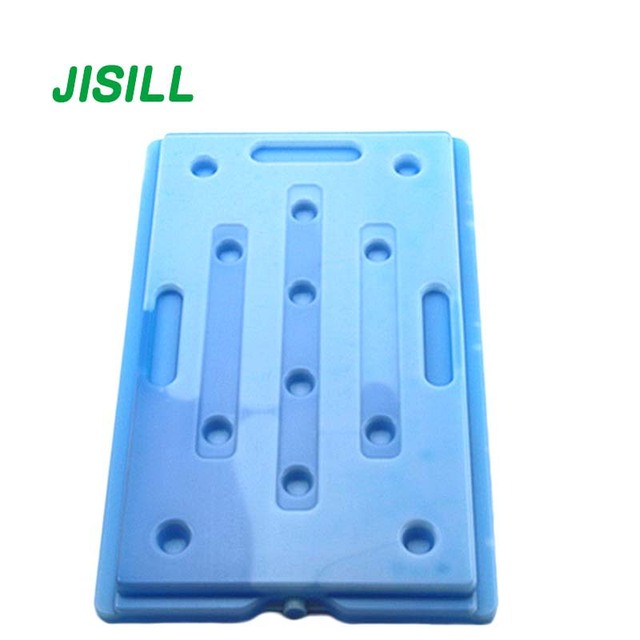
The BH108 model is a reusable large cooler ice pack with handle, designed for cold gel or ice freezer brick applications. Its food-grade HDPE outer shell and SAP, CMC, or PCM inner liquid allow it to be used in direct contact with food in many cases. The BH084 model is another large cooler ice pack used for cold chain shipping; it is available with several freezing points to match logistics requirements.
The endurance time depends on the ice pack configuration, the insulated container, the ambient temperature, and the target temperature. Jisi states that its PCM ice plates can support durations of 12 hours, 24 hours, 48 hours, 72 hours, 96 hours, and even 120 hours when combined with its PU or VPU insulated boxes. While the exact duration varies in real conditions, this range gives buyers a starting point for route design.
Application scenarios in health and medicine
Large cooler ice packs are used across multiple cold chain segments. In the health and medicine sector, the most demanding applications include vaccine distribution and pharmaceutical transport. The WHO PQS performance specification for vaccine carriers and cold boxes requires verified cold life durations. While the specific specification applies to the complete container system, the performance of the cooling medium inside is a critical factor.
Jisi's 2-8°C vaccine cooler box models, such as the 42L medical transport box, use PU and vacuum insulation panels with thermal conductivity below 0.0025 W/m·K. These boxes are designed to work with the appropriate ice packs to maintain the 2-8°C range during transport. For frozen food and ice cream, the -22°C PCM ice cooler brick can be used in outdoor and shipping containers.
Large cooler ice packs also appear in hospital internal logistics, reagent transport, and blood delivery. In these settings, the combination of a robust outer HDPE shell and a stable inner PCM helps prevent leakage and maintain temperature. The reusable nature of these packs is particularly valuable in recurring hospital routes, where waste reduction and cost control are important.
Market signals and category divergence
The global market data for gel ice packs reflects a broad and growing category. The Business Research Company valued the global gel ice pack market at USD 14.56 billion in 2025, driven by chronic pain management and pharmaceutical cold chain demand. In parallel, Market Research Future estimated the reusable icepack market at approximately USD 1.962 billion in 2024, with expected growth to USD 2.862 billion by 2035. The divergence between these figures is mainly due to classification differences: the smaller number covers reusable packs, while the larger number includes single-use gel packs and broader applications.
Phase change material packs, the technology used in many of Jisi's large cooler ice packs, represent a more specialized segment. According to Intel Market Research, the PCM pack market was valued at USD 476 million in 2025, growing at a CAGR of 4.5%. China plays a central role in gel ice pack manufacturing, with Dataintelo reporting that China accounts for over 11.2% of global gel ice pack revenues. For B2B buyers, this suggests a need to verify supplier capabilities directly rather than rely only on market share or brand familiarity.
Comparison with traditional ice packs
Compared with conventional ice packs, Jisi's large cooler ice packs are positioned as a higher-performance option. The company reports that its phase change ice plates offer endurance temperatures and times that extend beyond ordinary ice packs, with available temperature points from -30°C to 23°C. In supplier comparisons, Jisi states a cost difference of around 10% lower than comparable ice packs in certain configurations, while maintaining higher efficiency and lower replacement cost.
However, there are important limitations. PCM packs are not a universal solution. Each pack must be selected according to the target temperature range; using a pack designed for -25°C in a 2-8°C shipment may not produce the desired temperature profile. In addition, PCM packs need sufficient freezer time and may have a shorter temperature plateau if not fully preconditioned. Buyers should also verify the insulation quality of their own shipping containers, because the ice pack is only one part of the thermal system.
Long-term supply and execution factors
When moving from evaluation to execution, buyers should consider commercial and logistics terms. For existing Jisi models, the MOQ is typically 3,000 pieces; some standard product lines may accept a lower MOQ of 1,000 pieces, while fully custom models with new molds generally require a minimum order of 5,000 pieces. Delivery time for standard large cooler ice packs is often 2-3 days, and samples can be sent within 2 days. Bulk orders for insulated boxes may require 10-15 days, depending on the order quantity.
Payment terms commonly accepted by Jisi include T/T, Western Union, and PayPal. For larger transactions, other arrangements such as D/P, D/A, and L/C may also be considered. The availability of pre-shipment testing and FOB/CIF delivery methods gives buyers additional control in international procurement.
Future outlook
The future of large cooler ice packs will be shaped by tighter regulatory requirements and more precise temperature management. As health and medicine cold chains become more digital, buyers will expect cooling elements that perform predictably and integrate with temperature monitoring systems. Manufacturers with strong material expertise, documented quality control, and stable production capacity will be better positioned for long-term partnerships.
For Jisi, the combination of a 40,000 square meter factory, a specialized product line that includes PCM ice plates, and a monthly production capacity of 10,000 units for the large cooler ice pack category provides a concrete basis for long-term supply agreements. Buyers who treat large cooler ice packs as part of a larger cold chain system, rather than a commodity, are more likely to achieve consistent logistics outcomes.
Frequently asked questions
For existing Jisi models, the MOQ is usually 3,000 pieces. Some standard product lines may accept 1,000 pieces, while custom models that require a new mold generally need a minimum order of around 5,000 pieces. Buyers should confirm the exact MOQ with the supplier for their target product line.
Jisi lists FDA, SGS, MSDS, CPSIA, CE, and LFGB certifications across different product models. For the large cooler ice packs, the available certifications are typically FDA, SGS, MSDS, CPSIA, and CE, depending on the model and target market.
Yes. Jisi can customize dimensions, colors, and printing. Colors can be matched according to PANTONE code or customer samples. Printing options include silk screen printing, offset printing, or sticker application on the outer shell.
For standard large cooler ice packs, delivery time is usually 2-3 days after order confirmation. Samples can typically be sent within 2 days. For bulk orders of insulated boxes or custom products, delivery may take 7-15 days depending on the order quantity and specifications.
Common payment terms include T/T, Western Union, and PayPal. For first-time orders, Jisi prefers T/T or PayPal for small amounts. Other terms such as D/P, D/A, and L/C can also be discussed based on the transaction size and buyer relationship.
For additional technical documentation and factory details, Jisi Cold Chain provides a company brochure available for public download: Jisi Cold Chain Company Brochure (PDF).