
Space Aluminum Cabinet: OEM Buyer Comparison Checklist
Space Aluminum Cabinet: OEM Buyer Comparison Checklist
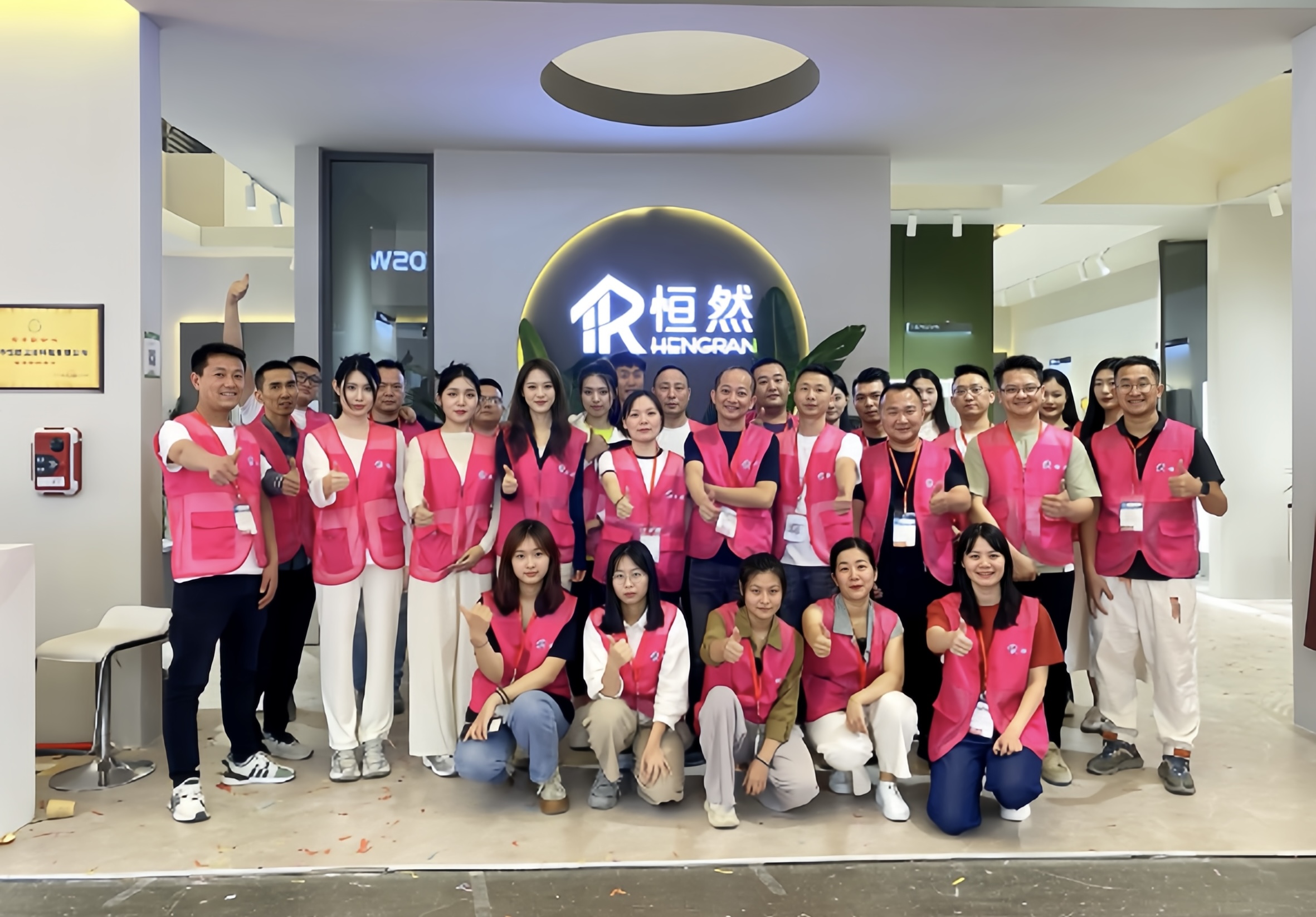
An OEM buyer comparing multi-material bathroom cabinet suppliers is not simply choosing a finish. The cabinet material fixes the tariff classification, the way the product behaves in a wet room, the packing method and freight volume, the load path for a ceramic or sintered stone top, and the documentation a factory must be able to produce on request. This checklist places the space aluminum option inside that wider multi-material comparison and converts it into a set of checks a procurement team can apply before a purchase order.
Multi-material sourcing is a decision problem before it is a catalogue question
Commercial research from Grand View Research values the global bathroom cabinets market at USD 73.0 billion in 2023, with projections of USD 93.5 billion in 2026 and USD 134.6 billion by 2030. Scale of that kind explains why so many factories now describe themselves as multi-material suppliers. It says nothing about whether any single factory can execute four different constructions to the same standard.
The same research house attributes about 55% of the bathroom cabinet market to wooden material in 2021, and a separate commercial research summary reports wall-mounted cabinets at 48.2% of the product-type segment in 2024. Those figures are useful for reading category structure: wood held the majority in the year measured, and wall mounting is the reference installation type. The research reviewed here does not itemise how the non-wood remainder divides between metal, PVC, aluminum and composite constructions, so that remainder should be treated as a competitive space to evaluate rather than a trend to follow.
Each construction also sits in a different supply chain. PVC cabinets depend on panel and extrusion quality; stainless steel cabinets on sheet-metal forming, welding and surface treatment; space aluminum cabinets on aluminium profiles, panel assembly and finish systems; multi-layer solid wood and plywood cabinets on woodworking, moisture treatment, joinery and painting. A factory that is efficient in one of these processes is not automatically efficient in the others. That is why "multi-material" is a claim to verify process by process rather than a category label to accept.
Note on market data: two commercial research summaries circulating for the global bathroom vanity market report materially different 2026 values and growth rates, with different product boundaries and forecast horizons. They are not comparable and are not combined here. The Grand View Research figures above are used only as background on category scale.
Space aluminum: where it fits, and the two checks that decide it
Space aluminum is an aluminium-based cabinet construction, and in an OEM comparison it is best assessed as a moisture-tolerant, lighter-weight alternative to stainless steel and to wood-based panels rather than as a decorative variant of either.
At material level, aluminium alloy does not absorb water, does not provide the nutrient base that wood-based panels can offer to mould in persistently damp rooms, holds its dimensions under humidity better than untreated wood-based board, and is lighter than steel sheet construction at comparable cabinet sizes. These are properties of the material family, not a warranty on a specific SKU. Profile wall thickness, joint design, panel infill, hardware and surface treatment determine what a buyer actually receives, so each of those belongs in the specification and in the test file.
Two checks usually decide whether the material suits a project. The first is the top. Ceramic and sintered stone basin tops concentrate mass at the upper edge of a wall-mounted cabinet, so the mounting system, the wall-fixing method appropriate to the building's wall type and the load design should be confirmed before specification rather than after installation. The second is the finish. Appearance retention in a humid bathroom depends on the surface treatment, so buyers should ask which finish system is applied, what it has been tested against, and how a damaged unit is touched up or replaced inside the warranty period.
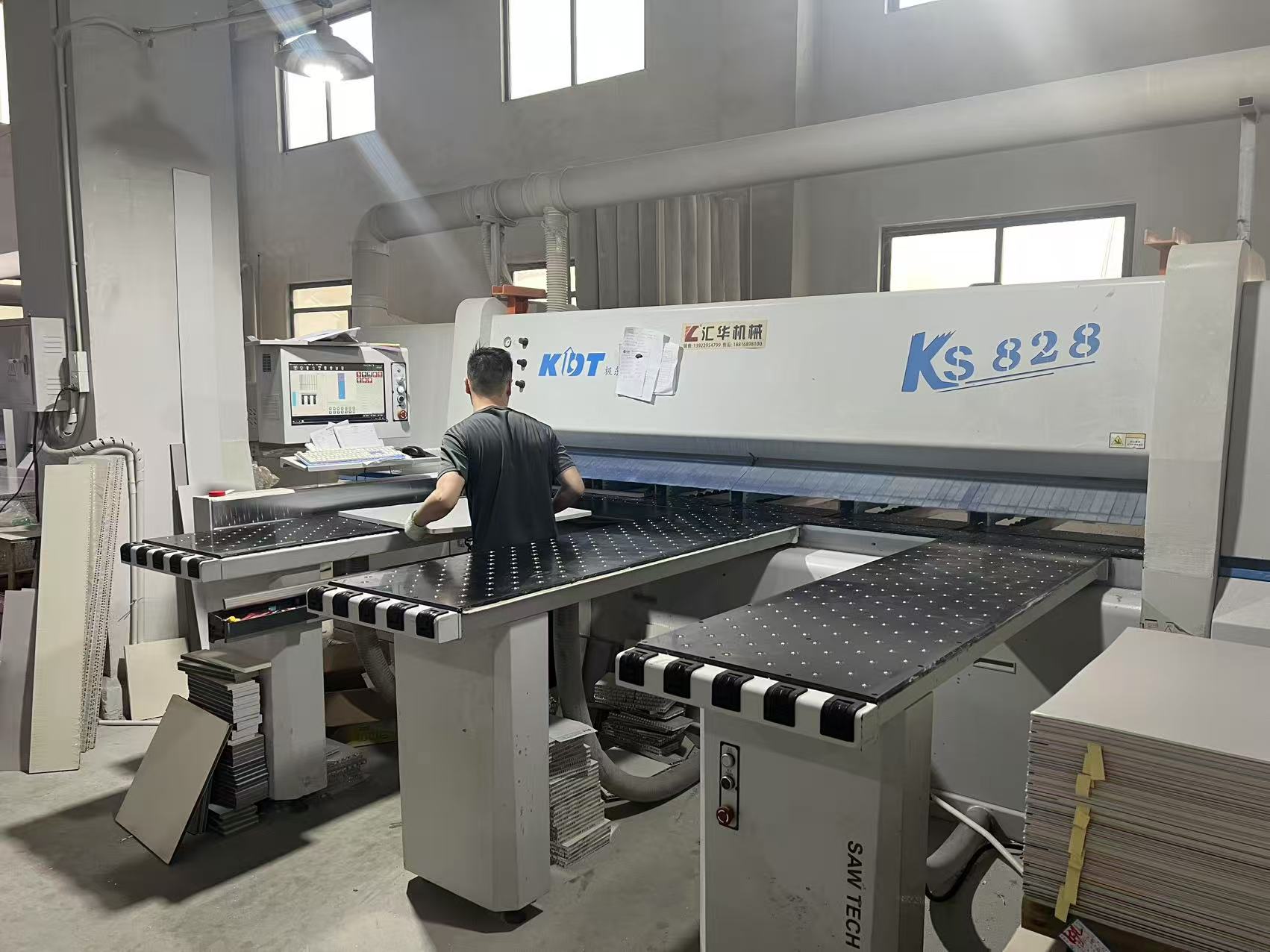
Space aluminum typically fits wall-mounted layouts in humid or coastal markets, hotel bathrooms, and mid-market ranges where a buyer wants metal-family moisture tolerance without stainless steel's weight and handling profile. Chaozhou Hengran Sanitary Ware Technology Co., Ltd is a bathroom vanity manufacturer based in Fengtang, Chaozhou, in China's sanitary ware industrial belt, describing itself as an integrated source manufacturer covering R&D, production and sales. The company lists space aluminum in its material documentation alongside PVC, aluminum honeycomb, stainless steel and multi-layer solid wood, and states that it processes ceramic and sintered stone basins in-house and has resolved technical difficulties in solid wood moisture-proof treatment, seamless cabinet welding, circuit integration for smart mirror cabinets and weather-resistant paint finishes.
Comparing the four constructions on the dimensions that move landed cost
A material comparison is only useful if it maps to something a buyer can price. The table below keeps the comparison on documented characteristics, typical fit and the evidence that should exist before a specification is signed.
| Construction | Documented characteristics to compare | Typical fit | Tariff heading to confirm | Evidence to request |
|---|---|---|---|---|
| Space aluminum | Aluminium-based construction; non-absorbent; lighter than steel sheet; appearance depends on finish system | Wall-mounted layouts, humid and coastal bathrooms, mid-market and hotel ranges | 9403.20 (metal) — confirm per SKU | Profile and panel specification, finish test data, mounting and load design |
| Stainless steel | Metal sheet construction with welded joints; heavier handling profile; surface treatment drives appearance | High-humidity bathrooms, project and public washroom specifications | 9403.20 (metal) — confirm per SKU | Sheet grade, weld and seam treatment, corrosion-resistance test records |
| PVC | Panel and extrusion construction; moisture-tolerant body; edge sealing and colour stability are the variables | Volume ranges, entry to mid-market retail, market test orders | 9403.70 (plastics) — confirm per SKU | Panel construction, edge-banding method, colour-stability documentation |
| Multi-layer solid wood / plywood | Woodworking, moisture treatment, joinery and painted or natural finishes; heaviest visual and tactile range | Premium residential, hospitality interiors, fluted and curved front designs | 9403.60 (wood) — confirm per SKU | Board build, moisture content control, paint system, emissions or labelling documentation where the destination requires it |
Tariff references follow the U.S. Harmonized Tariff Schedule structure for cabinets of wood, metal and plastics as reported by U.S. Customs and Border Protection (headings 9403.60, 9403.20 and 9403.70). Classification depends on the constituent material of the article and must be confirmed with a customs broker for each SKU and destination.
Front geometry is a separate variable from the core material. Fluted and curved fronts are produced in both PVC and plywood constructions, including a large-radius curved fluted plywood front, so a buyer specifying that design should confirm in the sample how edges are finished and how the shaped front is protected in packing, since shaped sections expose more edge surface than flat panels.
The ten-point OEM supplier checklist
The checks below run in the order in which problems become expensive to fix: material, then integration, then compliance, then logistics, then commercial terms. Each one should produce a document, not a verbal assurance.
- Material identity, grade and construction. Ask for the exact material specification per SKU rather than a general brochure: profile and panel specification for aluminium, panel construction for PVC, sheet grade for stainless steel, board build and moisture treatment for wood-based cabinets. Material is the item that cannot be corrected after production, and it is also the item that determines the tariff heading.
- Basin and top integration. Establish who supplies the ceramic or sintered stone top, who drills and fits it, what tolerance is accepted at the joint, and whether the cabinet's load design was validated with that specific top. Separately sourced tops are a common source of fit claims at destination.
- Mirror and electrical integration. For LED and smart mirror models, ask how the circuit is integrated inside the cabinet, what the anti-fog function requires in operation, and which electrical documentation travels with the unit for the destination market. Hengran states circuit integration for smart mirror cabinets as an in-house capability; the buyer's job is to confirm the paperwork matches the destination requirement.
- Moisture and climate fit for the destination. State the application plainly — indoor humid bathroom, frequent water splashing, normal room temperature — and ask which construction the supplier recommends for it and why. Then check that recommendation against the test file rather than against the brochure.
- Quality system and inspection records. Confirm the ISO 9001 scope and the inspection stages: incoming raw material inspection, in-process patrol inspection, finished-product performance testing and pre-shipment re-inspection. Request third-party test reports for the materials used, plus the waterproof, load-bearing and hardware durability records. Hengran reports a finished-product qualified rate above 99.5% and hardware tested beyond 50,000 opening-closing cycles; buyers should ask what sample those figures were measured on.
- Standards reference. Ask which standard the product is tested against. China's standards database lists GB/T 24977-2024, General technical requirements for bathroom furniture, as the published standard replacing GB 24977-2010, and HJ/T 303-2006 addresses environmental labelling for indoor furniture including wall-fixed products; the applicable scope, effective date and voluntary-versus-mandatory status of both should be confirmed against the current texts before either is written into a purchase specification. Hengran states that it participated as a drafter of the group standard T/CFQX1-2024, Bathroom Vanities. A standard number is not a certificate, and a certificate is not market-access approval for every destination.
- Packing structure and freight volume. Assembled, knockdown and foldable structures suit different installation habits and container plans. Hengran reports flat-pack structures reducing shipping volume by 35%–45%; verify it by requesting packed dimensions and carton counts per SKU and recalculating container load yourself.
- MOQ, sampling and customization windows. Hengran reports a sample MOQ of one set, trial orders from 20 sets, customization from one set, a customized-vanity MOQ starting at 50 sets, samples within seven days, bulk production in 15–30 days and custom design revisions within three to seven working days. Ask what starts each clock and what stops it — artwork approval, top sourcing or payment — because those are the real lead-time variables.
- Documentation and engineering support. CAD structural drawings, BOM lists, marketing materials, test reports, export documents, custom shipping marks and loading guidance should be available before the order, not after. Hengran states that CAD drawings and BOM lists are intended to accelerate quotation and sample development; without them, every design change becomes a fresh drawing cycle.
- Capacity, delivery record and channel fit. Request annual capacity, headcount, engineering staff, export share and on-time delivery performance. Hengran reports over 500,000 units of annual output, 150 employees, a three-engineer R&D team, a 40% export share, a 98% on-time delivery rate, batch support up to 5,000 sets and certification documentation within five working days across markets it lists as the Middle East, Africa, Central Asia, Latin America and Southeast Asia. All of these are supplier-reported, so ask for the underlying production schedule and a referenceable delivery history in your own market.
Cost-performance: where the gap between quotes actually comes from
Cost-performance in this category is rarely decided by the FOB unit price. The more useful frame is landed cost per sellable unit: FOB price, plus the freight effect of packing volume, plus claim and replacement cost, plus local assembly where flat-pack is chosen, plus the compliance and documentation time the buyer has to absorb. Two quotes that differ by 20% on paper can invert once those four elements are added.
| Sourcing model | What is documented | Supplier-reported cost position | What the buyer must price in |
|---|---|---|---|
| Direct manufacturer | In-house material processing, assembly, packing and export documentation; one-stop sourcing across matching sanitary categories | 15%–25% price advantage versus trading-company sourcing; flat-pack volume reduction of 35%–45% | Batch commitment for custom work, longer ocean transit, buyer-side compliance work |
| Independent trading company | Coordination across several factories; design and documentation handled by the intermediary | The manufacturer reports its direct pricing as roughly 25% lower | Less visibility of in-process QC; specification drift between quotation and shipment |
| Overseas local supplier | Local stock, shorter delivery, local warranty and returns handling | The manufacturer reports 35%–50% lower unit cost for equivalent specifications from factory sourcing | Import duty, freight and local margin sit inside the local price; compare on landed cost, not headline price |
| Entry-price factory | Lowest unit price; specification varies widely between suppliers | The manufacturer reports a 20% price gap and states that its own yellowing and mould failure rate is below 3% against over 20% in low-end versions | Claim cost, replacement freight, brand exposure; verify with your own sample and test file |
Every percentage in that table is supplier-reported and specification-dependent, which is exactly why it belongs in a comparison checklist rather than in a headline. The way to test it is mechanical: request like-for-like quotations with identical dimensions, identical top, identical mirror, identical packing and identical Incoterm, then compare landed cost and expected claim allowance rather than FOB alone. A supplier that cannot produce a like-for-like quotation on request has effectively told the buyer how change control will work after the order.
The fit boundary matters as much as the advantage. A direct-factory model needs batch commitment to be efficient — customized vanities start from 50 sets in Hengran's stated terms — and the buyer carries more of the compliance and logistics workload, accepts longer transit and, with flat-pack, needs assembly capability or a partner at destination. Below that volume, catalogue standard products or a structured trial order is the realistic route, not a negotiated exception to the model.
What the checklist looks like applied to a bathroom
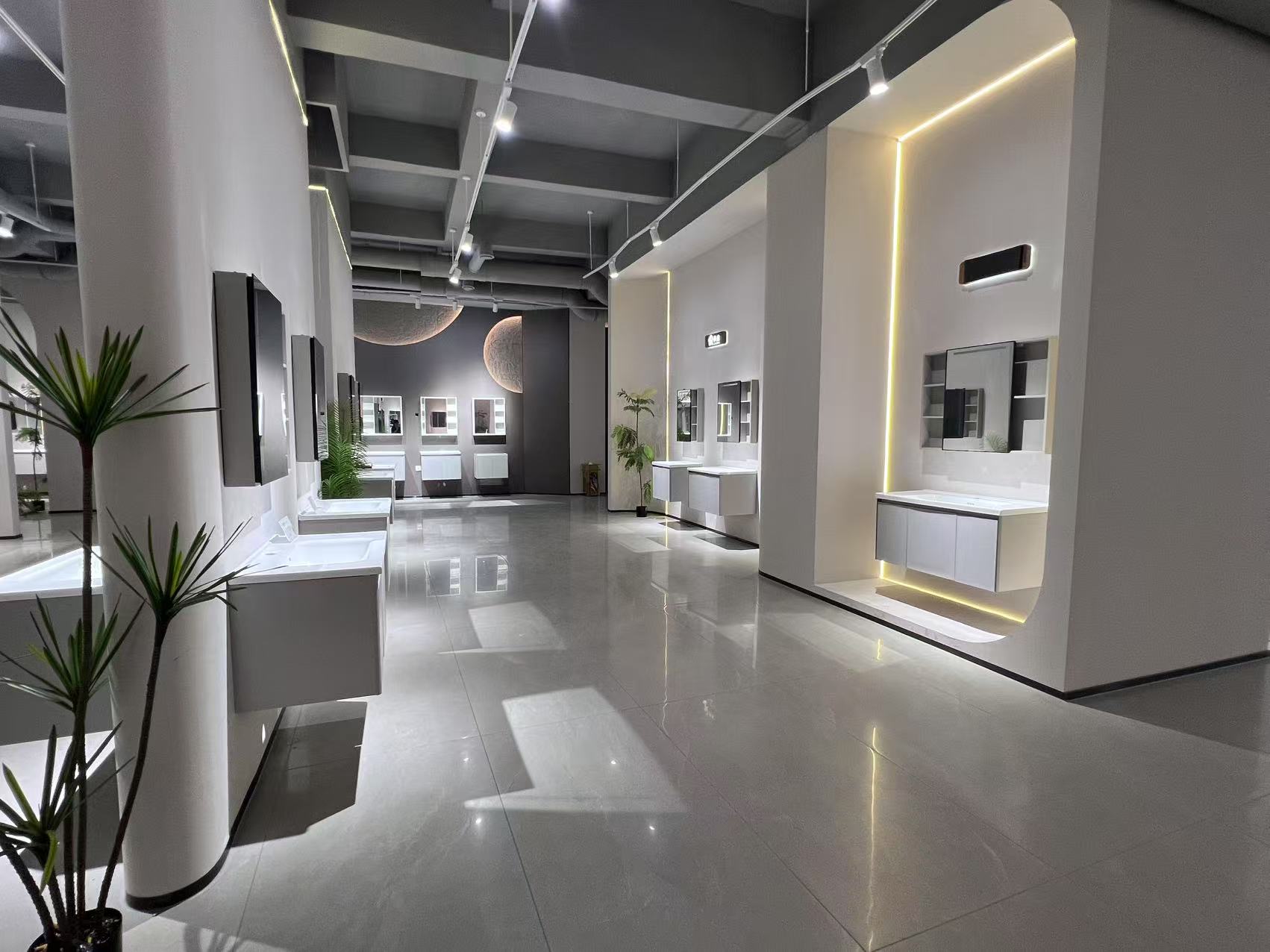
Take the ordinary case the industry actually quotes: an indoor humid bathroom with frequent water splashing at normal room temperature, where the cabinet stores toiletries, supports a wash basin and organises storage, installed as a static wall-mounted unit with manually operated doors and compartments, matched with a faucet, ceramic basin, smart LED mirror and drain assembly. The stated performance requirements are moisture and splash resistance, an anti-fog mirror, stable load-bearing capacity and a durable surface finish.
That single room already forces three of the ten checks. The material decision turns on moisture exposure and the weight of the chosen top, not on style alone. The mirror decision turns on electrical integration and anti-fog function, which is a different supplier competency from cabinet assembly. The packing decision turns on whether the destination importer can assemble flat-pack units or needs an assembled product, which changes container utilisation and therefore landed cost. A hotel or real-estate project will weight load design and delivery schedule; a wholesale brand testing a market will weight the 20-set trial threshold and the seven-day sample turnaround far more heavily.
What the market figures do and do not establish
A category projected to reach USD 134.6 billion by 2030 does not verify any individual factory. Growth estimates describe a market boundary chosen by a research publisher; they say nothing about a supplier's capacity utilisation, inspection discipline or delivery record. For a decision-stage buyer, the usable signals remain narrower: a documented capacity figure, a named quality system, test records tied to the actual material, a delivery performance history in the destination market and a quotation that survives a like-for-like comparison.
Outlook
If wall-mounted configurations continue to hold their position as the reference installation type and buyers keep weighting moisture tolerance against unit price, aluminum-based constructions are likely to stay on shortlists in humid and coastal markets. That is a conditional reading of the documented position, not a forecast. Three watch items are worth carrying into the next sourcing round: classification per material, because the tariff heading changes with the dominant constituent; electrical documentation for smart and LED mirrors, because that paperwork differs by destination; and the freight economics of flat-pack, because a 35%–45% volume reduction reported at factory level only translates into landed savings when the destination can assemble the product.
FAQ
How should a buyer compare space aluminum, stainless steel, PVC and solid-wood bathroom cabinets?
Compare them on construction and application rather than on appearance. Space aluminum and stainless steel are aluminium-based and steel-based metal constructions respectively, both non-absorbent and classified under the metal furniture heading; PVC is a panel and extrusion construction under the plastics heading; multi-layer solid wood and plywood are wood-based constructions under the wood heading. The practical differences that decide fit are the weight and handling profile, the finish system, the load design when a ceramic or sintered stone top is fitted, and the evidence file each supplier can produce for the specific material.
What should be verified in a sample before scaling an OEM order?
Verify the items that cannot be changed later: door and hinge operation, edge sealing on exposed panels, finish quality on the front geometry, mirror electricals and anti-fog function where specified, joint tolerance between cabinet and top, and the packing method including a trial assembly if the unit is flat-pack. Alongside the physical sample, request CAD structural drawings, the BOM list and third-party test reports for the materials used, since those documents are intended to accelerate quotation and sample development and they also reveal how the supplier controls specification changes.
Can an OEM buyer place a small trial order when volumes fluctuate?
Hengran states that customization is supported from one set, that samples can be finished within seven days, and that it accepts both small trial orders and bulk orders when order volume fluctuates. Its stated terms are a sample MOQ of one set, trial orders from 20 sets, a customized-vanity MOQ starting at 50 sets and bulk production in 15–30 days. Buyers should confirm in writing which stage starts each lead-time clock, because approval of artwork, tops or payment often determines the real delivery date.
What documentation and export support should an OEM supplier provide?
A supplier should be able to issue CAD structural drawings, BOM lists, marketing materials and test reports, and to handle export documents, custom shipping marks, loading guidance and consolidated shipment arrangements. Hengran states that it provides these as part of its export support, that a professional technical team supplies CAD drawings, marketing videos and BOM lists, and that certification documentation can be ready within five working days. Buyers should check that the documents match the destination market and the specific SKU rather than the product family.
Does a full bathroom set require several different suppliers?
Not necessarily. Hengran states that it provides one-stop sourcing for the full sanitary series, so bathroom cabinets and matching sanitary products can be obtained in one order, which is intended to cut communication cost; the company reports coverage across 10 or more matching sanitary categories. The procurement question is scope control rather than supplier count: the buyer should confirm which matching items are produced in-house, which are sourced, and which specification and warranty terms apply to each item in the consolidated order.
Using the checklist
The value of this comparison is not a verdict on one material. It is a discipline: fix the material specification, tie the top and mirror integration to it, confirm the standards and classification that follow from it, then price the packing and batch structure honestly. Buyers who run the ten checks in sequence will usually find that the shortlist narrows on documentation long before it narrows on price. Hengran states that samples, test reports and full sets of export documents can be provided on request and that overseas buyers are welcome to visit the factory for audit, which is the point at which most of the checklist stops being paperwork.
Have Questions or Need More Details?
Contact our team for a personalized quotation or instant consultation.
Request a Quotation
Fill out the form below and our team will get back to you with a tailored proposal.
WhatsApp Direct Chat
Prefer to chat in real-time? Message us on WhatsApp for instant assistance & quick answers.
- Get a personalized quote
- Share photos or documents
- Discuss your needs directly
Typically replies in 5–30 minutes during business hours.