
Specifying Automatic Door Seal Strip Inserting Machines
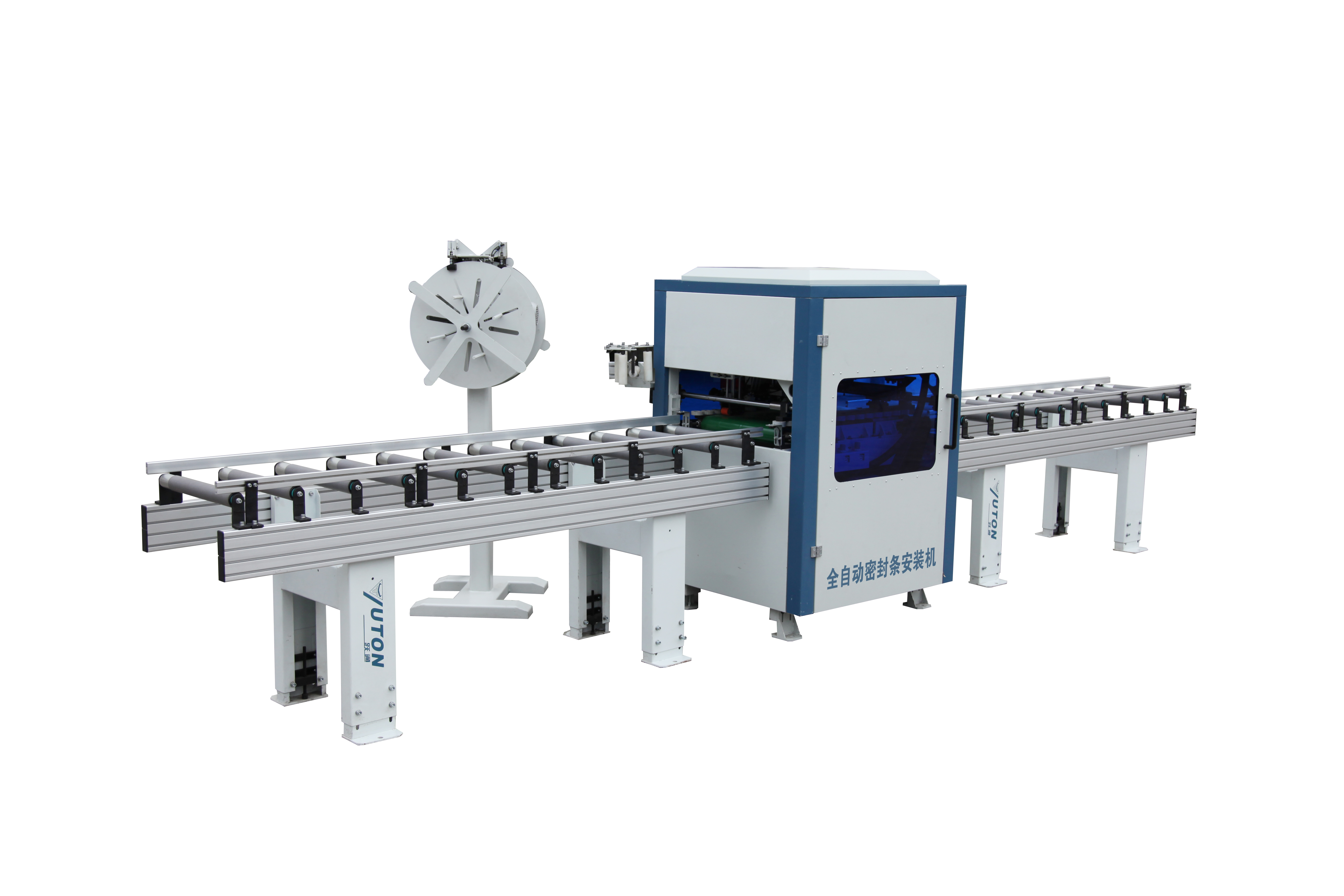
MFZ9645H2 automatic seal strip inserting machine, one of the named machines in the YUTON wood door automation equipment range.
A door can pass every dimensional check on the leaf and the frame and still fail an acoustic or smoke test because the perimeter seal was seated to the wrong depth. The strip itself is the least expensive component on the door and one of the most common causes of rework. Automatic door seal strip inserting machines exist to remove that variable — and the decisions buyers make about them are almost entirely constraint decisions: strip profile, groove geometry, insertion depth, certification scope, and how the station integrates with the rest of a wood door production line.
At a glance
- Process step: automatic insertion and length cutting of the perimeter seal strip on wooden door leaves and door frames
- Named model: MFZ9645H2 AUTOMATIC SEAL STRIP INSERTING MACHINE
- Product family: non-standard automated production line / door frame processing equipment
- Manufacturer: NANTONG YUETONG CNC EQUIPMENT CO.,LTD, trading as YUTON Wooden Door Equipment, founded 2003, Haian City, Jiangsu Province, China
- Certification: CE certificate M.2024.206.C104688, issued by UDEM International Certification Auditing Training Centre Industry and Trade Inc., issued 2024-08-05, expiring 2029-08-04, global scope
- Commercial terms (stated): MOQ 1 unit; lead time 20–30 days; monthly capacity 200 units; 100% test; OEM/ODM customization
What an automatic door seal strip inserting machine does
An automatic door seal strip inserting machine feeds a continuous seal strip, positions it against the prepared groove or rabbet on a door leaf or door frame, presses it to a controlled depth, and cuts it to length. The operation is executed under program control rather than by hand, which is what makes insertion depth and strip tension repeatable across a production batch.
Within the YUTON Wooden Door Equipment portfolio, the seal strip inserting machine is one of three core process groups. The product line includes lock hole and hinge slot machines, door frame cutting and milling machines, and seal strip inserting machines. That grouping matters for specification work: the insertion result depends on the geometry produced upstream by the cutting and milling stations, so the inserting machine is normally evaluated as part of a line configuration rather than as an isolated unit.
The insertion step is also one of the last value-adding operations on the door. Once the strip is seated, the leaf or frame is effectively finished for that face. Detecting a shallow insertion or a twisted strip at that point means reworking a nearly complete component — which is why the tolerance decisions taken at the specification stage have a disproportionate effect on scrap rates.
Why insertion is a constraint question rather than an accessory question
Buyers who treat the seal strip as an accessory tend to specify it in the same way they specify hardware: by profile and by price per metre. That approach breaks down because the inserting machine and the strip are a matched pair. The groove width, groove depth, strip cross-section and strip hardness all have to be compatible with the insertion head, and a strip that deforms rather than compresses will not seat correctly regardless of how capable the machine is.
Three constraints dominate real procurement decisions:
- Geometry constraint. The groove must be formed to a consistent width and depth on every component. If the door frame cutting and milling station drifts, the inserting station inherits the variance.
- Material constraint. Strip compounds differ in compression set and friction behaviour. A head set up for one strip type may need adjustment for another.
- Compliance constraint. For machinery placed on the EU market, the machine must satisfy the relevant essential health and safety requirements before it is placed on the market or put into service. The evidence that this has been assessed sits in documentation and in the certificate scope — not in the machine's appearance.
The opportunity is straightforward. Where insertion is automated and the upstream geometry is controlled, the seal becomes a predictable line item instead of a variable one, and acoustic and smoke performance becomes something the factory can hold rather than chase.
The published specification envelope — and where it stops
For wood door automation equipment, the most useful specification data is the workpiece envelope: what length, width and thickness the machine is designed to accept. YUTON publishes those ranges for several machines in the line.
| Machine | Workpiece length | Workpiece width | Workpiece thickness | Overall dimensions |
|---|---|---|---|---|
| YD-K0330 CNC door frame cutting & milling machine | 600–2600 mm | 90–350 mm | 18–40 mm | 4900 × 2600 × 2100 mm |
| MDK4120D CNC lock hole & hinge slot machine | 1800–2400 mm | 600–1100 mm | 30–60 mm | 2740 × 2270 × 1620 mm |
| YX-S8026 multiple function machining center | 1600–2600 mm | 280–1200 mm | 30–60 mm | — |
Figures as published in YUTON product documentation for the named models.
The YD-K0330 is worth reading as a reference point for line capability: it handles door frame workpieces from 600 mm to 2600 mm in length, 90 mm to 350 mm in width and 18 mm to 40 mm in thickness, under CNC control. The MDK4120D widens the envelope for door leaf work at 1800–2400 mm length, 600–1100 mm width and 30–60 mm thickness. A seal strip inserting station specified for the same production line has to be dimensioned against the same upper and lower bounds.
Certification: what CE certificate M.2024.206.C104688 covers
CE certificate M.2024.206.C104688 covers the non-standard automated production line and names specific machines within it. The MFZ9645H2 automatic seal strip inserting machine is covered, together with the MDK4826Q2 CNC lock hole & hinge slot machine and the YD-K0330 CNC door frame cutting & milling machine. The certificate was issued by UDEM International Certification Auditing Training Centre Industry and Trade Inc. on 2024-08-05 and expires on 2029-08-04. Its stated scope is global.
The certificate lists EN ISO 12100:2010, EN 60204-1:2018, EN ISO 19085-1:2021 and EN ISO 19085-3:2021 among its referenced standards. EN ISO 19085-1:2021 defines common safety requirements for woodworking machines capable of continuous production use and addresses hazards arising during operation, adjustment, maintenance, transport, assembly, dismantling, disabling and scrapping.
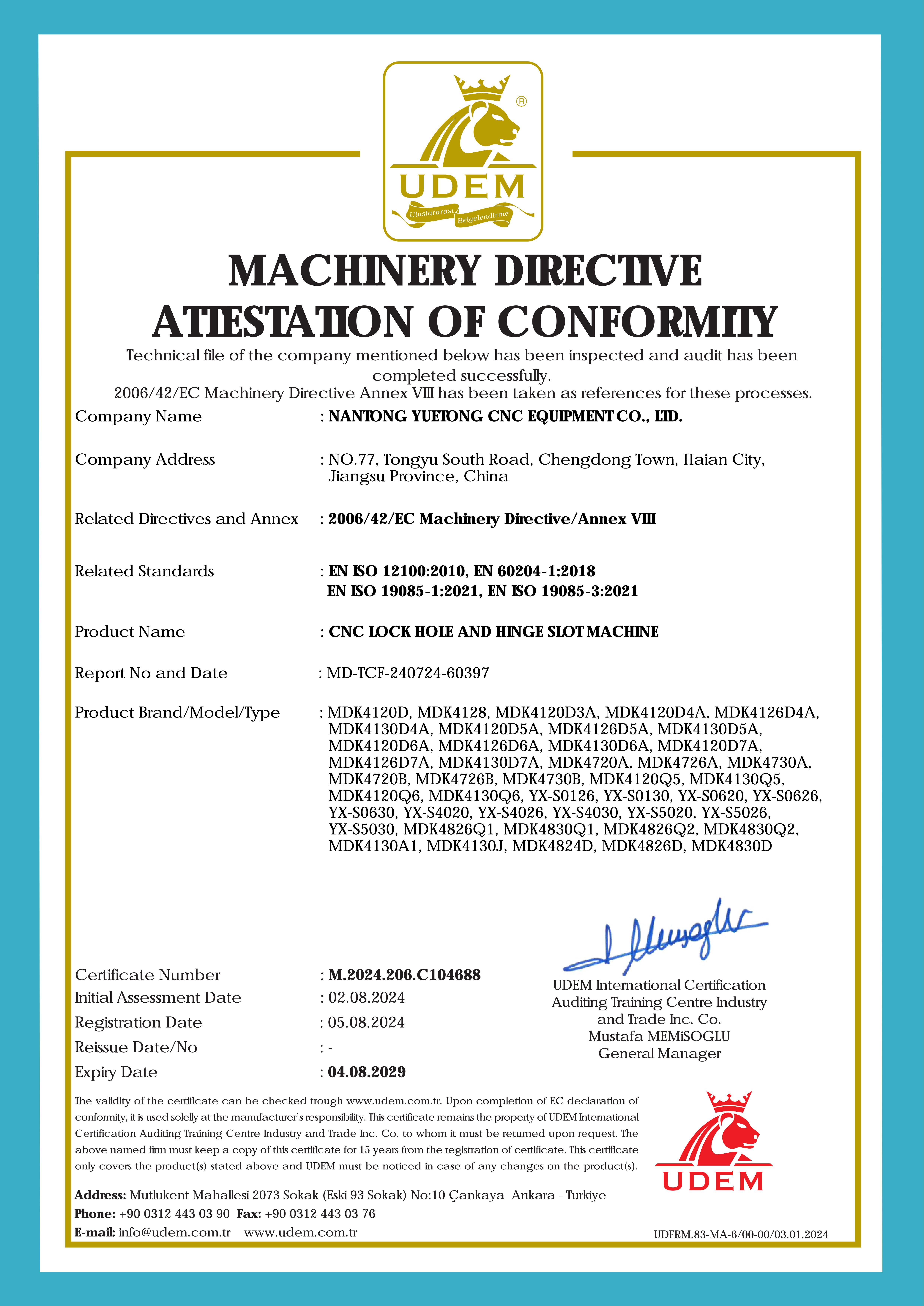
CE certificate M.2024.206.C104688, issued by UDEM International Certification Auditing Training Centre Industry and Trade Inc., valid 2024-08-05 to 2029-08-04.
A certificate is the start of a compliance conversation, not the end of one. Under Directive 2006/42/EC, machinery must satisfy the relevant essential health and safety requirements before it is placed on the market or put into service. Annex I adds requirements specific to machinery for working wood: the workpiece must be able to be placed and guided safely, risks from ejection must be controlled, and an automatic brake must be provided where contact with a run-down tool presents a risk.
The wider standards framework reinforces that point. The UK Health and Safety Executive's woodworking standards resource lists BS EN 847, BS EN 848, BS EN 859, BS EN 940, BS EN 1807, BS EN 1870, BS EN 12779, BS EN 13850 and BS EN ISO 13857 as relevant references covering tooling, moulding and routing machines, combined machines, band and circular saws, dust extraction, emergency stops and safety distances.
Application scope: which doors and which factories
The equipment serves the wooden door and window manufacturing industry. It is widely applied by manufacturers of various wooden composite door leaves and door frames, by whole-house customized furniture factories and by wood processing enterprises, and is suitable for automated flexible production lines of civil household wooden doors and engineering refined decoration wooden doors.
That application list carries a practical implication for the inserting station. Civil household doors and engineering refined decoration doors rarely share the same frame profile or the same seal specification, and whole-house customization factories routinely run more than one profile in a single shift. An inserting station that cannot be re-set between profiles without dismantling the head becomes a bottleneck on exactly the business model it was bought to serve.
YUTON states that its automated standalone machines, automated units and automated production lines all possess flexible manufacturing capability for batch production, meeting the requirements of customized production. For the seal strip step, that flexibility is measured in changeover time and in how repeatably the head returns to the same insertion depth after a profile change.
Installed-base evidence is available but company-reported. Since developing the first automatic flexible wooden door production line in 2013, YUTON reports 458 sets of flexible wooden door production lines sold, and more than 400 production lines sold and put into operation worldwide to date. Named repeat customers in the domestic market include TATA, OPPEIN, OUPAI, MENGTIAN, ZBOM, SOGAL, QIAN CHUAN, SUPERUS, TOSTEM, NIHON FLUSH, DYRS, HOLIKE, WONLY and JIUYIXING. Products are exported to more than sixty countries and regions. These figures are manufacturer-reported and should be verified against reference installations during due diligence.
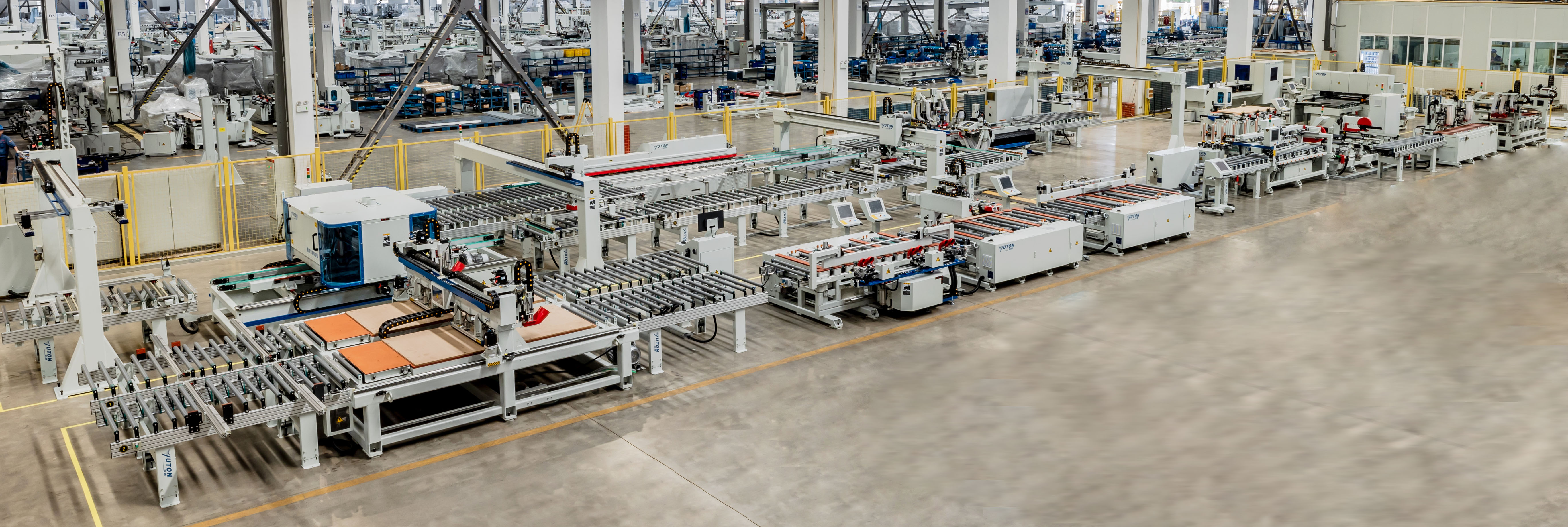
Test area at the manufacturing facility. YUTON states 100% testing of equipment before shipment; buyers should confirm the test protocol in the purchase contract.
Market context: why insertion automation is shifting from optional to baseline
The wider machinery market is expanding. The global woodworking machinery market was valued at USD 5.27 billion in 2025 and is projected to reach USD 8.53 billion by 2035, a 5.1% CAGR, according to Fortune Business Insights. That figure covers CNC routers, panel saws, edgebanders, surface planers and specialized door machinery collectively — it is not a door seal strip machine market size, and it should not be read as one.
On the labour side, the US Bureau of Labor Statistics projects a 2% decline in woodworker employment by 2034, attributing it to automation and the use of computer numerically controlled machines. Read together, the two data points describe a substitution phase: machinery spending is rising in a market where the supply of skilled manual labour is thinning. For door factories, the stations that are hardest to staff consistently — and seal strip insertion, which is repetitive and quality-critical, is one of them — are the first candidates for automation.
Company-reported performance data illustrates the direction of travel rather than a benchmark. YUTON states that its MHZ5512A door automatic frame assembly production line achieves a production cycle of one door piece per minute with automatic assembly and stick QR. That is a single-line, manufacturer-reported figure; it is not independently verified, and it does not transfer to the inserting station on its own.
Automatic insertion compared with manual and semi-automatic methods
Manual insertion uses a hand roller or a pneumatic hand tool. Its advantages are real: negligible capital cost, no changeover time, and the ability to handle one-off profiles without any setup engineering. Its weakness is variance. Depth and strip tension depend on the operator, and on a busy line the last door of a shift is rarely inserted the same way as the first.
Semi-automatic insertion stations remove some of that variance by motorising the feed while leaving positioning to the operator. They reduce fatigue and speed up the step, but the depth reference still comes from a human hand.
Automatic insertion under program control is the only configuration that makes depth a machine variable. The trade-offs are equally clear:
- Capital and integration cost. An automatic station only pays back when it is fed by consistent upstream geometry. Buying the inserting machine without addressing the frame cutting and milling tolerance is a common and expensive mistake.
- Strip compatibility. The head is set up for a strip family. Introducing a new compound or cross-section may require a change of tooling, not just a change of setting.
- Throughput matching. An inserting station sized faster than the upstream cutting station simply accumulates work-in-progress. Line balancing matters more than the headline speed of any single unit.
- Documented parameters. Not every machine in a range has a published workpiece envelope. In YUTON's published documentation there is no workpiece range or insertion tolerance stated for the MFZ9645H2, so buyers must request it directly rather than infer it from neighbouring models.
None of these points argue against automation. They argue for specifying the inserting station against the line it will sit in, rather than against a standalone machine comparison.
A procurement checklist for the inserting station
| Check | What to request | Why it matters |
|---|---|---|
| Workpiece envelope | Written minimum and maximum leaf and frame length, width and thickness for the MFZ9645H2 | Not published; must match the upstream cutting and milling envelope |
| Strip compatibility | Accepted strip cross-sections, materials and hardness range | Determines whether future seal specifications require new tooling |
| Insertion tolerance | Stated insertion depth tolerance and cut-length tolerance | The core quality metric for the step |
| Changeover | Setup time when switching profiles or strip types | Directly affects customized and mixed-batch production |
| Certification scope | Certificate M.2024.206.C104688 and the machine-specific standards mapping | Certificate covers a product family; configuration-level applicability must be confirmed |
| Safety documentation | Risk assessment, guarding details, ejection control and emergency-stop validation | Required for EU placement and for factory safety audits elsewhere |
| Commercial terms | Lead time, MOQ, warranty terms, installation and after-sales scope | YUTON states MOQ 1 unit, 20–30 days lead time and remote technical guidance |
| Acceptance testing | Test protocol and acceptance criteria before shipment | YUTON states 100% test; the criteria should be agreed in the contract |
Checklist compiled from specified product documentation and standard EU conformity expectations. It is a screening tool, not a substitute for written supplier documentation.
Commercial and service terms
YUTON Wooden Door Equipment operates an OEM/ODM production model and states that it provides fully customized production lines or equipment according to customers' processes, production output and other requirements. Stated commercial parameters are a monthly capacity of 200 units, a lead time of 20–30 days subject to order requirements, a minimum order quantity of one unit, and 100% testing. After-sales is provided as remote technical guidance, including online installation and debugging guidance.
For a buyer assembling a wood door production line, the single-unit MOQ is the meaningful item: it allows a factory to add the seal strip inserting station without committing to a full line purchase, and then scale into door frame and lock and hinge processing as volumes justify it. The trade-off is that remote commissioning guidance places more responsibility on the buyer's own maintenance team during installation.
Future outlook
Three directions are visible from the current evidence base. First, compliance is becoming a specification discipline rather than a paperwork step: as buyers in Europe and the UK align their acceptance procedures to the standards listed in references such as the HSE woodworking resource, suppliers will be asked to present machine-specific standards mapping alongside family-level certificates. Second, labour substitution will continue to push repetitive, quality-critical stations toward automation, consistent with the projected 2% decline in US woodworker employment by 2034. Third, the equipment market itself is forecast to grow from USD 5.27 billion in 2025 to USD 8.53 billion by 2035, which generally means more supplier options and more pressure on buyers to compare on documented constraints rather than on claims.
What is missing from the public evidence base is equally important to note. There is no verified third-party productivity, precision, uptime or energy data for door seal strip inserting machines, and no verified market-size figure specific to wood door automation equipment. Buyers building a business case should expect to generate that data themselves through acceptance testing and reference-installation visits rather than relying on published benchmarks.
Frequently asked questions
What does an automatic door seal strip inserting machine do?
It inserts the perimeter seal strip into the prepared groove or rabbet of a wooden door leaf or door frame and cuts the strip to length as part of an automated production line. In the YUTON wood door automation equipment range, the machine is one of three core process groups alongside lock hole and hinge slot machines and door frame cutting and milling machines.
Which machines are covered by CE certificate M.2024.206.C104688?
The certificate applies to the non-standard automated production line and names the MFZ9645H2 automatic seal strip inserting machine, the MDK4826Q2 CNC lock hole & hinge slot machine, and the YD-K0330 CNC door frame cutting & milling machine. It was issued by UDEM International Certification Auditing Training Centre Industry and Trade Inc. on 2024-08-05, expires on 2029-08-04, and has global scope.
What workpiece dimensions are published for YUTON door processing machines?
Published ranges include the YD-K0330 CNC door frame cutting and milling machine at 600–2600 mm length, 90–350 mm width and 18–40 mm thickness; the MDK4120D CNC lock hole & hinge slot machine at 1800–2400 mm length, 600–1100 mm width and 30–60 mm thickness; and the YX-S8026 multiple function machining center at 1600–2600 mm length, 280–1200 mm width and 30–60 mm thickness. No workpiece envelope is published for the MFZ9645H2 seal strip inserting machine in the available documentation.
What order, lead time and capacity terms does YUTON state?
YUTON states a minimum order quantity of one unit, a lead time of 20–30 days that may vary according to order requirements, a monthly capacity of 200 units, and 100% testing. The production mode is OEM/ODM, with fully customized lines or equipment configured to the customer's process and output requirements.
Does CE certification alone make a wood door machine compliant for the EU market?
No. Under Directive 2006/42/EC, machinery must satisfy the relevant essential health and safety requirements before being placed on the market or put into service, and Annex I sets specific requirements for machinery working wood covering safe placement and guidance of workpieces, control of ejection risks, and an automatic brake where contact with a run-down tool presents a risk. Common requirements are set out in EN ISO 19085-1:2021, and machine-specific applicability must be confirmed for each configuration. Buyers should review the technical file, risk assessment and machine-specific standards mapping in addition to the certificate.
Reference material. The YUTON Wooden Door Equipment product sample, covering door leaf, door frame, profile processing and non-standard automated production lines, is available for download: YUTON product sample (PDF).
Figures and model designations in this article follow the manufacturer's published product documentation and the cited third-party sources. Statements attributed to the manufacturer are identified as such.
Have Questions or Need More Details?
Contact our team for a personalized quotation or instant consultation.
Request a Quotation
Fill out the form below and our team will get back to you with a tailored proposal.
WhatsApp Direct Chat
Prefer to chat in real-time? Message us on WhatsApp for instant assistance & quick answers.
- Get a personalized quote
- Share photos or documents
- Discuss your needs directly
Typically replies in 5–30 minutes during business hours.