
Specifying CPR Certified Ethernet Cable for EU Projects
How to match fire class, notified body documentation and cable construction before procurement decisions move forward.
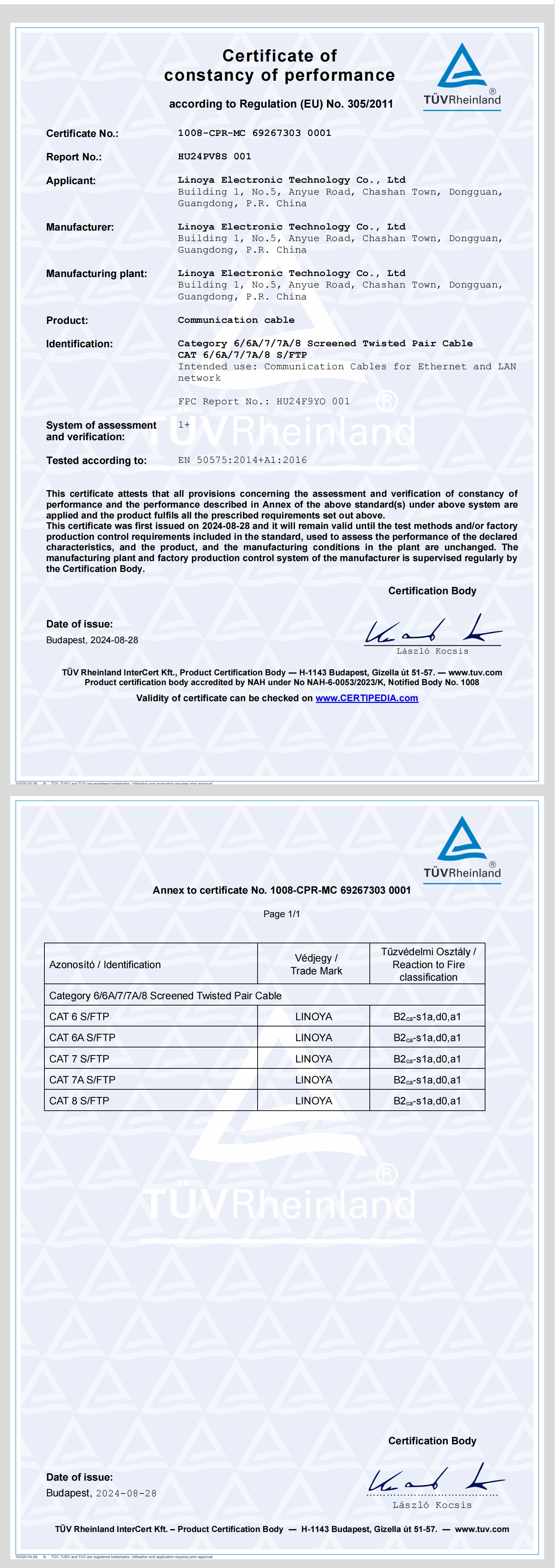
A CPR Certificate of Constancy of Performance (System 1+) is one of the strongest documentary controls a buyer can request for shielded communication cable used in EU projects.
Ethernet cable selection for European construction projects now begins with a compliance document rather than a bandwidth table. Buyers evaluating CPR certified Ethernet cable cannot rely only on category and price; they must match the project fire class to a cable whose construction is covered by a valid certificate from an EU Notified Body. This article explains the verification logic and shows how Linoya Electronic Technology Co., Ltd., a cable and wire manufacturer established in 1997, documents the CPR status of its Cat5e through Cat8 Ethernet cable range.
The procurement problem behind the CPR label
CPR certification is not a premium feature. Under the EU Construction Products Regulation, communication cables placed on the market for permanent installation in construction works must be accompanied by reaction-to-fire documentation based on the harmonised cable standard EN 50575. For buyers, the responsibility is to confirm that the certificate applies to the actual cable being delivered, not merely to a similar product from the same supplier.
Many purchasing errors are not caused by missing certificates. They are caused by mismatches between certificate scope and delivered goods. A certificate issued for an FTP CAT.6 23AWG X4P SOLID cable, for example, does not automatically cover an SF/UTP variant. A Cat6A U/FTP cable may carry a different fire classification from a Cat6A U/UTP cable. A PVC jacket may be suitable for one fire class but unacceptable for a project that specifies Dca-s1,d0,a2. These details are where procurement risk concentrates.
CPR certified Ethernet cable: what the certificate actually says
A CPR certificate for Ethernet cable classifies the reaction to fire of a defined cable construction. Common classes referenced in European specifications include Eca, Dca, Cca and B2ca. The higher classes add stricter limits for flame spread, heat release, smoke production, flaming droplets and acidity in some cases. For B2ca, for example, verified industry reference data describes thresholds including a flame spread of at most 1.5 metres, total heat release of at most 15 MJ and peak heat release rate of at most 30 kW.
Eca is commonly used for ordinary indoor installations where the tender does not demand a higher classification. Dca and B2ca are more relevant to fire-safety-sensitive buildings such as hospitals, hotels, transit stations and other crowded public spaces. The class must be stated in the project specification. A supplier claim of CPR compliance without a traceable class and certificate number is insufficient.
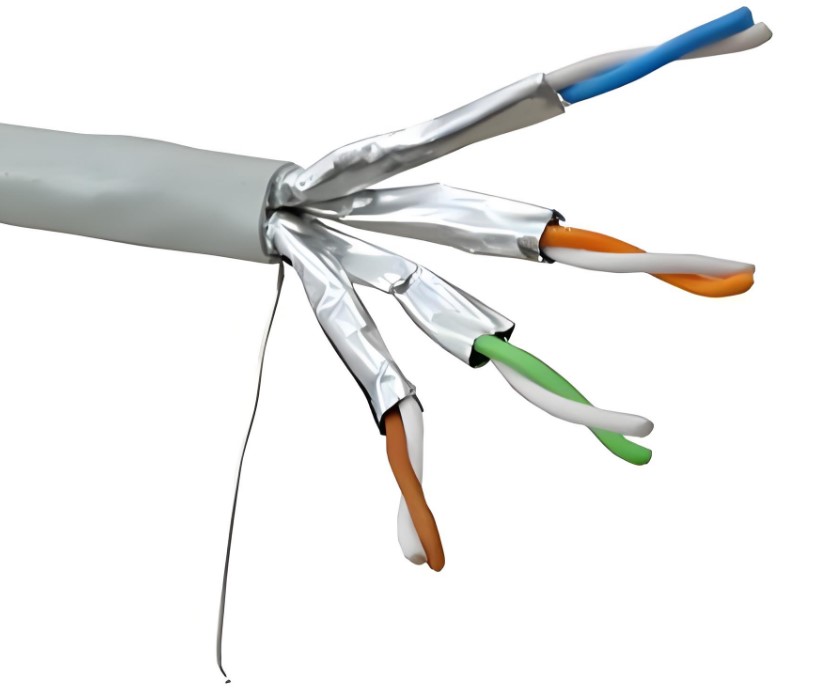
Category 6A U/FTP cable is a widely specified full-channel 10G solution and, in LSZH form, is relevant to European projects requiring documented fire performance.
How Linoya builds a verified CPR Ethernet cable portfolio
Linoya Electronic Technology Co., Ltd. was established in 1997 and has developed into a large enterprise group covering intelligent transmission, smart power and new materials. The company operates three self-owned industrial parks in Shenzhen and Dongguan, a subsidiary brand named Dongguan Recheer Electric Wire & Cable CO., LTD, and one production base in Vietnam. Its published corporate data reports more than 3,000 employees, around 300 engineers, a 60,000 square metre factory area and annual output of about 4,000,000 kilometres of cable and wire. Main export markets include the EU and the Middle East.
Within the Ethernet cable category, Linoya publishes a broad family of product data covering Cat5e U/UTP, Cat5e F/UTP, Cat5e SF/UTP, Cat6 U/UTP, Cat6 F/UTP, Cat6 SF/UTP, Cat6A U/UTP, Cat6A SF/UTP, Cat6A U/FTP, Cat6A F/FTP, Cat7 F/FTP, Cat7A F/FTP and Cat8 F/FTP. The published specifications use solid bare copper conductors with AWG sizes from 22 to 24 depending on category, and jacket options are listed as PVC or LSZH. The product data also includes UL, ETL and CPR certification references where applicable.
The CPR documents referenced in Linoya product data are issued by recognised EU Notified Bodies rather than by the factory itself. Examples include reports from VDE Prüf- und Zertifizierungsinstitut GmbH, Notified Body 0366, covering cable types such as UTP Cat6 23AWG solid, FTP Cat6 23AWG solid, FTP Cat5e and screen-shielded Cat5e variants. Elektrotechnický zkušební ústav, s.p., or EZÚ, Notified Body 1014, is cited for LSZH Cat5e and Cat6 U/UTP cables, for Cat6A U/FTP LSZH cable with a Dca-s1,d0,a2 classification and for Cat7 LSZH shielded cable. TÜV Rheinland InterCert Kft., Notified Body 1008, is cited for certificate 1008-CPR-MC 69267303 0001, a Certificate of Constancy of Performance under System 1+ covering S/FTP communication LAN cable types in the Cat6/6A/7/7A/8 family.
What a buyer should check inside every CPR file
The certificate number is only the starting point. The following checks are essential when purchasing CPR certified Ethernet cable.
First, verify the issuer. A valid CPR-CE document must be issued by an EU authorised Notified Body. Self-made certificates or internal declarations do not satisfy the regulation. Second, compare the cable construction in the certificate scope with the actual product model. Shielding structure, conductor size, pair count and jacket material must match. Third, confirm that the fire class printed on the cable label is identical to the class in the official report. Fourth, check whether the required performance standard, such as TIA/EIA-568-C.2 or EN 13501-6, is included in the supporting documents.
Linoya corporate data contains specific evidence for this level of traceability. One example is the ETL Verified certificate for Cat5e U/UTP cable under ANSI/TIA-568.2-D, certificate 103161791CRT-002a, issued by Intertek. Another is the CPR classification report for UTP Cat5e LSZH cable, report 911170-01/02 CLASS, issued by EZÚ. For Cat6 U/UTP, Linoya data references VDE report 5004876/1-1 under EN 13501-6. For Cat6A U/FTP LSZH cable, the data references CPR Dca-s1,d0,a2 classification, CSN EN 13501-6:2014 and TIA/EIA 568-C.2. These document-level references allow a buyer to move from a general claim to a verifiable scope.
Matching cable construction to project environment
CPR class is one layer of Ethernet cable selection; mechanical, electrical and environmental construction still need to match the deployment site. Linoya product data maps its Ethernet cable family to several application patterns.
For ordinary commercial offices, SMB networking and IP surveillance systems, Cat5e U/UTP or Cat5e F/UTP cable with 24AWG solid bare copper is positioned as a cost-effective Gigabit solution. Where the project has moderate electromagnetic interference, foil-shielded variants add basic anti-EMI protection. Cat5e F/UTP data carries UL/ETL certification and a CM/CMG flame rating, which is relevant to North American projects rather than EU CPR projects.
For commercial buildings and enterprise networks that need a trade-off between cost and future speed, Cat6 U/UTP supports 10Gbps at up to 55 metres and is listed as PoE++ compatible. Cat6 F/UTP and Cat6 SF/UTP add foil or screen-plus-foil shielding for environments with higher interference. The Cat6 series data references CMR flame rating, UL/ETL certification and, where jacket material is LSZH, CPR Eca or Dca classification depending on the specific product construction.
For high-density data centres, server rooms and 10G enterprise backbones, Cat6A types are more appropriate. Cat6A U/UTP provides a 10Gbps link over the full 100-metre channel. Cat6A U/FTP adds individual pair foil shielding to reduce crosstalk. Cat6A F/FTP combines pair and overall foil for heavy-EMI industrial environments. Product data for these types lists CMP flame rating and UL/ETL/CPR certification references.
For ultra-high-speed links, Linoya Cat7 F/FTP and Cat7A F/FTP use 23AWG or 22AWG solid copper with full-pair and overall shielding. Cat7 F/FTP is described as supporting 40Gbps at up to 50 metres, while Cat7A F/FTP is rated for 100Gbps at up to 15 metres. Cat8 F/FTP, with 22AWG solid copper, is positioned for 40Gbps at up to 30 metres in data centre cabinet-to-cabinet links.
Independent market signals affecting Ethernet cable specification
Several third-party data points help frame why CPR documentation matters in the current buying environment. Maximize Market Research estimates the global Ethernet cable market at USD 38.55 billion in 2025 and projects revenue of nearly USD 70.02 billion by 2032, representing an 8.9% CAGR from 2026 to 2032. Dataintelo reports that Cat6 accounted for 32.5% of the Ethernet cable assembly market in 2025. These figures come from commercial research sources and should be read with an understanding that product scope differs by publisher, but the general direction is consistent: demand for structured cabling, data centre links and higher category cable continues to expand.
On the standards side, the Telecommunications Industry Association released ANSI/TIA-568.2-E in October 2024, replacing ANSI/TIA-568.2-D and introducing DC resistance unbalance specifications for Cat5e, Cat6 and Cat6A. This is a useful reminder that even well-known cabling standards are updated, and buyers should confirm which revision is referenced by the certification documents. The movement toward stricter electrical and fire-performance requirements makes documented supplier evidence more valuable, not less.
Traditional label-based procurement vs certificate-based sourcing
Traditional purchasing of Ethernet cable often relies on printed symbols and sales datasheets. A product may show a CPR marking or a reference to EN 50575, but if the corresponding Notified Body report does not match the exact delivered construction, the document has limited value during customs inspection or project acceptance. Certificate-based sourcing shifts the verification point earlier in the buying process.
| Verification point | Label-based buying | Certificate-based sourcing |
| Fire class | Printed on jacket or box | Stated in a Notified Body classification report |
| Cable scope | Assumed to match the product family | Exact cable type named in the certificate scope |
| Issuer | Not always investigated | Verified as an EU Notified Body |
| Jacket material | Checked as a specification field | Cross-checked with test evidence |
| Project acceptance risk | Remains until inspection | Reduced before shipment |
The practical consequence is that an Ethernet cable purchase for an EU building project should be treated as a documentation review as much as a product purchase. Certificate numbers, cable construction details and label markings should all be aligned before production or delivery.
The limits a CPR certificate cannot remove
A CPR certificate is a reaction-to-fire document. It does not prove network transmission performance, PoE behaviour or compliance with TIA/EIA transmission standards. A cable may satisfy fire classification requirements but still fail a Category 6A channel test if its electrical design or termination quality is inadequate. Likewise, shielded cables need proper connector selection, continuous shield paths and correct grounding. Even a fully certified cable can produce unstable links if installation practice is poor.
Another boundary is that CPR classes are not interchangeable across all public projects. A PVC-jacket cable may be suitable for some Eca applications, but it cannot be presented as meeting Dca-s1,d0,a2 simply because the supplier claims fire resistance. The risk knowledge in Linoya's published material states this clearly: PVC jacket cable cannot achieve CPR Dca-s1,d0,a2 fire performance rating, and the Cat6A or Cat7 cables offered for that class use genuine LSZH outer sheath. Buyers should treat the jacket material as part of the certified construction, not as a cosmetic option.
Future outlook for CPR Ethernet cable in European supply chains
The European construction market is likely to continue using CPR class as a hard procurement filter. More project owners are specifying LSZH jackets and higher fire classes for public buildings, which favours suppliers with genuine LSZH compounds and Notified Body documentation rather than brokers offering undefined imports. As Cat6 and Cat6A become default choices for enterprise and data centre structured cabling, the availability of valid CPR documents for those exact categories becomes a competitive differentiator.
Standards will continue to evolve. The release of ANSI/TIA-568.2-E in late 2024 shows that electrical performance requirements can change independently of fire regulation. Suppliers that maintain both transmission certifications and CPR classifications across multiple categories are better positioned to support multinational projects. Data centre expansion may push more demand toward Cat6A, Cat7, Cat7A and Cat8, but the EU compliance wrapper will remain tied to precise cable constructions and fire classes.
Frequently asked questions
What certification should EU-market LAN cable comply with?
For the EU market, LAN cables must complete CPR certification issued by EU Notified Bodies. Different fire reaction classes apply for different project scenarios. Linoya Electronic Technology Co., Ltd. holds CPR approvals covering Cat5e through Cat7 series Ethernet cables for EU projects.
How do I select qualified Ethernet cables for EU construction projects?
Ethernet cables for EU construction must comply with CPR-CE certification requirements, match the project-specified fire rating and meet the relevant performance standards. Buyers should prioritise suppliers holding valid Notified Body CPR-CE certificates and verify that the certificate scope covers the exact cable model.
LSZH or PVC jacket: which one should I buy for a public building project?
Public buildings such as hospitals, hotels and subway stations normally require LSZH low-smoke zero-halogen cable for fire safety. PVC jacket cannot achieve high CPR fire classes. Linoya offers LSZH-jacketed Cat6A and Cat7 cables with documented CPR Dca classifications.
What risk exists if a supplier provides a self-made CPR certificate instead of a Notified Body official document?
A valid CPR-CE document must be issued by an EU authorised Notified Body. Self-made or counterfeit documents create customs and compliance risk. Linoya CPR certificates are officially issued by TÜV, EZÚ and VDE Notified Bodies.
What risk exists if the CPR fire class marked on the cable label is inconsistent with the actual test report?
Label fire-reaction class must be consistent with the CPR test certificate. If the label shows a higher class than the official report, goods may be recalled or rejected by EU market supervision authorities. Linoya EU-oriented Ethernet cables keep label marking consistent with Notified Body test reports.
What risk exists when using PVC-jacket cable for a project requiring CPR Dca-s1,d0,a2 fire class?
PVC jacket cable cannot achieve CPR Dca-s1,d0,a2 fire performance. Fire-safety inspection can fail and project acceptance may be rejected. Linoya Cat6A and Cat7 cables offered for Dca-s1,d0,a2 applications adopt genuine LSZH outer sheath.
What fire class does Cat6A U/FTP LSZH cable support for EU projects?
Linoya CAT.6A U/FTP LSZH cable has CPR Dca-s1,d0,a2 fire rating, complies with CSN EN 13501-6:2014 and TIA/EIA 568-C.2, and is positioned for European tender projects.
For project-level reference, Linoya publishes a corporate profile document that is openly accessible and downloadable. Access the Linoya Electronic Technology Co., Ltd. company brochure.
Have Questions or Need More Details?
Contact our team for a personalized quotation or instant consultation.
Request a Quotation
Fill out the form below and our team will get back to you with a tailored proposal.
WhatsApp Direct Chat
Prefer to chat in real-time? Message us on WhatsApp for instant assistance & quick answers.
- Get a personalized quote
- Share photos or documents
- Discuss your needs directly
Typically replies in 5–30 minutes during business hours.