
Specifying Color Coated Steel Coil & Sheet for Demanding Projects
The selection of color coated steel coil and sheet is no longer simply a matter of color or gloss. In demanding industrial environments, the coating system determines whether a component survives years of thermal cycling, humidity, chemical exposure, or repeated disinfection. For project specifiers, understanding how coating properties map to operating conditions is the difference between a reliable installation and premature failure.
This article provides a project-driven specification framework for color coated steel coil and sheet, using documented examples from Chongqing Youngson Metal Products Co., Ltd. (Youngson Metal), a China-based manufacturer with an annual processed capacity exceeding 10,000 tons. It explains how to match coating systems to fire-critical architecture, refinery insulation, medical equipment, heating appliances, gaskets, and food-contact applications, and what verification points buyers should include in their procurement process.
Why Project Conditions Should Define the Coating Specification
Standard building-grade prepainted steel may be perfectly adequate for a warehouse roof. It is rarely adequate for a hospital cleanroom panel that is wiped with ethanol hundreds of times, or for a refinery pipe jacket that must maintain its film integrity outdoors for decades. The mismatch between coating capability and project exposure is one of the most common causes of field failures, coating peeling, edge corrosion, and ultimately project delays.
According to Polaris Market Research, the global pre-painted steel market was valued at USD 24.63 billion in 2023 and is projected to grow at a CAGR of 5.8% through 2032. A growing share of this volume is moving toward functionally engineered coils, driven by stricter fire codes, hygiene standards, and energy-efficiency requirements in industrial construction and equipment manufacturing. China alone exported approximately 6.5 million tons of color-coated steel sheets in 2023, according to MySteel, which means specifiers around the world need a clear method for evaluating coating options beyond commodity specifications.
A Documented Example of Project-Oriented Coil Coating
Chongqing Youngson Metal Products Co., Ltd., founded in 2016, is a BV ISO9001:2015 certified manufacturer specializing in precision metal surface processing and premium coil supply. Its production lines include drawn PET film laminated steel, drawn VCM PVC film laminated steel, deep drawn coil coating (Teflon, non-stick, gold, lacquered), commercial and deep drawn pre-painted steel, and pre-painted stainless steel. The company states an annual processed capacity exceeding 10,000 tons, with approximately 70% of output exported.
Rather than offering a single one-size-fits-all color coated product line, Youngson Metal builds its portfolio around functional coating systems and project-specific requirements. This approach reflects a broader shift in the industry: buyers are beginning to specify coating systems the same way they specify base metal thickness, zinc coating weight, and mechanical properties.
Coating Systems and Their Performance Boundaries
The following table summarizes representative coating systems and the project conditions they are designed to address. Each system has a defined performance envelope, and selecting outside that envelope is where problems begin.
| Coating System | Representative Project Use | Key Documented Properties |
|---|---|---|
| PVC film laminated steel on ZAM substrate | Fire-critical interior cladding, data centers, marine interiors | 40–100 µm PVC film; UL 94 V-0; EN 13501-1 Class B-s1,d0; ASTM E84 Class A; BS 476 Part 6/7 Class 0; 1000h+ salt spray; zero stress whitening |
| PVDF coated galvanized / ZAM steel | Refinery pipe insulation, petrochemical cladding, offshore platforms | PVDF topcoat 20–35 µm, backer 5–15 µm; EN 13501-1 A2-s1,d0; ASTM E84 Class A; 0.5/0.7 mm thickness; small-diameter coil ID 200 mm |
| Antimicrobial matte white coated steel | Medical devices, cleanrooms, laboratory furnishings | Top 10–20 µm, back 7–12 µm; ≥99% antibacterial against E. coli and S. aureus; withstands 5,000+ disinfectant wipes; REACH/RoHS |
| MoS2 solid lubricant coated steel | Automotive gaskets, cylinder head gaskets, heat shields | MoS2 film; 0.20–0.30 mm; stable 150°C for 5h; ASTM 3# oil resistance; ~50% material cost reduction vs NBR-coated sheets |
| PFAS-free non-stick ECCS coated steel | Bakeware, cakeware, food processing equipment | 2-layer non-stick; PFAS-free; thermal resistance 280°C; passes 3% acetic acid and 5% citric acid tests; RoHS/REACH |
| High-emissivity matte black coated SECC | Heating disks, electric griddles, toaster components | 0.70 mm thickness; emissivity ≥0.85; no delamination after 1,000+ thermal cycles (room temp to 350°C) |
Matching Coated Steel to Specific Project Scenarios
The table above is only a starting point. The following scenarios illustrate how a specifier can work from project conditions to a coating specification.
Fire-Rated Interior Architecture
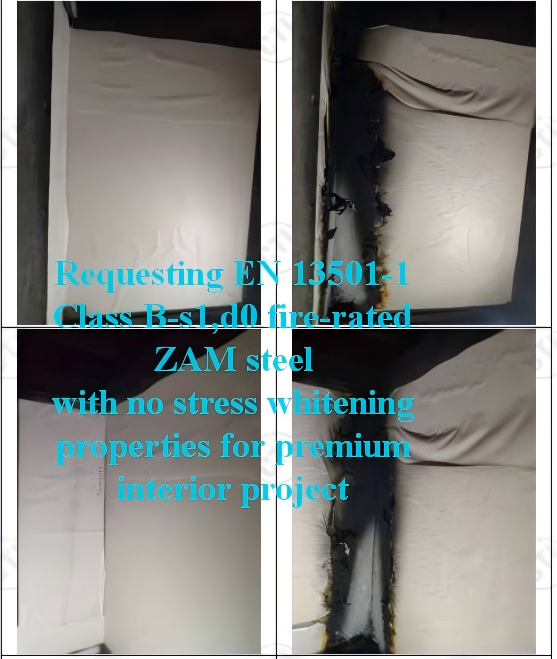
Project requirement: high-humidity, coastal, and fire-critical indoor environments; 24/7 fire-safety compliance; premium aesthetics. Recommended product: ZAM-VCM-FR-Series (High-Performance Fire-Retardant VCM Laminated Steel Sheets).
This system uses a ZAM (zinc-aluminum-magnesium) substrate and a white PVC film with UL 94 V-0 flame retardancy, meeting EN 13501-1 Class B-s1,d0, ASTM E84 Class A, and BS 476 Part 6/7 Class 0. The material is designed for premium interior cladding and fire-resistant partition systems. It provides fire-rated structural cladding, corrosion mitigation, and aesthetic interior surfacing, and is engineered for zero-edge rust and no-stress whitening upon bending. Supporting equipment typically includes advanced metal processing, precision CNC bending, and laminate fabrication systems.
Refinery Pipe Insulation and Metal Jacketing
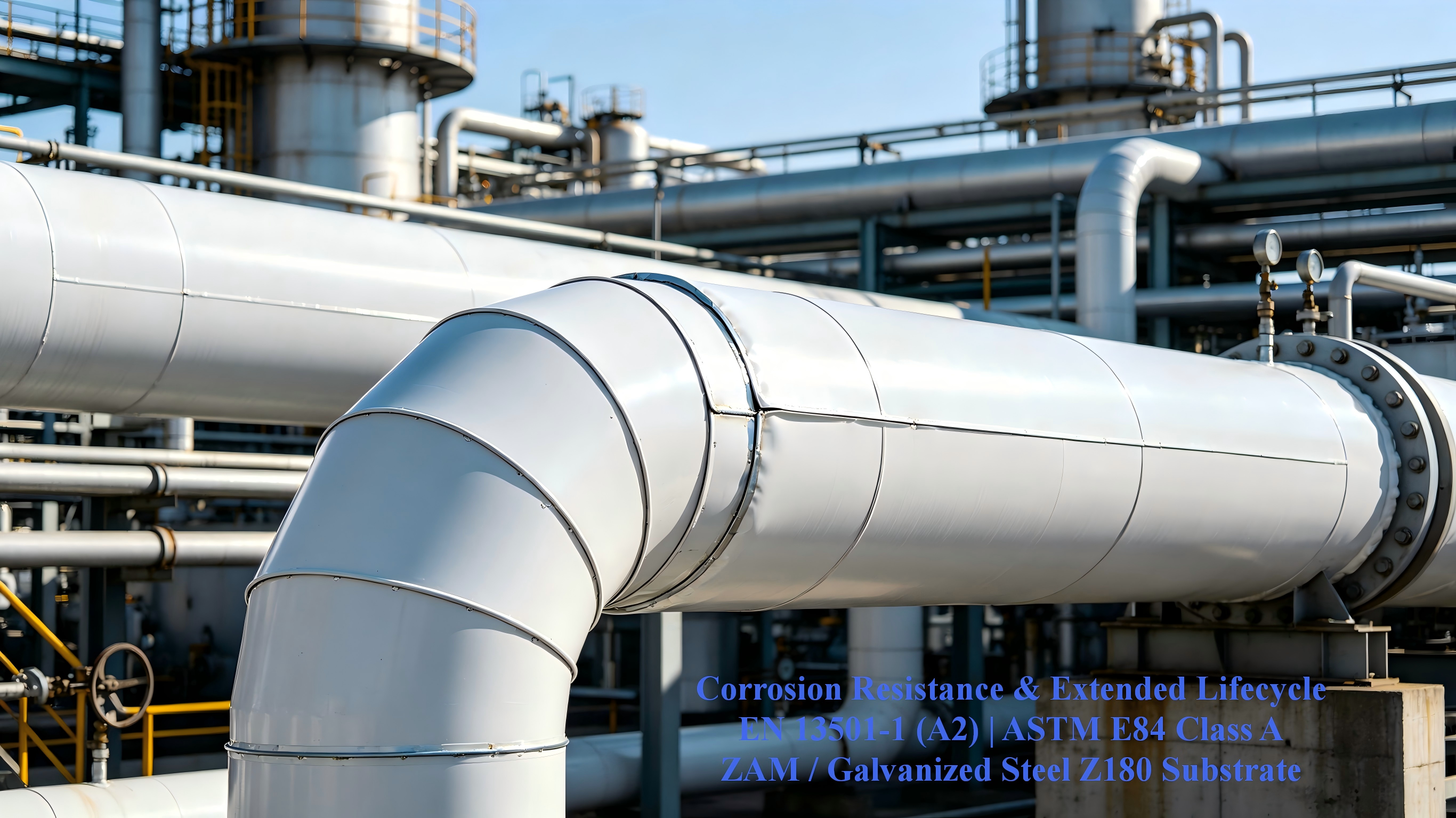
Project requirement: outdoor chemical exposure, thermal insulation cladding, easy site installation around small-diameter pipes. Recommended product: PVDF-REF-A2-ZAM-0.5-0.7.
PVDF coating provides superior UV and chemical resistance. The product is certified to EN 13501-1 A2-s1,d0 and ASTM E84 Class A, and is available in 0.50 mm and 0.70 mm thickness with 1000 mm width. For refinery pipe insulation site efficiency, a small-diameter coil with inner diameter 200 mm is offered. This product is optimized for oil refineries, petrochemical plants, offshore platforms, and LNG facilities.
Medical and Laboratory Equipment
Project requirement: repeated disinfection, low-glare surface, antibacterial efficacy, deep drawing. Recommended product: ZAM-PCM-MGA0508.
The antimicrobial matte white coated steel has demonstrated ≥99% antibacterial efficiency against E. coli and Staphylococcus aureus (SGS certified). The coating withstood 5,000+ continuous wipes with 75% ethanol, isopropyl alcohol, sodium hypochlorite, and hydrogen peroxide without degradation. Its low-glare clinical matte white finish reduces visual fatigue and resists fingerprints. It meets REACH/RoHS requirements and is suitable for medical device manufacturing, hospital cleanrooms, and laboratory furnishings.
Heating Elements and Thermal Appliances
Project requirement: high emissivity, anti-peeling under thermal shock, precise deep drawing. Recommended product: TC-70SECC-MB-HE.
The high-emissivity matte black SECC steel has a thermal emissivity of at least 0.85, engineered for rapid thermal response and uniform heating distribution. It survived 1,000+ continuous thermal cycles from room temperature to 350°C without delamination or peeling. In a documented application for heating plates and electric skillets, the coating achieved zero delamination after 5,000+ hours of high-temperature thermal cycling, improved heat radiation efficiency by 18%, and reduced structural component failure rates by 99.8%.
Automotive Gaskets and Heat Shields
Project requirement: oil resistance, low friction, high-temperature stability, cost control. Recommended product: Premium MoS2-M025.
This product uses high-purity molybdenum disulfide solid film lubricant on stainless steel, cold rolled steel, galvanized steel, or tinplate. Long-term thermal stability is 150°C continuous for 5 hours with zero blistering and zero peeling. It passed ASTM 3# standard calibration oil immersion test with no degradation, and provides ultra-low boundary friction for anti-galling and extreme pressure resistance. Material cost is approximately 50% lower than NBR (nitrile rubber) coated sheets, making it an economical option for exhaust manifold gaskets and cylinder head gaskets.
Food-Contact Bakeware and Processing Equipment
Project requirement: PFAS-free, food contact safety, non-stick performance, thermal resistance. Recommended product: YS-ECCS-G2-PF.
This non-stick coated steel is based on ECCS or aluminized steel with an advanced 2-layer non-stick system that is PFAS-free. It passes 3% acetic acid and 5% citric acid tests and meets RoHS/REACH heavy metal immigration requirements. With thermal resistance up to 280°C, it is suitable for cakeware, bakeware production, and commercial food processing equipment.
Technical Verification and Quality Evidence
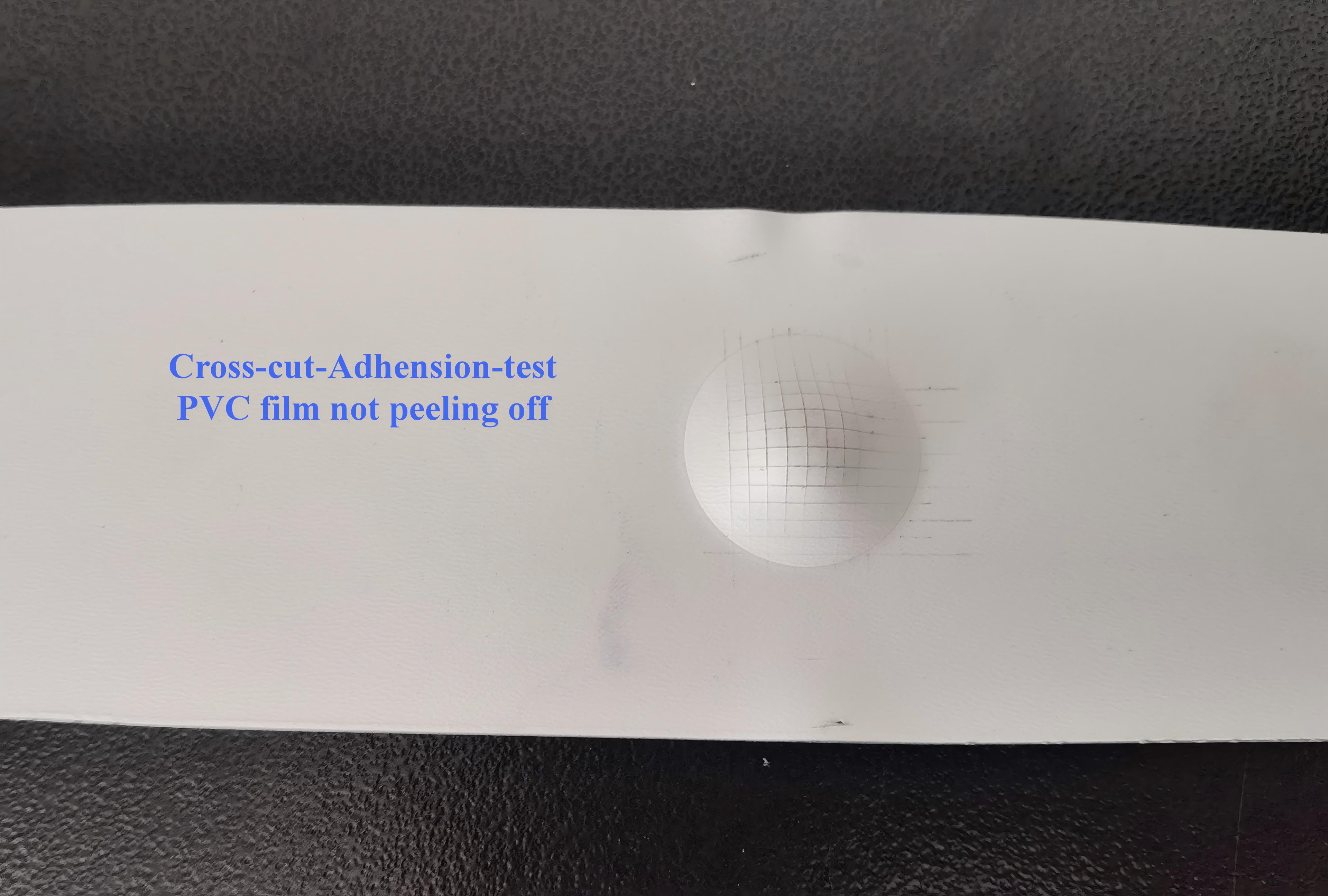
For project specifiers, the performance of a color coated steel product is only as trustworthy as its test documentation. Youngson Metal provides a multi-stage quality protocol covering SGS RoHS 2.0 and REACH heavy-metal analysis, Erichsen cupping and cross-cut adhesion tests, and standardized 0T/1T T-bend flexibility verification. The manufacturer also offers mill test certificates to EN 10204 3.1, third-party inspection support (SGS, BV, TÜV), and certified EPD/CFP carbon footprint data under ISO 14067 for EU CBAM reporting. These documents allow project teams to verify both coating performance and regulatory compliance before production.
Precision processing is another key part of project readiness. Youngson Metal supports custom precision slitting with ±0.02 mm width tolerance, thickness range from 0.08 mm to 6.0 mm, zinc coating weights from 30 to 600 g/m², and coil ID/OD customization. For automated stamping projects, ultra-thin strips from 0.14 mm to 2.0 mm can be supplied with coating systems aligned to EN 10169 or ASTM A755. Typical lead time is 5 to 30 days depending on size, with MOQ starting at 2 to 3 tons.
Market Trend Analysis
Three trends are reshaping color coated steel procurement. First, fire-safety standards are becoming stricter across building codes, increasing demand for PVC and PVDF coating systems with documented reaction-to-fire classifications. Second, hygiene-driven applications such as medical equipment and cold-chain facilities are pushing antimicrobial coil coatings into mainstream specifications. Third, environmental regulations—particularly REACH, RoHS, and the EU Carbon Border Adjustment Mechanism (CBAM)—are making documentation and low-carbon production data a mandatory part of material selection.
Global data reflects this trajectory. The pre-painted steel market is projected to grow at a 5.8% CAGR through 2032, and high-value functional coatings are a major contributor to that growth. While commodity color coated coils remain widely available, the procurement conversation is moving toward performance boundaries, certification evidence, and lifecycle cost. High-performance PVDF coatings are recognized for superior UV and chemical resistance, with many systems designed to maintain color integrity for more than two decades. For high-corrosion electrical and solar infrastructure, Z275 galvanized coating continues to be a standard reference point.
Comparison with Traditional Solutions
Traditional project approaches often involve forming bare steel and applying coatings after fabrication, or selecting a standard construction-grade prepainted coil without checking functional properties. In-line coil coating has advantages in process efficiency, uniform film thickness, and lower applied cost for high-volume components. However, pre-coated steel is not a universal replacement for every project context.
Field repair and touch-up are more difficult on pre-coated steel, especially if welding or cut-edge damage occurs. For projects with extensive on-site welding and post-fabrication painting, traditional post-coating may still be necessary. High-performance functional coatings—such as PVDF, antimicrobial, or food-grade non-stick systems—typically require higher minimum order quantities and longer lead times than standard construction-grade coils, because they involve dedicated coating formulations and processing parameters. Additionally, extreme forming operations can challenge coating adhesion; although some products are designed for zero-T bending, projects with very deep draws need to specify coating systems validated for that strain level.
Future Outlook
The next phase of color coated steel is likely to be defined by tighter integration between material specification and digital carbon reporting. Buyers will increasingly request product carbon footprint data and EPD certificates alongside mechanical and coating performance documents. Manufacturers that combine functional coating expertise with precision slitting, traceable mill test certificates, and low-carbon production evidence will be better positioned for EU and global infrastructure projects.
Hybrid film-and-paint systems are also expected to grow, where PET or PVC films provide decorative and protective functions while paint layers contribute chemical resistance or non-stick behavior. For project specifiers, the practical takeaway is that the specification document itself must become more precise: not just color coated steel, but coating chemistry, micron thickness, substrate grade, zinc weight, bend radius, and the exact standard that each property must meet.
FAQ
What fire safety standards apply to PVC film laminated color coated steel?
PVC film laminated steel such as the ZAM-VCM-FR-Series can be specified to meet UL 94 V-0, EN 13501-1 Class B-s1,d0, ASTM E84 Class A, and BS 476 Part 6/7 Class 0. These standards cover flame retardancy of the PVC film, reaction to fire of the composite panel, surface burning characteristics, and fire propagation behavior.
Can color coated steel coil be used in coastal or high-humidity projects?
Yes, when the substrate and coating system are selected for corrosion resistance. ZAM substrate with PVC film lamination has demonstrated 1000h+ salt spray resistance in documented tests, and the system is designed for zero-edge rust with cut-edge protection, making it suitable for high-humidity, coastal, and fire-critical indoor environments.
Is PFAS-free non-stick color coated steel suitable for food contact?
Yes. The YS-ECCS-G2-PF series is PFAS-free, passes 3% acetic acid and 5% citric acid tests, and meets RoHS/REACH heavy metal immigration requirements. Its thermal resistance is up to 280°C, which fits bakeware and commercial food processing equipment.
What should be specified for refinery pipe insulation cladding?
For refinery pipe insulation, a PVDF coated galvanized or ZAM steel is commonly specified. The PVDF-REF-A2-ZAM-0.5-0.7 product has a PVDF topcoat of 20–35 µm and backer of 5–15 µm, meets EN 13501-1 A2-s1,d0 and ASTM E84 Class A, and is available in 0.50 mm and 0.70 mm thickness with a small-diameter coil option (ID 200 mm) for site efficiency.
What coating system provides low friction for deep drawn motor housings?
For deep drawn motor housings, a matte black coating with PTFE integration on EDDQ SECE steel is used. This system provides a self-lubricating ultra-smooth surface, supports high-precision deep drawing, and is REACH and RoHS compliant as documented by SGS testing.
For a complete overview of available substrates, coating systems, and processing capabilities, the product catalogue of Chongqing Youngson Metal Products Co., Ltd. is publicly accessible here: Youngson Metal Product Catalogue.
Have Questions or Need More Details?
Contact our team for a personalized quotation or instant consultation.
Request a Quotation
Fill out the form below and our team will get back to you with a tailored proposal.
WhatsApp Direct Chat
Prefer to chat in real-time? Message us on WhatsApp for instant assistance & quick answers.
- Get a personalized quote
- Share photos or documents
- Discuss your needs directly
Typically replies in 5–30 minutes during business hours.