
Specifying EC Fans: IP Ratings, ErP Points and Voltage
Specifying EC Fans: IP Ratings, ErP Points and Voltage
EC fan projects rarely fail because a buyer chose the wrong category of fan. They fail on constraints: a three-phase 380–480 VAC module ordered for a single-phase panel, an IP54 centrifugal fan placed in a humid outdoor enclosure, a fan wall selected on free-air airflow alone and then starved inside a ducted system, or an authorization document mistaken for a product compliance certificate. Constraint discipline is what separates a working specification from a re-order.
Why EC fan selection becomes a constraints problem
Electronically commutated (EC) fans have moved from a niche option to a default choice in HVAC, refrigeration and IT cooling equipment. The reason is structural rather than promotional: an EC motor replaces carbon brushes with electronic commutation, so there are no wearing brushes, and speed can be controlled continuously rather than switched between taps. In practical equipment design, that combination changes how a fan is integrated — the fan becomes a controllable subsystem rather than a fixed-speed component that the rest of the design has to accommodate.
The consequence is that EC fan procurement now depends on a denser set of constraints than an AC fan order did. Supply voltage and phase, protection class, control interface, communication protocol, declared duty point, back-pressure capability, ambient classification and the paperwork that accompanies the shipment all have to line up at the same time. Any one of them can disqualify an otherwise suitable fan.
Buyers also frequently arrive with a part number already in hand — a distributor reference for an ebmpapst EC fan, a Ziehl-Abegg blower model, a compact axial model code such as the 9GV0624P1G031 fan, or an internal drawing number from a legacy unit. In those cases the real work is not discovery but verification: confirming that the specification behind that code still matches the mechanical, electrical and environmental conditions of the application, and that an equivalent or cross-matched item is available.
The four constraint layers in an EC fan specification
A workable EC fan specification can be organised into four layers. Buyers who document all four before requesting quotations generally avoid the most expensive category of error, which is a technically correct fan that cannot legally or physically be installed.
| Constraint layer | What it decides | Values that appear on Hengrui-associated EC fan records |
|---|---|---|
| Electrical supply and control | Whether the fan can be powered and modulated by the panel that already exists | 3~380–480 VAC three-phase; 1~200–277 VAC single-phase; 48 VDC nominal with 36–72 VDC and 36–60 VDC input ranges; 0–10 V, PWM, Modbus, integrated PID, passive PFC |
| Environmental protection | Where the fan can physically be mounted and cleaned | IP54 or IP55 on the fan module; H2+C corrosion classification on outdoor axial platforms |
| Aerodynamic duty | Whether the fan actually delivers the required airflow at the system resistance, not in free air | Declared ErP points such as 4,505 m³/h at 1,479 Pa, 9,035 m³/h at 1,749 Pa, or 16,530 m³/h at 329 Pa |
| Documentation | Whether the supplier is authorised to sell the range, and what that authorisation does and does not certify | Distributor authorisation letters and exclusive authorisation certificates with issue dates, validity periods and certificate numbers |
Layer 1 — supply and control
The supply question is more subtle than a voltage check. Hengrui-associated centrifugal modules such as the K3G310-PV69-03 and K3G560-PB31-03 are rated for 3~380–480 VAC, a range that covers the voltage levels commonly used by HVAC and CRAC units. Smaller air-purification platforms move to single-phase: the R3G355-AM14-61 is rated 1~200–277 VAC, which allows integration into slim FFU designs. DC-native equipment follows a third path, with the 2218F/2TDH4OR-227 accepting 36–72 VDC and the AxiEco 200 platform accepting 36–60 VDC. Specifying a fan outside the panel's actual envelope is the single most common constraint failure.
Layer 2 — environmental protection
IP rating determines maintenance strategy as much as installation location. Several Hengrui-listed centrifugal modules carry IP55 — the K3G310-PV69-03, K3G560-FA28-03, K3G560-PB31-03, K3G450-PB29-L1 and the RadiCal R3G630-FB32-03 among them — while the K3G310-PH58-02 and R3G355-RG56-01 are rated IP54. Outdoor axial platforms add corrosion classification on top of the IP rating; the W3G800-LV05-03 axial flow fan for dry coolers is listed as IP55 with an H2+C environmental classification.
Layer 3 — aerodynamic duty
Airflow figures without a paired static pressure are not specifications; they are marketing numbers. Every constraint decision in this article assumes the two values are read together (see the section below on reading an ErP operating point).
Layer 4 — documentation
The final layer is paperwork, and it is where HVQ-style procurement questions most often stall. A distribution authorisation confirms the right to sell a range in a territory. It is not the same as a product safety or efficiency certificate, and treating the two as interchangeable creates risk in tenders and inbound inspections.
How to read an ErP operating point
On EC fan datasheets, the ErP point is the declared duty point at which airflow and static pressure are quoted together — the point that is used when a fan's efficiency is documented rather than its maximum capability. Two numbers on the same line, for example 9,035 m³/h at 1,749 Pa, describe a specific operating condition.
Reading it correctly changes selection. A 450 mm centrifugal fan quoted at 9,035 m³/h against 1,749 Pa is a high-resistance machine: it is suited to dense filter banks and long duct runs. A 910 mm axial fan quoted at 23,685 m³/h against 182 Pa is a high-volume, low-resistance machine: it belongs on a dry cooler or condenser coil where the resistance is low and the airflow requirement is large. Comparing the two on airflow alone would produce a completely wrong conclusion, because the systems they serve demand different pressure capability.
This is also why the declared maximum back pressure matters. The AxiBlade W3G630-NU33-03 is listed with a maximum back pressure of 440 Pa and an ErP point of 16,530 m³/h at 329 Pa, while the 800 mm W3G800-KU21-05 is listed at up to 260 Pa maximum back pressure. A coil or duct network that exceeds the platform's back-pressure envelope will push the fan off its efficient region or off its curve entirely.
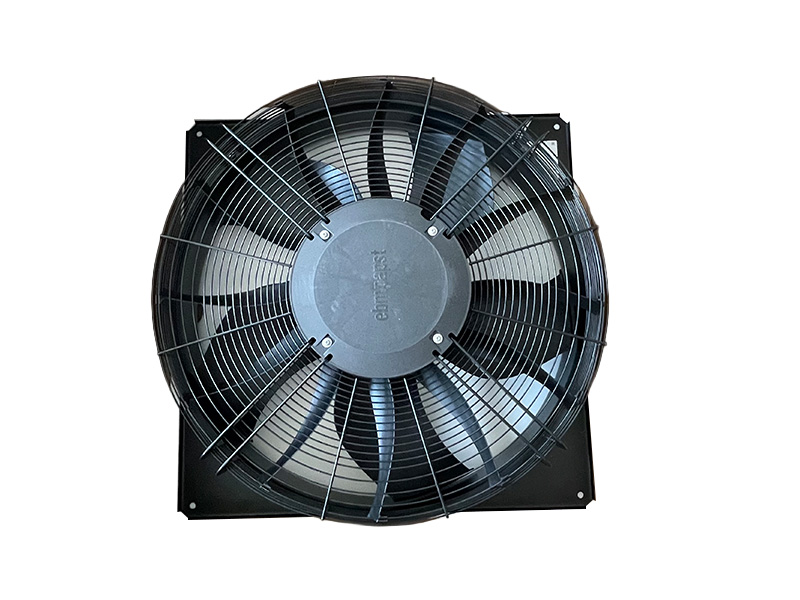
EC axial flow fans with guide vanes, specified for dry cooler and condenser duty where elevated back pressure has to be met at high airflow.
What an IP rating covers — and what it does not
An IP rating is a property of the tested assembly, not an inherited trait. The R3G355-AM14-61 cleanroom FFU and air purification fan is a useful illustration: its datasheet states a wide voltage range and adjustable speed control, and states explicitly that the final protection rating is determined by the complete unit. In other words, the module rating is a starting point that the equipment builder completes through enclosure design, sealing and cable entry practice.
For buyers, the practical rule is that IP55 on a fan module does not automatically make an outdoor cabinet, an AHU section or a rooftop unit IP55. It sets a ceiling on what the assembly can achieve, provided the surrounding design does not introduce an easier water or dust path.
The second common misreading is treating IP as a corrosion rating. It is not. Outdoor heat-exchange duty adds moisture, salts and temperature cycling, which is why the dry-cooler axial platform is documented with an H2+C environmental classification alongside its IP55 rating. Both values should appear in the purchase specification for outdoor equipment.
Voltage, control interfaces and communication
Control is the layer where EC fans differ most from the AC fans they replace. A traditional AC fan is governed by whatever external device the system builder installs. An EC fan carries its own electronics, and that changes both the wiring diagram and the failure-mode analysis.
The interfaces appearing on Hengrui-associated EC fan records fall into three groups. Analog and pulse control is the entry level, with 0–10 V or PWM inputs; the R3G225-RE07-03 and the 2218F/2TDH4OR-227 both use 0–10 V/PWM, and the latter adds speed feedback so the control system can confirm actual rotation. Serial control is the next step: K3G310-PV69-03, K3G560-PB31-03, K3G560-FA28-03 and K3G450-PB29-L1 support variable-speed control through Modbus, typically alongside an analog option, which supports parallel control of multiple fans in a fan wall. Integrated intelligence is the third group, where the module performs part of the control task itself — the R3G355-RG56-01 includes integrated PID control and passive power factor correction, and the K3G450-PB29-L1 includes a vibration sensor.
Two specification details are easy to overlook. First, soft start and integrated electronic protection on modules such as the R3G630-FB32-03 affect upstream breaker sizing and start-up current assumptions. Second, PFC and the input-stage design affect the harmonic profile a building's electrical study will need to accommodate.
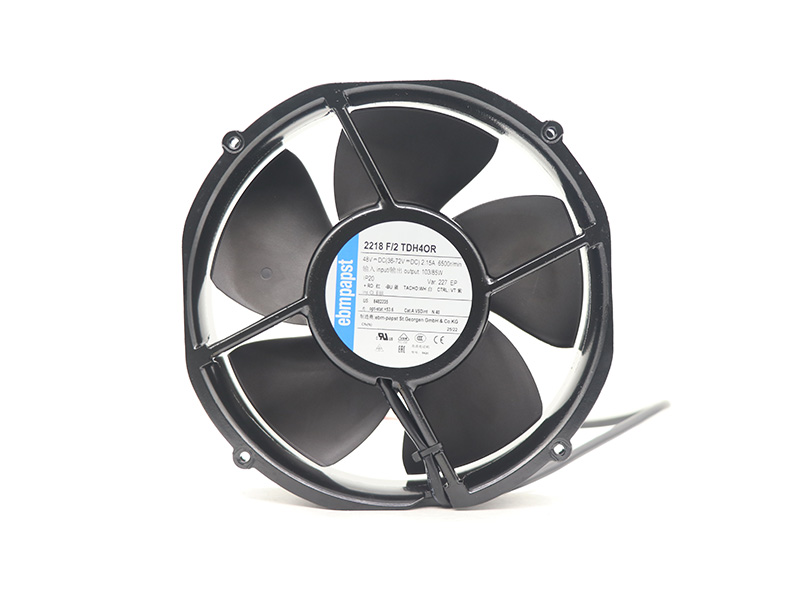
Compact 48 V EC axial fan for cabinet-level and telecom cooling, where DC supply range and mounting orientation are the binding constraints.
Where Hengrui Hongsheng sits in this picture
Beijing Hengrui Hongsheng Mechanical & Electrical Equipment Co., Ltd. is a supplier of ventilation, heat-dissipation and industrial control electromechanical products, established in 2011, providing sales, model selection and matching, and technical services. The company operates a service network with offices in Chengdu, Wuxi, Tianjin, Shenzhen and Hong Kong, reports a 100,000 m² facility with approximately 700 employees and an 80-person technical team, and states an export ratio of around 70% with the United States as a principal market. It reports cumulative service to more than 20,000 corporate customers.
Its relevance to a constraints-led specification is that it holds documented distribution relationships across the brand ranges that buyers are usually cross-matching. The company states long-term agent and distribution relations with ebmpapst, Ziehl-Abegg, SANYO, DELTA, SUNON, Rosenberg, WISTRO, SODECA, NMB, ADDA and S&P, and reports having held the title of sales champion among ebmpapst distributors. It also states that it has been rated as a Siemens premium supplier.
Those relationships are documented rather than implied. The ebmpapst Distributor Authorization Letter, number A50023867, is issued by ebm-papst Motor (Shanghai) Co., Ltd. and is valid from 2026-01-01 to 2026-12-31, designating the company as a distributor for ebmpapst products in North China. The SUNON Distributor Certificate, number TW2025-001198, issued by Sunon Electric Industry Co., Ltd. (Taiwan), is valid from 2025-12-01 to 2026-11-30 and authorises sales of SUNON brand fans, motors, cooling modules, Fan Tray and related accessories. The Soler&Palau Certificate of Exclusive Authorization, issued by S&P Sistemas de Ventilación S.L.U. on 2026-01-19, authorises the company as official agent for OEM ranges of S&P ventilation products in China. The Delta 2026 Distributor Authorization Certificate, number FM-MMXXVI 026, issued by Delta Electronics Enterprise Management (Shanghai) Co., Ltd., covers data centre fan ranges in the China market and covers the 2218F/2TDH4OR-227 cabinet fan in the ASEAN market. A WISTRO Certificate of Exclusive Authorization, number 06.10.26,W, is issued by WISTRO Elektro-Mechanik GmbH.
One boundary deserves emphasis for procurement purposes. The SUNON certificate is a distributor authorisation document; it does not state CE or RoHS certification, and no standard code is listed on it. It should therefore be filed as evidence of authorised supply, not as evidence of product conformity. Buyers who need conformity documentation should request it separately for the specific model and market.
On the supply side, the company reports an OEM production mode with a minimum order quantity of one unit, a lead time of seven days, monthly capacity of 100,000 units, and 24/7 technical support. For buyers in the research and evaluation stage, a one-unit MOQ matters because it allows a physical sample to be validated before a volume commitment.
Model-level constraint reference
The tables below consolidate the constraint data that appears on Hengrui-associated EC fan records for centrifugal platforms and for axial and DC-cabinet platforms. They are intended as a starting point for a specification dialogue, not as a substitute for project-specific selection.
Centrifugal and backward-curved EC platforms
| Model | Platform / size | Supply | Protection | Declared duty point | Control |
|---|---|---|---|---|---|
| K3G310-PH58-02 | 310 mm centrifugal, in-row / precision cooling | 3~380–480 VAC, 4,000 rpm | IP54 | 4,505 m³/h at 1,479 Pa | EC speed control |
| K3G310-PV69-03 | 310 mm centrifugal, compact cabinet / in-row | 3~380–480 VAC, 4,000 rpm | IP55 | 4,020 m³/h at 1,583 Pa | Modbus, 0–10 V |
| K3G560-PB31-03 | 560 mm centrifugal, CRAH / AHU | 3~380–480 VAC | IP55 | 9,825 m³/h at 1,049 Pa | Modbus |
| K3G450-PB29-L1 | 450 mm high-pressure centrifugal, fan grid | 3~380–480 VAC, 6,800 W | IP55 | 9,035 m³/h at 1,749 Pa | Modbus V6.3, vibration sensor |
| K3G450-PA31-03 | 450 mm backward-curved, CRAH / AHU | 3~380–480 VAC | IP55 | up to 1,275 Pa static pressure | 0–10 V or PWM |
| K3G500-PB33-01 | 500 mm RadiPac, CRAH / AHU | 3~380–480 VAC | IP55 | 10,945 m³/h at 1,245 Pa | EC stepless speed control |
| K3G560-FA28-03 | 560 mm backward-curved module, AHU / CRAH | 3~380–480 VAC | IP55 | 11,970 m³/h at 831 Pa | Modbus |
| R3G355-AM14-61 | 355 mm cleanroom FFU / air purification | 1~200–277 VAC single-phase | Determined by complete unit | 2,050 m³/h at 400 Pa | Adjustable speed |
| R3G355-RG56-01 | 355 mm in-row / precision cooling | 3~380–480 VAC | IP54 | 3,205 m³/h at 640 Pa | Integrated PID, passive PFC |
| R3G225-RE07-03 | 225 mm compact FFU / air purifier | 1~200–240 VAC | IP54 | 705 m³/h at 458 Pa | 0–10 V / PWM |
Axial and DC platform constraints
| Model | Platform / size | Supply | Protection | Declared duty point | Control |
|---|---|---|---|---|---|
| W3G630-NU33-03 | 630 mm AxiBlade axial, dry cooler / chiller | 3~380–480 VAC, 3,600 W | IP55 | 16,530 m³/h at 329 Pa; max back pressure 440 Pa | EC drive, Modbus |
| W3G800-KU21-05 | 800 mm axial, dry cooler / condenser | 3~380–480 VAC, 2,900 W, 4.4 A, 1,100 rpm | IP55 | 19,455 m³/h at 247 Pa; max back pressure 260 Pa | EC drive |
| W3G800-LV05-03 | 800 mm axial with guide vanes, dry cooler | 3~380–480 VAC, 3,500 W, 1,190 rpm | IP55, H2+C | 19,225 m³/h at 337 Pa; max back pressure 350 Pa | EC drive |
| W3G910-KU25-03 | 910 mm axial, dry cooler / condenser | 3~380–480 VAC, 2,550 W | IP55 | 23,685 m³/h at 182 Pa | Stepless speed control |
| 2218F/2TDH4OR-227 | 200 × 200 × 51 mm DC axial, cabinet | 48 VDC nominal, 36–72 V range | Metal frame platform | 1,220 m³/h free air; max static 1,170 Pa | 0–10 V / PWM with speed feedback |
| 8317081096 / VWLH200CKLXS | AxiEco 200, 200 × 200 × 70 mm | 48 VDC nominal, 36–60 V range | UL, VDE, CSA, CCC | 1,820 m³/h free air; max static 1,300 Pa | 0–10 V / PWM, speed feedback |
Application fit by system type
Dry coolers, condensers and chillers
Outdoor heat exchange is a high-volume, low-to-moderate-resistance duty, and the binding constraints are corrosion resistance, IP protection and back-pressure headroom. The 630 mm AxiBlade platform is documented with guide vanes for swirl recovery and an IP55 / H2+C combination, which addresses both the aerodynamic and the environmental side. The 800 mm and 910 mm platforms extend the same logic to larger coils.
Data centre CRAH, AHU and fan walls
Here the constraint inverts: airflow density matters less than static pressure, because dense filters and long duct paths push the operating point to the steep part of the curve. The 450 mm K3G450-PB29-L1 is documented at 9,035 m³/h against 1,749 Pa, and the K3G500-PB33-01 at 10,945 m³/h against 1,245 Pa. Both sit in a range where a free-air airflow figure would be misleading.
In-row and precision cooling
Compact, high-resistance modules dominate here. The 310 mm K3G310-PV69-03 supports Modbus and 0–10 V control and an IP55 rating, and its impeller diameter is intended for installation inside compact cabinets and in-row units where there is no room for a larger impeller.
Cabinet, telecom and power electronics cooling
DC-native equipment changes the specification entirely. The AxiEco 200 platform operates at a nominal 48 VDC within a 36–60 VDC range and carries UL, VDE, CSA and CCC certifications; the 2218F/2TDH4OR-227 accepts 36–72 VDC and supports any mounting orientation, which matters when the cabinet layout is fixed and the airflow path is not.
FFU and air purification
Single-phase supply and low noise are the decisive constraints in cleanroom and purification equipment. The R3G355-AM14-61 operates on 1~200–277 VAC with adjustable speed, while the compact R3G225-RE07-03 delivers 705 m³/h at 458 Pa in a 225 mm frame.
EC direct drive compared with traditional air-movement solutions
EC fans are usually compared with two alternatives: an AC induction motor with an external variable frequency drive, and a belt-driven arrangement with an AC motor and pulleys. The comparison is not one-sided, and a credible specification should acknowledge where each approach still holds ground.
| Criterion | EC direct drive | AC motor + VFD | Belt drive |
|---|---|---|---|
| Speed control | Continuous, integral to the fan | Continuous, but requires a separate drive and its enclosure | Limited to pulley ratios unless a drive is added |
| Wear components | No brushes; electronic commutation | Bearings; drive electronics in a separate unit | Belts and pulleys are consumables |
| Wiring and panel complexity | Fewer external components | Additional panel space, cabling and harmonic considerations | Simplest electrically, most complex mechanically |
| Repairability | Module replacement rather than field rewind | Motor can often be rewound locally | Motor and belt serviceable with basic workshop tools |
| Main limitation | Electronics are integrated into the fan; service strategy must be replacement-oriented, and the module IP rating only sets the ceiling for the assembled unit | Drive adds a second failure point and further panel heat | Lower efficiency and higher maintenance load over life |
The limitations matter. An EC fan is not a drop-in answer to every reliability problem: because the commutation electronics are integrated, a failure is generally resolved by replacing the module rather than by rewinding a motor, which changes spare-parts policy and, in remote installations, repair time. Integrated electronics also introduce thermal considerations — a fan rated for outdoor service in a documented ambient window still requires the control electronics to be sited within their own limits.
The second boundary is documentation. IP55 on a fan module, an H2+C classification, or a distributor authorisation letter are three different things, and none of them automatically satisfies a project's conformity or warranty clause. Buyers who need a specific declaration should specify it in the enquiry rather than assume it travels with the fan.
What is changing in the EC fan market
Three shifts are visible from the specification side. The first is a move from component purchasing to module purchasing: buyers increasingly ask for a fan, its control interface and its protection rating as one documented unit, because the alternatives require them to assemble and validate the electronics themselves. The second is the growth of high-static-pressure cooling, driven by denser IT and power-electronic loads, which pushes demand toward 450–560 mm backward-curved centrifugal platforms rather than larger low-pressure axial fans. The third is the normalisation of DC bus architectures in cabinets and edge equipment, where 48 VDC fans with wide input tolerance replace AC-powered cabinet cooling.
Underneath all three is a compliance trend: equipment buyers now ask for the authorisation and certification documents alongside the price, and increasingly expect the document to state exactly which products and which territories it covers. Certificates that name specific models, territories and validity windows — as the ebmpapst, SUNON, S&P and Delta documents described above do — are easier to file and defend than generic supplier statements.
Future outlook
The likely direction of EC fan specification is toward tighter coupling between the fan and the system controller. As Modbus-capable modules with integrated protection and vibration sensing become standard in data centre fan walls, the fan's own data becomes part of the maintenance record rather than a separate monitoring project. That in turn makes selection quality more consequential: an underspecified fan that runs off its efficient region will show up in the telemetry, not just on the energy bill.
For suppliers, the differentiator is less about catalogue breadth than about verification capability — the ability to confirm, quickly and in writing, that a given model satisfies a given voltage, protection, pressure and documentation constraint, and to supply a single unit for validation before a volume order. For buyers in the research and evaluation stage, the practical recommendation is unchanged: write the four constraint layers into the enquiry, ask for the declared operating point rather than a free-air airflow figure, and separate authorisation documents from product conformity documents in the evaluation file.
FAQ
What does the IP rating on an EC fan actually cover?
It describes the protection of the tested fan assembly against dust and water ingress. It does not automatically extend to the equipment the fan is installed in. The R3G355-AM14-61 cleanroom FFU fan, for example, is documented with a wide voltage range and adjustable speed, and its final protection rating is explicitly determined by the complete unit. In practice, the module rating sets a ceiling that enclosure design, sealing and cable entry must maintain.
How should an ErP operating point be used when comparing EC centrifugal fans?
The ErP point pairs airflow with static pressure at a defined condition, so it should be compared as a pair rather than as a single airflow number. A fan documented at 9,035 m³/h at 1,749 Pa serves high-resistance systems such as dense filter banks, while a fan documented at 23,685 m³/h at 182 Pa serves low-resistance, high-volume duties such as dry cooler coils. Comparing the two on airflow alone would misrepresent both.
Which control interface should be specified: 0–10 V, PWM or Modbus?
The choice follows the control system that already exists. Analog and pulse inputs (0–10 V or PWM) are used on platforms such as the R3G225-RE07-03 and the 2218F/2TDH4OR-227, which also provides speed feedback. Serial control via Modbus is supported on K3G310-PV69-03, K3G560-PB31-03, K3G560-FA28-03 and K3G450-PB29-L1, and is generally preferable where multiple fans must be coordinated. Modules such as the R3G355-RG56-01 go further and include integrated PID control, moving part of the control task into the fan itself.
What do distributor authorisation documents actually confirm?
They confirm authorised supply of a brand's range within a stated scope. The ebmpapst Distributor Authorization Letter, number A50023867, valid from 2026-01-01 to 2026-12-31, designates the holder as a distributor for ebmpapst products in North China. The SUNON Distributor Certificate, number TW2025-001198, valid from 2025-12-01 to 2026-11-30, authorises sales of SUNON fans, motors, cooling modules and related accessories. These documents do not, by themselves, certify product conformity — the SUNON certificate does not state CE or RoHS certification and lists no standard code.
What are the practical supply constraints when sourcing EC fans?
MOQ, lead time and stock policy determine whether a specification can be validated before commitment. The company reports an OEM production mode with a minimum order quantity of one unit, a lead time of seven days and monthly capacity of 100,000 units, alongside 24/7 technical support. A one-unit MOQ is significant at the evaluation stage because it allows a sample to be tested in the actual equipment before a volume order is placed.
Where do EC fans still compare unfavourably with traditional AC solutions?
The main trade-off is serviceability. Because commutation electronics are integrated into the fan, a fault is typically resolved by module replacement rather than by field rewinding a motor, which affects spare-parts stocking and repair time in remote installations. AC motor plus variable-frequency drive arrangements remain easier to repair with local workshop capability, and belt-driven arrangements are simpler electrically, although they carry belt and pulley wear. Specification decisions should therefore weigh service strategy and site capability alongside efficiency and controllability.
Constraint-led specification is not a bureaucratic step added to EC fan purchasing; it is the step that determines whether the fan performs in the system it was bought for. Voltage and control interface, protection rating and corrosion class, declared duty point and back-pressure headroom, and a clear separation between supply authorisation and product conformity documentation together form a short enough checklist to apply to every enquiry — and a specific enough one to prevent most of the expensive mistakes.