
Specifying Flare Systems for Methane-Rich LFG and Biogas Plants
Specifying Flare Systems for Methane-Rich LFG and Biogas Plants
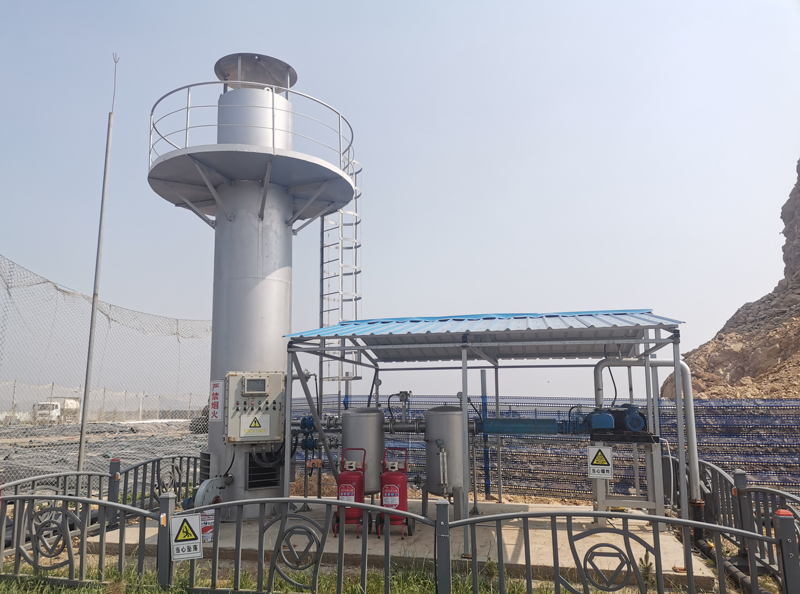
Biogas flare and landfill gas (LFG) flare system for continuous methane-bearing gas from landfill, digestion and wastewater sources.
Landfill gas and biogas plants generate methane continuously, deliver it at low pressure, and rarely hold the flow rate steady for long. Global context explains why these three conditions now attract commercial as well as technical attention: the World Bank recorded 151 billion cubic meters (bcm) of gas flared worldwide in 2024, the highest level since 2007, while the flare systems market was valued at approximately USD 4.8 billion in 2025 (Dataintelo). For landfill, digestion and wastewater sites, the flare is the equipment that determines how much of the methane not converted to energy is actually destroyed — which makes matching flare systems to methane-rich, variable-flow operation a compliance decision as much as an engineering one.
Why Generic Flare Specifications Fall Short on LFG and Biogas
A flare specification written for a refinery or petrochemical unit normally assumes a defined relief event, a known gas composition and a pressure profile capable of pushing gas to the tip. Landfill gas and biogas behave differently in three specific ways, and each one moves a design variable.
- Methane content sits in a mid-range band. Product data for the ZXE-BGF Series biogas flare / landfill gas flare / methane combustion system describes methane concentration as typically 35%–65% CH₄, depending on the source. That is a lower heating value than most refinery relief streams, so flame stability rather than peak flow becomes the first design question.
- Pressure is low. Gas arrives from landfill wells or digester tanks close to atmospheric pressure, which means a blower and a gas control train are part of the system rather than an accessory. The scenario profile for landfill, biogas and waste-to-energy applications lists the matched equipment set as a biogas flare stack, blower, ignition system and monitoring system.
- Flow varies by nature. Landfill gas generation shifts as waste cells age, moisture content changes and collection networks are extended; digester gas output shifts with feed composition and process temperature. The same scenario profile therefore records the working condition as methane-containing gas, low-pressure gas, variable flow rate and continuous gas generation.
One consequence deserves emphasis early in an evaluation: destruction efficiency is a conditional figure, not a fixed property of a product family. The ZXE-BGF Series is documented at methane destruction efficiency ≥98%, depending on system design and operating conditions. Buyers who compare headline percentages without comparing the assumptions behind them are comparing design intent rather than delivered performance.
The ZXE-BGF Series: A Flare Family Defined by Gas Source
Shandong Zexuan Environmental Protection Technology Co., Ltd., established in 2015, manufactures industrial flare systems and thermal treatment equipment as a manufacturer, OEM/ODM and engineering solution provider. The ZXE-BGF Series is the family inside that portfolio configured specifically for methane-bearing gas from municipal landfill sites, waste management facilities, wastewater treatment plants, anaerobic digestion projects, agricultural biogas plants, food processing waste treatment and renewable energy projects. Model designation follows gas flow rate and project requirements rather than a fixed size list.
Configuration options inside the series are an open biogas flare, an enclosed biogas flare, a landfill gas flare (LFG flare), an anaerobic digestion flare and a methane destruction flare. The factual envelope is easiest to read as a table.
| Parameter | ZXE-BGF Series specification | What it changes for a landfill or biogas buyer |
|---|---|---|
| Gas sources | Landfill gas, biogas, digester gas, wastewater treatment gas | One platform can serve a plant that combines landfill, digester and wastewater gas streams. |
| Methane concentration | Typically 35%–65% CH₄, depending on source | Sets the combustion stability requirement and the need for blower-assisted feed. |
| Gas flow capacity | Customized according to project requirements | Flow range and turndown must be stated in the enquiry, not assumed. |
| Operating temperature | Typically 800°C–1100°C | Drives burner material grade and refractory selection in enclosed designs. |
| Methane destruction efficiency | ≥98%, depending on system design and operating conditions | Efficiency claims must be linked to the design case, not treated as a constant. |
| Ignition and monitoring | Automatic ignition and flame monitoring system available | Supports unattended continuous operation at remote landfill sites. |
| Operation mode | Continuous or intermittent operation design | Continuous gas generation and intermittent venting are different duty cycles. |
| Materials | Carbon steel, hot-dip galvanized steel, SS304, SS316L, high-temperature resistant alloys for burner components | Material grade follows gas chemistry, temperature and outdoor exposure. |
Matching One Design to a Flow Rate That Keeps Moving
Variable flow is the condition that separates a workable LFG or biogas flare specification from an unworkable one. A flare sized only for the design maximum either loses combustion quality when flow falls away, or forces the operator to vent at times when the plant cannot sustain a stable flame. Two design levers address this directly.
Turndown and duty cycle
Zexuan's elevated flare systems are documented with a turndown ratio of up to 100:1, with flare heights from 10 m to 150 m+ depending on process conditions. For biogas applications, the ZXE-BGF Series is offered with continuous or intermittent operation design, which allows a plant to distinguish between base gas generation and intermittent venting duties instead of treating both as one case. Where a site experiences low-flow continuous venting alongside occasional larger releases, that distinction decides whether one flare or a staged arrangement is the better fit.
Ignition, monitoring and control
Automatic ignition and flame monitoring are available on the series, and the associated scenario profile lists the ignition system and monitoring system as part of the standard equipment set. Practically, this is what allows a landfill operator with limited on-site attendance to run continuous methane destruction and still have a record of flame status. The design basis for flare headers themselves follows API Standard 521 (Pressure-Relieving and Depressuring Systems), which specifies, among other details, a minimum flare header slope of 1/4 inch per 10 feet for drainage — a reminder that liquid management upstream of the tip affects reliability as much as the burner does.
Materials Follow the Gas Chemistry and the Site, Not the Label
Material selection in LFG and biogas service is driven by three inputs: combustion temperature, condensate and trace contaminant exposure, and long-term outdoor mounting. The ZXE-BGF Series lists carbon steel, hot-dip galvanized steel, SS304, SS316L and high-temperature resistant alloys for burner components. Carbon steel and hot-dip galvanized steel carry structural and ducting duties where corrosion exposure is moderate; stainless grades such as SS304 and SS316L are specified where moisture and condensate are present; high-temperature alloys are reserved for burner-side components where operating temperatures reach the 800°C–1100°C band.
Where the application calls for an enclosed configuration, the material set broadens. The ZX-EGF Series enclosed ground flare uses carbon steel, SS304, SS316L and SS310S together with refractory lining materials, operating between 800°C and 1200°C with combustion efficiency up to 99.9%, low radiation and low noise design, and a footprint suited to limited-space areas. In biogas service this matters where a site sits close to site boundaries or residential edges and the visible flame of an open flare is the constraint rather than the combustion itself.
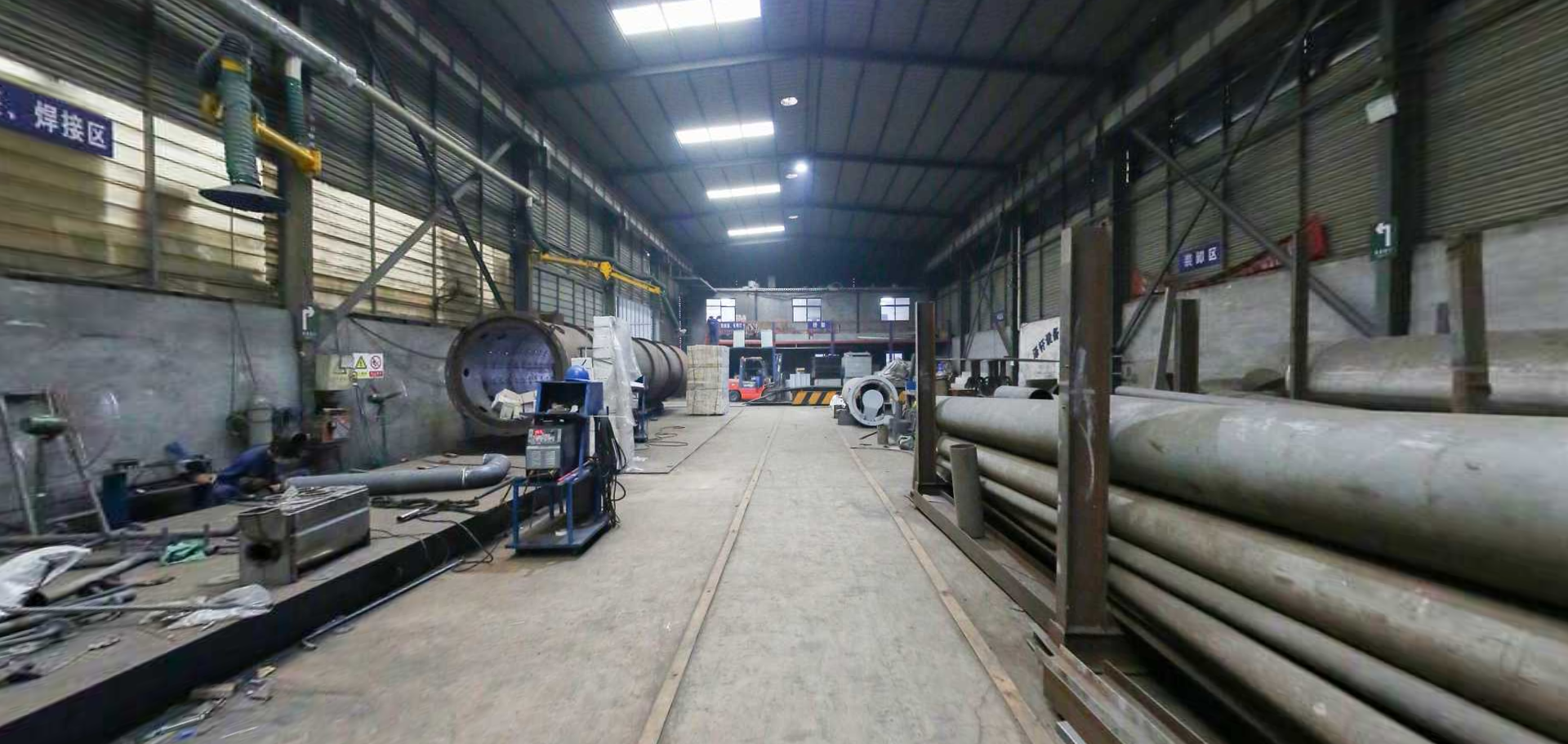
Flare and thermal treatment system fabrication at Shandong Zexuan's manufacturing base, where material grade, welding and inspection records are established before Factory Acceptance Testing (image: Zexuan).
Scenario Fit: Landfill, Digester, Wastewater and Waste-to-Energy
The scenario profile for this application describes continuous operation, an outdoor open-air environment, and special requirements of automatic ignition, stable combustion and outdoor reliability. That profile maps to markets recorded as including Nigeria, Algeria, Egypt, Türkiye, South Africa, India, Brazil, Mexico and Vietnam — regions where landfill gas capture and agricultural digestion capacity are expanding alongside municipal waste management.
In practice, three site types dominate the enquiries:
- Municipal landfill sites where collected gas volume is driven by waste age and cover integrity, and where gas quality declines over the field's life.
- Anaerobic digestion and agricultural biogas plants where gas production follows feed regime and digester temperature, so flow and methane content move together.
- Wastewater treatment and food processing waste treatment plants where digester gas and odour-control streams require destruction rather than recovery.
For buyers evaluating a flare investment, these distinctions decide the configuration, not just the model number.
Open or Enclosed? The Configuration Trade-Off
| Decision factor | Open biogas flare | Enclosed biogas flare |
|---|---|---|
| Thermal radiation and visibility | Visible flame and higher radiant heat; setback distance from site boundaries becomes a siting constraint. | Low radiation design with the combustion zone shielded by refractory lining; suited to limited-space sites. |
| Noise | Combustion and feed noise are largely unshielded. | Low noise operation is documented as part of the enclosed design intent. |
| Materials | Carbon steel, hot-dip galvanized steel, SS304, SS316L, high-temperature alloys for burner components. | Adds SS310S and refractory lining materials to the material set. |
| Destruction performance | Methane destruction efficiency ≥98%, depending on system design and operating conditions. | Combustion efficiency up to 99.9% documented for the enclosed ground flare platform. |
| Construction and maintenance profile | Simpler structure with fewer high-temperature materials. | More material and refractory work in exchange for radiation and noise control. |
The trade-off is rarely about which option is better in the abstract. It is about which constraint binds first: available land and neighbour distance, or budget and maintenance capability at the site.
Market Trend: Methane Accountability Is the Real Demand Driver
The growth story in this segment is driven more by measurement and disclosure than by new gas volumes. Three data points frame the trend.
- Global flaring volumes reached 151 bcm in 2024, the highest level since 2007, according to the World Bank — evidence that methane-bearing streams are still frequently handled as a disposal problem rather than a managed resource.
- The global Totally Enclosed Ground Flares (TEGF) market was valued at USD 113 million in 2024, with growth attributed to destruction efficiencies exceeding 98% (Intel Market Research). That figure points to enclosed configurations being adopted specifically for emission performance.
- Asia-Pacific held a 35% share of the flare gas recovery system market as of 2025, the largest regional share globally (Grand View Research).
The supplier landscape remains concentrated at the top end: Zeeco, John Zink Hamworthy (Koch), Honeywell UOP and Baker Hughes are identified as major global competitors in the flare and combustion segment (HTF Market Intelligence). For regional projects, however, market sizing should be treated with care — published estimates for the flare gas recovery market diverge materially by source and scope, with figures such as USD 5.84 billion by 2031 (Mordor Intelligence) and USD 8.52 billion by 2032 (Fortune Business Insights) illustrating how differently the boundary of the category is drawn.
Comparison with Conventional Approaches — and Where a Flare Is Not the Answer
A flare system competes less with other flares than with three other ways of handling methane: energy recovery, thermal oxidation of a different design, and doing nothing except venting. Being clear about the boundaries is part of specifying correctly.
- Destruction efficiency is not a constant. The documented ≥98% methane destruction efficiency for the ZXE-BGF Series is explicitly qualified by system design and operating conditions. Where methane concentration falls below the typical 35%–65% CH₄ band, or where flow swings beyond the design turndown, the design case has to be re-verified rather than simply purchased.
- Flares destroy methane; they do not monetise it. Sites with stable, high-quality gas and an offtake route may prioritise engines, boilers or upgrading, and treat the flare as backup capacity. Flares are the right primary answer where gas volume is too small, too variable or too contaminated for energy recovery.
- Configuration choices carry ongoing obligations. Enclosed ground flares rely on refractory lining and higher-temperature stainless grades, so inspection and lining maintenance become part of the operating routine. Open flares avoid that material complexity but pay for it in radiation and setback distance. Neither option removes the maintenance obligation entirely.
- A flare cannot repair gas collection. The volume and quality of gas reaching the flare header depend on wellfield design, cover integrity and condensate management upstream. A correctly specified flare performing exactly as designed will still under-deliver on site-level methane reduction if the collection network is not delivering gas.
- Alternative streams need different equipment. Where the waste gas stream is dominated by VOCs, solvents or hazardous components rather than methane, thermal oxidizers or incineration systems such as the ZX-TO / ZX-RTO / ZX-RCO series and the ZX-INC Series are the appropriate platforms rather than a biogas flare.
What Buyers Should Verify Before an Evaluation Closes
For a Research-to-Evaluation stage purchase, evidence matters more than configuration tables. Five verification items are worth standardising.
- Certification validity and scope. Shandong Zexuan holds an ISO 9001:2015 quality management system certification (certificate number 26326Q00079R001), an ISO 14001:2015 environmental management system certification (certificate number 26326E00054R001) and an ISO 45001:2018 occupational health and safety management system certification (certificate number 26326S00054R001). All three are issued by CSU International Certification Co., Ltd., with issue date 2026-03-18 and expiry date 2029-03-17. The certification scope covers the development of waste gas treatment equipment and control units and the sale of waste gas and waste liquid treatment equipment, and is valid for the domestic China market under the CNAS accreditation mark and for international markets under the IAF multilateral recognition mark.
- Quality control sequence. The documented process covers incoming material inspection, welding inspection, dimensional inspection, pressure/leak testing where applicable, functional testing, Factory Acceptance Test (FAT), and final inspection before shipment, described as full process inspection with FAT before shipment.
- Commercial parameters. MOQ is 1 set, lead time is 60–120 days depending on project requirements, and monthly capacity is 5 sets of customized industrial systems.
- Customization and documentation. Customization scope covers flare type, capacity, material, structure, control system, layout, voltage and documentation — the last item is frequently the one that delays commissioning.
- Delivery and after-sales support. The service scope covers remote support, commissioning assistance, spare parts and training, which matters where the operating team is small relative to the equipment.
Manufacturing context supports these claims: a 24,100 m² manufacturing base, more than 80 employees including 30+ engineers and technical specialists, an R&D team of more than 20 engineers, annual capacity of 60+ sets of flare and thermal treatment systems, and international project experience in more than 10 countries across the Middle East, Central Asia, Southeast Asia, Africa and Russia.
Future Outlook
Two forces look likely to shape the next procurement cycle for LFG and biogas flares. The first is measurement: as methane reporting tightens, destruction efficiency stops being a marketing line and becomes an auditable number tied to a specific design case, which favours suppliers able to document the assumptions behind ≥98% or 99.9% figures. The second is site constraint: enclosed configurations that combine low radiation, low noise and limited footprint address the reality that many landfill and digestion sites are now closer to built-up areas than they were when the first flares were installed. Combined with automatic ignition and flame monitoring as default expectations rather than upgrades, the trajectory points toward flare systems specified as monitored emission-control assets rather than as overflow protection.
FAQ
1. What gas parameters need to be defined before specifying a flare for a landfill or biogas plant?
At minimum, the methane concentration range, the gas flow range including minimum and maximum, the pressure available at the flare header, the duty cycle (continuous or intermittent), and the gas source. For reference, the ZXE-BGF Series is designed for landfill gas, biogas, digester gas and wastewater treatment gas, with methane concentration typically 35%–65% CH₄ depending on source, and flow capacity customized according to project requirements.
2. How does variable gas flow affect flare selection?
Variable flow determines the required turndown and whether the flare is specified for continuous or intermittent duty. Zexuan's elevated flare systems are documented with a turndown ratio of up to 100:1, and the ZXE-BGF Series offers continuous or intermittent operation design. A specification that only states a single maximum flow value usually leaves the turndown question unanswered.
3. When is an enclosed biogas flare preferred over an open biogas flare?
Enclosed configurations are generally preferred where radiation, visibility or noise are constrained by site boundaries, and where available space is limited. The enclosed ground flare platform is documented with a low radiation design, low noise operation, combustion efficiency up to 99.9%, and a footprint suited to limited-space areas. Open configurations remain simpler in material terms and avoid refractory lining maintenance.
4. Which materials are typically specified for biogas and LFG flare systems?
The ZXE-BGF Series lists carbon steel, hot-dip galvanized steel, SS304, SS316L and high-temperature resistant alloys for burner components. Enclosed configurations add SS310S and refractory lining materials, operating at 800°C–1200°C. Material grade follows combustion temperature, condensate exposure and outdoor mounting conditions rather than a single default.
5. What certifications and quality documentation should a buyer verify?
Shandong Zexuan holds ISO 9001:2015 (26326Q00079R001), ISO 14001:2015 (26326E00054R001) and ISO 45001:2018 (26326S00054R001), all issued by CSU International Certification Co., Ltd. with validity from 2026-03-18 to 2029-03-17, covering the development of waste gas treatment equipment and control units and the sale of waste gas and waste liquid treatment equipment. The documented quality sequence includes incoming material inspection, welding inspection, dimensional inspection, pressure/leak testing where applicable, functional testing, FAT and final inspection before shipment.
6. What are the limits of a flare system in an LFG or biogas project?
A flare destroys methane rather than recovering it, so sites with stable, high-quality gas and an offtake route may prefer energy recovery with flaring as backup. Documented destruction efficiency is conditional: ≥98% for the ZXE-BGF Series depending on system design and operating conditions, which means gas composition or flow outside the design envelope requires re-verification. Enclosed designs add refractory lining maintenance, and no flare can compensate for an upstream gas collection network that is not delivering gas to the header.
A technical brochure covering Zexuan's flare and thermal treatment portfolio, including the ZXE-BGF Series, ZXE-EGF Series, ZXE-GWF Series and ZXE-SSEF Series model designations, is available for reference: Shandong Zexuan technical brochure (PDF). Shandong Zexuan Environmental Protection Technology Co., Ltd. is headquartered at No. 2000, Shunhua Road, Innovation Zone, Jinan, Shandong Province, China, with its manufacturing base at Huji Industrial Park, Mudan District, Heze, Shandong Province.